

German automotive sector at high risk due to Brussels' regulations
The German automotive industry is turning abroad due to rising costs and the European Union's strict regulatory policies. This development raises concerns that the sector could face permanent job and investment losses within the country.



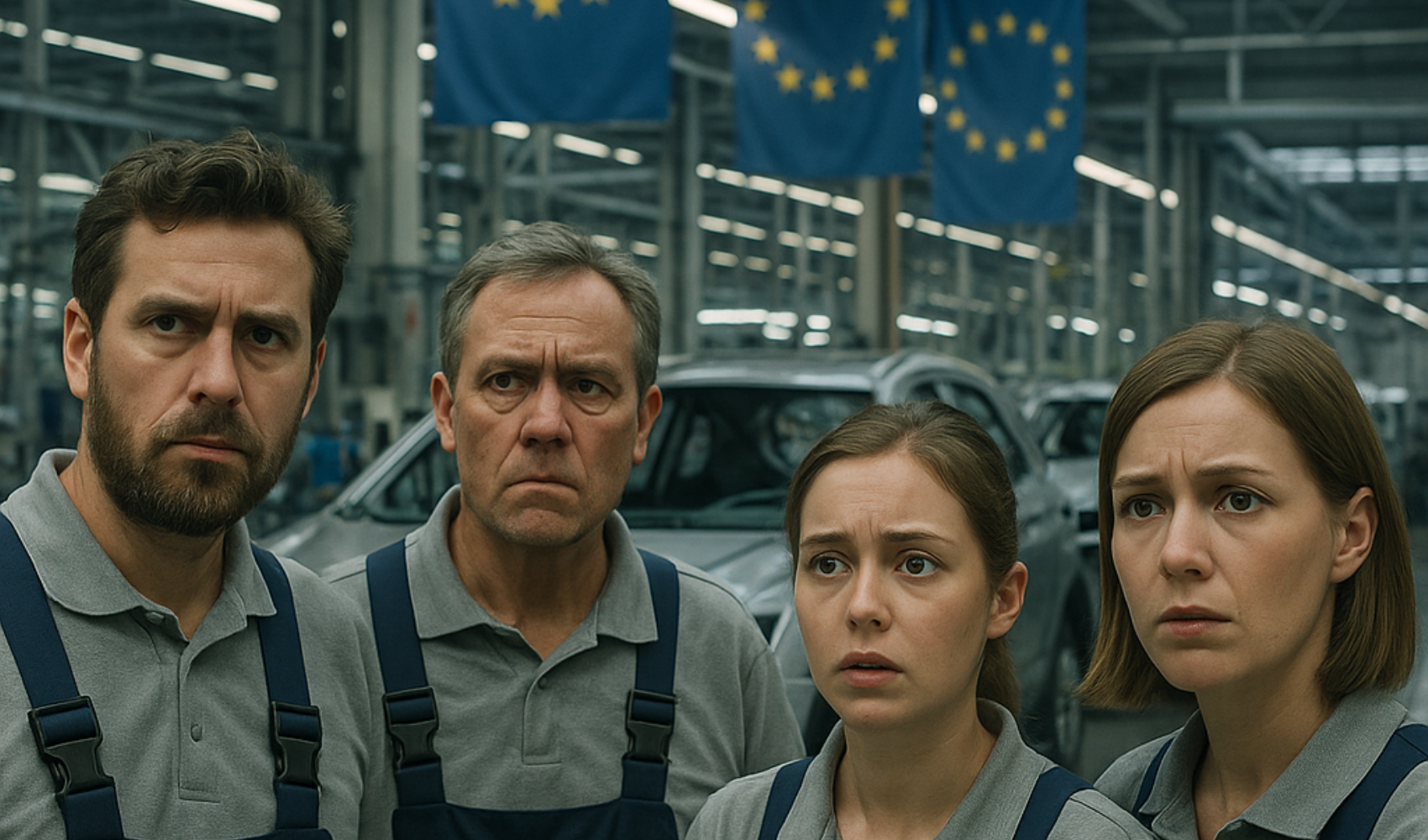
Hildegard Müller, President of the German Association of the Automotive Industry (VDA), highlighted the serious problems facing the sector at an annual press conference held in Berlin.
Emphasizing that the investment climate in Germany and across Europe has deteriorated rapidly in recent times, Müller stated that this is particularly challenging for small and medium-sized automotive firms.
Müller stated, "What we are experiencing is not just an industrial decline, but a clear indication that Germany is facing a major economic crisis." Noting that current conditions are pushing many automotive manufacturers to move their investments abroad and abandon new projects within the European Union, Müller warned that this trend could have serious consequences for Germany's economic prosperity and social stability.
INVESTMENTS ARE SHIFTING ABROAD
Referring to a recent survey conducted by the VDA among its members, Müller reported that 72 percent of companies planning investments in Germany have either suspended, canceled, or redirected these plans to other countries. While 28 percent of firms are planning to move their operations abroad directly, 19 percent are abandoning their projects entirely; 25 percent report that they are postponing their investments due to ongoing uncertainties.
Stating that these economic pressures are also significantly reducing domestic employment, Müller noted that nearly half of the companies have already reduced their number of employees in Germany, while they are opting to increase staff abroad.
"BRUSSELS IS OUT OF TOUCH WITH REALITY" CRITICISM
Hildegard Müller expressed her criticisms of the European Commission with candor. Arguing that decision-makers in Brussels often ignore the internal dynamics of the sector, Müller said, "We frequently encounter a state of denial of reality and illusion among decision-makers in Brussels. Without economic strength, Europe will have no weight on the international stage. However, the EU Commission has not yet been able to internalize this fact."
She noted that countries like the US and China are gaining an advantage over Europe and competing for leadership in the automotive industry thanks to their more flexible approaches. Touching upon the rigidity of the EU's plan to ban the sale of internal combustion engine vehicles by 2035, which also creates question marks in the sector, Müller emphasized that these plans should not remain limited to promises on paper.
It was observed that Müller included the following statement in her speech: "Aiming for a 90 percent reduction in emission rules and tying this to new conditions and complex requirements does not provide any relief to the sector and destroys planning security. Technological openness should not just be promised, it must be implemented."
"A CHANGE IN MINDSET IS ESSENTIAL FOR A WAY OUT"
Stating that the loss of a constructive discussion environment plays a major role in blocking comprehensive reform in the sector, Müller expressed that deliberate misunderstandings spread on social media and political conflicts of interest make improvement steps difficult.
Müller used the phrase, "The tactic of deliberate misunderstanding, which is a tool of populists, is now creating a blockade in front of reforms by being fueled by social media algorithms. It is impossible to get out of this crisis without a change in mindset and the courage to make decisions," underscoring that decisive and innovative moves are necessary for the future of the sector.
Stating that she trusts the innovation capability of the German automotive industry, Müller highlighted that they are in a position to set global standards with strong SMEs and a high-quality workforce. However, she added that for this to happen, the "distrust created by excessive regulations" must be eliminated and more market-oriented incentives must be brought to the forefront.
News Source: 12punto
Most Read
Historic words from Özgür Özel at the CHP group meeting

Air Force Academy student Veli Bilgin has died

Striking picture for Özgür Özel's 'New Party'

How did the newspapers view Özgür Özel's farewell to the CHP?
Tuncer Bakırhan calls for a framework law

The PKK opening and Özgür Özel’s path!..

He killed his wife by slitting her throat: Their children witnessed the moments
Here are the names that will be in Özgür Özel's new party!
AKP mayor held responsible
Kılıçdaroğlu's 'controlled' shopkeeper visit