



Greetings,
Free-thinking, free-conscienced, beautiful people.
Continuing to look through the mirror of art…
What appears to us today through the mirror of art is beauty once again, but beauty within mathematics…
Let me write down mathematics once more so that our point is fully understood…
Mathematics and beauty.
Those who have not had pleasant memories of mathematics since their student years, who have naturally had trouble with mathematics in the past, and who are still in trouble due to mathematical calculations that cannot be finalized over the inflation-salary raise relationship; might say, Professor Abidin, when did this mathematics ever make our lives beautiful for it to do so now… If they say that numbers have never been on our side, why should they be now?
Believe me, dear reader; I would never be angry.
Because I know, that is not mathematics, it is hocus pocus. If you are going to ask if I am giving some messages while talking about beauty, mathematics, and so on. Who am I to do that, sir… As you know, I am a helpless mortal trying to write about art. The mathematics we know is not enough to give such messages, sir… Besides, there are places in our country that are claimed to be cold. I am a summer man, sir, I don't like the winter season and such…
Professor Abidin, you started the article in such a way, are you saying that beauty cannot come from this mathematics?
You are not entirely wrong, okay, it may not come from this mathematics, but beauty comes from Pythagoras' mathematics. If you ask if there is personalized mathematics, there is, sir, there certainly is. It is not about what two times two equals, but if you are going to do philosophy, science, art, and architecture with that mathematics, if you are going to try to define the human, nature, and the universe, it certainly is.
What was Pythagoras saying; oh humanity, everything consists of numbers… Think accordingly…
We thought about it too, sir.
What if everything is a digital simulation consisting of numbers, just like in the Matrix movie…
Dear reader, just think about the fact that the things you see when you look at a bird, a tree, insects, clouds, your spouse, your lover, your child, and your friends are beings that have come into existence only by consisting of numbers… You couldn't think of it, could you? Are there those who say I could think of it? Maybe there are…
Are there not those who are influenced by the Matrix movie and assume they are in a simulation? Of course there are… What if we are really in a simulation and everything actually consists of numbers… Film critics like Roger Joseph Eber and Peter Bradshaw wrote that the philosophical background of the universe, which consists of digital codes that form the main theme of the Matrix movie, directed by the Wachowski sisters Lana and Lilly, was designed by being inspired by Pythagoras' theory of numbers. Are you saying what is that to us? My dear brother, what if the truth is something else; you might want to think about it a little… Would it be bad…
If you ask what the beauty-mathematics relationship in this film is; the answer is simple; it is that this relationship has turned into thought first, then image, then design, and finally into the art of cinema. This is the art born from the theory that everything is number and the cinematic beauty derived from it.
Also, have you ever thought? For example, how do cats and dogs or other living things see the world? When they look at something, do they see the same thing and the same colors as we do? I know how they see, but I won't write it. Please, you research that too, my dear brother. For example, if our human visual threshold were like that of snakes, we would see the world as if looking from behind a thermal camera. If our eyes had evolved to perceive X-rays, we would see the world exactly like an X-ray film. What would our understanding of beauty be then? Isn't it scary even to think about it? You are asking where we came from numbers to the Matrix movie and from there to the visual abilities of snakes and then to comparing them with us, right? Perhaps we are only one in a trillion of the possibilities of seeing, sensing, perceiving, and interpreting in the universe. Could the reason for the coexistence of these near-infinite possibilities be a reality consisting of numbers?
Now let's come to Pythagoras, who made me think and write all these;
Pythagoras, who lived between 570 BC and 495 BC, who influenced the philosophical thought of Plato and Aristotle first and then all of Western philosophy, born on the island of Samos, the son of a ring-stone maker, and a student of Thales of Miletus, who is shown as the first philosopher according to Aristotle, wanted to show that the sensation of beauty, which appears by saying "With the beauty of numbers comes the existence of truth, the purest formula of truth," and which appears in everything we see and in their own selves, in their coming together side by side, and in the way they show themselves holistically, actually comes from the existence of numbers that give them the opportunity to be pleasing and therefore perceived as beautiful. His teacher Thales claimed that the essence (arche) of everything in the universe was water. Anaximander from the Miletus School claimed that the essence of everything was apeiron, and Anaximenes from the same school claimed that the essence of everything was air. Why am I writing these detailed pieces of information? Because I want to show how Pythagoras was influenced by the spirit of the time while saying that the essence of everything consists of numbers. I am writing this because I want to say, in the fashionable phrase, you are the average of the five people you hang out with, or in the old-fashioned phrase, tell me who your friend is, and I will tell you who you are. By the way, this Miletus school is in Didim, Aydın. Let's say our first philosopher is our fellow countryman, maybe it will inspire our new philosopher candidates.
Pythagoras, upon the guidance of his teacher Thales, first goes to Egypt and then is taken prisoner to Babylon after Egypt is invaded by the Persians. According to some sources, he later travels to Iran and India. Within the scope of all these journeys, Pythagoras acquires knowledge on metaphysical subjects such as mathematics, primarily geometry, astronomy, and reincarnation, and interprets this knowledge in his own way and develops a philosophical perspective. In other words, he is not a Greek miracle on his own. To spread his thoughts, he settled in Crotone, a Greek city in the south of Italy, and opened a school there. It is good that he did. Here, he also founded one of the oldest known esoteric sects in history.
Dear reader, I definitely recommend that you also examine Pythagoras from his mystical aspect. Also, there are many different narratives regarding his death.
Now let's come to the relationship between numbers, mathematics, and beauty; According to a narrative, Pythagoras, hearing the sound coming from the anvils while blacksmiths were working, thought that this was very harmonious and said, "If the laws of nature allow this, these laws are mathematical." Of course, since he was a smart man, he realized that he could develop mathematical formulas from notes, and upon this, by examining the relationship between the pitch and the string length, he found the octave (the eight-note interval in the scale), the quint (the five-note interval in the scale), and the quart (the four-note interval in the scale) of today as the string length changed. Thus, the mathematical background of the harmony between sounds, that is, the feeling of pleasure arising from harmony and the use of the concept of beauty in terms of its description, was discovered. The mathematical harmony that a seeing mind can discover in nature and the beauty born from it. Look carefully; I say a seeing mind, according to him… Thank God Pythagoras saw.
It would be out of place to talk about the Pythagorean Theorem in this article, but I think it would be a shame if we didn't talk about the mystical meaning he attributed to numbers. Pythagoras also believed that behind the mathematical harmony in the universe formed through numbers, there were mystical and spiritual meanings of numbers. Pythagoras attributed certain symbolic, mystical meanings to numbers, and according to him, numbers symbolize different aspects of life, balance, and universal laws.
One: Unity and wholeness, the starting point. It is the source of everything.
Two: Duality, balance, opposites. It is associated with concepts such as the unity of opposites, male and female, nature and spirit.
Three: Creation, life cycle (birth, life, death). It is accepted as the symbol of the trinity. It also represents the spirit, mind, and body.
Four: Matter, basic elements (earth, water, air, fire). It is associated with order, stability, and structure.
Five: Human, senses, and the five senses. It is connected to the process of finding one's own identity.
Six: Completion, marriage, and harmony. It is associated with family and social relationships.
Seven: Spiritual development, mystical experience. Seven is a universal number and holds an important place in many cultures.
Eight: Rebirth, infinity. It is also associated with wealth and power.
Nine: Completion, maturation. It is the peak point of human potential.
Ten: It is the most sacred and perfect number in the universe. It consists of the sum of the first four numbers (1+2+3+4). It symbolizes the universe, wholeness, and completion. The Pythagoreans used to take their oaths on the triangular shape representing the number 10, called the Tetraktys.
Do you know how this mystical meaning Pythagoras attributed to numbers and the orderly universe born from this meaning, that is, the cosmos, that is, the idea of beauty, influenced artistic creativity?
With the influence of Pythagorean thought, for the Greeks living in the Ancient Age, the beautiful, that is, the ideal, was a phenomenon based on reason, intellect, and measure that could not be left to chance or just eye pleasure. Thus, for the first time in sculpture and architecture, canons and the golden ratio began to be used. Thanks to these developments, the famous sculptors of the Classical Period Greek Sculpture, Polykleitos and Phidias, who would later deeply influence Renaissance Art, transformed gods and heroes into immortal statues with perfect, symmetrical, and proportional body lines. Again, in that period, architects like Theodoros, who were influenced by Pythagoras' thoughts, built temples and structures that would influence the development of the art of architecture. Renaissance architect Andrea Palladio determined the dimensions of the rooms according to numerical ratios in musical chords while designing his villas. During the Renaissance, artists such as Leonardo da Vinci (Vitruvian Man) and Albrecht Dürer placed capturing the mathematical order in the anatomical structure of nature and man at the center of their art.
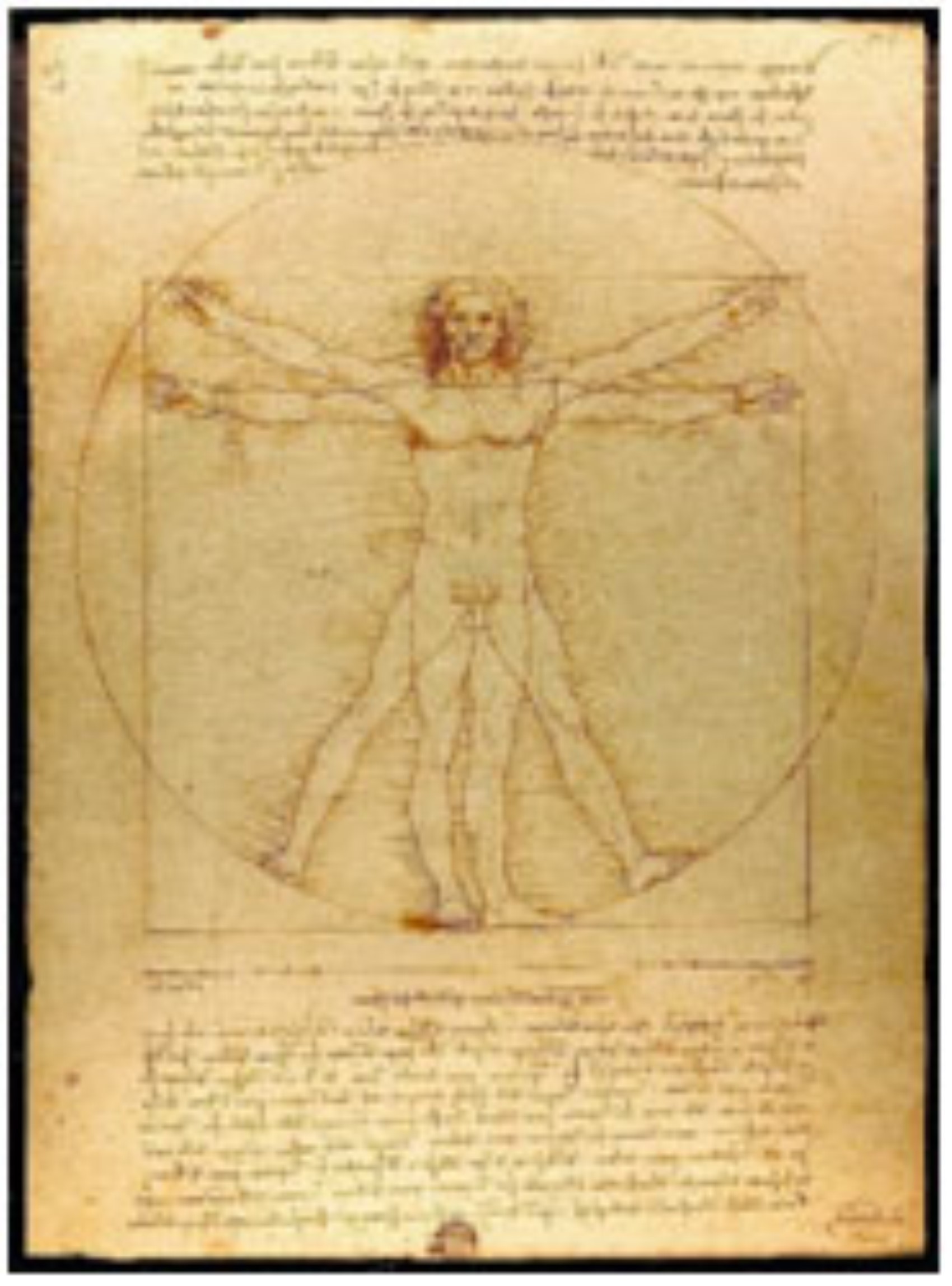
Western music composers (for example, Bach) built their works on these mathematical balances and geometric symmetries.
Pythagoras' understanding of beauty, which arises from the harmony consisting of numbers, ratios, and their combination, did not only influence sculptors, architects, and composers, but also philosophers.
For example; Plato, taking Pythagoras' idea that "numbers and ratios lie at the foundation of the universe," integrated it into his own Theory of Forms and created a context from the material to abstract beauty.
Just as numerical ratios were a supra-sensory reality for the Pythagoreans, for Plato, "Absolute Beauty" (the Idea of Beauty) is a perfect and abstract reality independent of the material world. By saying that beautiful objects in the world are beautiful to the extent that they partake in these ideal ratios and forms, he influenced the art and aesthetic theories that came after him.
Aristotle, unlike his teacher Plato, does not see beauty as an abstract "Idea" independent of the material. However, he completely preserves the Pythagorean idea of measure and ratio in the definition of beauty. According to him, for a tragedy to be beautiful, it should not be too big or too small; it is enough for it to have a perceptible measure and size. Measure is a must, mathematics is a must, he said. A smart man, of course…
This approach is the adaptation of Pythagoras' idea that "the limited (the harmonic) is beautiful, and the unlimited is ugly" to art.
The relationship between beauty and mathematics was not limited to Pythagoras and Greek art.
The relationship Pythagoras established between beauty and mathematics; in Islamic art, where there is a prohibition of depiction, geometric patterns and polygons full of connotations formed important elements of aesthetics. Look, do you see the brotherhood of mathematics, it makes no distinction of faith. There are lessons to be learned from this. Anyway, let's continue; these works of art were created with mathematical calculations and contained deep meanings. Especially Divine ratios, coming together with Sufi philosophy, aimed to create a spiritual experience in the viewer.
Pythagoras' understanding of mathematical order and universality has deeply influenced the nature of art. Modern art, by investigating the effects of numbers and ratios on aesthetic experiences in a more deepened form, has emphasized that art is not just a visual experience, but also a mathematical and philosophical field of inquiry. In this context, Pythagoras' thoughts have reinforced this deep bond established between mathematics and art over time.
Pythagoras' idea that the universe consists of numbers and a mathematical order has placed the phenomenon of beauty into an objective mold and has deeply influenced artists for centuries. Thanks to this; from Ancient Greece to the Renaissance, from modern architecture to contemporary art, artists have used mathematics as a guide to reflect the hidden order in nature into their works. The fundamental effects of this philosophy on the perception of beauty and the art world are as follows: Change in the Phenomenon of Beauty: "Beauty is in Number." Before Pythagoreanism, beauty was seen more as an abstract or divine grace, but with Pythagoras, beauty began to be defined as a mathematical proportion and harmony. Objective Definition of Beauty: The idea was born that for an object, structure, or melody to be beautiful, there must be a correct and measurable ratio between its parts. Cosmos and Order: The concept of Cosmos, which is a Greek word meaning "order, ornament, beauty," was used to express the mathematical perfection of the universe and the aesthetic value of this perfection.
Dear reader, so what does it mean; there is no beauty without harmony, and there is no harmony without mathematics, so was mathematics a must… It was a must, wasn't it? Oh mathematics, what are you capable of, and we haven't been able to appreciate you.
Now the dear reader is rebelling; they didn't make us love it, teacher, they didn't let us know, teacher…
And I answer; you are right too, you are right too.
Our Eternal Leader Gazi Mustafa Kemal ATATÜRK addresses us on the subject of mathematics as follows;
“I have attached great importance to the subject of mathematics in my education life, and I can say that I have benefited from this to achieve success in various stages of my life. Therefore, everyone should believe that mathematical knowledge is very necessary.”
Then what is the duty that falls to us, the Teachers of the Republic? It is to make mathematics loved. Because let's say a beautiful life is a matter of mathematics and end the article here.
May you have auspicious mathematics…
Stay well,
Until our next meeting, goodbye for now, right now and always, breathe with art, stay with art.
Most Read

Fenerbahçe issues statement on FIFA transfer ban

How did the manipulation cycle function in the fund crisis?

Fenerbahçe star Greenwood's new address has been revealed

Deniz Baysal's 7-year marriage ends in a single hearing

The fund fraud scandal and MSCI 'Status Concern'

Who would have thought, my dear, that one day we would fall out

From economy to education: The impasse of the gap between rhetoric and action

What is beauty anyway (mathematics)

As masks fall in New York...

The Makkah Joint Defense Agreement is a collective commitment to regional peace