


Is the world growing, and is Turkey developing? Turkey's critical crossroads on the axis of growth, prosperity, and demography



The world is wealthier than ever; yet, it is also more unequal than ever. While the economic value produced on our planet, home to 8.15 billion people, exceeds 117 trillion dollars, looking at how this wealth is shared reveals the chasm between growth and prosperity in all its nakedness. As global power balances are reshaped, demographic structures shift, and countries gain new ground in the technology race, Turkey is also undergoing a silent but critical transformation. On one side, there are growing economic indicators, and on the other, eroding purchasing power; on one side, rising national income figures, and on the other, an aging population and declining fertility rates. This picture reminds us of an important truth: The real issue is not how much the economy grows, but to what extent the produced value can be transformed into social welfare, equal opportunity, and future security.
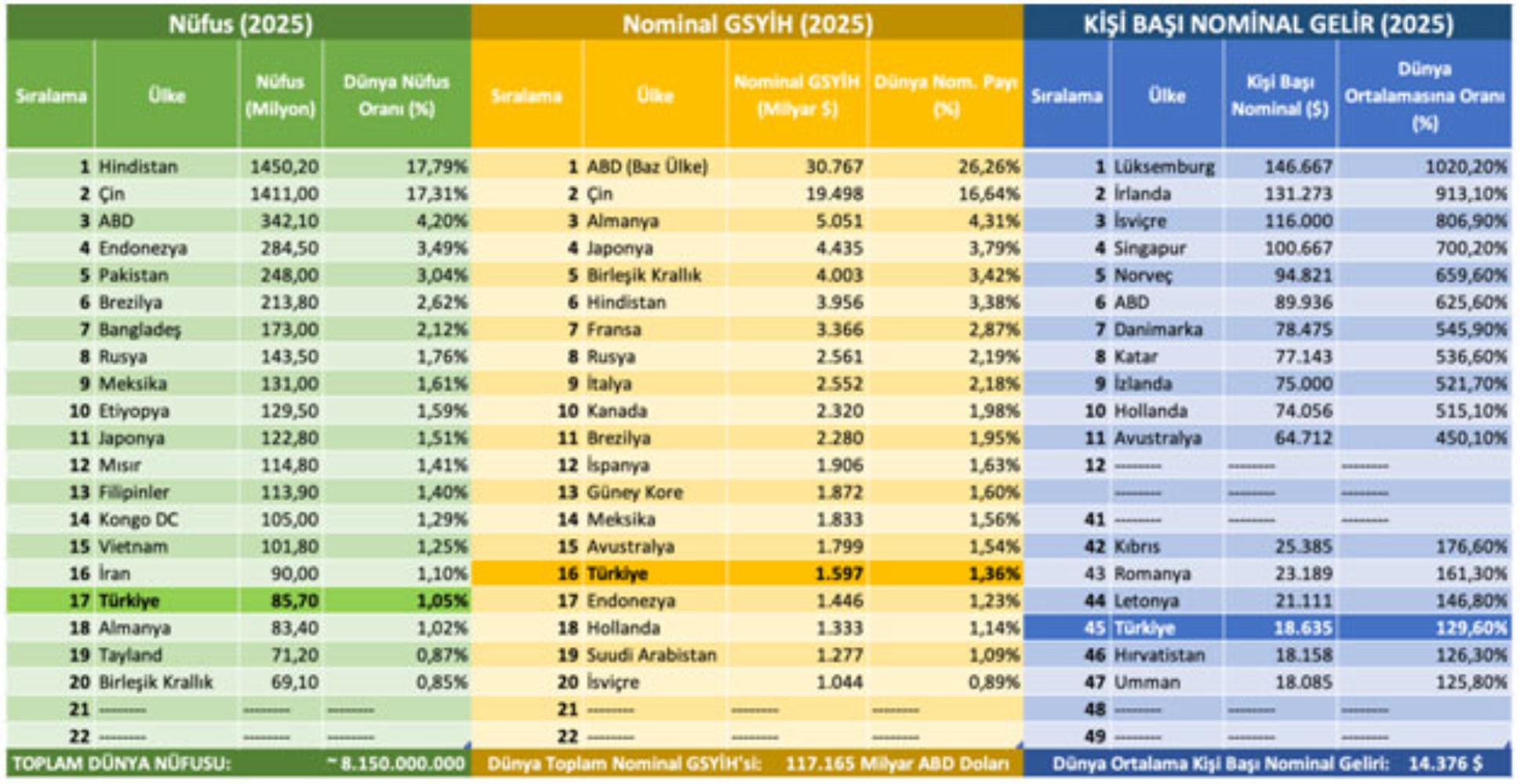
Throughout history, economic and demographic power centers have constantly shifted. As summarized in the table below, as of 2025, the world is witnessing a critical period in which not only economic balances but also population structures, production models, and distribution relations are being reshaped. It is no longer possible to explain development solely through growth figures. Because the fundamental issue today is not how much is produced, but by whom the produced value is shared and to what extent it reflects on the quality of life of societies. In this framework, in light of the most current global data, we will seek an answer to the following question: As the world population increases, how is global income distributed, how are new power balances formed, and where does Turkey stand in this great transformation?
DEMOGRAPHIC DIVISION: The Rejuvenating South, the Aging North, and Changing World Balances
The future of the world is now determined not only by economics but also by demography. Where the population increases, where it ages, and how it moves directly affects many areas from production to employment, and from social policies to global power balances. For this reason, demography has ceased to be a census topic stuck in statistical tables; it has become a strategic element that shapes the economic and political destiny of countries. As of the end of 2025, the world population has reached approximately 8 billion 150 million. However, this growth does not occur at the same speed in every region of the world. Population growth is slowing in developed economies, and in some countries, the population is even beginning to shrink. While industrial giants like Japan, Germany, and Italy struggle with the economic and social costs created by an aging population, South Asia and Africa are emerging as the new centers of global population growth.
Today, while India hosts approximately 18 percent of the world population with its 1 billion 450 million people, China ranks second with 1 billion 411 million people. The USA is in third place with a population of 342 million. These three countries alone make up approximately 40 percent of the world population. This picture also explains why global economic and political competition is largely shaped around these countries. However, population size alone does not mean an advantage. Population growth not supported by qualified education, employment, and production capacity can produce unemployment, poverty, uncontrolled urbanization, and migration pressure instead of development. This is exactly one of the most important challenges Africa and South Asia are facing today.
On the other hand, developed countries are facing a different problem. The decline in fertility rates and the increase in life expectancy lead to a contraction of the working-age population, while creating increasing pressure on pension systems, health expenditures, and social security balances. For this reason, migration policies are no longer just humanitarian or security-oriented; they are also becoming one of the fundamental tools of economic sustainability. In short, the world has entered a new period of demographic fracture. On one side, there are rejuvenating and growing societies, and on the other, aging and shrinking populations. In the coming years, this demographic transformation will lie at the root of many developments, from economic competition to global migration movements.
THE GLOBAL INCOME PIE AND THE ILLUSION OF “SIZE”
We have seen how the world population is shaped. So, how much is the economic value produced by these 8.15 billion people, and by whom is this value shared? According to data from the end of 2025, the global economy has reached a size of approximately 117 trillion dollars. At first glance, we are talking about the largest economic production capacity in human history. However, when looking behind the numbers, it is seen that this massive income is distributed extremely unequally.
The United States, which has only 4.2 percent of the world population, produces more than 26 percent of global income alone with its economy of approximately 30.7 trillion dollars. While China receives approximately 16.6 percent of global income despite hosting 17 percent of the world population, India, the world's largest country in terms of population, can only receive a 3.4 percent share of global income despite having approximately 18 percent of the world population.
This picture clearly reveals that the main determining factor in today's world is not population size, but technology, productivity, institutional capacity, and high value-added production. Economic power is now measured not only by how much you produce, but by what you produce and at what level of technology you perform it. However, there is a common mistake made when evaluating the global economy: thinking that total economic size and social welfare are the same thing.
Yet, a country having a trillion-dollar economy does not mean that its citizens live in equal prosperity. Indeed, while the nominal income per capita in China, the world's second-largest economy, is at the level of 13,819 dollars, the income per capita in Luxembourg, which is not at the top of the total economic size ranking, exceeds 146 thousand dollars. This example alone is enough to show the difference between economic size and individual prosperity. A similar situation is seen in global averages. The nominal income per capita worldwide is around 14,376 dollars. However, this figure does not reflect the true income distribution of the world. Because a significant portion of global wealth and income is concentrated in a limited number of countries and segments of society.
Therefore, measuring the success of countries only with national income figures would be an incomplete approach. What is truly important is that economic size can be transformed into quality education, accessible health services, technological development, social security, and fair income distribution. Development is not just producing more; it is the ability to spread the produced value to broad segments of society. For this reason, the fundamental debate in today's world is no longer shaped around the question of “how much did the economy grow?” but rather “who got what share of the growth?” and “we grew, but did we develop?” Because numbers can grow; but if prosperity is not spreading at the same speed, growth begins to lose its meaning for broad segments of society.
TURKEY'S COORDINATES IN THE GLOBAL EQUATION
After revealing the big picture of global population and income distribution, it is necessary to return to the main question: Where does Turkey stand in this picture? 2025 data shows that Turkey has significant economic and demographic weight within the global system. However, the same data also reveals structural risks that should be read carefully regarding the future. In other words, Turkey is at a critical threshold in terms of having high potential but transforming this potential into sustainable development.
Population: Turkey's Silent Transformation
With a population of 85.7 million, Turkey constitutes approximately 1.05 percent of the world population and ranks 17th among 194 countries. While this size makes Turkey an important power on a regional scale, it also offers significant advantages in terms of young labor force, production capacity, and domestic market.
However, when looking at the trends behind the numbers, a different picture emerges. For many years, Turkey was considered a country that stood out with its young population advantage. Today, it is seen that this advantage is gradually weakening. The decline in the child population ratio, the decline in the share of the young population in the total population, and the rapid increase in the elderly population show that a deep transformation is taking place in the demographic structure.
Although this transformation is not noticed at first glance, in the long run, it has a nature that will directly affect many areas from the economy to the social security system, and from education policies to health expenditures.
Child Population is Declining (Harbinger of the Future): One of the most important indicators regarding a country's future is the child population ratio. Because children constitute the future labor force, producers, and taxpayers. As of 2025, while the child population ratio worldwide is at the level of 29.3 percent, this ratio has declined to 24.8 percent in Turkey. In other words, Turkey is now among the countries with a child population ratio below the world average. This is not just a statistical change. It is also an important signal indicating that the working-age population will shrink in the future, production capacity will be under pressure, and the social security system will carry more burden.
Erosion Has Begun in the Young Population: A similar picture is seen in the young population data. While the share of the 15-24 age group in the population is at the level of 15.6 percent worldwide, this ratio has fallen to 14.8 percent in Turkey. Although Turkey still has a younger population structure compared to many European countries, the difference is decreasing every year. More importantly, a significant portion of the current young population faces structural problems in education and employment. Inequalities in access to qualified education opportunities, youth unemployment, and anxiety about the future make it difficult for Turkey to transform its demographic advantage into economic value. The young population is not just a numerical power; when supported by the right policies, it can become the engine of development, and when not supported, it can turn into a missed opportunity.
The Reality of an Aging Turkey: The most striking dimension of demographic transformation is the increase in the elderly population. As of 2025, while the ratio of the population aged 65 and over worldwide is at the level of 10.4 percent, this ratio has reached 11.1 percent in Turkey. Thus, Turkey has entered the ranks of countries with an elderly population ratio above the world average for the first time. This development is a positive indicator in terms of longer life expectancy. However, it also brings new economic and social responsibilities. The sustainability of the pension system, the financing of health expenditures, and elderly care services will be among the most important topics of public policy in the coming years. Today, the reality of an aging population lies at the root of many problems that Europe is facing. Turkey is also at the beginning stage of a similar process, and measures not taken in time may lead to higher costs in the future.
Alarm Bells in Fertility: One of the most striking headings in Turkey's demographic outlook is the sharp decline in fertility rates. As of 2025, while the world average is at the level of 2.24 children per woman, this ratio has declined to 1.42 in Turkey. Yet, the threshold value required for a population to renew itself is approximately 2.1. This picture shows that Turkey is well below not only the world average but also the level considered critical for the sustainability of the population. Rising housing costs, increasing living expenses, inadequacies in nursery and care services, conditions that make it difficult for women to balance work life and family life, and the uncertainties of young people about the future directly affect fertility decisions. Therefore, the issue of fertility is not just a demographic topic; it is also a strategic development issue with economic, social, and cultural dimensions.
From Numerical Advantage to Demographic Vulnerability: The emerging picture is clear: Although Turkey still has a significant population size, demographic indicators are giving serious warnings about the future. While the child and young population are decreasing, the elderly population is increasing, and fertility rates are hovering below the level of the population renewing itself. If this trend continues, the working-age population will shrink, production capacity will remain under pressure, the burden on the social security system will increase, and the sustainability of economic growth will become difficult. In short, the issue Turkey is facing is not just the size of the population, but the quality and sustainability of the population. Because the element that determines the power of countries in the 21st century is not just how many millions of people they have; it is how well they can educate, produce, and prepare that population for the future.
GDP and Income Per Capita: Growth or Prosperity?
While demographic indicators give important signals about Turkey's future, economic data similarly deserve to be read carefully. Because in the economy, while some figures tell a strong success story at first glance, it is possible to encounter a different picture when going into details.
As of 2025, the Turkish economy has reached a size of approximately 1 trillion 597 billion dollars, receiving a 1.36 percent share of the global economy and ranking 16th among the world's largest economies. This performance is an important indicator in terms of showing that Turkey can produce economic value above its 1.05 percent share in the world population.
In the same period, the nominal income per capita has risen to the level of approximately 18,600 dollars, thus Turkey has exceeded the world average of 14,376 dollars and continued to take its place in the upper rungs of the upper-middle-income group.
At first glance, the emerging picture seems positive. However, to grasp the true meaning of economic data, one must ask this fundamental question: How much of this growth is caused by production, and how much by price movements?
Why Has Prosperity Not Increased at the Same Speed While Numbers Rise? One of the most important debate topics of the Turkish economy in recent years is the difference between growth figures and the citizen's daily life experience. On paper, national income is increasing, income per capita is rising, and the economy is growing. However, in the same period, a significant improvement in the purchasing power of broad segments of society is not felt. This situation brings up the difference between nominal growth and real prosperity. What is truly important in the economy is to what extent the produced value reflects on the citizen's standard of living. If income growth is eroding against inflation, and housing, education, and health costs are rising rapidly; growth figures cannot go beyond being an abstract data for a significant part of society.
Exchange Rate-Inflation Scissors and “Enrichment on Paper”: The tight monetary policies and high-interest environment implemented in 2025 significantly limited the rise in the exchange rate, while inflation continued to maintain its high levels. As a result, the national income calculated in Turkish Lira grew rapidly, and because the exchange rate did not rise as much as inflation, national income figures in dollar terms also showed a strong increase. However, there is an important detail to be noted here. Not all of the rise in national income in dollar terms stems from productivity increases, technological transformation, or efficiency gains. A significant portion of this increase consists of the rise in price levels and the statistical effects created by exchange rate dynamics. In other words, while the economy grows in dollar terms, the citizen may not get richer to the same extent. Because the element that determines real prosperity is not just the size of national income; it is purchasing power, income distribution, and cost of living.
The Difference Between Average Income and Real Life: Income per capita data should also be evaluated carefully in a similar way. Although the national income per capita reached the level of approximately 18 thousand dollars in 2025, this figure does not mean that the entire society has the same income level. Because income per capita is a statistical average obtained by dividing the total income by the population. In economies where income distribution is distorted, while average income rises, a similar improvement may not be experienced in the income level of broad segments of society. In some periods, real living standards may even decline while average income increases. In recent years, while the incomes of segments owning financial assets, real estate, and capital income have increased faster; citizens living on wage income have become more vulnerable against high inflation. For this reason, a significant distance has formed between the rise in average income and the level of prosperity felt by society.
Middle-Income Trap and Technology Problem: Another fundamental issue facing Turkey is the quality of economic growth. Although Turkey has a significant production capacity today, the share of high-technology-intensive products in total exports is still at limited levels. Since a sufficiently strong leap could not be realized in high value-added sectors, economic growth often carries a character based on domestic consumption, credit expansion, and price movements rather than productivity increases. This situation keeps alive the “middle-income trap” risk that has been debated in Turkey for many years. Because countries can only move to a higher league after reaching a certain income level through technology, innovation, and high value-added production.
The True Measure of Growth: As a result, the Turkish economy is growing; but the quality of growth is at least as important as its size. The real issue is not how many trillion dollars the national income has reached, but to what extent this growth reflects on the citizen's table, income, and quality of life. If growth is fed more by price increases than productivity, more by exchange rate effects than technological transformation, and more by average calculations than fair distribution, the emerging picture will be insufficient to write a sustainable prosperity story. For this reason, the fundamental goal before Turkey is not just to be a larger economy; it is to build an economic structure that is more efficient, more competitive, and can share the prosperity it produces more fairly.
CONCLUSION: A Development Story Beyond Numbers
2025 data reveals an important truth for both the world and Turkey: Economic size is increasing, but prosperity is not spreading to the same extent. While capital, technology, and production power are concentrated in certain centers on a global scale; inequalities in income distribution are deepening, demographic balances are changing rapidly, and the quality of development is gaining more importance every day. The fundamental issue of today is not how much is produced, but by whom the produced value is shared and to what extent it reflects on the quality of life of societies.
Turkey is also right at the center of this great transformation. On one side, there is a country that is among the world's largest economies, has strong production capacity, and strategic advantages; on the other, there is a social structure facing an aging population, declining fertility rates, purchasing power problems, and distortions in income distribution. This picture shows that the real issue before Turkey is not just to grow, but to transform growth into permanent and inclusive prosperity.
Demographic indicators point out that time is not working in Turkey's favor. While the share of the child and young population is decreasing, the elderly population is increasing rapidly. The decline of fertility rates below the level of the population renewing itself will bring new challenges in many areas from the labor market to the social security system in the coming years. On the economic side, although national income figures are rising, it is seen that this increase is not felt to the same extent in all segments of society. Because prosperity is born not only from growing statistics; but from people being able to make future plans, raise their children safely, and receive the reward for their labor.
For this reason, the fundamental task before Turkey is to reshape economic growth on the axis of productivity, technology, qualified education, and fair sharing while managing demographic transformation correctly. A holistic approach extending from nurseries to housing policies, from women's employment to education reforms, from technology investments to tax justice is no longer a choice, but a strategic necessity.
In the final analysis, what will determine Turkey's future is not the size of its population or the volume of its national income; it is how much it can develop its human resources, how fairly it can share the value it produces, and how strong a future perspective it can offer its citizens. Because true development is born not from the growth of numbers; but from the empowerment of the individual and the society's ability to look to the future with hope.
Would you like to get notifications about new developments and save news?
- NotificationsNew developments and breaking news
- SaveNews is stored in the app
Most Read

National Anthem surprise from Japanese Ambassador

Diesel protest in Italy brings roads to a standstill
Kılıçdaroğlu sends formal notice to YENİ Party

Diyanet Foundation, which claimed 'we have no resources,' owns 73 percent of the fund!

Is it time for the Turkish Parliament to revoke its 31-year-old 'Casus Belli' decision?

No to the 'opening' bar masked as change, yes to the Republic's bar

Ezel Akay and his brother's test results came back positive

Why is Paris burning? The crisis of the welfare state and the revolt of social justice

'From a Journalist’s Pen: The Tüfekli File'

The politics of particles and the financing puzzle: 'Calamitous questions'