İlkcan Kemer
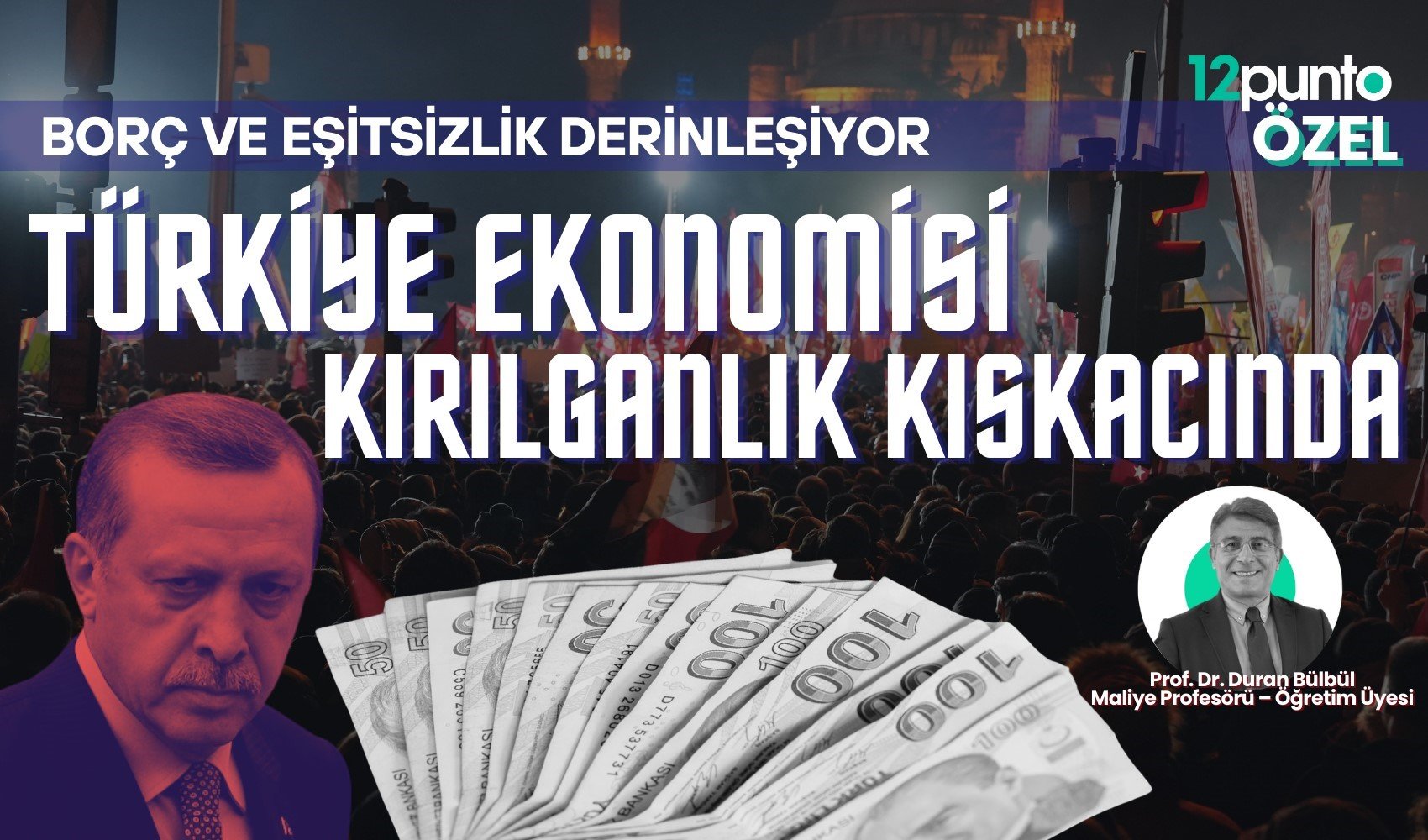
Finance Professor and Faculty Member Prof. Dr. Duran Bülbül stated that Turkey's total debt stock has reached 38 trillion liras and that the interest burden has exceeded the principal, saying, “Due to economic instability, the public's debt burden is steadily increasing, and wealth inequality is deepening further.”
 As economic fragility in Turkey continues to rise, the debt burden and injustice in income distribution are negatively affecting social welfare, and it is emphasized that the crisis will deepen unless structural reforms are implemented in economic management. Speaking to 12punto, Finance Professor Prof. Dr. Duran Bülbül pointed out that the total debt stock in our country has reached 38 trillion liras and that the interest burden has exceeded the principal, stating, “Due to economic instability, the public's debt burden is steadily increasing, and wealth inequality is deepening further.”
Bülbül stated that the richest 1 percent in Turkey owns 40 percent of the total wealth, expressing that economic balances have been disrupted.
Prof. Dr. Duran Bülbül continued his words as follows:
 ‘WHY IS OUR ECONOMY SO FRAGILE?’
Due to the events that have occurred, the Turkish public has made sacrifices for the future of our state and country over the last two years with great devotion, giving up their level of prosperity, the opportunities of their children, spouses, and jobs. However, the price of this sacrifice has been paid in the form of poverty and impoverishment. We see that the great devotion of the public is being wasted.
Why is our economy so fragile? Why is our economy shaken so much by tiny events? Yet we have experienced much greater crises and political turmoil, but the economy had not become this fragile.
One of the biggest fundamental reasons for this is that the interest and foreign exchange policies imposed by economic management in the name of stability become inoperable unless necessary structural reforms are made, and the economy takes on a fragile structure.
‘TURKEY’S DEBT BURDEN HAS REACHED 38 TRILLION LIRAS’
Stating that Turkey's total debt stock has reached 38 trillion liras and that 56 percent of this is debt to be paid in foreign currency, Prof. Dr. Duran Bülbül said, “If we need to make a concrete analysis of the Turkish economy, Turkey has a debt of approximately 38 trillion 50 billion liras as of the end of 2024. In contrast, it has a national income of around 1 trillion 200 billion liras. 56% of this 38 trillion 50 billion lira debt is foreign currency debt. This means the following: As foreign exchange increases, our debt burden will increase, and as our debt burden increases, the public will become even poorer. As foreign exchange increases, inflation will rise, and as inflation rises, the public will become impoverished again.”
 ‘THE ONGOING CRISIS HAS BROUGHT CURRENCY-PROTECTED DEPOSITS AND INTEREST AGREEMENTS BACK TO THE AGENDA’
Stating that Turkey's interest burden has exceeded the principal, Prof. Dr. Duran Bülbül emphasized that this situation shows that the economic crisis is deepening, and continued: “Furthermore, as of the end of 2024, the interest burden has exceeded the principal. The ratio of the interest burden to the principal has reached the 135 percent level. In other words, the amount of interest the state pays is more than the debt it received itself.”
‘WEALTH GAP IS DEEPENING: THE RICHEST 1 PERCENT OWNS 40 PERCENT OF TOTAL WEALTH’
Underlining that inequality and injustice in wealth distribution are becoming increasingly evident, Prof. Dr. Duran Bülbül said, “The distortion in wealth distribution in Turkey is very clear. The richest 20 percent own 80 percent of the total wealth in Turkey. While the richest 5 percent hold 60 percent of the country's total wealth, the richest 1 percent own 40 percent of the wealth. This is one of the greatest distortions in income distribution in Turkey,” he expressed.
Prof. Dr. Duran Bülbül continued as follows:
 “PROPOSED SOLUTIONS: STRUCTURAL REFORM IS A MUST!’
What needs to be done to ensure economic stability is very clear:
• An economy based on agriculture, industry, and production must be built.
• Inflation must be reduced, and the informal economy must be combated.
• If the informal economy is taxed, it is possible for the state to generate an additional 90 billion dollars in annual revenue.
• Tax expenditures, exemptions, and incentives must be reviewed, and elements that distort income distribution must be corrected.
• A transition from a consumption economy to a production economy must be made.
Furthermore, the political power must cleanse the economy of gang-like structures, remnants of religious sects, and interest groups. Law, justice, and democracy must function, and necessary measures must be taken against corruption. Otherwise, political influences on the economy and fragility will continue, and the public's burden will increase even further. For this, an institution to prevent corruption and public loss must be established.
News Source: 12punto