
Headaches stand out as a problem frequently experienced by many people in today's world. While experts believe that factors such as stress, environmental noise, and staring at screens for long periods trigger headaches, remarkable findings have been obtained regarding the genetic dimension of the issue.
According to a recently published scientific study, the origins of a brain-related disorder that can cause headaches in some people may date back to Neanderthal genes. This disorder is known as "Chiari malformation," which occurs when the lower part of the brain shifts toward the spinal cord. This anomaly, which can be found in 1 out of every 100 people worldwide, can lead to head and neck pain in particular.
According to the researchers' data, CM-I, the mildest form of Chiari malformation, causes common complaints such as frequent headaches and neck pain, while it is stated that neurological complications can also arise if the deformation reaches more serious dimensions. Scientists are examining the possibility that these types of genetic disorders stem from gene flow between Homo sapiens and Neanderthals in the past.
MODERN AND PREHISTORIC HUMAN SKULL MODELS COMPARED
In the new study, 3D skull scans of 103 modern humans were compared with fossils of eight ancient human species, including Neanderthals. The results are striking: the skull shapes of individuals with Chiari malformation resemble only Neanderthal skulls. In contrast, other human species such as Homo erectus and Homo heidelbergensis show similarities to modern humans who do not have the Chiari anomaly.
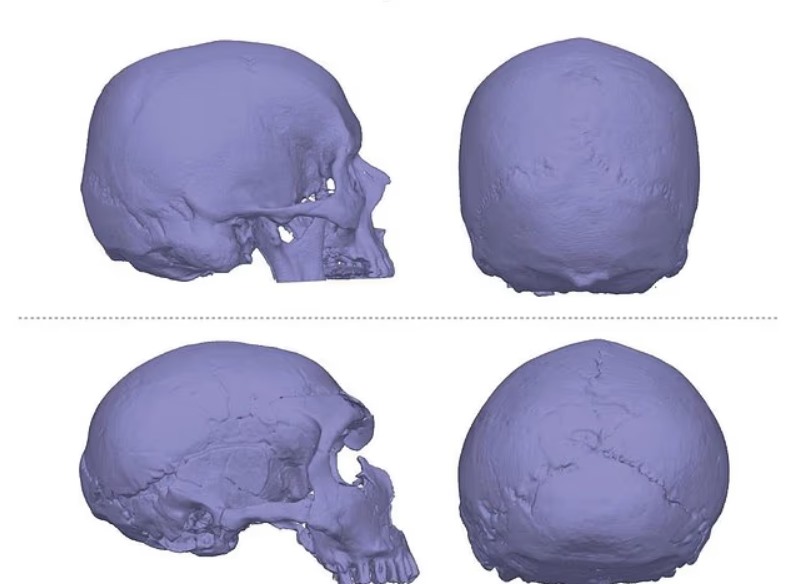
Dr. Kimberly Plomp from the research team stated, "Our findings reveal that the Neanderthal skull shape is also seen in today's Chiari patients. This supports the idea that genetic heritage plays a role in the emergence of the disease." The findings indicate that susceptibility to headaches may be linked not only to modern living conditions but also to our evolutionary and genetic past.
THE SPREAD AND IMPACT OF NEANDERTHAL GENES
Research shows that Neanderthals and Homo sapiens interbred intensively in the Levant region for about 200,000 years, starting approximately 250,000 years ago. Today, it is known that traces of Neanderthal genes are found in approximately 45 percent of the human genome. The distribution of this ratio can vary from region to region.
For example, the rate of Neanderthal genes in individuals living in East Asia can reach up to 4 percent. In the African continent, where Neanderthals did not live, this rate remains extremely low. Scientists emphasize that these genetic differences may also affect the incidence of Chiari malformation.
In conclusion, while investigating the causes of headaches, it is once again revealed that we need to look not only at our current habits and environmental factors but also at our genetic heritage from tens of thousands of years ago.
News Source: 12punto