

RSF 2026 Index: Press freedom at its lowest in 25 years!
Press freedom is sounding alarms on a global scale. According to the Reporters Without Borders (RSF) 2026 Index, the lowest average of the last 25 years has been recorded, with more than half of the countries regressing into the “difficult” or “very serious” categories. Turkey ranked 163rd out of 180 countries due to increasing pressure on journalism, lawsuits against reporters, and the systematic use of accusations such as “disinformation” and “insulting the president.”



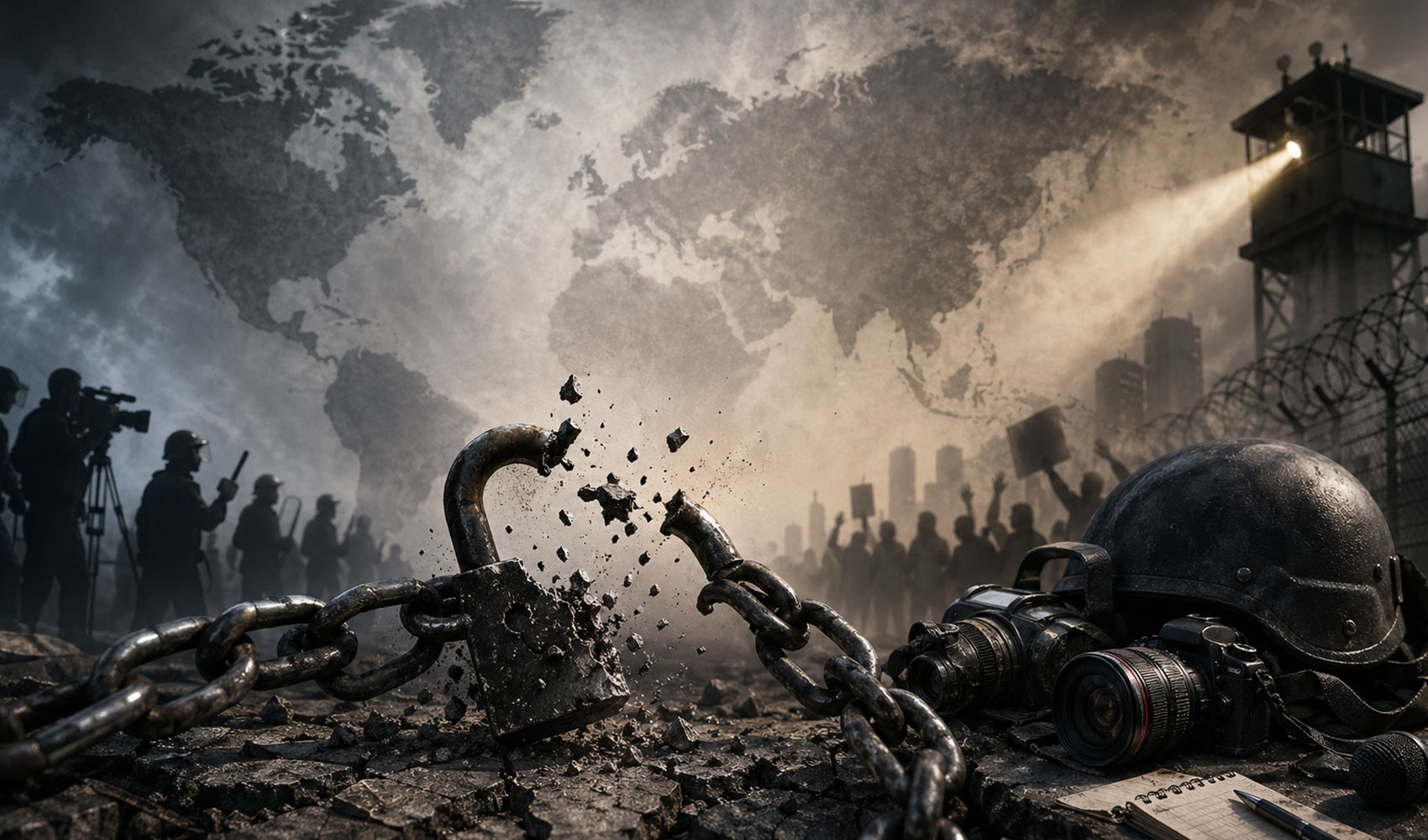
For the first time in the history of the World Press Freedom Index prepared by Reporters Without Borders (RSF), the majority of countries in the world are shown to be in a “difficult” or “very serious” situation. In the last 25 years, the average score of all countries examined has never been this low.
The spread of increasingly restrictive legal regulations, particularly linked to national security policies, has been eroding the right to access information even in democracies since 2001. While the legal indicator showed the greatest decline this year, this situation indicates that journalism is increasingly being criminalized. A significant change is also taking place in the Americas: while the US has fallen seven places in the index, many Latin American countries are also being dragged into a spiral of violence and repression.
Turkey ranked 163rd out of 180 countries in the RSF 2026 Index, due to the instrumentalization of accusations such as “disinformation,” “insulting the president,” or “defaming state institutions” to suppress journalism and imprison reporters.
BOCANDÉ FROM RSF: HOW MUCH LONGER WILL WE TOLERATE THIS?
Stating that RSF is not content with just looking at the past on the occasion of the 25th anniversary of the index's publication, RSF Publishing Director Anne Bocandé points out that the perpetrators of the increasingly sophisticated attacks on the right to receive information are no longer hiding:
“With the perspective it presents on the occasion of its 25th anniversary, RSF is not content with just looking at the past; the organization addresses the future directly by asking a simple question: How much longer will we tolerate the strangulation of journalism, systematic obstacles to journalists, and the constant erosion of press freedom? Because even though attacks on the right to information have diversified and become more sophisticated, the perpetrators of these attacks are no longer hiding: Authoritarian states, complicit or negligent political powers, predatory economic actors, and platforms that have become uncontrollable bear direct and overwhelming responsibility. In the face of such a situation, remaining passive means a form of approval. It is no longer enough to defend principles: active protection policies are essential, and these policies must be the driving force. This begins primarily with ending the criminalization of this issue: the abuse of national security laws, strategic lawsuits against public participation (SLAPPs), and systematic obstacles to those who investigate, reveal facts, and disclose names. Protection mechanisms are still inadequate, international law is collapsing, and impunity is becoming widespread. Definite guarantees and concrete sanctions are needed. The ball is in the court of democracies and their citizens. It is up to them to stand against those who impose silence. Because the spread of authoritarianism is not an inevitable fate.”
Five key facts about the 2026 World Ranking:
1- The average score of all countries in the world has never been this low. For the first time in the 25-year history of the index, more than half of the world's countries (52.2 percent) are in a “difficult” or “serious” situation.
2- Of the five indicators used to measure the state of press freedom globally (economic, legal, security, political, social), the legal framework indicator showed the greatest decline this year.
3- While the US (64th place) fell seven places, other American countries such as Ecuador and Peru also experienced major drops in the rankings.
4- Norway has remained at the top of the ranking for the tenth consecutive year, while Eritrea has been at the bottom of the ranking for the last three years.
5- Post-Assad Syria (141st place) recorded the biggest jump in the ranking in 2026 (+36).
THE LOWEST AVERAGE SCORE OF THE LAST QUARTER CENTURY
Since the 25 years that RSF has been publishing the World Press Freedom Index, press freedom has been steadily deteriorating. Journalists are still being killed or imprisoned for their work, but the tactics of attacks on press freedom are changing: Journalism is being stifled by hostile political rhetoric targeting reporters, weakened by a stagnant media economy, and kept under pressure through the instrumentalization of laws against the press.
WARS AND RESTRICTIONS ON ACCESS TO INFORMATION
In some countries, this decline can be explained by armed conflicts that regularly break out, such as in Iraq (162nd), Sudan (161st), or Yemen (164th). It is obvious that ongoing wars have had a clear impact on this year's ranking. For example, the Israeli army has killed over 220 journalists in Gaza since October 2023, at least 70 of whom were on duty, in the war waged by Benjamin Netanyahu's government in Palestine (Israel, -4 points).
For some, the situation unfortunately never changes due to dictatorial regimes. This is the case in countries like China (178th), North Korea (179th), and Eritrea (180th); in Eritrea, journalist Dawit Isaak has been detained without trial for 25 years. Eastern Europe and the Middle East continue to be the two most dangerous regions for journalists, as they have been for the last quarter-century.
Vladimir Putin's Russia (172nd), which continues its war against Ukraine, is among the worst in terms of press freedom. Caught between regime repression and the wars the US and Israel are waging on their territories, Iran (177th; -1) remained at the bottom of the rankings.
Some countries have witnessed a shrinking of their information space over the last 25 years due to changes or hardening of political regimes. Since the Chinese central government took power, the Hong Kong region (140th) has fallen 122 places in the index, while El Salvador (143rd), which declared war on gangs, has fallen 105 places since 2014. This situation also applies to Georgia (135th place), which has increased repression in recent years and has fallen 75 places since 2020.
Niger (120th), caught between attacks by armed groups in the Sahel region and the ruling junta that suppresses pluralistic reporting, was the country with the biggest decline, falling 37 places. Saudi Arabia (-14 places) is paying the price for the government's repeated acts of violence against journalists in 2025; especially due to an unprecedented event in the world, such as the execution of Turki al-Jasser. In contrast, the collapse of Bashar al-Assad's dictatorial regime in December 2024 raised Syria, which had been among the ten worst countries in the world for press freedom for years, from 177th to 141st place during its political transition process.
CRIMINALIZATION OF JOURNALISM PEAKED
The legal indicator is the indicator that showed the greatest decline this year. This indicator worsened in 110 out of 180 countries between 2025 and 2026, meaning in more than 60 percent of countries. Examples of these countries include India (157th), Egypt (169th), Israel (116th), and Georgia (135th). The criminalization of journalism through the violation of press law and the abuse of emergency laws or general law has become a global phenomenon.
ABUSE OF NATIONAL SECURITY LAWS CAUSES LEGAL INDICATOR TO FALL IN 2026
As 25 years have passed since the September 11, 2001 attacks in the US, the expansion of defense secrets and the national security sphere has become a tool in many countries to prevent issues of public interest from being brought to the agenda as news. This trend, which is striking in authoritarian regimes and has become largely widespread in democracies, is seen alongside the abuse of laws against journalists under the guise of counter-terrorism.
Among the regimes closed to the press, Russia (172nd) under Vladimir Putin is specialized in using counter-terrorism, separatism, or anti-extremism laws to restrict press freedom. As of April 2026, 48 journalists are imprisoned in the country, and those who want to continue their work have been forced into exile – but they cannot escape the judicial pressure that extends beyond borders.
This instrumentalization of national security measures is also seen particularly in neighboring Belarus (165th), Myanmar (166th), Nicaragua (168th), and Egypt (169th). In Africa's Great Lakes region, as of April 13, Sandra Muhoza was the only female journalist still imprisoned in this region in 2026. Muhoza was being tried in Burundi (119th) on the charge of “harming national territorial integrity,” which is frequently used in this region. In Ethiopia (148th place), four journalists have been imprisoned for three years to be tried on terrorism charges.
In Turkey (163rd), this maneuver goes beyond the counter-terrorism legislation used in the country. In Recep Tayyip Erdoğan's country, accusations such as “Disinformation,” “Insulting the President,” or “Defaming state institutions” are regularly instrumentalized to suppress journalism and imprison reporters.
In North Africa, Tunisia (137th) cannot escape this global trend called “lawfare.” While Decree-Law No. 54 on “fake news” is a real tool for criminalizing critical journalism, the suspension of media outlets' activities and repeated judicial prosecutions show that the judiciary is increasingly being used as a tool against reporters.
PRESSURE ON PUBLIC MEDIA AND SLAPP LAWSUITS
The deterioration of the legal indicator can also be explained by the abuse of existing laws to bring journalists to court. This situation emerges with the intensification of strategic lawsuits against public participation (SLAPPs), whether in Bulgaria (71st) or in Guatemala (128th), as in the symbolic case of José Rubén Zamora. In Indonesia (129th), Singapore (123rd), and Thailand (92nd), political or economic elites also exploit a legal framework that is inadequate to protect the press. These legal restrictions are also seen in countries that are relatively high in the index, such as France (25th).
In the face of all kinds of risks that journalists face, whether security or legal, public policies are insufficient to provide a structural solution. In more than 80 percent of the countries examined, protection mechanisms are either non-existent or ineffective.
Although the European Media Freedom Act (EMFA) guarantees the independence and sustainability of the media, especially public broadcasting, in the European Union, it is regularly violated through national legislative initiatives. This situation is encountered in countries that are better positioned in the index, such as Slovakia (37th), Lithuania (15th), and the Czech Republic (11th), as it was in Hungary (74th) during the term of Viktor Orbán's outgoing government.
AMERICAS GRAPPLES WITH POLITICAL AND SECURITY ISSUES
Since 2022, the decline observed in 28 American countries (-14 points) resembles the Eastern Europe - Central Asia (EEAC) and Middle East and North Africa (MENA) regions, which are the two most dangerous regions in the world for journalists. Despite some developments in recent years, such as Brazil's (52nd) rise in the rankings, the recent history of press freedom on the continent points to two trends: the increase in acts of violence committed by organized crime groups and the increase in acts of violence originating from security forces...
US President Donald Trump has turned regular attacks on the press and journalists into a systematic practice, pushing the country down to 64th place (-7) this year. The detention and deportation of Salvadoran journalist Mario Guevara leads to a further deterioration of the security environment, which is already marked by violent police repression.
Furthermore, the sharp decrease in the number of personnel at the US Agency for Global Media (USAGM) has also had international effects; the disappearance, suspension of activities, or downsizing of media teams such as Voice of America (VOA), Radio Free Europe/Radio Liberty (RFE/RL), and Radio Free Asia (RFA) in countries where they are sometimes the only reliable source of information has led to consequences.
Donald Trump's ardent defenders in Latin America, Javier Milei and Nayib Bukele, are unsurprisingly following the strategy the White House pursues against the media. Argentina (98th; -11) and El Salvador (143rd; -8) have recorded a significant decline, especially due to the deterioration of political and social indicators, which shows that hostility towards the press and government pressure are increasing.
NOTE:
For the detailed methodology of the RSF Index:
https://rsf.org/en/methodology-used-compiling-world-press-freedom-index-2025?_com=
News Source: 12punto
Most Read
Historic words from Özgür Özel at the CHP group meeting

Air Force Academy student Veli Bilgin has died
Is this an opportunity for Özgür Özel to shed the CHP's ideological baggage?

The same refrain

Why you should not let your children play Roblox

Collapse: What kind of alternative program?
Tuncer Bakırhan calls for a framework law
After the final: The political economy of football
Here are the names that will be in Özgür Özel's new party!
Major crisis in CHP