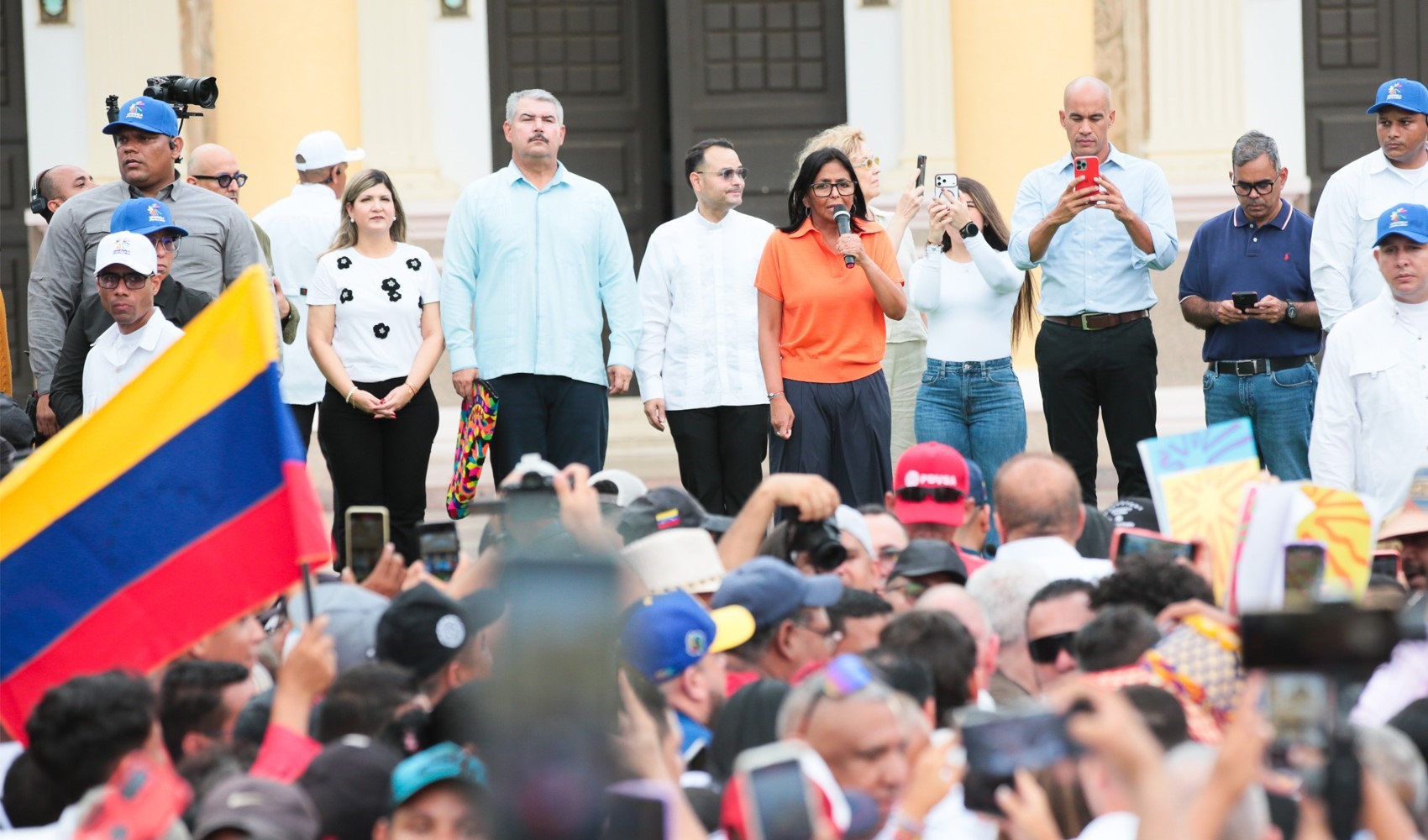
Venezuelans are demanding the removal of more than a thousand sanctions that the US has imposed on their country since 2014. Yesterday, Venezuelans launched a movement called the "March for a Venezuela Without Sanctions" from Maracaibo, the country's second-largest city. The march is scheduled to conclude in the capital, Caracas, on May 1. Protesters are demanding the lifting of all US sanctions and an increase in their salaries.
Professor Luis Ortega from the University of Health Sciences pointed out that US sanctions directly lead to a lack of investment in education, stating, "As academics, we are affected in many ways. If such sanctions exist, there is no investment in universities or infrastructure. There is no way to increase salaries, and this affects not only teachers' unions at the primary, secondary, and university levels but the entire society. Because it leads to a decrease in resources. Despite this, we have learned to be self-sufficient."
"Venezuela is facing a blockade that prevents the country's progress"
Roxana Urdaneta, a teacher, stated that the sanctions have destroyed the quality of life and the development of local schools, saying, "Because of these sanctions, Venezuela is facing a blockade that prevents the country's progress."
"I believe the public will regain their purchasing power"
Edgar Zavala, a retiree from the Ministry of Transport and Communications, drew attention to the cost of living, saying, "A single bus ticket is 250 bolivars (0.53 dollars), and this makes it impossible for people to even use public transport with their current income. If the President returns with full authority and the sanctions are lifted, I believe the economy will rise, salaries will be adjusted, and the public will regain their purchasing power."
Venezuelan Interim President Rodriguez evaluates her first 100 days
Venezuelan Interim President Delcy Rodriguez made a comprehensive assessment of her first 100 days since taking office on January 3. Releasing a video message, Rodriguez drew attention to the internal stability achieved following the high-tension events earlier in the year. Stating that the country has entered a "new political era," Rodriguez highlighted the significant increase in oil production. Expressing that Venezuela has now reached a daily oil production of 1.1 million barrels and aims to return to December 2025 levels, Rodriguez also noted that 8,000 people have been released under the new Amnesty Law thanks to political dialogue and diplomacy. Rodriguez said, "I wanted to address Venezuela after these 100 days; we have taken decisive steps toward consolidating a new historical era for our country. In unity, we are opening a path for national reunion, free from classism and racism."
Regarding public safety, Rodriguez stated that Venezuela is one of the safest countries in the region, with a homicide rate of 3 per 100,000 people.
Drawing attention to economic data, Rodriguez announced that the Gross Domestic Product has grown by 9 percent over 20 quarters. Emphasizing that this growth should be reflected to the public as more employment and better income, Rodriguez stated that reforms to be made in the Hydrocarbons Law and the Mining Law are expected to attract new technology and foreign investment to the country within a framework of "clear rules" without compromising national sovereignty.
US sanctions
The process, which began with targeted sanctions against individuals following the US Congress's passage of the Venezuela Defense of Human Rights and Civil Society Act, paralyzed the country's financial sector in 2015 when former US President Barack Obama issued an executive order declaring Venezuela an "unusual and extraordinary threat to national security." By 2018, the US had also included the gold sector under sanctions. Since 2019, a full-scale blockade has been applied to the oil and economic sectors. Crude oil trade was banned, and all Venezuelan assets in the US were frozen.
The current minimum wage in Venezuela is 130 bolivars (approximately 0.27 dollars).
News Source: 12punto