



The news reports titled “Surprise return home ends in tragedy” and “Final moments on camera” were based on the words of Özlem and Sanem Pancar, the wife and daughter of Nihat Pancar, who died in the ship that sank off the coast of Kyrenia:
“He was a cook, he had been working in Cyprus for three months. He set off without telling us to surprise us. We learned the news from the television. We called everywhere but couldn't find him.”
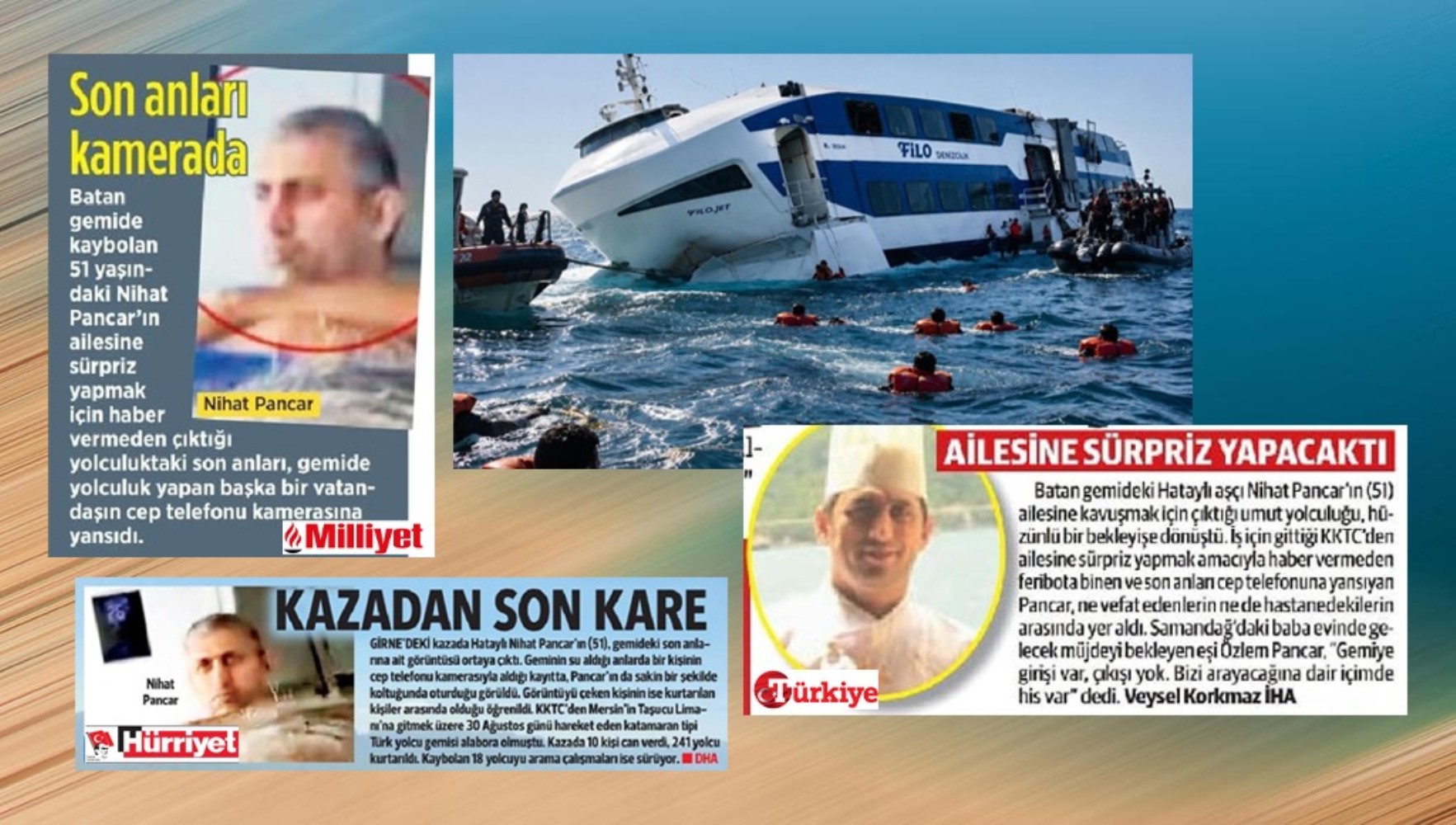
How painful, the media provided the real surprise! They learned of the death of their loved one while sitting at home watching television! Yet death is a private matter for every individual. Everyone has the right to learn of the death of a relative in their own private space, using a language and method that respects their grief. It was a mistake for the media to publish the names of Nihat Pancar and those who died in the accident before the authorities had informed their families.
Unfortunately, in this accident, it did not stop at publishing the names of the deceased before their relatives heard them; the photos and footage published on social media following the accident were also broadcast by media organizations without passing through any editorial filter. Real photos and images were mixed with those created by artificial intelligence programs. The panic, screams, and desperation experienced by the passengers as the ship sank were broadcast exactly as they were, without being filtered.
The fundamental difference between journalism and social media influencing is that journalism is a profession that encompasses rules and ethical principles. In journalism, not every photo or image is published as is; it is processed through an editorial filter before it becomes news. In news about accidents and disasters, images that would cause trauma to people, especially children, that reflect desperation, horror, and the fear of death, and that constitute an intrusion into the private space of the victims, are filtered out.
Following the accident in Cyprus, the Turkish Cypriot Journalists Association also felt the need to issue a warning due to the failure to apply professional rules and the repeated broadcasting of footage of the horrific moments on news sites and television without any filtering.
In the Board of Directors statement, which said, “Newsworthiness does not justify the unlimited display of the most vulnerable and horrific moments of people's lives,” they called for “filtering images, not using sounds of screaming and panic, preventing the identification of individuals, adding content warnings before broadcasting, not circulating images repeatedly, and focusing on the causes of the disaster and possible negligence.”
Unfortunately, this warning was also ignored. The same images are still being broadcast repeatedly on screens. Some of our colleagues seem to have forgotten the respect for humanity that is the essence of this profession.
Hearing aid advertisement from a columnist
Ömür Gedik, who writes for Hürriyet's Kelebek supplement, bought a hearing aid for her mother. She felt the need to announce their satisfaction with this device to the world with a video.
I saw the video shot by Ömür Gedik on the social media account of the company that sells the hearing aid. The video was presented by saying, “Dear Ömür Gedik also chose … Hearing Aids for her precious mother. They are now communicating much more comfortably!” Ömür Gedik was praising the device as follows:
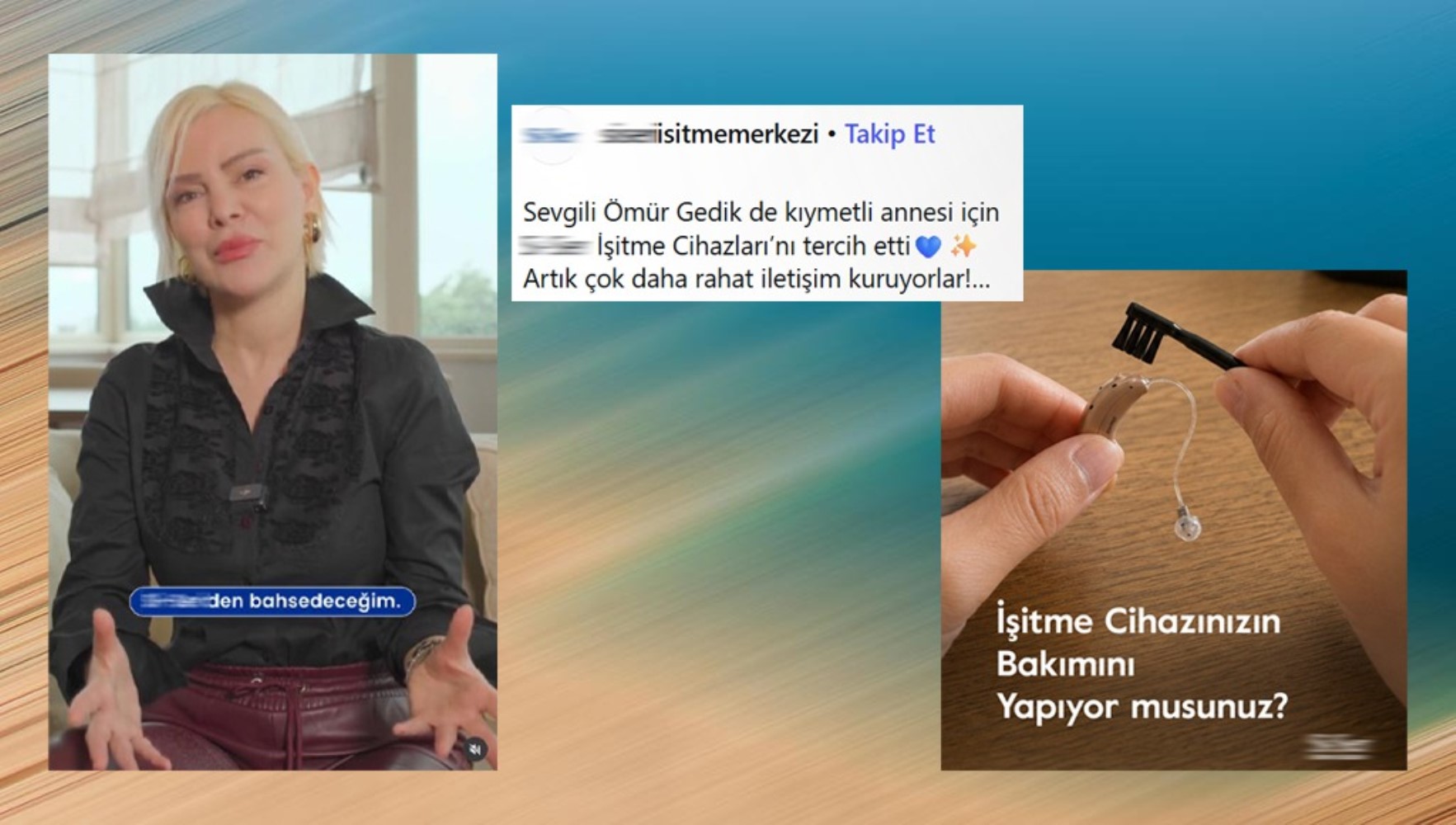
“I will tell you about a device that changed my life and changed my relationship with my mother. … I will talk about … which is a hearing aid that I think is much better than its counterparts abroad.”
The company is taking advantage of her fame by presenting Ömür Gedik's image as “feedback”; it is advertising. However, Ömür Gedik's fame comes not only from being an artist but also from her newspaper column writing, which she started earlier.
As a writer, establishing an advertising relationship with the company from which she bought a hearing aid for her mother is wrong, even if she paid for it. If people trust her tomorrow and buy that device and experience problems, won't they also hold Ömür Gedik and Hürriyet responsible?
A writer appearing in advertisements both creates the impression of establishing a conflict of interest and damages their credibility regarding their writing.
News to please the boss
The favorite of the economy pages in recent days is Murathan Kalyoncu, Chairman of the Board of Kalyon Construction Company.
On August 28, news reports prepared with interviews conducted with him were published in six different newspapers. Headlines such as “Europe's largest luxury outlet comes to IGA” in Akşam, “Opening with the goal of becoming a center in shopping tourism” in Ekonomi, “A new tourism story is being written” in Hürriyet, “The most ‘luxury’ investment” in Milliyet, “Europe's largest luxury outlet is opening” in Sabah, and “It will open its doors on September 17” in Yeni Şafak filled the economy pages.
On September 1, news reports such as “Damascus Airport is counting down the days” in Hürriyet's economy page, “A worldwide investment move” in Milliyet, and “It will plant a solar field in Europe” in Sabah were published. These reports were also based on interviews with Murathan Kalyoncu.
The main reason for the pro-government media showing such great interest in Murathan Kalyoncu is undoubtedly that he is one of the executives of Kalyon Holding, the owner of Turkuvaz Media, which also includes the newspaper Sabah.
Indeed, the first news report in Sabah bears the signature of Dilek Güngör. It is not a normal situation for an Economy Service Manager of a newspaper to write a simple promotional bulletin news piece like a shopping mall opening. It is clear that she felt the need to show close interest when it came to the boss's news.
In any case, granting privileges to the promotion of boss companies in the media is not limited to the promotion of one's own boss. Every media group is also open to the company promotions of the bosses of other media groups. Today, the Demirören, Albayrak, and Yeşildağ groups reported on Kalyon; tomorrow, Turkuvaz will promote those groups. It goes on like this, and it is journalism that suffers.
Vedat Milor and that ice cream shop
The allegation is that gastronomy writer Vedat Milor received 9 thousand euros (approximately 504 thousand TL) from an ice cream shop but did not provide the promotion he promised.
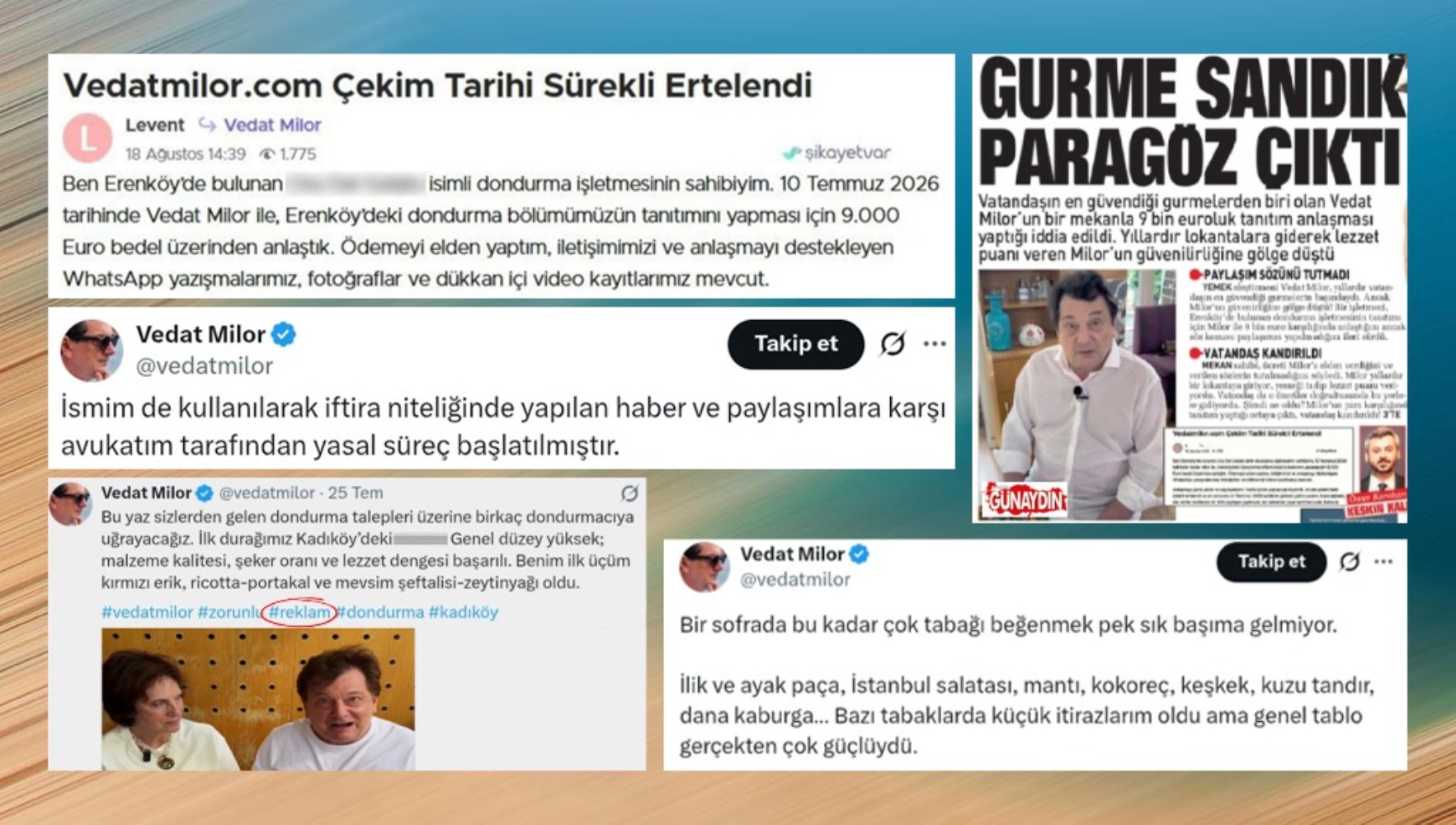
All of these news reports, which spread first on social media and then on websites, were based on a post on the “Şikayetvar” site. The person with the nickname Levent, who filed the complaint and stated that he was the owner of a business in Erenköy, claimed that they had agreed with Vedat Milor for promotion in exchange for money, and that a shoot was even done on July 24, but it was not published.
This is not how journalism is done. News cannot be written as an allegation based on a post by a person whose surname is not even clear and whose status as the actual owner is not certain. One cannot commit character assassination by looking at a post about anyone, let alone Vedat Milor.
The name, address, and phone number of the ice cream shop are known. One goes there or at least calls. The accuracy of the complaint is investigated; since there were WhatsApp correspondences and a shoot was done, those correspondences and images, if any, are also obtained as evidence. The opposing view is also obtained from Vedat Milor; that is how news is made.
I'll skip the news reports; Ömer Karahan, a writer for Sabah's Günaydın supplement, repeated the same accusations without investigation even in an article he wrote a few days later. He was unaware of Vedat Milor's post from the day before, which stated, “Legal proceedings have been initiated regarding the defamatory news and posts.”
Ömer Karahan was right at the end of his article when he said, “You cannot be both a referee and an advertising face. You cannot take money from a business and also present yourself to the public as an independent critic.” I checked, and while Vedat Milor used to put an “not an advertisement” label on his posts, he has removed the “not” since the beginning of this year! There is also an “advertisement” label on the ice cream shop posts he made last month! Of course, he cannot be expected to evaluate a place he is advertising with an objective eye.
Still, one cannot write “if the allegation made is true.” It is investigated, verified, and written with evidence. If the accusation is not true, the reputation and credibility of journalism take another blow.
The responsibility of not correcting the Amedspor mistake
Last week, I criticized Sözcü TV, as well as the newspapers Sözcü and Korkusuz, for reporting that “Amedspor fans booed the National Anthem at the Kocaelispor match.” Because I had found the footage proving that they were not booing the National Anthem, but the slogan “My life is sacrificed for the homeland.”
There was no sound from Sözcü and Korkusuz, but Serap Belovacıklı, who presented that news, responded to my article with a post saying, “When I learned that the booing was not for the National Anthem, I apologized and made a correction. You, like everyone else, have chosen to join the caravan of those who attack without understanding or listening. What a pity.”
I apologized for my shortcoming, stating that I had looked at her posts and researched, but still had not noticed her correction on the broadcast. She responded by thanking me.
After our correspondence, I found and watched the broadcast Serap Belovacıklı mentioned. The correction was in the broadcast titled “Aklın Yolu” on August 28, which aired two days after the “Yellow bags” news was published. In that program, Belovacıklı stated that Amedspor fans had written to her after that broadcast and said, “I feel the need to correct it here. There was no booing of the National Anthem. Let us also apologize to Amedspor here.”
Serap Belovacıklı acted with the sensitivity to correct the mistake; I congratulate her. However, the false news had been published on Sözcü TV's main news bulletin; therefore, the responsibility did not belong only to Serap Belovacıklı. Sözcü TV should also have corrected it on the main news bulletin.
In addition, the newspapers Sözcü and Korkusuz also committed a major mistake. They should have admitted that the broadcast, which accused and targeted all Amedspor fans, was based on false information and corrected the mistake. Not correcting it after it was revealed to be untrue means failing to fulfill the public responsibility of journalism.
Reader opinions:
Serhan K. Sözüşen: In the new series titled “İki tez arasında” (Between two theses) airing on Kanal D, misleading information is presented as general truths. It is very clear that the series, which proceeds with a psychopathic killer environmentalist character and a patriotic and scientific miner character, is a commissioned production prepared for the commercial purposes of gold miners. The issue is not about flowers and bugs, but about the destruction of the country's lands, ecological devastation, and public health. A perception operation is being carried out using the media as well.
Süha Alzafer: Dr. Hüseyin Nazlıkul's columns regarding neural therapy, which is his special area of interest, are published on Odatv. Although medical information is provided on the webpage given at the end of his articles, there is also an Appointment/Contact tab, and from here, one is directed directly to the appointment screen. This situation creates a feeling in me that covert advertising is being done.
In a single sentence:
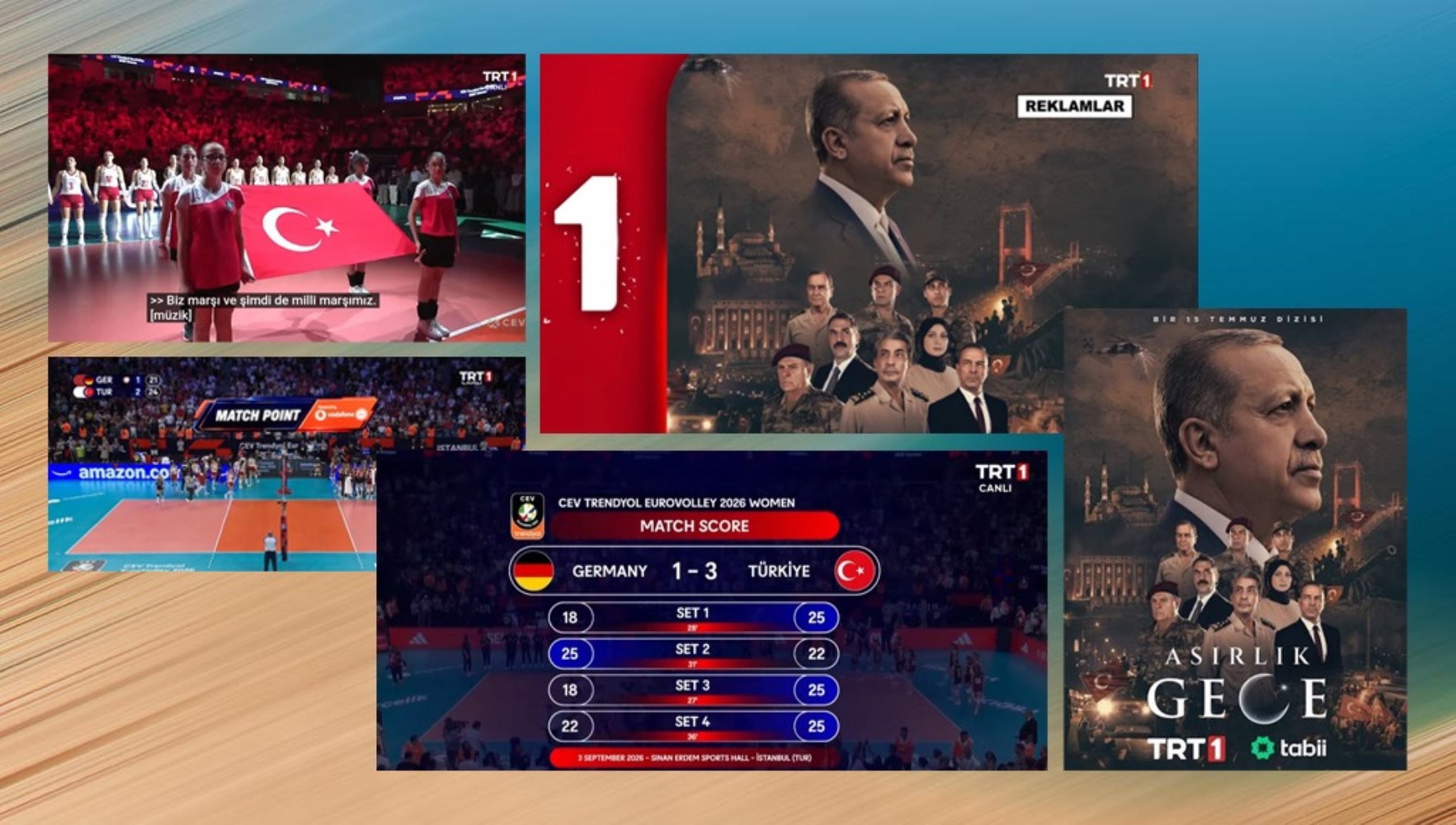
• TRT 1, which broadcast the A National Women's Volleyball Team's match against Germany, brought the poster of the “Asırlık Gece” series featuring President Erdoğan to the screen during every break, but the name of the series was not on the poster.
• Necdet Saraç, who has been serving as CHP Deputy Chairman for three months, did not remove the phrase “Journalist-Writer” from his social media profile—despite Zeynel Lüle's reminder.
• Sabah, in its news titled “Election game in Üsküdar by the New Party and CHP,” did not mention that the vote that the AKP lost was canceled by a court decision and that two municipal council members were detained.
• A Haber tarnished the memory of actor Serhat Kılıç, who is no longer in a position to respond, by reporting his death with the headline “Here is what came out of his house” and photos from the house.
• Akşam, in its news titled “Caught like a rat,” coded the name of the Iranian who was caught while hiding under the truck as S. P. S., but wrote the name of Arif Kocabıyık, who is known for his videos on YouTube and was caught with him, openly and published his photo.
• Ensonhaber, unlike many news sites, not only wrote that the burning electric vehicle was a Mercedes in its first report but also published a news piece titled “The incident in Aydın is not the first occurrence: Mercedes electric vehicles are burning away.”
FOR YOUR CRITICISM, COMPLAINTS, AND SUGGESTIONS: [email protected]
Most Read
Serdal Adalı wanted to show Erdoğan controversial plays!

Foldable iPhone is coming: The price will be jaw-dropping

Return dates for Osimhen and Lemina confirmed
NEW Party leader Özgür Özel has determined his A-Team!
Turkish language request for GTA 6 reaches Take-Two: Official statement expected
So there is a 'Good' and a 'Bad' terrorist organization after all!..
Government warning to DEM Party: 'Turkey's anti-terror laws have not changed!'

Are New Helsinki and New Westphalia processes possible in Europe and West Asia?
5th wave of operations against Ahbap Association!

Suing God