



Most of the reports claiming “Mustafa Balbay wanted the CHP to be shut down,” “He said the CHP should be shut down,” or “He said the CHP must be shut down” did not include the full context of the speech by Cumhuriyet columnist Mustafa Balbay.
Upon seeing Mustafa Balbay’s statements saying “I did not say the CHP should be shut down,” I found and watched the recording of the program on TV100. While evaluating the decision of the CHP and the New Party to act together in the deputy mayor election at the Üsküdar Municipality, Mustafa Balbay says the following:
“I think everyone has started to get to the essence of the matter. The main problem here is the use of the judiciary in shaping politics. We have seen this many times in our political history; the AKP is also a product of such a process. But there is also this reality: Even the worst decision is better than indecision or the inability to make a decision, leaving everything in limbo.
I am not wishing for it, of course, but I am saying this to explain the issue very clearly. If the CHP were shut down, everyone would have sat down and found a new path. A consensus of reason would have formed. What can we do? Different thoughts might emerge at first, but no matter what, everyone would have set out with a new formation.”
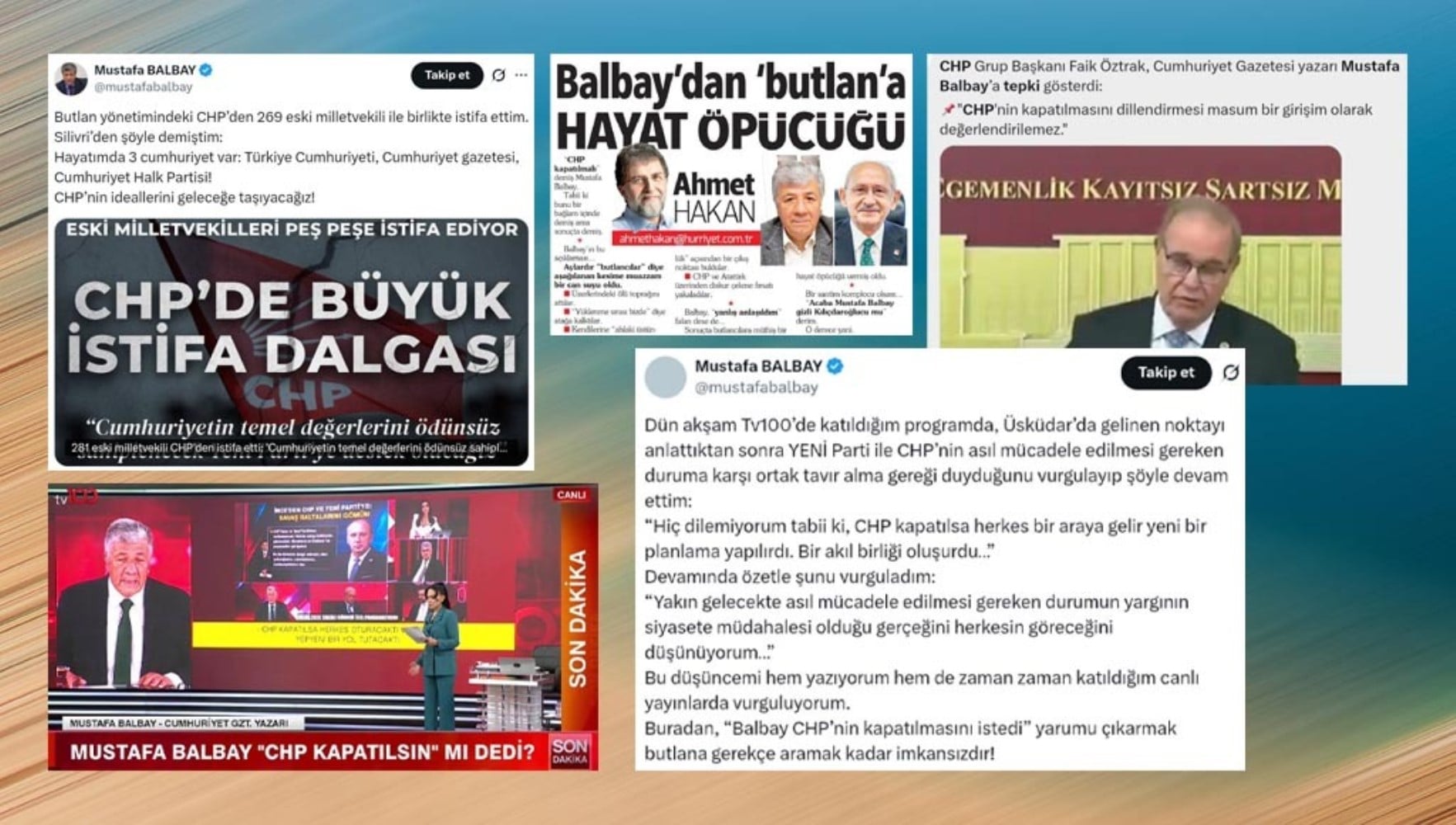
When watched in its entirety, it is understood that Balbay did not say “the CHP should be shut down,” but was trying to emphasize the severity of the current situation, implying that “if the CHP had been shut down, it would have been better than the current situation with absolute nullity.” Those who wrote that he “wanted the CHP to be shut down” distorted his words.
However, the biggest factor in the distortion and spread of these words and the growth of the debate is that Balbay carries a political identity alongside his journalism. Balbay had announced that he resigned from the CHP along with 269 former deputies after Kemal Kılıçdaroğlu returned to the chairmanship by court order, saying, “There are three republics in my life: The Republic of Turkey, Cumhuriyet newspaper, and the CHP! We will carry the ideals of the CHP into the future!” This statement was as much a declaration that he was maintaining his political identity as it was a political stance.
As such, it is inevitable that what he writes and says is perceived as political commentary. It would be beneficial for Mustafa Balbay to draw a thick line between journalism and politics to avoid becoming the target of such debates.
The deceased actor and the “criminal reporting” blunder
The first post titled “What was found in the home of the famous actor Serhat Kılıç, who was found dead” came from Doğan Can Cesur, who writes “Intelligence Police Correspondent” on his profile. Under this headline, he had posted photos taken by the police from Serhat Kılıç’s home.
This post by Doğan Can Cesur was soon followed by another “police reporter,” Emrullah Erdinç, and A Haber. They were also writing with almost the same expressions: “Alcohol bottles and paper used for rolling cigarettes were found in Serhat Kılıç’s home.”
Finding “alcohol bottles and cigarette paper” in a home has no news value. However, writing that these were found in the home of a deceased actor certainly has a very different meaning. The publication of the photo, which was understood to have been taken by the police by bringing in all the materials in the house, including plastic water bottles, cigarette papers, etc., and placing Serhat Kılıç’s ID card, created the perception that he died from drugs.
Publishing such posts and news full of insinuations before the cause of death was confirmed was a complete character assassination. Both journalists produced fodder for social media trolls with these posts; they paved the way for disrespecting the memory of Serhat Kılıç, who is no longer with us.
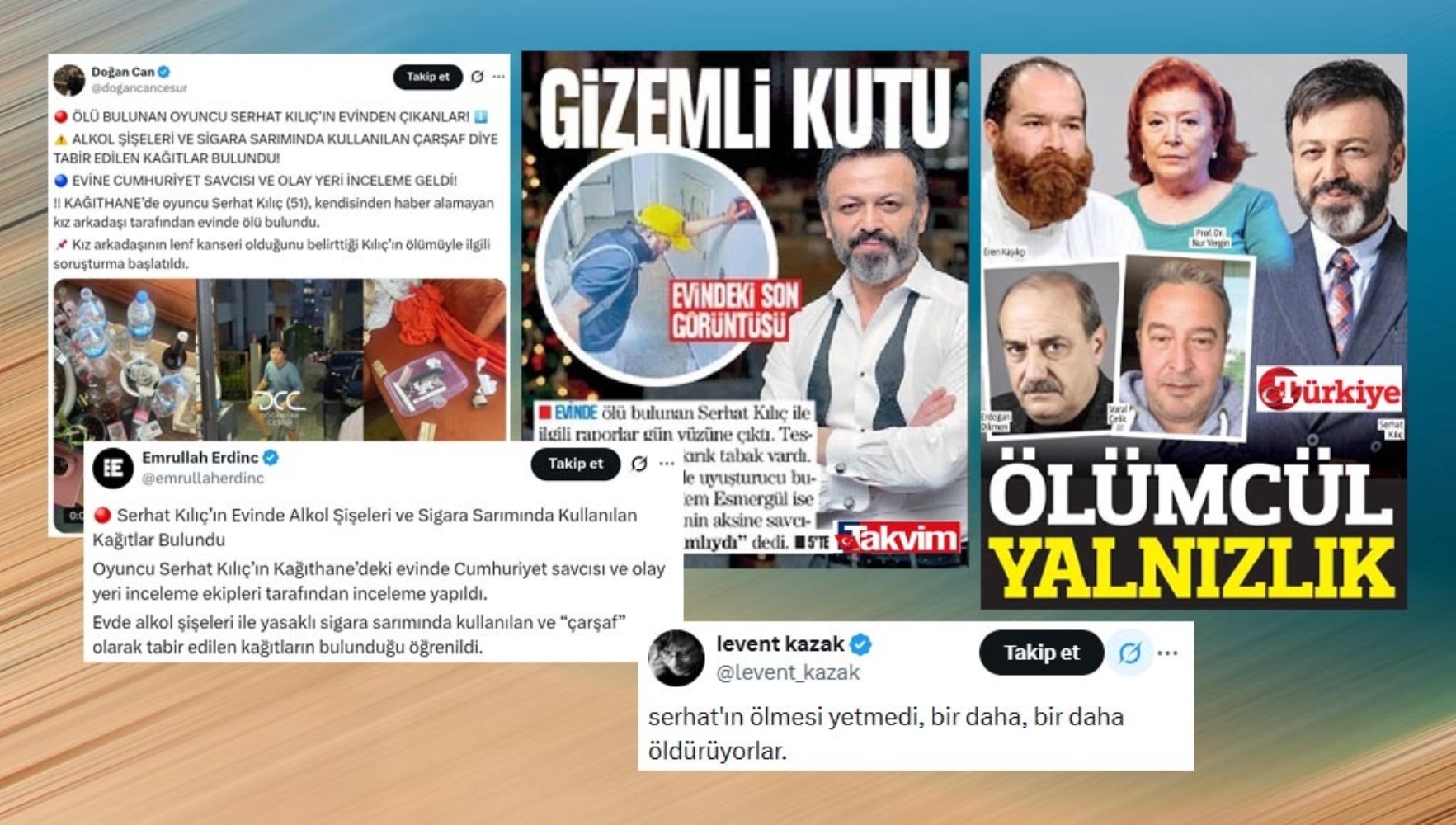
Yet, in journalism, disparaging expressions regarding anyone’s lifestyle are not used; especially when someone who has passed away is involved, even more care is taken. Because a person who is no longer alive is in no position to respond to those expressions and accusations.
Unfortunately, the reactions did not stop those journalists. Emrullah Erdinç even defended what he wrote by saying that “those who criticize these reports do not know criminal journalism.” However, there was no suspicion of murder in Serhat Kılıç’s death, so one cannot speak of a criminal report. Furthermore, even if a death is of a criminal nature, news is not written this way. Speculations are not presented as information, and rumors are not presented as verified data. Crime scene photos are not presented in a context that creates a perception.
Unfortunately, some media outlets also tried to prove the perception created regarding the actor’s death in the following days. Takvim and Sözcü wrote that drugs were found in the house and that his girlfriend, Özdem Esmergül, said in her statement, “I know Serhat used drugs.”
The Türkiye newspaper went even further, writing in the spot on the front page of its “Deadly Loneliness” report that “It is estimated that the artist, who had cancer, died from drugs!” But the phrase in the report that “the cause of death has not yet been finalized” contradicted that spot.
Journalists who write posts and news based on guesses and prejudices may have received a lot of interaction on social media by exposing the private life of a deceased person and trying to humiliate him, but they have damaged the reliability and credibility of journalism.
The happy result of the invited trip
Last week, praise for Hatay Governor Mustafa Masatlı and his wife suddenly began in the media; reports on how successful he was in erasing the traces of the earthquake in Hatay followed one another.
“The light in our hearts from the Hatay Governor and his wife” (Fatih Çekirge / Hürriyet), “Hatay is reborn from the destruction” (Mustafa Kartoğlu / Akşam), “Hatay’s economic map is being redrawn” (Necla Dalan / Patronlar Dünyası), “Hatay is born from its ashes” (Deniz Zeyrek / Nefes)
“Destroyed public buildings moved out of the city, their sites became reserves” (Vahap Munyar / Nasıl bir ekonomi), “90 percent of the transformation in Hatay is complete” (Barış Ergin / Sabah).
The headlines of the reports explain their content sufficiently. It seems that talking to Governor Mustafa Masatlı was enough for them to understand that the problems in Hatay were largely solved. Only Deniz Zeyrek included his conversations with citizens and their problems in his article.
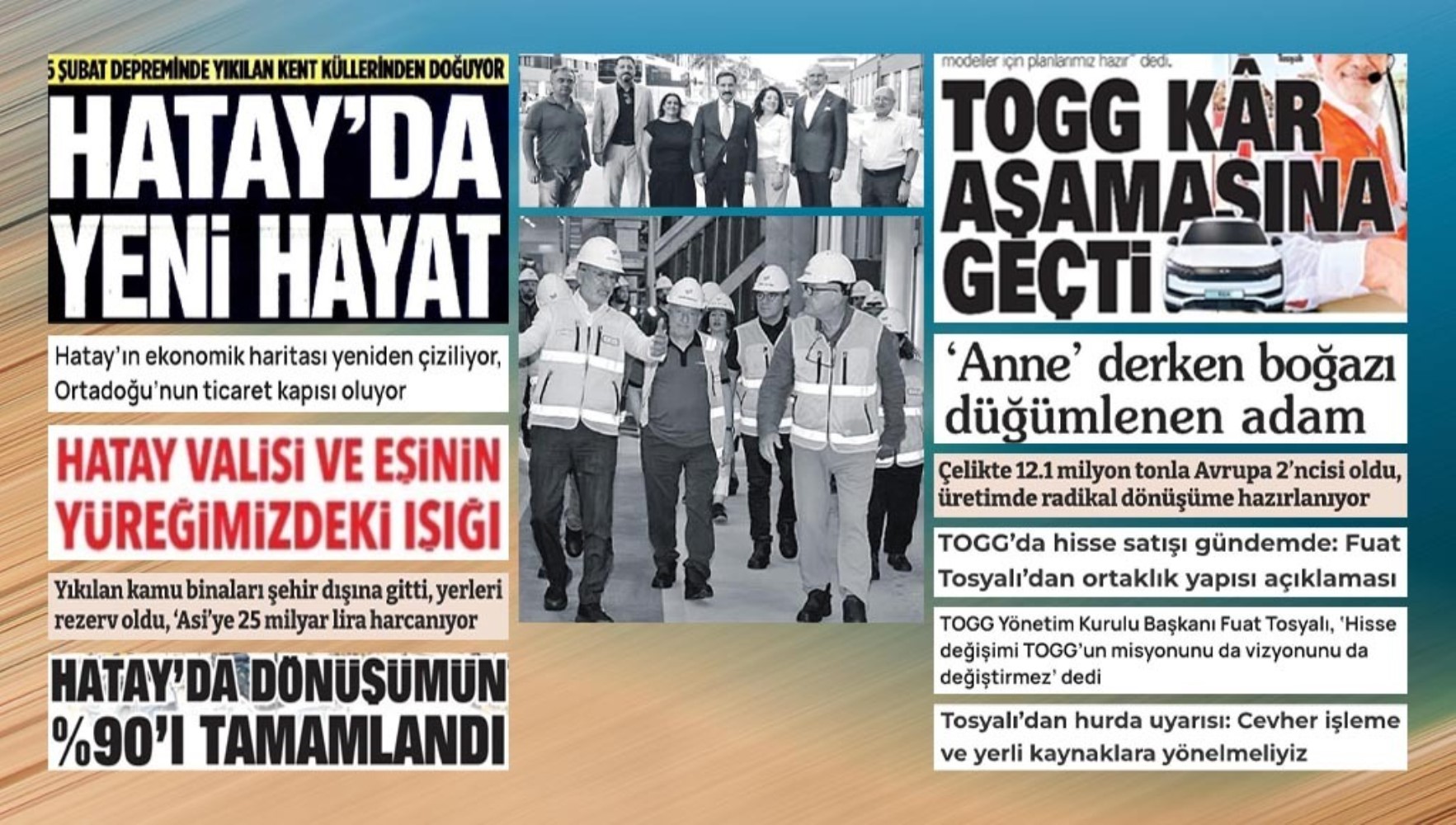
Following the governor reports, a series of reports written by the same journalists this time from İskenderun, centered on Tosyalı Holding Chairman of the Board Fuat Tosyalı, were published.
“The man whose throat tightens when he says mother,” “TOGG has reached the profit stage” (Mustafa Kartoğlu / Akşam), “From a handful of shops to a world steel giant” and “Fuat Tosyalı: TOGG is on the path to profit” (Fatih Çekirge / Hürriyet), “The cure for the risk of deindustrialization” (Deniz Zeyrek / Nefes), “Became Europe’s second with 12.1 million tons in steel” (Vahap Munyar / Nasıl bir Ekonomi), “Scrap warning from Tosyalı” and “Partnership structure statement from Fuat Tosyalı” (Jülide Yiğittürk / Dünya), “Share exchange does not change TOGG’s mission” (Necla Dalan / Patronlar Dünyası).
The group photos in these reports gave a clue, but the real information was between the lines of Vahap Munyar and Fatih Çekirge. It turns out that seven journalists had “gone to Hatay and İskenderun hosted by Tosyalı Holding, walked around there, and attended some events organized by the holding.”
If these journalist friends were curious about what was done in Hatay after the earthquake and the steel facilities in İskenderun, they could have gone on their own. There was no need for the holding to cover their expenses and invite them. They did not need to go there to talk to Fuat Tosyalı either.
When they accepted the holding’s invitation and were hosted in the city, they unfortunately acted in accordance with the holding’s purpose. This invitation, which was bad for journalism but successful in terms of the holding’s promotion…
The news value of divorce while in prison
Journalist Seyhan Avşar was the first to write on social media that Tayfun Kahraman, whom the Constitutional Court ruled twice was “not tried fairly,” and his wife Meriç Demir had decided to divorce. This information spread rapidly on social media and news sites…
However, there were many who reacted to Seyhan Avşar. There were those who argued that the spread of this information was a “violation of the family’s privacy.” Meriç Demir’s lawyers also made a statement saying, “Although we filed a lawsuit with a request for a press ban and a closed session, unfortunately, we could not protect the privacy”; they requested that “everyone approach the process respectfully.”
Seyhan Avşar responded to the criticisms by saying, “Does it not have news value when a well-known name who is currently in prison unjustly and unlawfully decides to divorce? Does it not show what those who are made to live through this cost?”
I agree with Seyhan Avşar. Tayfun Kahraman is not an ordinary person or an unknown prisoner. He is a political figure whose imprisonment for over four years on the grounds of the Gezi protests and the malicious treatment he received there are constantly on the media’s agenda. In fact, his being away from his daughter Vera during this time, her photos in front of the prison, and his wife’s efforts have always been news. They constantly conveyed what they experienced as a family to the public as part of their protests.
Therefore, the fact that the prison process brought this family to the point of breaking up also has news value. Media outlets also confirmed the news value by quoting what Seyhan Avşar wrote. A few days later, Tayfun Kahraman and Meriç Demir announced in their separate posts that they had ended their marriage by “making a joint decision.”
However, it is contradictory for Seyhan Avşar to share this development, which she thinks has news value, on social media instead of reporting it as news. It would have been more correct if she had written it as news and not used an expression that directs perception, such as “I encountered very sad news today.”
Now that the case is over and they have officially separated, it is necessary to stay away from the details regarding the divorce. Their divorce is news, but the rest is their private life. Everyone should step back…
In a single sentence:
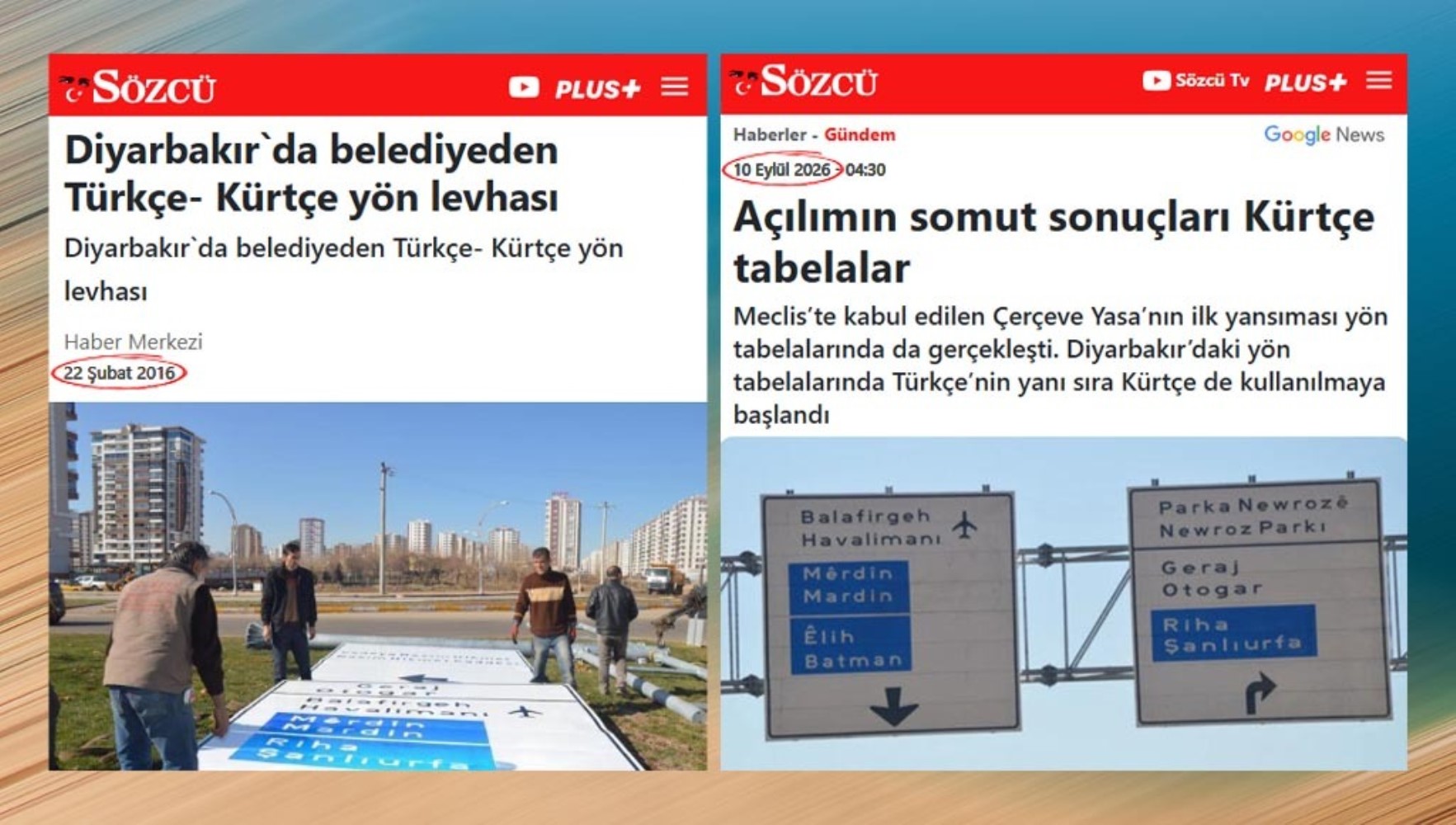
• In the report “The opening process continues at full speed: Kurdish signs, Zazaki lessons,” the Sözcü newspaper, which wrote that the Kurdish signs were newly installed, had reported the installation of these signs in 2016 as “Kurdish direction signs from the municipality in Diyarbakır”; the Kurdish signs had been hanging for 10 years.
• Journalist Selahattin Günday was arrested in the investigation into the death of MİT executive Kaşif Kozinoğlu in prison, with his journalistic activity from 15 years ago being accepted as a crime and a legal regulation that was not in effect at the time being applied.
• TV100 presented Ali Haydar Fırat, who participated in the program where political developments were evaluated, as a “Communication Scientist,” hiding that he was the “CHP Communication Coordinator.”
• While BirGün, Cumhuriyet, Hürriyet, Milliyet, Nefes, Posta, and Sözcü published a full-page advertisement for an e-sales platform on the same day with an “advertisement” warning, Akşam and Yeni Şafak published it without a warning as if it were news; Sabah even put a reporter’s signature on it as if it were an exclusive report.
• Karar headlined the news of Ahmet Davutoğlu being called to testify as “This is a first in the history of the republic,” but former prime ministers Bülent Ecevit had been tried for statements he made to foreign media during the September 12 period, and Necmettin Erbakan for his speech in Bingöl.
• In the report “The crying voice on the phone: This is how Üsküdar’s fate changed,” Sözcü wrote Özgür Çelik as “CHP İstanbul Provincial Chair” instead of the New Party; it has not been corrected for days.
• Yeni Akit did not even report on the A National Women’s Volleyball Team winning the European Championship for the second time and their meeting with President Erdoğan.
• The CHP gave its 103rd anniversary advertisement titled “Our path is clear” only to Nefes among newspapers, and digitally through Google to about 50 sites, including Ensonhaber, Halktv, Toplumsal Haber, Sözcü, Gazete Pano, İz Gazete, and Turktime.
• Akşam newspaper columnist Murat Çiçek, in his article “They cannot win without cheating,” ignored the AKP’s transfer of four CHP municipal council members and the arrest of two CHP members before the vote at the Üsküdar Municipality.
• Habertürk TV reported on Justice Minister Akın Gürlek’s meeting with “judicial reporters at the Istanbul courthouse” as if the ministry were an office superior to journalism, saying he “accepted” them.
FOR YOUR CRITICISMS, COMPLAINTS, AND SUGGESTIONS: [email protected]
Most Read
Footage of the moment Kenan Evren was sentenced has emerged

Increased rates for mandatory traffic insurance have begun

Leadership change at Katılımevim
Great reaction to the shocking demolition decision at Zeytinburnu Denizatı Kent Sitesi!
Allegations that a baby missing in Sivas was given away for money
Erdoğan: 'There is no situation where a villa will be allocated'...
Mehmet Şimşek makes statement on tax audits and high income

Plan for Scotland, Wales, and Northern Ireland to break away from the United Kingdom

From Gunboat Diplomacy to Sanctions

The problem is not Balbay’s words, but his identity