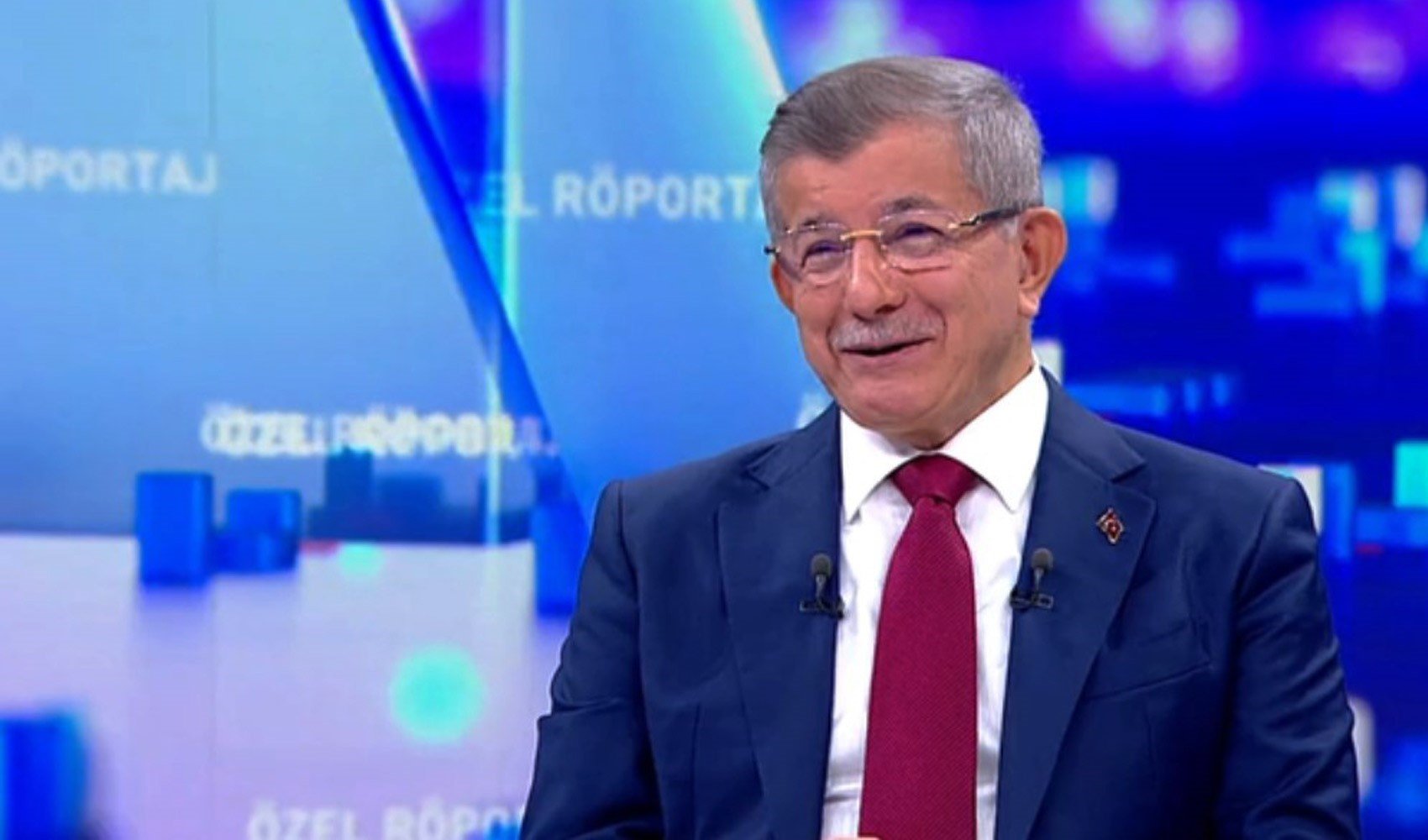
Davutoğlu made statements to Mehmet Akif Ersoy on Habertürk TV. The highlights from Ahmet Davutoğlu's statement are as follows:
"NO DIRECTIVE WAS GIVEN"
The AK Party has now completed 22 years. I was Chief Advisor for approximately the first 8 years of this, and Prime Minister in the second half. I have not been in office for the last 8 years. I have been gone for 8 years. When Turkey's opening to Africa is mentioned, it is recounted as Mr. Erdoğan's great success. It was also a period shared by Mr. Gül and myself. But when something is criticized, people say, 'Well, there is Davutoğlu's period.'
I have not shied away from criticism. During my time as Prime Minister and Foreign Minister, no journalist was ever given a directive saying, 'You can ask these questions, do not ask those questions.' Such a practice never existed. I have never told domestic or foreign press members, 'Do not let them ask these questions.'
When criticizing Davutoğlu, one should not damage Turkey's honor. Criticize me, but protect Turkey's honor. There comes a point in Syria and other areas where, while criticizing me, it reaches a point aimed at damaging Turkey's reputation. When criticizing me, do not forget that the entire Republic of Turkey state acted in unison.
"THEY DECLARED ME A TERRORIST"
My contribution as Chief Advisor was to create policy, develop strategy, and present these to our Prime Minister and our President. A striking example is the gathering of countries neighboring Iraq. The idea belongs to me, that is true. But the political will is shared. The state has a morality and a tradition. Those who take responsibility in the state should be able to stand in the line of fire when an attack comes.
I stood in the line of fire during the attacks on Mr. Erdoğan. I did not know about Khaled Mashal's arrival, but I never said, 'I didn't know.' It was being planned, he arrived early. I did not say anything so that pressure would not be put on our Prime Minister. The next day, the newspaper said to be the flagship of Turkey ran the headline, 'He Also Appeared Behind the Terror'; meaning me. They had declared me and Khaled Mashal terrorists. I could have sacrificed myself in any way. I was thinking of returning to academia a few years later. If a lawsuit had not been filed against the AK Party, I would have left within a month or two. I went to our Prime Minister and said, 'This is a war, and I will not leave you alone in war,' and I stayed.
We did this case not in Çırağan, but in Baghdad. It was done during our Prime Minister's visit to Iraq. The world is currently boiling. I am in constant contact with abroad. One wishes that we could talk about the future. The date is 2007, the Dağlıca raid had occurred, in November. Turkish-Iraqi relations had entered a crisis. A Kirkuk referendum was planned for December 2007. President Talabani said, 'I won't even give a cat.' Our soldiers had been martyred, Talabani was in a sense saying, 'We will not hand over the PKK members.' A referendum was to be held in Kirkuk. The TSK entered Northern Iraq on February 21. I went to Syria for a secret meeting with Bashar al-Assad. There was an MGK meeting in Turkey. Turkish soldiers and the Peshmerga were face-to-face, ready to draw weapons. Definitely, Mr. Erdoğan, myself, Bashar al-Assad, Walid Muallem, Olbert, and Turkomani were there. The US did everything to block this. The Neocons were in office in the US. They saw Syria as an 'axis of evil.'
After meeting with Assad, I was in Zaynabiyya. A call came from Turkey. Turkish soldiers were so close to clashing with the Peshmerga. Our Prime Minister and our Chief of General Staff, the late Büyükanıt, were holding a meeting inside. Headlines like 'Let's bomb Erbil' were being thrown in the newspapers of that day. My fear was that a Turkish-Kurdish conflict would break out; there was a risk of conflict between Iraq and Turkey. I went to Baghdad on February 26. I met with Talabani one-on-one.
I gave him a very clear message; Turkey will never make concessions to the PKK. If our soldiers have entered, you will take a clear stance. The Kirkuk referendum will not be held on your terms. I asked for it to be conveyed to Masoud Barzani: 'Turkey does not want conflict with the Kurds, but if weapons are drawn on our soldiers, it will be reciprocated.' I told Talabani, 'If you take steps regarding the PKK, we will take steps with you that history has never seen.' On February 29, our soldiers withdrew safely. On March 7, Talabani came to Ankara. This is how the High-Level Cooperation Council with Iraq was realized. The point we reached was that in Kirkuk, it should be 30 percent, 30 percent, 30 percent, and 10 percent for Christians...
The military was against Talabani's arrival. We went with Mr. Erdoğan in July. We gathered the cabinet with all the ministers and signed 52 agreements. We signed this agreement with Maliki. Maliki was our close friend. We always advised Iraq to have coalitions instead of Shiite and Kurdish party divisions. Iraq is being divided into three; it is being torn apart as Shiite, Sunni, Turkmen, and Kurdish Iraq.
In fact, when Allawi came to us after the Egyptian coup and made an argument as if Turkey was supporting the Ikhwan, I asked, 'We were behind you because you won the elections; were you a Sunni?' For us, it is important to support whoever wins the election democratically.
There are those who accuse Turkey of Ikhwanism in order to attack me. Turkey's policy was never pursued on a sectarian, denominational, or ethnic basis. What was the problem with Maliki? Allawi made a brave initiative and cooperated with Sunni parties. The Sunnis also accepted Allawi as the bloc leader. We found such a development healthy for Iraq.
"WHEREVER I WENT, I BROUGHT PEACE"
You see America and Iran as opposites in everything, right? Iran-US cooperation prevented this political unity that transcends sects. We had harsh arguments with Clinton and the US at that time. The issue was not the Maliki issue. In 2009, when Maliki and Assad reached the point of war, I went to Assad and, with the data I received from Maliki, we saved the two countries from war. But Iran and the US wanted the sectarian division of Iraq.
Well, who were Allawi's partners? Some are trying to bring out a behind-the-scenes man who starts wars, stirs up the insides of countries, and enjoys shedding blood. Wherever I went, I brought peace. Whenever there was a Sunni-Shiite crisis in Iraq, I was called and told, 'Please come.' Maliki was kept in power despite losing the election with Iran-US support. A very unpleasant thing happened between them in a phone conversation with our Prime Minister.
Events became tense due to Maliki's impolite attitude. This is a private matter. Sometimes personal things can be influential. Now, Davutoğlu has a paradigm. I gave this to my country. If I made a mistake, it belongs to me. If I hadn't accepted that I made a mistake, I wouldn't have left the AK Party.
The reason for the main perception formed about me goes back to the March 1 memorandum. I was an academic. I had given a promise: 'If there is a need, I am at your command, but I will never enter politics.' The Iraq intervention was on the agenda. The letter that came to our Prime Minister from the then-President Bush envisaged US soldiers entering the Gulf of Iskenderun. My stance was clear; I was never a supporter. While they were waiting for passage, we developed an alternative policy. We went to the region. The public does not know; I went to Syria secretly for the first time to meet with Bashar al-Assad. Then we held the Neighboring Countries Summit in Istanbul. This was seen as Turkey's axis shift and was attributed to me. At that time, Turkey's flagship newspaper ran the headline, 'Teacher, go back to school.'
An intelligence note came to me regarding a meeting held by an American who had served in Turkey with a deceased politician. This American was saying, 'Prepare to establish a political party as soon as possible.' Upon this, a Turkish official used an expression following the rejection of the March 1 memorandum, and I was called 'the most dangerous man in the Middle East.' I have explained the reason for the high-five 50 thousand times. Everyone has a way of celebrating. My grandchild was born that day. All the Arab ministers hugged me. Hillary Clinton said, 'I am also waiting for a grandchild,' and we high-fived. I am a man of Turkey. I am a Muslim Turk born in the Taurus Mountains. Everyone knows the struggle I gave during the March 1 memorandum period. I served as Chief Advisor for 7.5 years. In November 2005, we had gathered Iraqi Sunni leaders in Istanbul. We gathered the communities that were said to be 'going to wage jihad' and convinced the tribal leaders we brought one by one to enter the election. The Americans realized this: 'The country that finds a solution when Turkey is involved.' We did the right thing in the March 1 memorandum, and we did the right thing while getting the Sunnis into the election.
"I AM PROUD ON BEHALF OF MY COUNTRY"
We had a perspective regarding Iraq, and we should have it today as well. To protect Iraq's territorial integrity, not to see the Kurds as a rival and enemy. I spoiled the games that wanted to make Turkey fight the Kurds. The referendum that would destroy the rights of the Turkmens has still not been held in Kirkuk. If I had acted condescendingly, would Bashar al-Assad have seen me as the sole authority for Israeli negotiations? We made the ceasefire in Gaza; it was the beginning of 2009. That war had lasted 22 days. I spent 7 days in Cairo and Damascus. Sarkozy, an enemy of Turkey, called Mr. Erdoğan on January 4. 'As the EU term president, I will go to Syria and try to ensure a ceasefire. It is not possible for us to meet with Hamas. Would you send your Chief Advisor to our delegation?' he said. When I entered the hall on January 6, it was a historic scene. I am proud on behalf of my country. When I entered the hall, Bashar al-Assad and Sarkozy were sitting. When I entered, I said, 'Where do you think it is appropriate for me to sit?' Sarkozy said, 'The chief advisor of a country conducting the negotiation will sit in our delegation.' Assad said, 'He is as Syrian as we are, he will sit in our delegation.'
Maliki was Prime Minister, explosions were happening. Maliki said, 'Syria is behind all the explosions.' I said, 'Give me 1 week, please, we do not want to see Syria and Iraq face to face.' We wanted to establish a Mesopotamia Union. As Chief Advisor, I never used the phrase 'Greater Middle East Project.' I never wanted it to be used as a concept. The Greater Middle East project was the Neocons' project. The Arab Spring was because honor had been broken in the face of Israel, and there was a crisis that year, young unemployed people had poured into the streets. The democratic transformation that took place in Europe in the 90s needed to happen in the Arab world as well. Arab youth poured into the streets. You cannot see an Arab youth who burns himself as an American agent. You cannot see people who want reform in Syria as terrorists. If I have the opportunity one day, I will write about 2013. 2013 changed the axis of the Arab Spring.
If you try to portray the man who was 'the most dangerous' in the Middle East to America as 'America's man' later. Exporting democracy is not our duty. We never interfered in the internal affairs of any country. Only as they requested. When leaders requested something from us, we went and told them what we knew to be right. Many things changed and developed in the world after us. We tried to do what we knew to be right under the conditions of that day. We supported the new government in Tunisia. We supported it when it was elected democratically in Egypt. I mediated in Bahrain. Iran was defending democracy there. How can the EU come and say, 'It would be good if it were like this'? We had nothing other than friendly advice to the countries. Iran acted bilaterally, but Turkey never acted bilaterally.
"IF IRAN HAD USED CHEMICAL WEAPONS, THEY WOULD HAVE SHAKEN THE HEAVENS AND THE EARTH"
DAESH emerged in 2013. Where did it emerge? It emerged from American prisons. Ali Dabbagh had told me. Prisons were emptied one night in America. The government did nothing. Criminal types emerged. Against Sunni Arabs and Kurds in Iraq, in Mosul. Then it did not fight Assad in Syria. ISIS had no issue with Assad. If Iran had used chemical weapons, they would have shaken the heavens and the earth. Syria used chemical weapons in 2013, they did nothing. Because for America, the weaker the Syria, the better the Syria. Our advice to everyone during the process in Egypt was this: not to nominate candidates during the transition process. This happened in 2012. I said that the Ikhwan should not enter the Presidential election.
There are some things that even if your policy is correct, it may not show its effect when some factors change. Let me express clearly in our Syria relations, these are the relations I attach the most importance to. I made my first secret visit to Syria. We are a new government, the US had accepted Syria as an 'axis of evil.' Therefore, official contacts between Turkey and Syria were not welcomed warmly. In that visit, we had long conversations with both Bashar al-Assad and Farouk al-Shara. I told them, 'There is a new government in Turkey, we will establish the most intense relations with you.' At that time, Assad was not a Sunni, there was no democracy in Syria, there was a Baath regime.
We need to see this: when Syria and Iraq were handed over by colonial administrations, they were handed over to minorities; we need to see this. This is a conscious policy. In Syria, administration was given to the Alawite minority. This is the tactic of colonialism. A structure formed in Syria over time. In Iraq, Saddam filled all the cadres with Sunnis and Arabs. In Syria, 85 percent of the intelligence, economy, and army of that place were Alawites under Hafez Assad. I am not saying this with a sectarian motive.
We did not tell Syria, 'You be Sunni, be democratic.' Bashar al-Assad had no problems with Turkey while he was at peace with his own people. Is it right when an Iraqi or Egyptian requests it, but not when the Syrian people request it? We wanted to keep Syria out of this wave. We also opposed the intervention against Gaddafi in Libya. We tried to convince Gaddafi until the end. When he bombed Benghazi and Misrata... A state does not bomb its own people from the air. Whoever does it is a tyrant. We need to be consistent on this issue. We did our best in Sudan as well. I know that some work is being done right now. We opposed the intervention in Libya. There was a teleconference between 4 countries: the US, England, France, and us. March or April 2011. There is something I said at that time: 'If you intervene in Syria in the same way, know that you will find us against you.' We evacuated 25 thousand people from Libya within a week. This is state power. Until not a single Turk remained; even citizens of other countries.
"TURKEY DID NOT INTERFERE INSIDE SYRIA"
Our position was clear. We had a meeting with Syria on April 4. In fact, there was a friendship dam opening in February. Mr. Erdoğan was also there at that time, we sat down and talked. We said, 'Let this wave not hit Syria.' If there is oppression somewhere, there will be opposition. We tried to bring them and the Americans together so that the problem with Iraq would be solved. We also tried to bring the regime and the opposition together in Syria. The regime you call Syria has produced its own opposition. If the massacres committed in Hama and Homs have been repeated, isn't it normal for an opposition to be born?
When I went on April 4, when we went with Mr. Erdoğan, we always said, 'Please do not use your army! Let us give you police equipment, let us give you tear gas,' we said. 'Okay,' he said, we sent the equipment. How did the month of Ramadan pass in Syria? There was nothing left standing in Hama. Such a regime is right next to us. The reason for the arrival of refugees is that their own regime applies these pressures. Turkey did not interfere or anything. I said, 'Let a region be formed up to 5 km deep from our borders, let us not take the refugees to Turkey.' It was not accepted at that time. Turkey did not interfere inside Syria.
Assad stayed there, but Syria was razed to the ground. Today, in the face of those responsible for these events, there is Iran, which did not accept to work with us. Syria and Assad are weak today. Turkey had an EU perspective, it had rising prestige. Assad wanted to walk with Turkey. Iran wanted Syria to maintain its structure. We said we want a strong, undivided, and integrated Assad with his people. Chemical weapons were used. A social democrat friend asked the other day, 'Why did the people rise up in Syria?' I gave a very simple answer: 'What would you say if it were said now that no party other than the AK Party and the People's Alliance can be established in the constitution?' I said. 'I would rise up,' I said. It is like that in Syria too.
There is a President, Prime Minister, and Chief of General Staff of Turkey that day. Was border control in my hands? I said, 'I brought peace, not war, to the place I went.' I went to Baghdad and prevented a war, I prevented an Iraq-Syria war. Events started in Kyrgyzstan, we united the Kyrgyz groups on October 2, we sent them to the election together. We ensured peace between Serbia and Bosnia. The AK Party government is currently using the successes; they should use them, that is the success of the Republic of Turkey.
We had helped as much as we could so that the Syrian regime would not face such a result. Cutting off relations with Syria is not my decision. I did what was in the interest of the Republic of Turkey. I took Mr. Gül's letter and Mr. Erdoğan's verbal message to Damascus. Mr. Erdoğan's message was this: My brother, Syria is heading towards a great risk. Do not bomb mosques on a day of Ramadan, do not raze cities to the ground. Do not use your army against your people. Do not create refugee pressure on us. Make peace with your own people. Sit and talk with the opposition you deem appropriate...
"WE MUST CLEARLY DEFEND DEMOCRACY"
In 2011, because most of the commanders were Alawites, they gave the order to operate to mid-level Sunni commanders. They took their weapons and fled rather than operating on their own villages. That became the Free Syrian Army. I had reported it to our President and our Prime Minister upon returning from Damascus. We evaluated the Hama observations. Until the groups supporting Bashar al-Assad raided Aleppo and our embassy in Damascus. Syria being in weakness today is not to Turkey's benefit. It is necessary to sit and talk with Syria against a common enemy.
I have not held any position on this issue for 8 years. In 8 years, Turkey-Egypt and Turkey-Syria relations could have improved. I wanted to be involved in the mediation mission in Cairo. At that time, our Prime Minister's stance was towards 'we must clearly defend democracy.' I never saw the coup as legitimate. It is necessary to improve relations honorably, not as if begging. The Turkey-Egypt-Iran trio needs to be in close contact with each other. It is discussed on a topic-by-topic basis with the Assad regime. What I do not approve of is that the President of the Republic of Turkey does not request a meeting from the President of Syria. Its infrastructure is formed, all institutions meet, and steps are taken together. The issue that hurts my pride is the approach of 'we will meet if you do this,' which does not befit the Presidency of Turkey.
We were the ones who ensured the ceasefire in Gaza. In 2009, there was Mubarak in Egypt. Hamas had a trust issue. It was Turkey that convinced Hamas to a ceasefire. We convinced Hamas with Walid Muallem. Mr. Abdullah Gül announced the bilateral ceasefire. Hamas was close to the Morsi administration. There was a trust issue between the Morsi administration and America. The 2014 ceasefire was ensured by Turkey-Qatar-USA and Egypt.
After the French revolution, counter-revolutions were experienced even in France. Muslim societies have big problems; at their foundation is autocracy. I cannot reject the spiritual heritage of so many innocent people. The Arab Spring was exploited by America and Russia. Did Turkey start the Arab Spring? Change happened in Tunisia, Egypt, and Yemen, and then we went. Were we not going to establish a relationship with Morsi, who came to power through elections? I talked to everyone from February 2011 to June 2012. I said, 'Do not nominate candidates, nominate a coalition.' I said, 'Form a single front.' If there was a suggestion other than Turkey, you will ask others.
I would do exactly the same thing now as I did after the 2006 Lebanon war. We had an intense Lebanon contact. We had gone with Mr. Abdullah Gül. Afterwards, we developed such a policy in Lebanon that the Lebanese President was elected through our mediation, and Mr. Erdoğan was hosted in the Lebanese Parliament. How did we get there, then? Because we went to Lebanon. We had a relationship with Israel in this sense. When the Israel-Syria negotiations started, we had two conditions for Assad and Olmert. We told Assad, 'Lebanon will be calm,' and we told Olmert, 'Gaza will be calm.' Has anyone gone to Lebanon these days? The French Foreign Minister went. It is meaningful for France to go as an old colonialist, but why is it meaningless for the Republic of Turkey to go? When you go, you show your presence. The world will say, 'Turkey is playing a role here.'
"THE MAN DID HIS SHOW"
Sisi came to Turkey recently. Meetings were held in Ankara. Netanyahu made a press statement at the same hour. The whole world gave it, the man did his show. No one in the world was curious about the meeting in Ankara. The biggest issue right now is being owned. Some want their own troubles to be worried about. Israeli strategy was based on Netanyahu's message: We are actually fighting Iran. I want the friends in the state to do this right now. Take the map in front of you; where would crises break out in case of possible expansion? Do not evaluate the Russia-Ukraine war only with Russia and Ukraine. Israel turns to Arab countries and says, 'Iran is threatening you.' Turkey is not a country that has boarded the wagon of Arab countries. We were successful because we followed our own unique policy outside of Arab countries.
Netanyahu spoke in the US Congress. I made a call: 'Let Ismail Haniyeh also speak in the Turkish parliament.' They were going to wage a war because of Ismail Haniyeh's Iran connection. It is necessary to show the world that Lebanon is not just Hezbollah.
I see a risk for Turkey the moment a regional war spreads. If Mr. Erdoğan has influence in the region right now, which I believe still continues. It is necessary to take some measures to reduce tension. We had established the Turkey-Iran-Azerbaijan trio. It is the time when it is needed most right now. There are very serious signals of operations towards Iran after Lebanon. To show that the region is not ownerless against Israel. This is the first image. Why is the French Foreign Minister going? He has an interest. Why is the Turkish Foreign Minister not going? In 2007, Ahmadinejad went to Saudi Arabia through our mediation. The Gaza crisis cannot be solved without Egypt being involved.
"MR. ERDOĞAN'S REPUTATION IS TURKEY'S REPUTATION"
I am a servant of this nation, I want this state to rise. I offered an action plan four or five times last year. Mr. Erdoğan's reputation is Turkey's reputation. I raise my opposition to moral decay and public order problems. I thanked Mr. Bahçeli. Mr. Bahçeli's stance was important while the opposition was defining Hamas as terrorism.
If the state needs me, I am here; if the nation needs me, I am here. I also meet with Mr. Bahçeli. There is no obstacle to this. What those in power should do right now is this: Israel's strategy is to pit Arab countries and Iran against each other, and if possible, Turks and Kurds, Arabs and Persians. Especially against the possibility of using the Kurds in the region, it is correct to revive these relations both within Turkey and in the region. Mr. Bahçeli's statements are meaningful.
Someone asked me, 'If you were to rewrite 'Strategic Depth,' what would you review?' I said, 'Psychological factors' at the beginning. It is necessary to evaluate political vision, will, and psychology together. Turkey's problem right now is a public order problem. It is necessary to eliminate the disarray of politics. My coming together with DEVA, Saadet, and Yeniden Refah is valid today as well.
News Source: 12punto