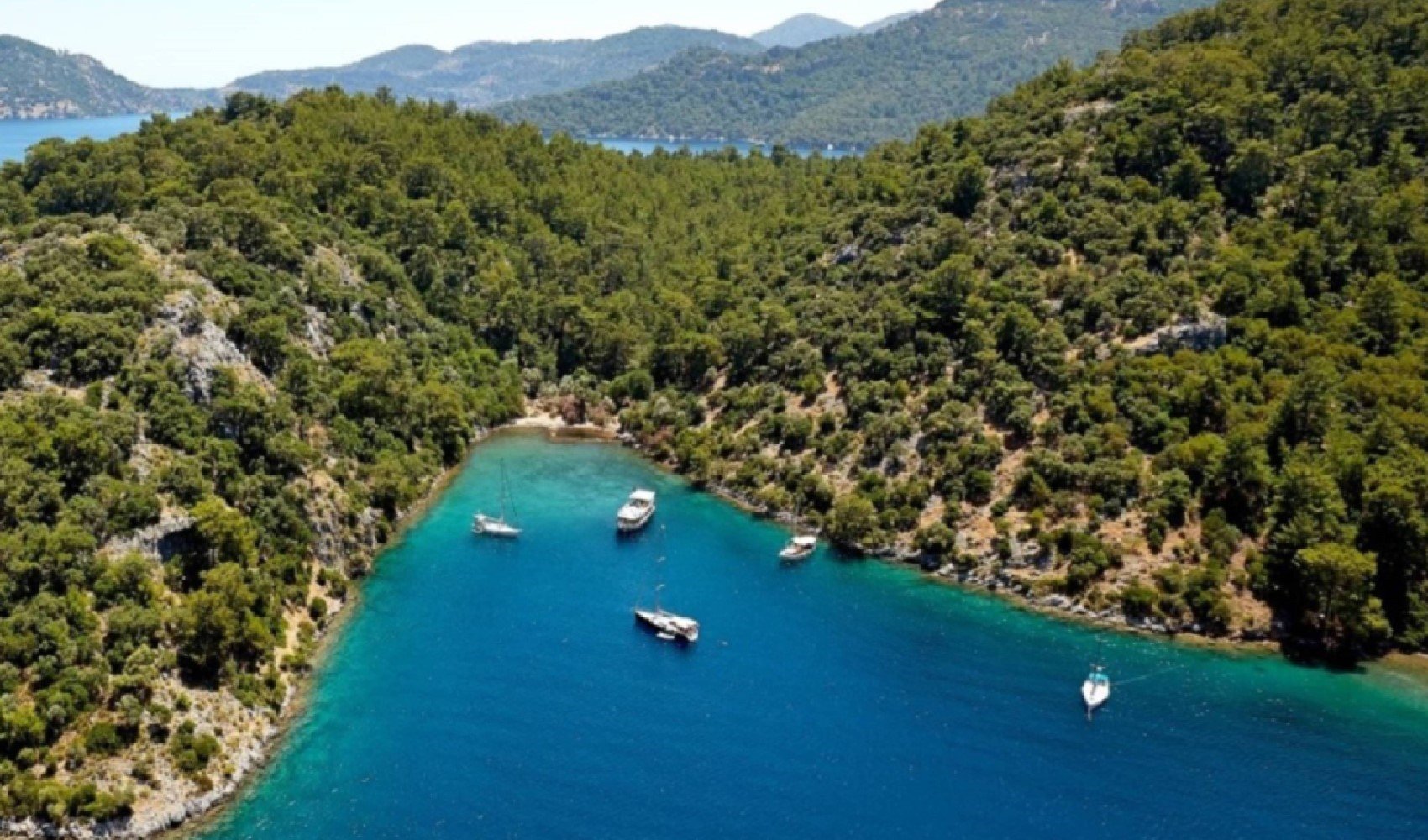
The Ministry of Environment, Urbanization and Climate Change, through the Muğla Environment Foundation (MUÇEV), has stepped on the gas for a new plunder of nature. Despite all objections, a tender announcement has been made for the yacht marina project planned for Ayten Bay in the Göcek district of Fethiye, Muğla. Accordingly, a tender will be held on February 3, 2025, using the bargaining method to operate the region as a yacht marina for a period of 10 years.
In the announcement published on the official website of the General Directorate for the Protection of Natural Assets of the Ministry of Environment, Urbanization and Climate Change on January 22, the protection status of Ayten Bay was also included. The announcement contained the phrases “Within the Fethiye-Göcek Special Environmental Protection Area and 1st Degree Natural Protected Area.”
On January 21, 2025, the Project Introduction File (PTD) for the Establishment and Operation of Mooring Buoy Systems in the Göcek Dalaman Bays was published on the Ministry of Environment's EIA announcement list. According to the report by Ali Boratav from Gazete Oksijen, the project description in the PTD is exactly as follows:
“With the project; it is aimed to bring the area under control to prevent visitors from damaging the environment, to meet the needs of visitors, to protect biological diversity and environmental values, and to prevent pollution in order to protect the environmental values possessed by the Göcek Gulf and to resolve existing environmental problems. As a result of the studies conducted, considering factors such as bottom structure, depth, geographical location, boat/ship maneuvering areas, maritime traffic, allocations in the bays, etc., service will be provided to a total of 864 boats in 20 bays across an area of 805 square kilometers, with 918 mooring buoys, 857 anchors, 891 buoys, 2 floating pontoons (platforms), and 22 service pontoons.”
The rest of Ali Boratav's article continues as follows:
"It was a project we were expecting. It has finally emerged. Of course, with its question marks and problematic aspects. Let's look for answers to these questions together:
Question 1: Will the project regulate the conditions for using Göcek, or will the Göcek bays turn into a giant marina complex?
There is a statement in the first pages of the PTD submitted by TUÇA to the ministry:
“In the current situation, the total mooring number of other marinas and piers located and planned in the Göcek Gulf is 1,142. The total general capacity in the Göcek Gulf will reach a mooring capacity of 2,006 boats.”
In other words, the subject is defined from the beginning as 'marinas + bays = total mooring capacity of Göcek'. This means the bays are also a kind of marina, a shelter... Yet, sailors primarily want to know how they will be able to use the bays when this project is completed.
Question 2: A period of paid accommodation will begin in the Göcek bays. This is certain. But what kind of pricing will there be?
The previous Minister of Environment, Mehmet Özhaseki, had said, “There is no free use, boats will pay 100 euros to stay overnight.” Sailors rightly asked, “Will every boat pay 100 euros?” After all, one boat is 2 years old and 40 meters long, while another is 20 years old and 10 meters long. One is worth 60,000 euros, the other 6 million euros. Will they both pay the same fee?
Question 3: Will commercial yachts (gulets) pay a fee? What kind of fee? Where will daily tour boats dock during their trips? At a buoy? Or will they anchor? Will the people of Göcek and Dalaman benefit from the sea for a fee? What about the fishermen?
These questions are the most critical issues for the region, sea workers, and maritime operators. During the previous failed tender period, the people of Dalaman and Göcek vehemently objected to the possibility of those residing in Göcek having to pay to use the bays. They stated that this sea is the sea they inherited from their ancestors, like ancestral land. Daily tour boat cooperatives rebelled. Gulet operators (this also falls under the Chamber of Shipping) went as far as to say that the tender had nothing to do with them. So, will a modest amateur sailor who is a retiree and does not have the power to pay a 100-euro fee for an overnight stay (as the former minister said) not have the right to benefit from Göcek? What kind of equality and justice is this? Or will a 'green card' system start at sea as well?
The PTD does not have the answers to these three questions. It is merely stated that an operating system project has been prepared. But the maritime public is mainly curious about the answers to these questions.
Question 4: What kind of boats is the project intended to serve? How was the distribution of type and size determined?
There was a major deficiency in the 2022 tender specifications. A single type of anchor was offered, and these anchors were suitable for serving boats up to 20 meters. In the 2025 PTD, 3 types of anchors ranging from 2 to 11 tons in weight are defined according to different boat sizes and weights. As can be seen in the site plans I have attached for large boats (for example, Domuz Island), the placement has been made on the open sea sides of the bay. (Figure 1)
The first problem here is this: There is a category called 'small boats'. It is described as 8-20 meters. In no sea in the world are 9 meters and 19 meters put in the same category. The former is mostly a modest amateur sailor, the latter is mostly a huge motor yacht.
The second important problem is this: The project envisages serving 27 superyachts over 40 meters and 358 megayachts between 20-40 meters in size. So, how were these numbers determined?
60 percent of the planned bay boat mooring capacity has been allocated to megayachts and superyachts over 20 meters. While imagining the density of large boats in the bays, also take into account that 182 very small boats are planned to be moored to two floating piers between the marinas in front of the city of Göcek.
(Note: The problems are endless. One of the floating piers where very small boats are planned to be moored is placed right on top of the underwater ruins of the ancient Lycian city of Kallimache in Göcek Harbor.)
As far as I know, the latest scientific data we have is from 2007 (the Göcek bays carrying capacity research conducted by METU). In this research, the number of small and medium-sized (under 20 m) boats is roughly around 95 percent. Of course, boat sizes have grown a lot in the 18 years that have passed, but the projection in the PTD is very strange. If there is a new study, why wasn't it explained in the PTD? (Table 2) Or should the fundamental question be changed to: Is the goal for the Göcek bays to become a mega and superyacht marina?
Question 5: Who will make the investment? And who will operate this giant project?
The project owner in the document appears to be the Presidency of the Turkish Environment Agency (TÜÇA). TÜÇA was established in 2020 under the Ministry of Environment with the goal of establishing and operating zero-waste and deposit management systems. Following the failure of the Göcek bays tender in 2022, an additional article was added to the law regulating the establishment of TÜÇA, stating that the presidency “installs and operates anchor and buoy systems in places under the state's rule and disposal – in the bays.”
The PTD states that the cost of the project is 150 million liras and the construction period is 6 months. The institution that will make the investment and operate it also appears to be TÜÇA. However, the second addition made to the establishment law in 2022 is as follows: “The Agency may carry out these activities by establishing companies with private legal personality or by becoming a partner in companies, if necessary. The Agency's partnership in companies is decided by the President.”
In other words, just like in the leasing of MUÇEV marinas and beaches, which have transparency issues, different – and private – companies can also get involved. In the MUÇEV example, businesses far from transparency, such as partnerships, subcontractors, and tenants, which were the subject of intense criticism, had started this way.
Question 6: Is there a connection between TÜÇA and MUÇEV?
There is and there isn't. For example, bays such as Osmanağa, Ayten, Atbükü, Günlüklü, and Eğriçam (İnceburun) in Göcek were allocated to MUÇEV in 2023, and MUÇEV leased these bays to third parties. But it is seen in the PTD prepared by TÜÇA that these bays – except for Ayten Bay – will be included in the new system. We do not know how this commercial confusion was resolved.
Another more interesting connection is this: The former president of TÜÇA was Mahmut Kaçar, a former AKP Şanlıurfa MP, who is still the chairman of the board of directors of MUÇEV A.Ş. Mahmut Kaçar handed over the presidency of TÜÇA to Prof. Dr. Ferhat Pirinççi, an expert in international relations. Pirinççi is known for his work, especially on the Middle East, in think tanks that have been popular in Ankara in the last 20 years, such as SAM, ORSAM, and SETA.
Question 7: Have improvements been made in terms of environmental protection in the project presented by TÜÇA compared to projects in previous years?
The file contains a lot of environmental structure information about Göcek. For example, living birds, mammals, sea and land creatures whose species are at risk in terms of IUCN, noise management, what will be done with waste batteries, earthquake risk map, climate conditions, sea salinity rate, etc. But there is no explanation in the PTD on critical issues such as waste collection from boats and bays, where/how the management team will work, and the number and size of coastal facilities. I suppose these will be included in the operation project.
However, there is an example bay layout drawing. In this drawing, we see a layout plan that is literally beyond dire. A road has been opened into the forest. In the same drawing, we see 5 buildings on the seaside – where trees also have to be cut down in some areas. Already, among the construction machinery listed in the PTD, there are 5 trucks. If the trucks are going to carry materials to the bays, it means roads will also be opened in the forest. (Figure 2)
(Note: PTD p: 157- “Within the scope of the planned project, trucks, transit mixers, concrete pumps, loaders, excavators, and mobile cranes will be used inside and outside the facility.”)
We cannot understand from the PTD where this concrete pump and transit mixer will be used.
A small marina operation in every bay... So where will the electricity be supplied from? A solar energy system cannot be installed in the vast majority of these bays. Is there an explanation in the PTD? No. (Figure 2)
Another issue: We understand that TÜÇA insists on continuing a mistake from projects in previous years. Different sizes of anchors are defined in the PTD according to boat size and weight. But all of these are concrete anchors. Two holes are opened in them and they are called nature-friendly concrete. The 'friendship' part is this: “Baby fish will hide inside.”
Yet, there are many plants and rocks in the sea where baby fish can happily hide. It is impossible to understand why we are still far from the nature-friendly metal pile anchor system.
Continuing on the subject of anchors: There are 112 5-ton anchors thrown into the bays in Göcek 15 years ago. They have no ropes or buoys, but the concrete anchors are standing solid on the bottom. These 112 existing anchors are not mentioned at all in the PTD. Cannot sea bottom protection be done by using existing anchors? Will TÜÇA protect our seas by throwing tons of unnecessary concrete masses on top of them?
Question 8: What do the site plans say? Are the mooring numbers in the bays well-designed from a maritime perspective?
There are a few problems. First, as can be easily seen in the example site plans I have attached, mooring for large boats is envisaged not in sheltered bays, but in parts of the gulf that can be considered open sea. A significant portion of these are very uncomfortable, and sometimes dangerous, especially during the hours when the meltem wind intensifies.
Even a person who has been out to sea in Göcek twice would be speechless when they see these plans. Example: The northern shores of Tersane Island, the northern shores of Killebükü, the eastern shores of Yavansu, the western shores of Domuz Island…
Second, there are some obstructions. For example, boats have been moored to TÜÇA anchors at yacht stopover points such as Göbün, Küçük Sarsala, Bedri Rahmi, Zeytin, and Manastır Adaia, on top of piers and docks. Are those who make and approve these site plans not aware that there are 6 legal yacht stopover points in Göcek? Or will our yacht stopover points, which also have lease agreements with the Ministry of Forestry, become history?
Three: In some important regions; for example, the western shore of Büyük Yassıca, Küçük Hurmalı (south of Sıralıbük), Binlik
(Kuyrucak), and Kurşunlu bays; anchor buoys have not been placed in a significant part of Bedri Rahmi… Why?
Or are the areas left empty in the site plans to be allocated to different and more frightening projects?
Question 9: Is there another parallel agenda?
It seems so… The project introduction of TÜÇA was published on the Ministry of Environment's e-EIA announcement page on January 21. On January 22, it was announced by the Ministry of Environment that the tender for the 10-year yacht mooring place for Sıralıbük (Hurmalı) Bay would be held on February 3, 2025.
In other words, in addition to the TÜÇA project, it is understood that another process is starting in Göcek. The tendering of some bays with a mechanism similar to the one in 2022. A bay tender has started right now. We do not know if there are other bays in line.
Sıralıbük (Küçük Hurmalı) is a bay with a magnificent sea and an incredibly beautiful nature; it is a small valley whose slopes are covered with pine forests. There are 2-3 palm trees right in the middle of the shore, which is where it gets its name. A 17,831-square-meter area in the coastal region of this unique bay will be leased for 10 years using the bargaining method. A base price (lower limit for bargaining) of 10 million 115 thousand liras has been set for the first year.
Question 10: Are the technical specifications of this yacht mooring place clear?
In the tender announcement, it is stated that the area has the status of a 1st degree natural protected area and an SEPA (Special Environmental Protection Area). Although it is defined as a strictly protected natural site area, a sea fill is envisaged for the northeastern part of the coast. Two piers with a total length of 350 meters have been planned on the western and eastern shores of the bay, facing each other. An average of 70 boats of average size can easily fit into a pier area of this length.
It is not specified in the technical specifications, but as in the 2022 example, the investor may be granted the right to 2-3 buildings and a restaurant at the bottom of the bay. The specifications state, “The facility will be built according to the zoning plan.” But it has been stated that the zoning plan will also be prepared by the investor and submitted to the administration in an interesting way (Technical Specifications p: 2).
A road to Küçük Hurmalı is very difficult; all the trees on the steep slopes would have to be cut down. In that case, a lot of buildings are needed for the workers. Additionally, if the investor also wants a boutique hotel that respects nature in the zoning plan proposal, it would be even more interesting."
News Source: 12punto