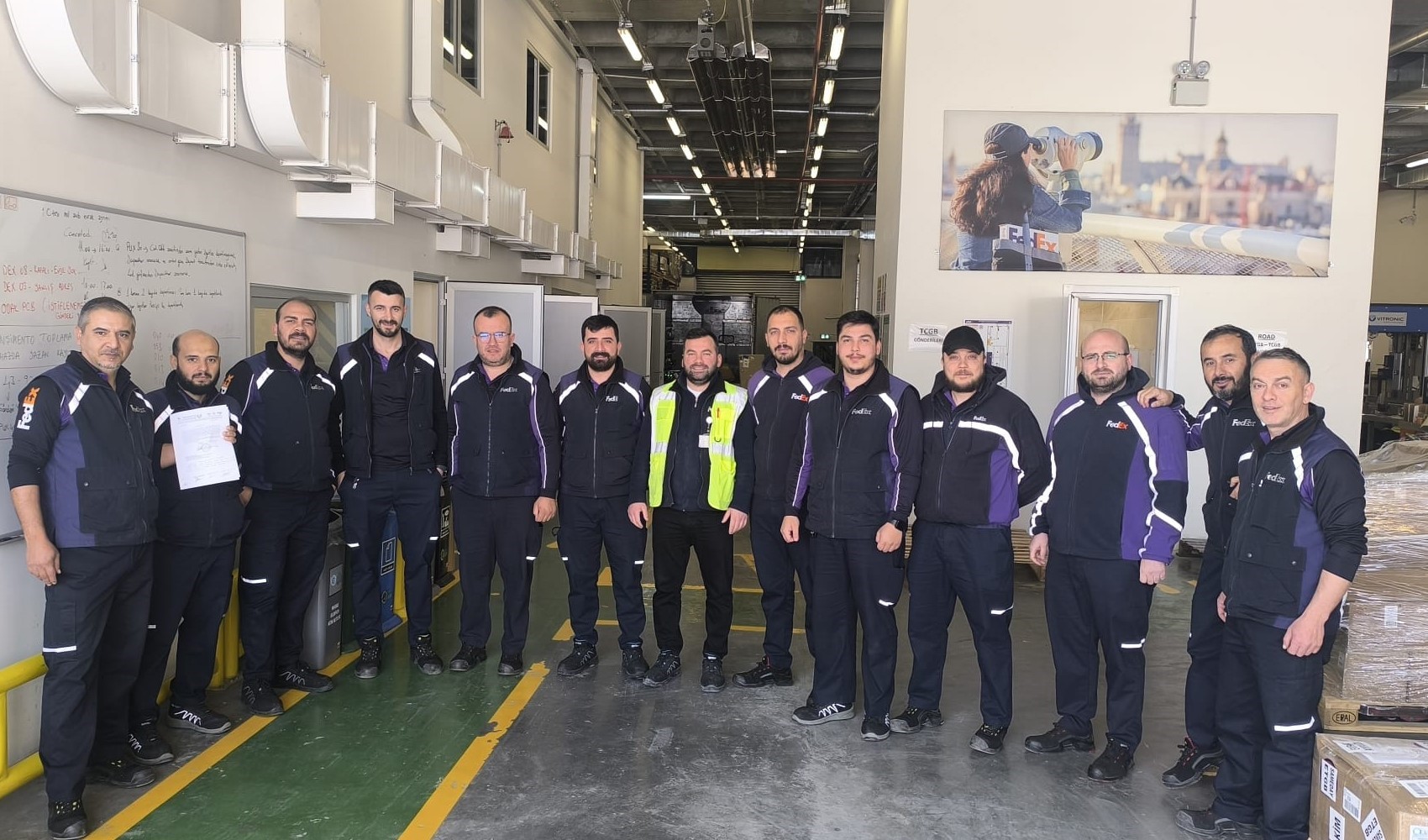
At FedEx Express, one of the world's largest cargo companies based in the United States, where approximately 900 workers are employed in Turkey, the third-term CBA negotiations have reached the point of a strike after no agreement could be reached despite the process moving to the mediation stage.
‘THERE HAVE BEEN PROCESSES WHERE SIGNIFICANT GAINS WERE ACHIEVED’
Küçükosmanoğlu describes FedEx Express as “one of the largest cargo businesses worldwide. It is American-based and is the most important cargo business in the world, especially regarding air transport.”
The company, which has nearly 1,000 employees in total in Turkey, has a majority of its staff working in Istanbul. They are present in Ankara, İzmir, Bursa, Adana, Antalya, Eskişehir, Konya, and various other provinces of Turkey, but nearly 70% of the total employees work in Istanbul.
On the other hand, Küçükosmanoğlu explained the gains workers have achieved at FedEx Express so far.
“As the Nakliyat-İş Union, we are conducting the third-term Collective Bargaining Agreement at FedEx Express. Even though we have reached the third term, it is a process where the employees have achieved significant gains compared to previous years—that is, compared to the non-union period,” said Küçükosmanoğlu, stating that it has become one of the leading businesses in its sector in Turkey, especially regarding social rights and wages. He noted that in previous periods, especially when inflation was on the rise, there were also additional wage increases in the Collective Bargaining Agreements.
‘OUR GOAL; TO ENSURE A REAL INCREASE’
Küçükosmanoğlu also drew attention to the current inflation in Turkey and the data from TÜİK (Turkish Statistical Institute).
“When we look at the inflation values in our country, one month's inflation is like a year's inflation in many countries. We look at Ukraine, where the war is ongoing. There is an inflation rate that is one-third of Turkey's annual inflation. And then, inevitably, we look at the inflation calculation in Turkey... It is also clear that TÜİK's inflation does not reflect the reality. As the Nakliyat-İş Union, our priority goal is to protect the purchasing power of our members and worker friends in an environment of rising inflation and the cost of living, and to ensure a real increase as much as possible,” he said.
On the other hand, Küçükosmanoğlu stated that the injustice in income distribution and wealth sharing in Turkey played an active role in the strike decision.
“We look at the tax brackets. The first tax bracket, which is 15% after 190 thousand liras, rises to 20%. Currently, even for our working friends, the 15% income tax bracket rises to the 20% bracket within the first 3-4 months. These are all situations that naturally affect the Collective Bargaining Agreement processes. Because there is a reality here. On one side is the FedEx business, the capital and employer front, and on the other side are the interests of the workers; it is actually a struggle in collective bargaining processes... In such a process, the employer's approach has not been one that could truly reach a compromise,” he expressed.
‘WE ARE LEGALLY REQUIRED TO IMPLEMENT THE STRIKE’
While describing the wage increase proposed by FedEx management for 2026 as unacceptable, Küçükosmanoğlu said, “In such a process, the approach of the FedEx employer is to condemn our workers to a starvation wage.”
Stating that the collective bargaining procedure is continuing within the framework of the Trade Unions and Collective Bargaining Law No. 6356, Küçükosmanoğlu expressed that the strike stage must also be legally implemented within this process.
“There was no agreement at the mediation stage. Naturally, we had to make a strike decision within a certain period anyway,” he said.
He stated that under these conditions and in the face of the employer's approach, the strike stage is the working class's most effective power in a legal sense.
“That is why we made the strike decision, because in this situation, the process is suspended. Since it is impossible for us to reach an agreement with this approach from the employer, we have to implement the strike decision we made legally by May,” he remarked.
Additionally, while Küçükosmanoğlu conveyed that the implementation date of the strike decision has not yet been announced, he said, “If there is a development during this period, we will evaluate it accordingly. If there is no development, the strike will have started in practice by the end of May.”
WHAT DO THE WORKERS THINK?
Speaking about what the workers think regarding the course and importance of the process, Küçükosmanoğlu said, “May 1st is a day of struggle where the working class demonstrates its unity, solidarity, and organization. In that respect, it is also important that it coincides with such a date against the capitalist class. Signing a collective agreement that the vast majority of our friends do not accept is out of the question for us.”
Stating that the point reached is a result of 'yellow unionism' (company-controlled unionism), Küçükosmanoğlu expressed that this is clearly seen with the FedEx contract. He also said that the contracts made so far in other cargo businesses doing similar work to FedEx were contracts made despite the reactions of the workers.
“We look at the problem within the framework of the interests of the working class, which we take as our basis, and the living and working conditions of the working class. Here, of course, collective bargaining processes are not just about wages and economic things, but also about improving working conditions,” he said.
‘WE ARE PREPARED’
While sharing a positive development with 12punto, Küçükosmanoğlu stated that this would not affect the strike decision.
“In the collective bargaining process at FedEx Express, the weekly working hours are 45 hours; the employer has accepted a weekly working time of 42.5 hours. So, this has been a positive stage of the collective bargaining process, or rather, a gain. For the first time in this sector, the weekly working time in an international cargo business will be reduced from 45 hours to 42.5 hours. So, a mutual compromise has been reached here,” he said. He stated that they hope to achieve a result that will meet all the expectations of the workers based on these developments.
At the same time, he drew attention to the lack of strikes during the AKP era;
“Strike postponements can be made arbitrarily on the grounds of security. In that case, the union is sidelined and the contract is made by the High Arbitration Board. In that respect, we share with our worker friends the will to protect our right to strike against the possibility of a postponement. I want to state that we are prepared for this as well,” he said.
WHAT KIND OF ACTION POLICY WILL THERE BE?
Regarding Nakliyat-İş's action policy in this process, Küçükosmanoğlu said, “On May 1st, especially at FedEx, where we have reached the strike stage, there is also a collective bargaining process at Sarp Lojistik in Eskişehir. One of the large businesses there is doing the logistics for the ETİ group, where we are organized. There are about 800 total employees there as well, and no agreement could be reached. In the coming days, if there is no agreement, we may reach the point of making a strike decision.”
Küçükosmanoğlu stated that the trade union movement remains weak, especially in this period when many companies have reached the strike stage and on the eve of May 1st. “There is a trade union movement that unfortunately cannot intervene in its own concrete problems,” he said.
‘THE ORGANIZED WORKING CLASS WILL WIN’
Finally, Küçükosmanoğlu expressed, “It is clear that the Turkish working class struggle has achieved significant gains in this process. In line with this example, we will continue on our path by using all kinds of legitimate and de facto methods necessary for the interests of the working class. Our strikes, resistance, and occupation actions in past periods are examples of this. In that respect, I believe that we will conclude a collective bargaining process that meets the expectations of our worker friends by overcoming the obstacles that stand in the way of the struggle in the contract processes regarding our own members. Our working class, which struggles in an organized manner, will win.”
News: Cenk BAŞBOĞAOĞLU
News Source: 12punto