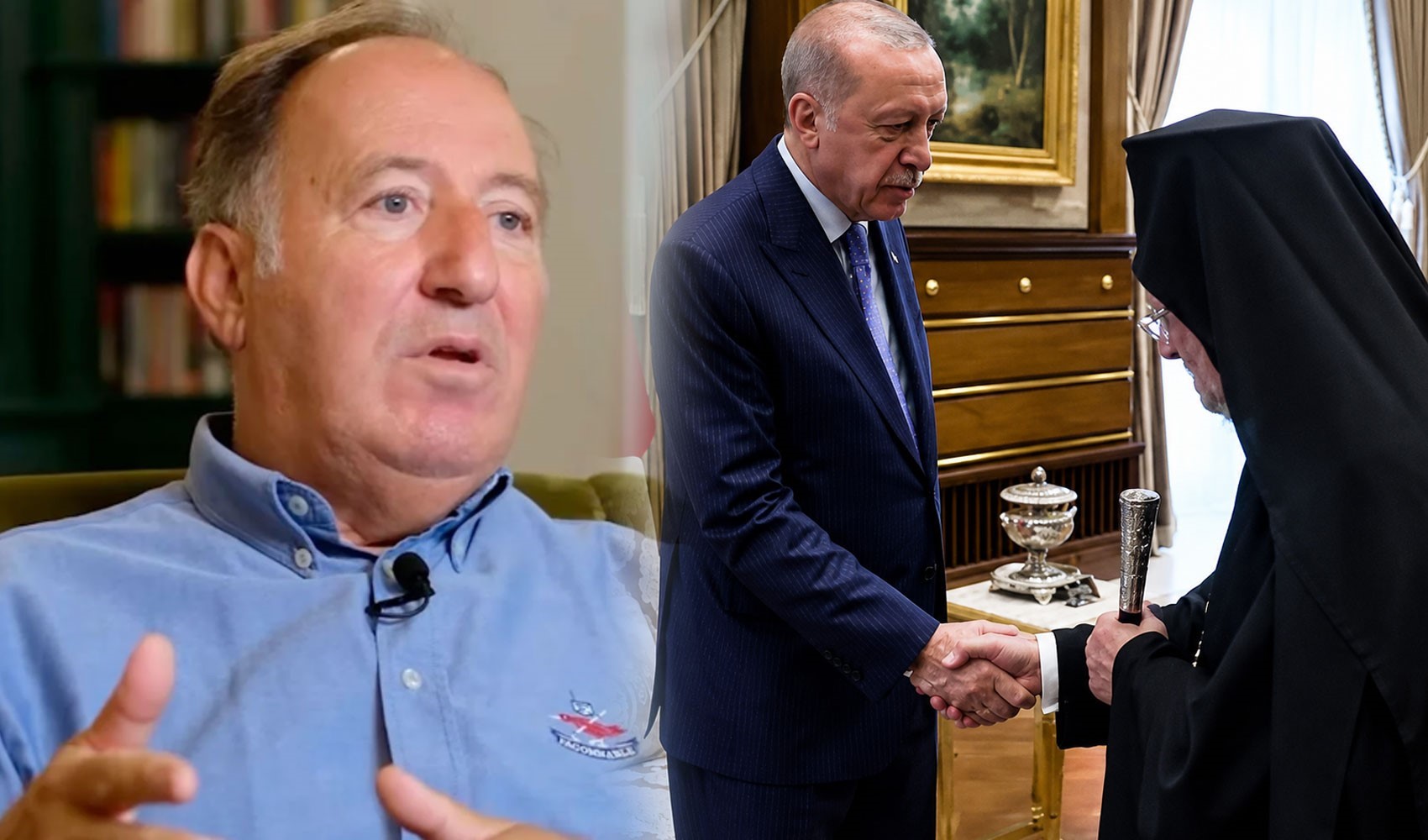
The Ecumenical Patriarch of Constantinople, Bartholomew, the spiritual leader of Orthodox Christians based in Istanbul, met with AKP Chairman and President Recep Tayyip Erdoğan in Ankara.
According to a statement from the Patriarchate, Bartholomew and his senior aides traveled to the capital for the meetings.
The statement noted that the meeting focused on the possibility of reopening the Halki Seminary within the framework of the ongoing dialogue between Turkish education officials and the Patriarchate.
It was stated that the meeting between Bartholomew and Erdoğan took place in a "sincere atmosphere."
REACTION-FILLED LINES FROM GÜRDENİZ
Retired Admiral Cem Gürdeniz made striking assessments regarding the Erdoğan-Bartholomew meeting in a statement shared on his social media account.
Stating that the issue should not be viewed merely as the opening of a school, Gürdeniz issued important warnings.
Here is that statement by Cem Gürdeniz:
The issue of the Fener Greek Patriarchate is a geopolitical and strategic matter rather than one of religious freedom and worship.
The reason the Patriarch insists on using the title "Ecumenical" is not to meet the religious needs of the small Greek community in Turkey. The goal is to position himself as the universal leader of world Orthodoxy and Istanbul as the center of the Orthodox world once again.
Throughout history, major religious centers have not been merely places of worship; they have also produced influence and power. For the Catholic world, institutions that form the intellectual and spiritual backbone of the Vatican, especially the pontifical universities in Rome, have served this function. In the Sunni Islamic world, Al-Azhar in Cairo is not just an educational institution but a center that produces religious authority on a global scale. In the Protestant world, established theological centers such as Oxford, Cambridge, Heidelberg, and others have produced clergy, academics, and thought for centuries.
For this reason, the opening of the Halki Seminary cannot be seen as a matter of training a few Greek Orthodox priests. The real issue is for the Patriarchate to acquire a center where it can train its own clergy worldwide, develop its own theological doctrine, and manage its international networks. Such a school would provide an academic, institutional, and international foundation for the Patriarchate's ecumenical claim and would undoubtedly consolidate its position.
The continuous strong support given to the Patriarchate by the US and the European Union should also be evaluated in this context. The Phanar has become an important geopolitical tool used against the Moscow Patriarchate and the Russian Orthodox world, especially in recent years. Therefore, the issue is not just religious freedom, but also a global power struggle over the leadership of the Orthodox world.
The international legitimization of a structure that operates in the heart of Turkey with a title not recognized by Turkish law, and which claims to be the leader of the entire Orthodox world, through the reopening of the Halki Seminary, will have not only religious but also strategic consequences.
At a time when the Greece, Greek Cypriot Administration, Israel, and US axis is increasing pressure on Turkey in the Eastern Mediterranean, it would be a vital mistake for Ankara to evaluate this issue solely under the heading of minority or religious freedom.
The problem we are facing is not the training of a few clergymen, but rather within which theological and geopolitical framework Istanbul and Heybeliada will be defined in the future. It is not a situation that history will easily digest for the island, which has been training naval officers for the Turkish Naval Forces since the 19th century, to turn into an indoctrination center for a vassal of imperialism with a so-called ecumenical title.
Let us not forget that religious institutions do not always just produce faith; they also produce history, identity, memory, and geopolitical arguments. The Greek record on this subject is too extensive to fit into books.
The issue of the Fener Greek Patriarchate is a geopolitical and strategic matter rather than one of religious freedom and worship.
— Cem GÜRDENİZ (@cemgurdeniznet) June 17, 2026
The reason the Patriarch insists on using the title "Ecumenical" is not to meet the religious needs of the small Greek community in Turkey. The goal is to position himself as the world... https://t.co/eES2b9YJSh
News Source: 12punto