With the Presidential Decree published in the Official Gazette dated May 21, 2024, the monthly late payment surcharge rate for public receivables increased from 3.5 percent to 4.5 percent.
With this increase, the annual interest rate became 54 percent.
Bolu Mayor Tanju Özcan had written a letter to the Presidency of Religious Affairs regarding this applied increase, asking whether the interest applied was permissible. Diyanet has now responded to the letter written by Özcan.
ANNOUNCED BY SAYING 'WE ARE OFF THE HOOK'
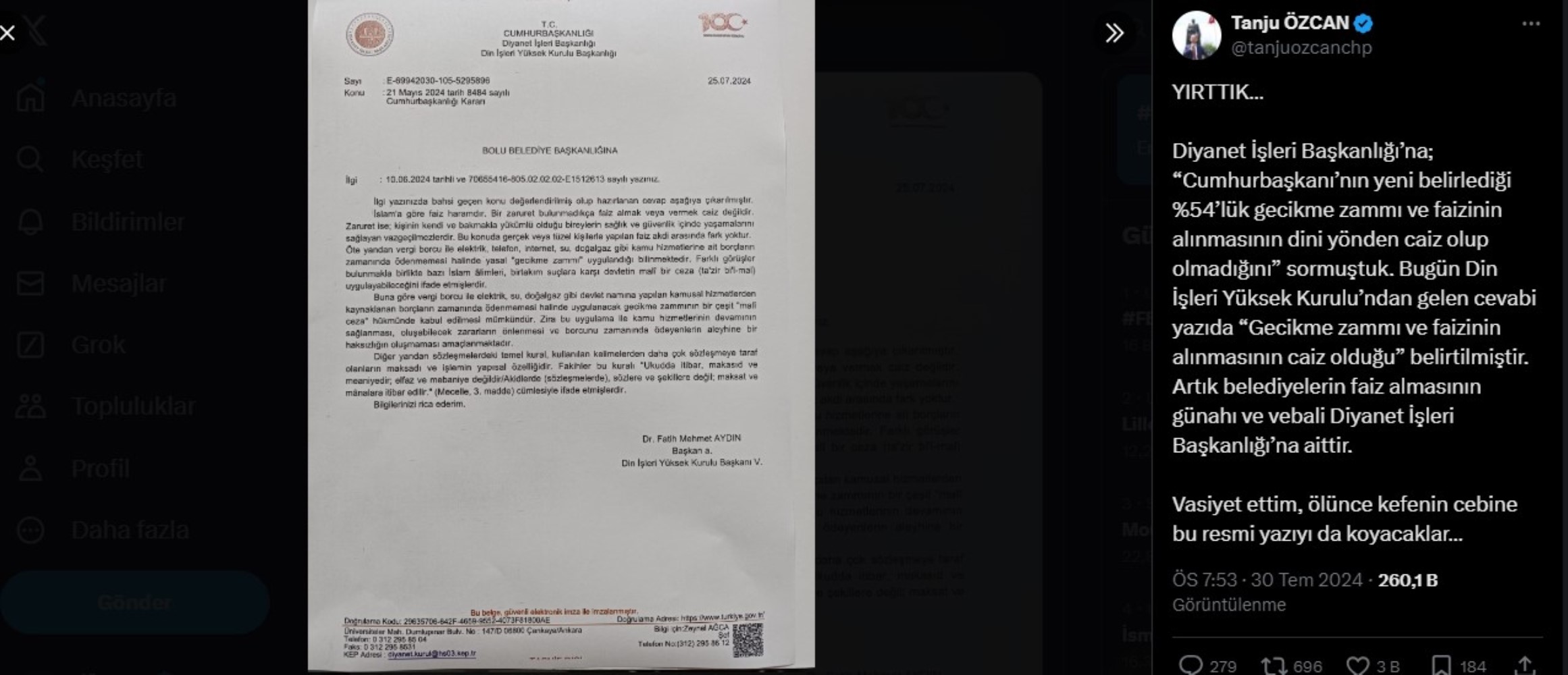
In its response, the Diyanet stated that "it is permissible to collect late payment surcharges and interest." Sharing the response, Tanju Özcan announced it by saying, "We are off the hook... From now on, the sin and liability of municipalities collecting interest belong to the Presidency of Religious Affairs. I have left a will; when I die, they will put this official letter in the pocket of my shroud..."
Bolu Mayor Tanju Özcan's post is as follows:
WE ARE OFF THE HOOK… We had asked the Presidency of Religious Affairs whether "it is religiously permissible to collect the 54% late payment surcharge and interest rate newly determined by the President." In the response letter received today from the High Board of Religious Affairs, it was stated that "it is permissible to collect late payment surcharges and interest." From now on, the sin and liability of municipalities collecting interest belong to the Presidency of Religious Affairs. I have left a will; when I die, they will put this official letter in the pocket of my shroud...
The response from the Presidency of Religious Affairs is as follows:
"The subject mentioned in your letter of interest has been evaluated, and the prepared response is provided below.
According to Islam, interest (riba) is forbidden (haram). Unless there is a necessity, it is not permissible to take or give interest. Necessity refers to the indispensable requirements that ensure a person and those they are responsible for live in health and safety. In this regard, there is no difference between interest contracts made with real or legal persons.
On the other hand, it is known that a legal 'late payment surcharge' is applied if tax debts and debts related to public services such as electricity, telephone, water, and natural gas are not paid on time. Although there are different opinions, some Islamic scholars have stated that the state may impose a financial penalty for certain offenses.
Accordingly, it is possible to accept the late payment surcharge to be applied in case of failure to pay tax debts and debts arising from public services provided on behalf of the state, such as electricity, water, and natural gas, as a form of "financial penalty." Because the purpose of this practice is to ensure the continuation of public services, to prevent potential damages, and to ensure that no injustice occurs against those who pay their debts on time.
On the other hand, the fundamental rule in contracts is the intent of the parties to the contract and the structural nature of the transaction rather than the expressions used. Jurists have expressed this rule with the sentence: “Ukudda itibar, makasıd ve meaniyedir; elfaz ve mebaniye değildir / In contracts, consideration is given to the purposes and meanings, not to the words and forms.” (Mecelle, Article 3). I kindly request your information.
President of the High Board of Religious Affairs, Dr. Fatih Mehmet Aydın"
HERE IS ÖZCAN'S LETTER TO THE DIYANET
Emphasizing the verse in which God strictly forbids interest, Özcan said, "Is the interest that our administration is forced to apply based on the Presidential Decree haram? Are we being made intermediaries for usury, which is strictly forbidden by our religion?"
Quoting from Surah Al-Baqarah, Özcan included the following statements in his letter:
REPUBLIC OF TURKEY PRESIDENCY OF RELIGIOUS AFFAIRS
Subject: Presidential Decree dated May 21, 2024, numbered 8484
With the Decree numbered 8484 dated May 21, 2024, it has been determined by Presidential Decree in accordance with the aforementioned article of Law No. 6183 that the late payment surcharge rate included in the first paragraph of Article 51 of the Law on the Procedure for the Collection of Public Receivables No. 6183 shall be set at 4.5% to be applied separately for each month.
In Verse 275 of Surah Al-Baqarah, Allah Almighty has forbidden "INTEREST." It has been decreed that those who engage in usury will never be able to leave hell for eternity.
Furthermore, in the Tafsir (Path of the Quran) explanation; "...The first of the four basic rules and measures, which are very important for social life to be conducted in an orderly, balanced, and humane manner, namely infaq (spending in the way of God) and charity, has been presented in a vivid and clear style in the preceding verses. The second is the prohibition of waste, and this prohibition has found expression in many verses. The third is usury, which was previously forbidden and whose prohibition is reinforced here with a firm and severe style. At the head of these rules is the rule of 'a person trying to earn a living through their own manual labor and sweat,' which has been encouraged in many verses and hadiths. It must be because of the relationship between these four measures and rules that the transition was made to the prohibition of interest after the verses about infaq. In addition, there is a relationship of opposition between interest and infaq/charity, in that the former consists of taking without return, while the latter consists of giving without return."
While the interest rate, which was increased to 4.5% to be applied separately for each month by the Presidential Decree, corresponds to an annual rate of 54%, regarding this exorbitant interest rate;
1- Is the interest that our administration is forced to apply based on the Presidential Decree mentioned above haram?
2- Is it permissible to apply interest to receivables arising from public services?
3- Because of the interest that we are forced to apply based on the relevant Presidential Decree, are we being made intermediaries for usury, which is strictly forbidden by our religion?
Since doubts have arisen regarding the stated issues, I request that your Presidency provide an opinion on these matters urgently;
I submit for your consideration.
News Source: 12punto