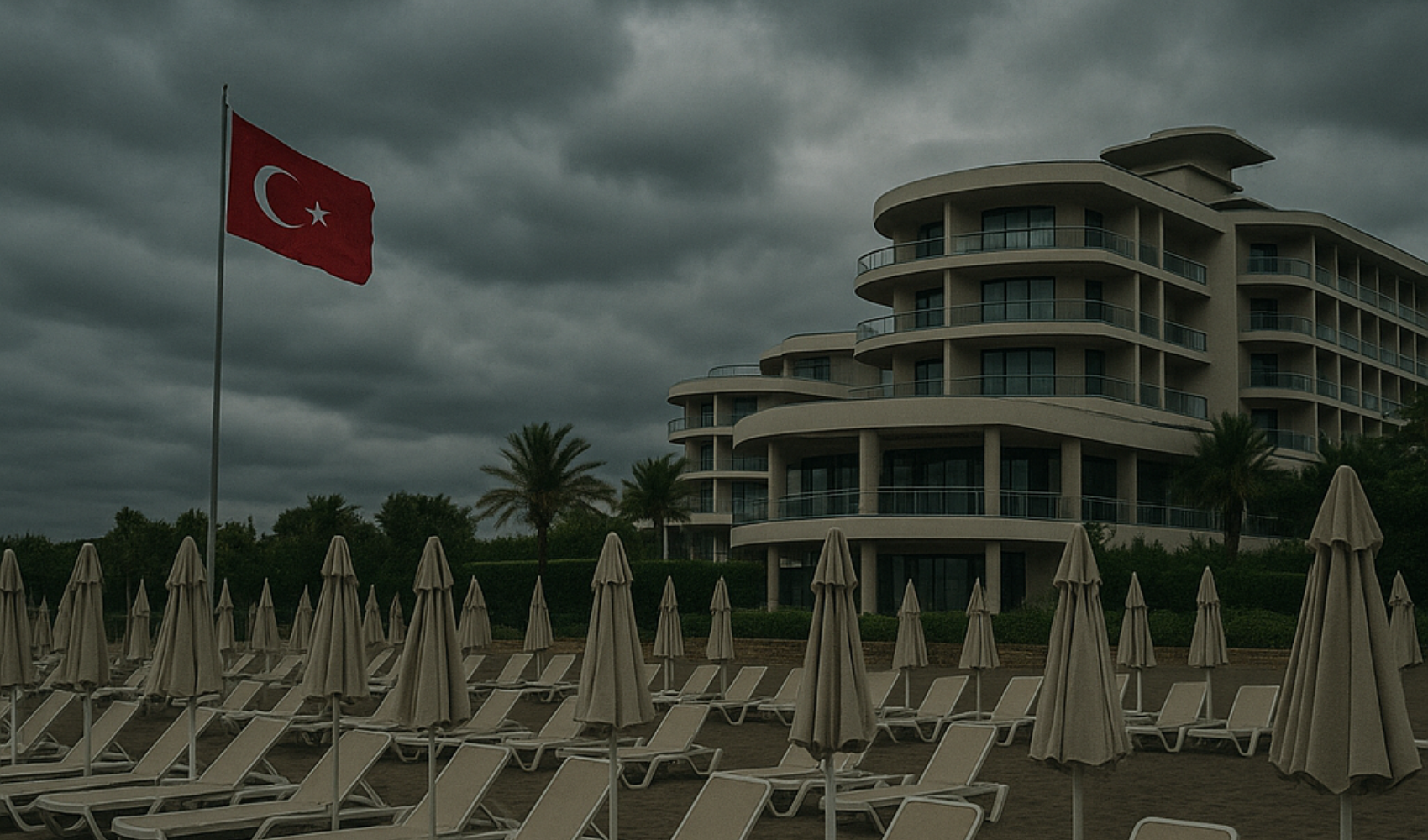
The tension that began in March with the impact of attacks by the US and Israel on Iranian targets has led to significant shocks in many sectors, primarily tourism. Although the ceasefire reached on April 7 allowed for some improvement, the Easter period, when the season's highest activity is expected, was much quieter on the Mediterranean coast compared to previous years.
While losses of up to 60 percent have been reported in bookings from abroad in the Mediterranean and Aegean regions, industry representatives stated that bookings made from the UK and Europe for September–November are quite weak compared to previous years. TÜRSAB Board Member Elif Ural states that this serious decline in bookings is not just short-term and is negatively affecting the entire summer season.
According to analyses by Oxford Economics, the conflict environment in the Middle East has directly put tourism in the Gulf and surrounding countries in a difficult position. The company's senior economist, Jessie Smith, says, "With the start of the war, uncertainty and security concerns have increased significantly, which is leading to a weakening in demand and a shift in the market." Turkey, in particular, appears to be in a risky position due to both its geopolitical location and its dependence on tourists from the Middle East. Smith assessed, "Even though there are alternative markets, it is not very likely to fully compensate for these losses."
THE SITUATION IN THE EASTERN BLACK SEA AND WESTERN MEDITERRANEAN
Representatives of companies providing tourism services express that the war is being felt strongly, especially along the Eastern Black Sea and Mediterranean line. Hüseyin Kurt, co-founder of GlobeMeets & Oliva MICE, underlined that the Eastern Black Sea is an important destination for tourists from the Middle East and Gulf countries, stating, "The loss in this region is reaching 30-40%." In addition, travel warnings from European firms and the fact that some regions are not considered 'safe' are also leading to a serious decline in bookings.
According to information provided by tourism professionals, the sector, which had just completed its post-pandemic recovery process, is now facing geopolitical risks. Linda Hill Miller, owner of the Scotland-based LAH Travel, states that the season they are experiencing is "worse than even the Covid-19 pandemic": "Our phones aren't ringing; we aren't receiving any demand. People are very afraid of the unknown, and economic concerns are also hindering travel."
In Istanbul, hotel occupancy rates are trending downward. According to data released by Lighthouse Intelligence, while Istanbul's hotel occupancy was 57% in the first half of April last year, it has fallen to 47.5% this year. Although no wave of mass cancellations has been observed, the growth momentum of bookings has slowed down significantly. Average room prices in Bodrum and Antalya are also showing a decline compared to the beginning of the year.
DIFFICULTIES IN THE AIRLINE SECTOR AND OPERATIONS
Cirium's data revealed that global flight cancellations in March 2026 increased by 111 percent compared to the previous month. The cancellation of flights, especially to the Middle East and Africa, creates additional costs for airlines and tour operators. Otto Dmc General Manager Cem Yağcıoğlu reports that this two-way effect not only increases costs but also creates a 'wait-and-see' behavior among Turkish consumers. It was also emphasized that the differences in fuel costs experienced in travel negatively affect both intermediary institutions and customers.
Industry representatives underline that these losses will be reflected in net profitability. Yağcıoğlu states that for tours prepared at fixed prices, last-minute cost increases make operations largely difficult and that "this year, the sector will face a serious test."
RECOVERY WILL TAKE TIME
According to Elif Ural, it is predicted that even if the tension ends in a short time, the recovery process will take at least a year. "We will have to almost forget about the Middle East market starting from Eid al-Adha, because both flights and plans have changed; it will take time to recover," she says.
On the other hand, it is predicted that rising oil and jet fuel prices will bring a 5-10 percent increase in ticket prices, and this situation will further squeeze profit margins.
Industry officials state that the end of the conflict could progress similarly to the post-pandemic recovery, but that it will require time for travel habits and demand dynamics to be reshaped. Despite everything, it is hoped that people's longing for travel and, in particular, the demand for corporate trips could rise again if the conflict subsides.
News Source: 12punto