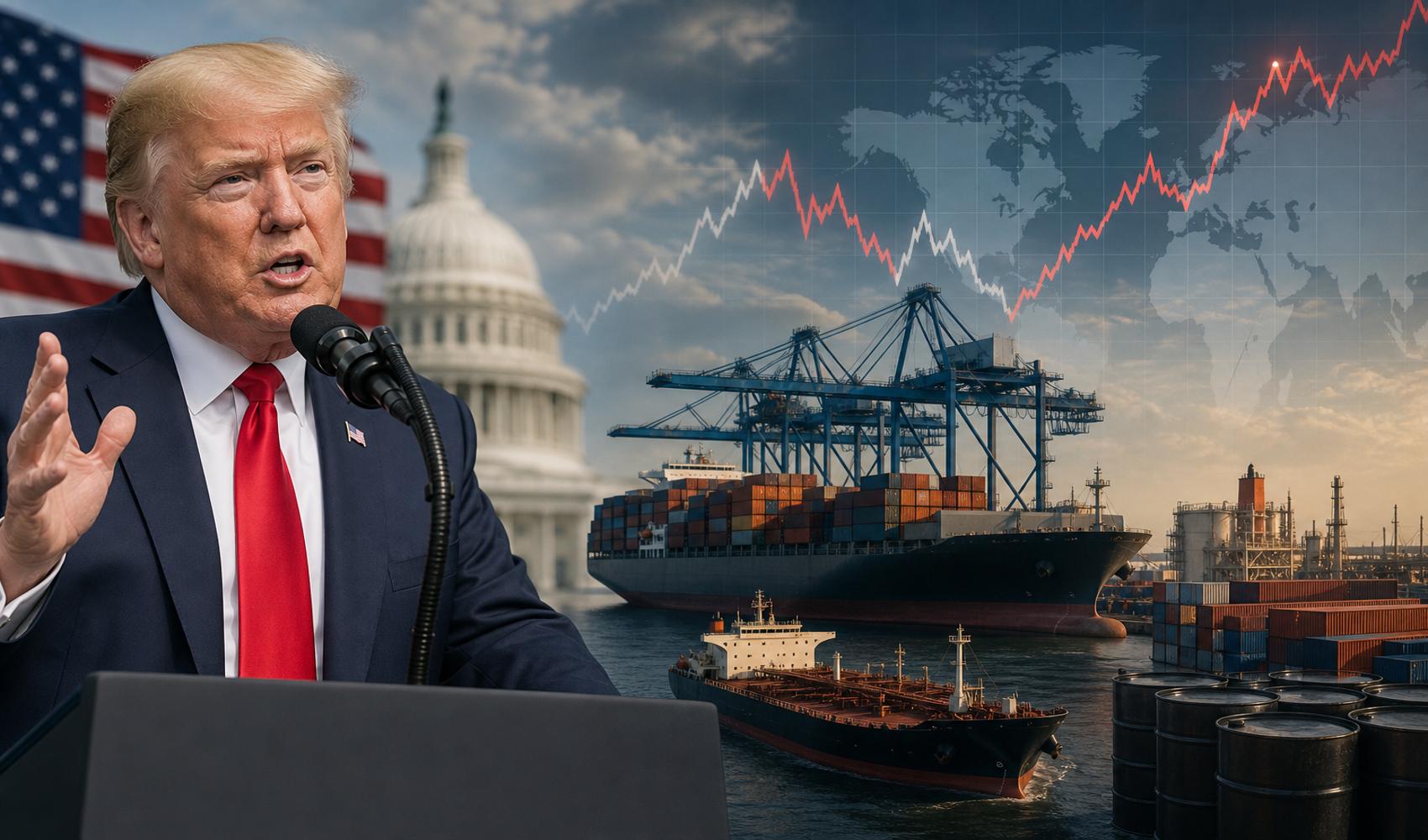
U.S. President Donald Trump’s implementation of new import tariffs on more than 80 countries has once again increased uncertainty in global trade. However, according to economists, the primary vulnerability this time stems not only from tariffs but also from the pressure created on energy markets by the escalating war in the Middle East.
On April 2, 2025, when Trump announced his first comprehensive customs tariffs, the price of a barrel of oil was around 70 dollars. Today, disruptions in trade and energy routes around the Persian Gulf have pushed the price of oil close to 100 dollars. This picture could cause the cost impact of the new tariffs to be felt on a more sensitive global economy.
Carsten Brzeski, chief economist at ING, stated that the new trade tensions are emerging on a weaker global foundation compared to last year, noting, "These new trade tensions are emerging at a time when the global economy is weaker than it was on last year's Independence Day due to rising energy prices."
The new tariffs stand out as a move by the Washington administration to reinstate customs duties following the U.S. Supreme Court's cancellation of most of the previous tariffs in February. The regulations, prepared on the grounds of unfair labor practices by trade partners, replaced similar tariffs that were previously applied temporarily. It is stated that additional tariff steps may come to the agenda in the coming period.
ENERGY SHOCK OVERSHADOWS TARIFFS
Analysts are of the opinion that a significant portion of the impact of Trump’s trade war on inflation has already been priced in by companies and consumers. Northern Trust Chief Economist Carl Tannenbaum said, "The worst of goods inflation linked to tariffs is likely behind us." According to Tannenbaum, companies raised their prices last year and did not roll back these increases following the court decision.
In contrast, the pressure on the energy side is creating a broader and faster impact. While the Iran war is causing disruptions in critical energy trade routes such as the Strait of Hormuz and the Red Sea, the escalation of tensions between the Houthis in Yemen and Saudi Arabia has also increased the market's risk perception. The renewed rise in oil prices has led to a sell-off wave in government bonds and a decline in stock markets.
The rise in gasoline prices in the U.S. to 4 dollars per gallon and the increase in mortgage rates show that energy costs are affecting not only corporate balance sheets but also household spending. The Cabinet Office of Japan also pointed out that companies might be passing on war-related cost increases to consumers even faster than the energy shock experienced after Russia’s invasion of Ukraine in 2022.
Paola Subacchi from Sciences Po University in Paris stated that the situation in the Middle East is more concerning for the global economy than the tariffs, commenting on the developments on the trade front as "more or less the same story."
ASIA AND CHINA ARE CRITICAL
Asia is among the regions most affected by the tariffs and the energy shock. Regional economies are highly dependent on both exports and imported energy. Countries such as Japan, South Korea, and Taiwan have sought common ground through investment commitments to limit trade tensions with Washington.
It is stated that Japan has pledged 550 billion dollars in investments to the U.S. in exchange for a 15 percent reduced customs tariff; South Korea has committed to allocating tens of billions of dollars to shipbuilding and battery production, and Taiwan to advanced semiconductor production. Despite this, it is noteworthy that regional economies have shown higher-than-expected resilience recently.
Nomura economist Sonal Varma, pointing to the performance of Asian economies against shocks, said, "For me, the most important conclusion is how resilient these economies are to all these shocks."
The most critical topic of the global trade war continues to be the negotiations between the U.S. and China. Tannenbaum stated, "The real determining factor of this process is the struggle between the U.S. and China." China’s power over rare earth elements and minerals used in permanent magnet production is seen as an important bargaining tool against Washington.
Mary E. Lovely, a senior fellow at the Peterson Institute for International Economics, conveyed that Chinese leaders are confident that their dominance in this field will limit the U.S. from raising tariffs much higher. It is assessed that this situation could lead to China facing lower tariffs compared to some of its neighbors and gaining an advantage over its competitors.
According to experts, the defining question for the global economy in the coming period will be not only to what extent the new tariffs will disrupt trade flows, but also how much lasting pressure the war in the Middle East will create on energy supply and prices.
News Source: 12punto