


If you don't have money, you couldn't get treatment; now you can't even become a doctor



Let us begin by recalling two of the fundamental duties of a social state: providing equal, free, and quality education to its citizens, and ensuring that access to healthcare is not dependent on income level. Today, Turkey is experiencing a process of collapse in both of these areas.
Getting an appointment at public hospitals and accessing healthcare has become almost impossible. If you didn't have money, receiving healthcare was a miracle. Now, the era of “If you don't have money, you can't become a doctor” is beginning. Before long, the healthcare system will also transform into an “If you don't have money, die” system.
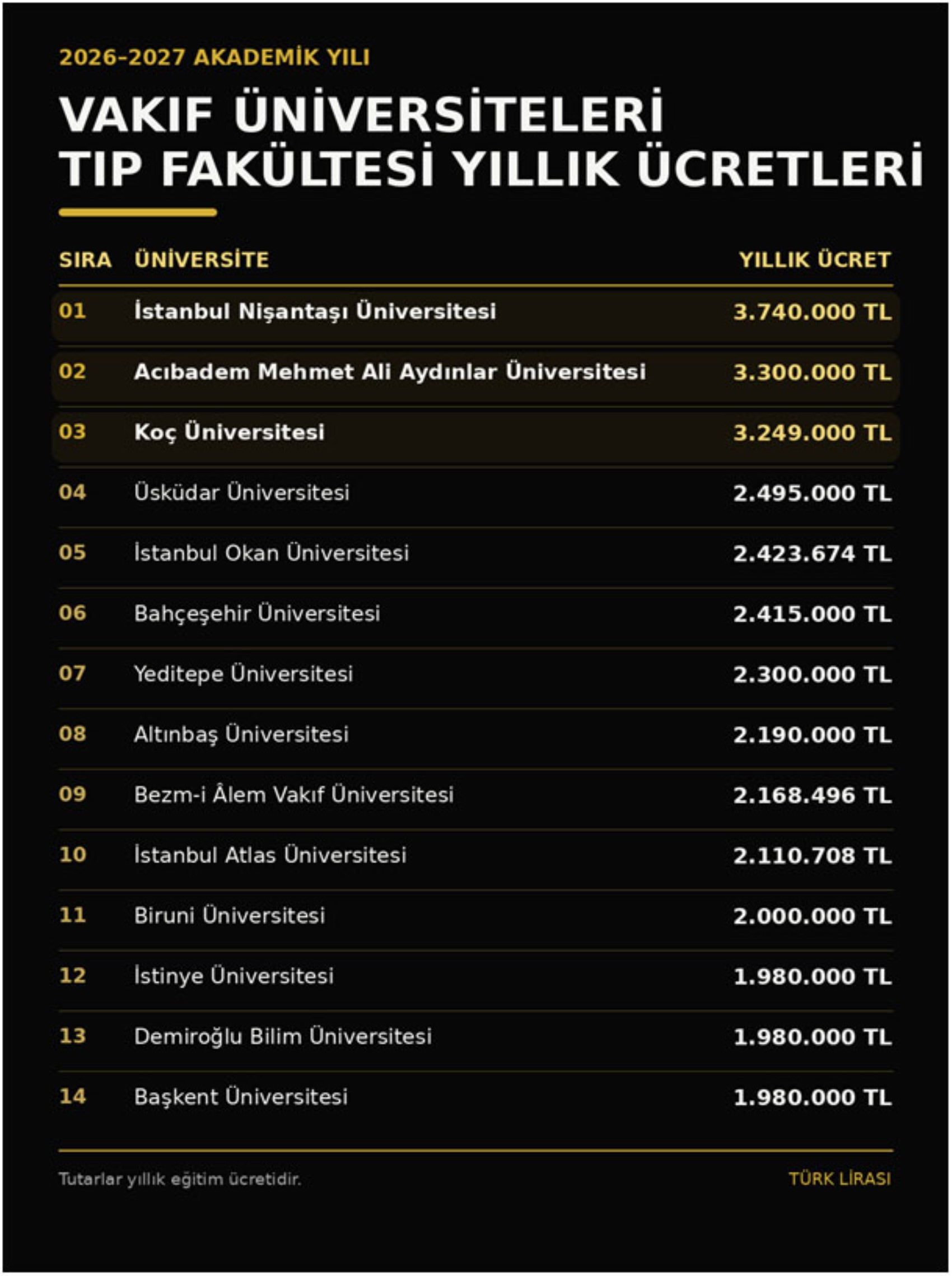
Finally, when we look at the announced annual tuition fees of foundation universities, there is no hope for the future. Annual list prices, including VAT, range between 1 million 800 thousand liras and 3 million 740 thousand liras. The annual cost of studying medicine at an average foundation university in Turkey has reached the 42 thousand to 80 thousand dollar band.
Not all, but the annual medical school tuition fees of three or four famous foundation universities are higher than the annual fees of world medical giants like Harvard Medical School at 72 thousand dollars and Stanford at 73 thousand dollars.
In England, medical education for local students is subsidized by the state and capped at £9,790 (607,000 TL, $12,900) per year. In Turkey, foundation university fees are 4-6 times higher than this. The tuition fees demanded for domestic students in Turkey are competing with the tuition fees applied to foreign (international) students in England.
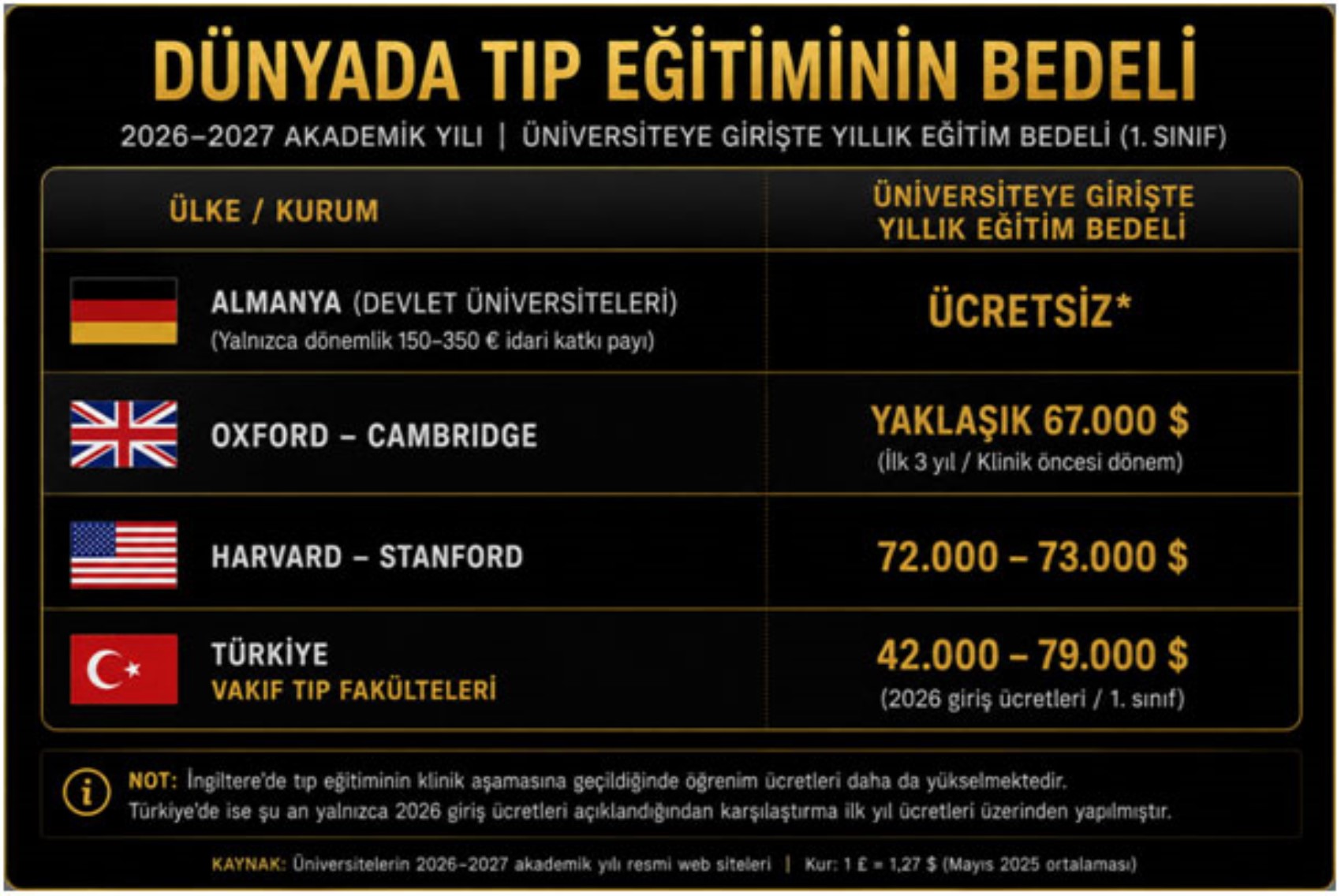
In Germany, which is a social state, medical education at a world giant university like Charité Berlin is zero TL (free); whereas in our country, medical education has completely detached from rationality and has become an uncontrolled tool for rent-seeking and the market. In a system where health and education are commodified to this extent, one cannot speak of public interest or the principle of a social state.
LOSE THE TRAINED PHYSICIAN, EXPAND THE FACULTY WITHOUT INFRASTRUCTURE
In 2002, approximately 7 thousand 170 physicians were graduating in Turkey annually. In the 2024–2025 academic year, the number of medical faculties reached 124, the total number of students exceeded 125 thousand, and the annual number of graduates reached 19 thousand. If you look at the numbers, it is presented as a "great success"!
What kind of education is being provided in these more than 120 medical faculties opened without sufficient professors, associate professors, laboratories, and hospital infrastructure?
If you exclude our deep-rooted universities with tradition and academic staff such as Hacettepe, Çapa, Cerrahpaşa, Ege, Dokuz Eylül, Akdeniz, and Trakya; our children who are educated in faculties that accept students without sufficient academic staff, laboratories, and teaching hospitals are unfortunately being included in the system with inadequate infrastructure. The vast majority of faculty members in medical schools with tradition are also nearing retirement. We increased the quantity, but we destroyed the quality!
On one side, according to data from the Turkish Medical Association (TTB); 2,700 to 3,000 of our qualified and experienced physicians who know foreign languages obtain a "Certificate of Good Standing" annually to go to the West due to harsh working conditions and lack of merit. We do not have an exact number on how many of our physicians who receive a Certificate of Good Standing have settled abroad. But there is an explosion in the number of those receiving the Certificate of Good Standing.
Even if today's entrance fees do not increase at all, the six-year tuition cost at the most expensive foundation medical schools approaches 450 thousand dollars. Considering that fees are redetermined every year and that the total will likely exceed this when clinical training begins in later years, it would not be an exaggeration to say so.
A young physician whose family has paid hundreds of thousands of dollars for medical education is burdened with the pressure to recoup this investment the very day they start their profession. Such a financing model directs the physician not to public service, but to private hospitals that provide high income and to abroad.
Thus, the qualified specialist physician goes abroad or escapes to the private sector that pays their money; public hospitals are left to the mercy of inexperienced physicians whose training processes are struggling with academic crises and clogged appointment systems.
Now is the time to ask the real constitutional and economic question:
According to the Constitution, the Republic of Turkey is a "democratic, secular, and social state governed by the rule of law." The primary duty of a social state is to provide its citizens with free, equal, and quality healthcare services.
If this state;
• Is losing its most qualified trained doctors to abroad,
• Is hollowing out medical education with "signboard" universities,
• Is pushing its citizens into the arms of foundation universities charging 3 million liras annually or private hospital bosses,
• And if access to health, which is the most basic human right, has become a privilege...
If the trillions of liras of taxes collected do not finance either a quality education or a free and accessible healthcare system…
Then we ask: Why are we, as citizens, paying these taxes?
Would you like to get notifications about new developments and save news?
- NotificationsNew developments and breaking news
- SaveNews is stored in the app
Most Read
Video response to Kim Jong-un claims
Murat Ağırel’s police statement has been revealed
Azerbaijan issues arrest warrants in absentia for 7 people living in Turkey

The Orionid meteor shower will be visible from Turkey!
The penalty for Ronaldo, who left the national team camp, has been announced

Fatoş Seğmen reveals the cause of her daughter's death
Latest status in the race between AKP and YENİ Party revealed
Injury shock at Liverpool: He may miss the Fenerbahçe match
Who authorized the concert held in a parking garage?
From brotherhood to a distant partnership...