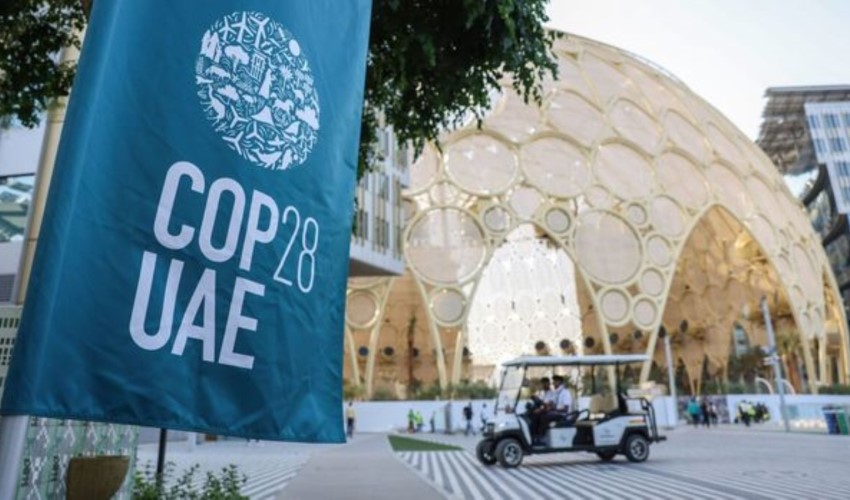
COP28, presided over by the United Arab Emirates and held in Dubai from November 30 to December 12, concluded one day after its official end date as negotiators struggled to reach an agreement on the final text.
For the first time in the nearly 30-year history of climate negotiations, the text includes a reference to "fossil fuels," calling for a "transition away from fossil fuels" to limit temperature increases.
Since a "call" within the UN framework means "inviting" or "requesting" parties to act, experts following the negotiations argue that the call to transition away from fossil fuels is a weak outcome and will not ensure the sharp emissions cuts needed to limit global warming.
While the parties agreed on targets to triple global renewable energy capacity and double the rate of energy efficiency improvements by 2030, the operationalization of the Loss and Damage Fund was also included in the final text.
Although the final text refers to the need for climate finance in developing countries and the funding required for adaptation to the effects of climate change, it contains gaps regarding how adaptation finance will be scaled and its timeline.
COP28 PRESIDENT AL JABER DESCRIBES THE OUTCOME AS A "HISTORIC ACHIEVEMENT"
Speaking at the closing session after the adoption of the final text, COP28 President Sultan Ahmed Al Jaber described the outcome of the negotiations as a "historic achievement," stating, "The world needed to find a new way, and by following our north star, we have found that new path. We have faced the facts and steered the world in the right direction. In this regard, we have prepared an action plan to make the goal of limiting global temperature rise to 1.5 degrees reachable."
Arguing that this plan is led by science and is a plan that combats emissions, fills the gap in adaptation, and redesigns global finance, Al Jaber said, "We built this on common ground, strengthened it with cooperation. This is a balanced, historic package developed to ensure we make no mistakes in accelerating climate action."
UNFCCC Executive Secretary Simon Stiell pointed out that all governments and the business world must turn their commitments into action without delay, stating, "At COP28, humanity needed to firmly put the brakes on the core climate problem. We did not close the fossil fuel era in Dubai, but today's result is the beginning of the end for fossil fuels."
Reactions from climate and finance experts
WWF Global Climate and Energy Lead and COP20 President Manuel Pulgar-Vidal, in his assessment after the negotiations, recalled that countries agreed on transitioning away from fossil fuels, saying, "While countries accepted this, a consensus could not be reached at COP28 on the complete phase-out of coal, oil, and gas. However, the decision to transition away from fossil fuels is still an important result. In 30 years of UN climate negotiations, countries have finally shifted their focus to the polluting fossil fuels that cause the climate crisis. This result should signal the beginning of the end for the fossil fuel era."
Pulgar-Vidal pointed out that the text also includes dangerous language such as large-scale carbon capture and storage technologies and "transition fuels," adding, "We need a complete phase-out of all fossil fuels for a livable planet."
Linda Kalcher, Executive Director of the think tank Strategic Perspectives, stated that for the first time, UN climate talks addressed the need to stop fossil fuel use, noting the following:
"COP28 marks the beginning of the end of the fossil fuel era. This result should be used by governments and markets. Economic realities will eliminate some of the false solutions included in this text, such as carbon capture and storage technologies and so-called 'transition fuels.' COP28 leaders cannot claim they have saved the 1.5-degree goal. This agreement is still full of gaps, lacks timelines, and fails to provide the support that the majority of the world's people will need to finance the rapid transformation required right now."
Marcio Astrini, Executive Secretary of the Brazil-based Climate Observatory, stated that the COP28 outcome was "strong in signals but weak in content," adding, "Without real action, the result from Dubai will not be celebrated among communities around the world suffering from extreme climate events."
Christian Aid Senior Climate Advisor Joab Okanda assessed, "We may not have hammered the final nail into the coffin at COP28, but the end of climate-damaging energy is approaching. However, there is a massive gap in climate finance to effectively fund the transition from fossil fuels to clean energy in developing countries. Without this, we face the risk that global change will be much slower."
News Source: 12punto