Find news published in the date range below
and and
and and
and and
Clear
Euro
Arrow
53,9533
Dollar
Arrow
44,7419
Sterling
Arrow
63,0515
Gold
Arrow
6263,5436
BIST 100
Arrow
10.729

A remarkable tradition in Sivas: Door knockers indicate gender

In the Divriği district of Sivas, the door knockers on the exterior of historic mansions seem to speak, signaling whether a visitor is a man or a woman. Divriği culture researcher Ruhan Özaygün stated, "Women ring the 'şakşak' (clapper), while men use the 'tokmak' (knocker)."

Don't leave your news choices to an algorithm - decide for yourself what you read. Add 12punto to your preferred sources!
A remarkable tradition in Sivas: Door knockers indicate gender
The Divriği district of Sivas, which takes its visitors on a journey into the past with its historical and natural beauty, also makes a name for itself with its centuries-old mansions.
The mansions attract attention not only for their architecture but also for the door knockers found on their exterior doors.

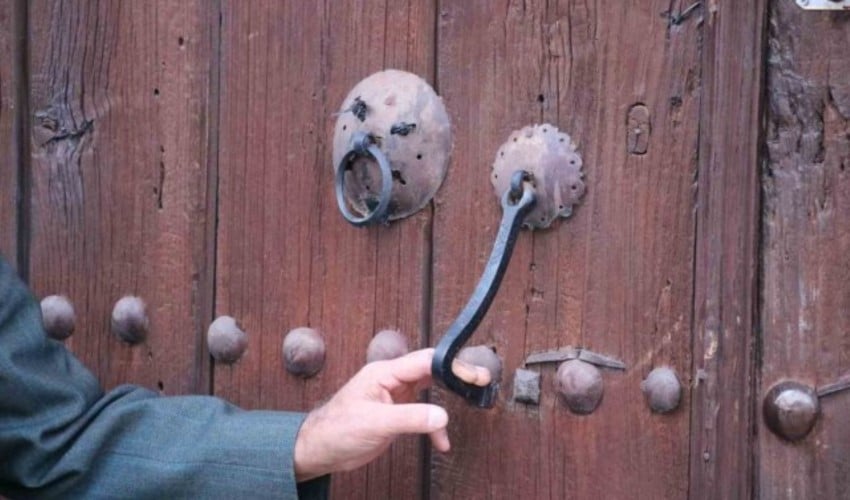
The door knockers, known as the 'şakşak' (clapper) and the 'tokmak' (knocker), which reflect the culture and art of the district, seem to speak for themselves.

When a man comes to the house, he uses the tokmak, while women use the şakşak, allowing the household to understand whether the person at the door is a man or a woman.

'THE SOUND OF THE KNOCKER AND CLAPPER IS DIFFERENT ON EVERY DOOR'

Retired teacher and Divriği culture researcher Ruhan Özaygün stated that the sounds of the knockers and clappers on every door are different, saying, "On our doors, there is a tool we call the 'şakşak' that our women use. There is also the 'tokmak' that men use.

When strangers use the clappers and knockers on the exterior door, we know who the person is, whether they are a stranger or part of the household. The reason the knockers are different is this: because the art of blacksmithing was so advanced in Divriği, the aesthetic art and beauty of these items also developed separately.

The decoration of the 'şakşak' on each door is different from the decoration of the 'tokmak'. When you look at the door, you can easily understand the culture of that house and the character of the people living there," he said.

'NO TWO KNOCKERS SOUND THE SAME'

Providing details about this culture, Özaygün said, "Women ring the 'şakşak', while men use the 'tokmak'. The 'şakşak' is found on both sides of the door. There is only one 'tokmak'. There is a belief that the reason there are two 'şakşak's represents the fertility of women, while the reason there is only one 'tokmak' represents the singularity of men. A stranger has arrived.
When someone knocks on my door, I know the sound of my own door knocker. Because they all produce different sounds, no two knockers sound the same," he stated.

News Source: İHA

Sivas door knocker