12punto.com.tr
Cenk BAŞBOĞAOĞLU
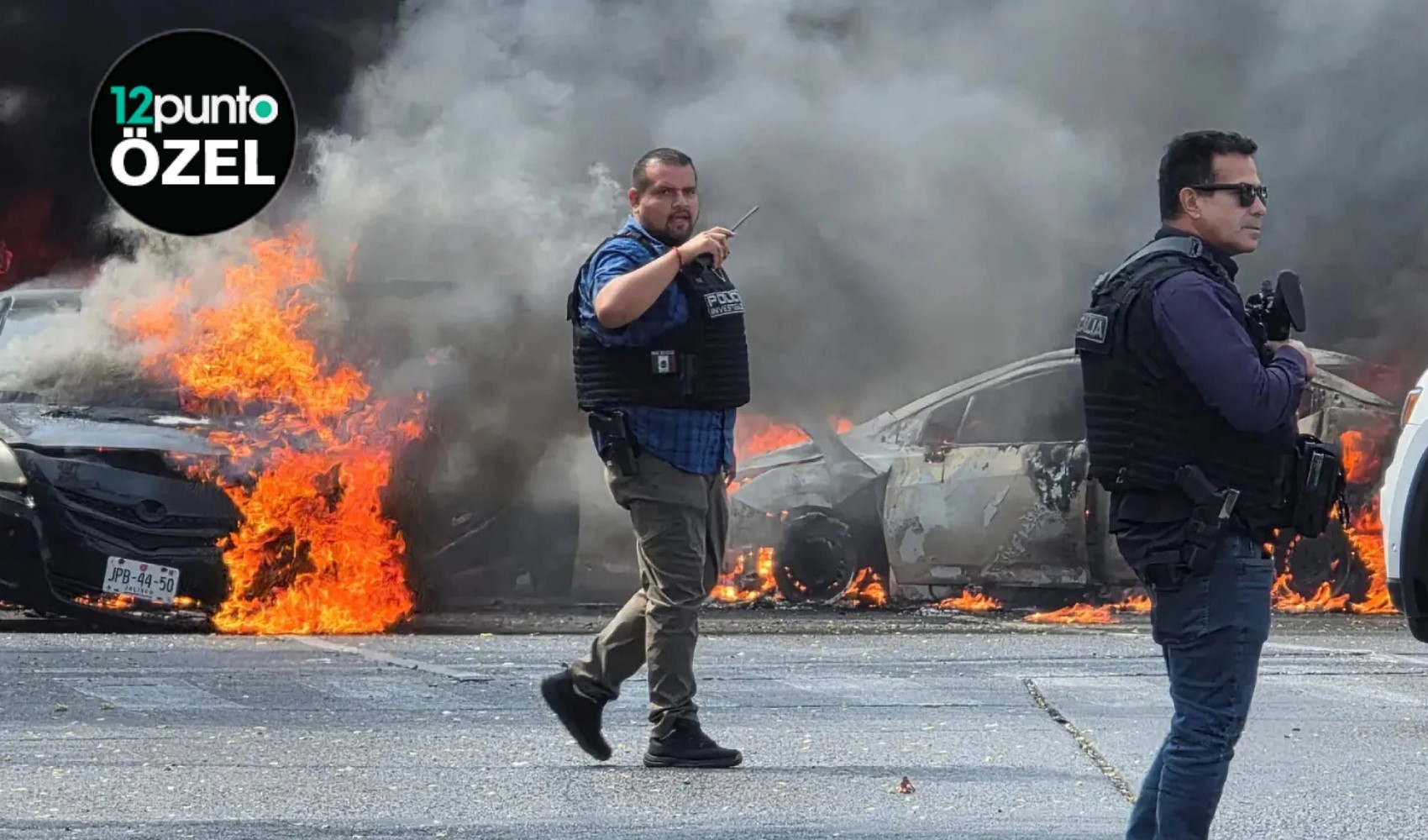
While the tension between the US and Iran occupies the international agenda, the question of whether the US has other motives behind the crisis in Mexico has emerged. Journalist Çağlar Tekin evaluated the hot agenda of the Middle East and its relationship with the events in Mexico on 12punto. Tekin stated that the world is currently in a war of hegemony, which is a war fought within the capitalist world itself, and defined this situation as a breaking point on the imperial chain.
'THE MEXICO-US JOINT OPERATION HAS A SHARE'
In his statements following the US invasion of Venezuela, Trump had pointed to Mexico as well, in addition to Greenland and Cuba. Tekin evaluated the US's share in the recent developments: “It is actually necessary to divide it into two under the Mexico heading. One, to think that the US has a share in this sense. Since it started through a Mexico-US joint operation, it is obvious that there is a share here. But I think the part that should be looked at is the historical dimension. That is, how this drug business rose in the Latin American continent, how it reached such a profitable state... We can also remind you of what we mean by how much: In the last CIA report released last year, a drug volume of 1.2 trillion dollars is mentioned. It is mentioned that 70-75% of the volume in the world is Latin America-based. So we are talking about a pie of more or less 700-800 billion dollars, and there are two big actors here. One of them is Colombia - which are the production centers - and the second part is the distribution leg, and they are predominantly Mexico. Because a very large part, or almost all, of the drugs produced in Colombia go to the US.”
'NATO HAS A VERY BIG CONNECTION...'
Tekin expressed how the networks in question emerged with the following words:
“First of all, it is necessary to accept NATO's connection. NATO has a very big connection here. NATO used this for many years in the financing of operations used to keep Latin America in the US axis, and likewise, when we look at the Asia-Europe line in the old World, the center of this was Afghanistan. Again, through NATO, this financing was used in the process of organizing a 'jihadism' against that Democratic Republic/Socialist administration in Afghanistan. Afterwards, the main source of financing for NATO's other operations and the general functioning in Afghanistan in parallel, as well as operations in other countries in parallel to this, became drugs.”
Then Tekin said, “It must also be stated clearly - cases of this were also heard in the US - especially in the traumatic period that began after the Vietnam War - you know there is a Vietnam trauma in US society - cocaine use was encouraged to alleviate this. It was also encouraged with drugs. Drugs actually spread legally within America. The fact that this spreading drug became a need and created a market opened a new door. And this door was also used in the drug financing business established against the left-wing organizations in Colombia, especially in Colombia, in the war against these guerrilla organizations, in their financing. A serious total wealth, an oligarch total was created from here. These were organized through the Colombian administration, and the CIA had a very serious connection here. Considering that NATO and US experts carried out the entire process for the fight against FARC and other organizations in Colombia, the main axis behind this pie, the drug business being a plague on the world, is NATO and the US. Latin America was used as a base here, as a laboratory. A very strong financing was created through this, and a network was woven. While this network was selling drugs on one hand, it was operated under the title of 'fighting against socialists and communists' on the other. Both were carried out in parallel. Of course, this is an inevitable end in such businesses: When you create such a high-rent area, this rent area gives birth to its own economy, its own way of functioning, and its own organization in a short time. Just as we see the birth of the Taliban or this or that through Asia, when we look at Latin America, we can see Mexico's cartels, those counter-revolutionary organizations in Colombia, all of them in the same place.” he said.
'TWO STATES THAT THE US IS TRYING TO BRING UNDER CONTROL'
Tekin stated that he approached the handling of developments in Mexico in parallel with the US-Iran tension with suspicion, but added, “We know this. The story of Trump reviving this Monroe doctrine was based to some extent on isolating the Colombia, Mexico, Cuba, and Venezuela line from the world. That is, a special area where neither China, nor Europe, nor Russia will be involved in this geography, under the control of the US, and based on opening a period where these states and the administrations that will emerge here will be connected to the US. We were already saying this comfortably: Since the late 1990s - if we are to put a milestone, we can say 1999 - a rupture occurred with Chavez gradually coming to power in Venezuela. There were many coup attempts against the US hegemony over Latin America, but these resulted in failure, and the left wave rising in this process created an effect in the region. It created an effect of states moving away from the US. We see that that wave is also extending here. Indeed, Colombia and Mexico are also structures that we can define as two separate states that the US is currently trying to bring under control at certain points.” he added.
'A STRUGGLE FOR HEGEMONY...'
Regarding the possibility of a world war that is constantly on the agenda, Tekin said, “It is certainly difficult to say when a physical war will be born, how it will be born. But we can easily say that a war is currently already underway, that it continues in the form of a struggle for hegemony, and that it continues in the form of an economic struggle. If we are to say that this necessarily has a starting period - it is not that easy to say exactly that it started here - it must be said that there are certain cornerstones. The first is 2007. For example, at the Munich Security Conference, Putin had an outburst to the effect of 'Your desire for a unipolar world is over, that is, this is not possible. We are also trying to create a new wave here with a second pole.' From the 2007 speech Putin made at the Munich Security Conference... We can call this an important cornerstone, on the other hand. As a second cornerstone, the turning upside down of Libya could be here. For example, there was a self-criticism that Russia gave itself there. That is, Russia had opened a door that allowed the US to plunder Libya through the UN. Later, he said that he tried to correct this through Syria, but no success was achieved there either. These are the formation of a whole of objections to the US over this world hegemony step by step. In the background of this, of course, there is an economic structuring. Who is there? I mean, of course, it would not be very correct to mention this like this. We are not talking about a fight like the fight between the Soviet Union and the US in that period. There were two separate worlds. One was a socialist world, one was a capitalist world. There was a struggle between these two worlds. Today, the capitalist world has no alternative. The struggle is actually 'a breaking point on an imperial chain fought within the capitalist world itself'. World wars generally arise from fights on this chain anyway. That is, what we call the Second World War happened upon Germany's attempt to enter a place on this chain. Likewise, the First World War emerged for the same reason. Today, China is forcing this chain from one place, pushing it towards breaking. It is becoming the world's largest economy, the world's most powerful state, it is coming step by step. That is, even in the worst estimates, by the 2030s, China will have become a world leader by far, both militarily and industrially. The steps the US is taking are actually against this.” he said.
In light of the developments in the world, it is quite difficult for Turkey to be isolated. Commenting on both the region, Turkey, and the Kurdish Question, Tekin said, “Now, Turkey found a gap, an empty space for itself here, especially in the earlier periods of this struggle for hegemony, that is, as we came towards the beginning of the 2020s, and it tried to take steps to move itself a little higher within this hierarchy, again in a way that would cooperate with the US. Syria was the most important field for this. However, Turkey does not have the infrastructure to feed this here. That is, you have to weave an industrial technological infrastructure to fill the bottom of this as soon as you aspire to take an imperial role. Turkey is lacking in this. Because it is lacking in this, it has neither the power to feed the steps it takes financially, nor the capacity to direct them militarily or politically. But the geography it is in, a strong army coming from the past, the robustness of its social structure compared to other countries in the Middle East, etc., were the points that brought Turkey to the fore. But two things are happening here rapidly. One of them is, as I said, the angle between desires and reality no longer contains the potential to carry the desires. Because of this, Ankara's hand is becoming increasingly closed. The Kurdish heading has become one of its main cards here right now. However, there are other obstacles here. An attempt was made to take a step that transforms Turkey's regime through Syria. That is, more Islamized, more Ottoman-like, etc. They tried to use the Kurds here. But this was not very successful. Now there is a move towards Iran. Here, the AKP is trying to show that it is a power, a focus that can actually do the US's work in the region by taking the Kurds under its protection. But there is more than one constraint on a heading like Iran.
One of them is how the Iranian society or state will collapse. How possible this collapse is is a debate. The second is, even if there was a collapse. This collapse will not be a collapse to be compared with Syria, etc. That is, the place we call Syria had a structure that could build its own society without underground and above-ground resources, which found a political space with the gains of the old Baath administration, that is, the socialist period, the gains of the socialist period in the world. Its population was narrow, its wealth was low. Because of this, there were some constraints in terms of attacking this place, and in terms of their resistance. Iran is not like that.
1- Iran has a much more deep-rooted state structure, a much more deep-rooted social mechanism, and there is also a separate share of Shiism. Because there is a leadership of the Shiite world there against the Sunni world in Iran. And they operate their connections with Tehran in a separate way through a religious attachment beyond people's nationalities, etc. Consequently, it is not that easy to do things as was done in Syria.
2- We are talking about a much different structure militarily. We are talking about a strong structure first of all.
3- The allies are strong. It is not as weak as Syria, it is a bit stronger, especially because it has resources like oil.
Also, in such a picture, that is, in a situation of Iran's collapse, a population change process that Turkey cannot handle will emerge. This is due to two reasons. One of them is that we are talking about a country of 90 million, and there is no point they can escape to the East. That is, one of your neighbors is Afghanistan, who wants to escape to Afghanistan? Pakistan, who wants to escape to Pakistan? People want to escape to the West and want to come over Turkey. In an atmosphere where 90 million, let's say 10% of them escape, 20% of them escape, we are talking about a figure close to 20 million. This is not a figure that Turkey can handle. Additionally, the political Islam jihad in the AKP's mind creates a picture that will make its designs for Turkey meaningless with the arrival of a Shiite population of nearly 20 million Shiites to Turkey. Because a jihadist Sunni vein is being tried to be created here right now. But a Shiite population that will come there does not sit in a place that the AKP can embrace with that concept of Turkishness, nor does it sit in a place that it can embrace religiously, and in this sense, it brings a deadlock point. It seems that this is one of the reasons for Ankara's resistance to the Iran War.
'ANKARA'S INTENTION...'
Finally, Tekin explained what lies behind Turkey reaching a power as it thinks in the region and realizing its claim: “The Kurds reached a place close to what we described in Syria to a large extent. It can be said for Turkey as follows. A mass that is tried to be more Islamized will look a little more at the AKP through this Islamization. That is, it will support the AKP regime. Through this, the birth of an atmosphere where borders are stretched - which Israel and the US's near-term plans are also shaped in this way -, where borders become uncertain and uncontrolled, and states become meaningless in this sense is mentioned. This is not that easy for Turkey, of course. Using the Kurds in the Iran heading does not seem that easy either. But it must be said: If Ankara can propose an economic infrastructure at certain points, it can reach a dimension where it can also undertake the protection of the Kurds here. Its intention seems to be partially like this. But as I said, we still have a long way to go in our preparations for this. Both in the economic sense and in the political sense, steps need to be taken. That part needs to be re-evaluated after a while based on how it relates to reality.”
News Source: 12punto