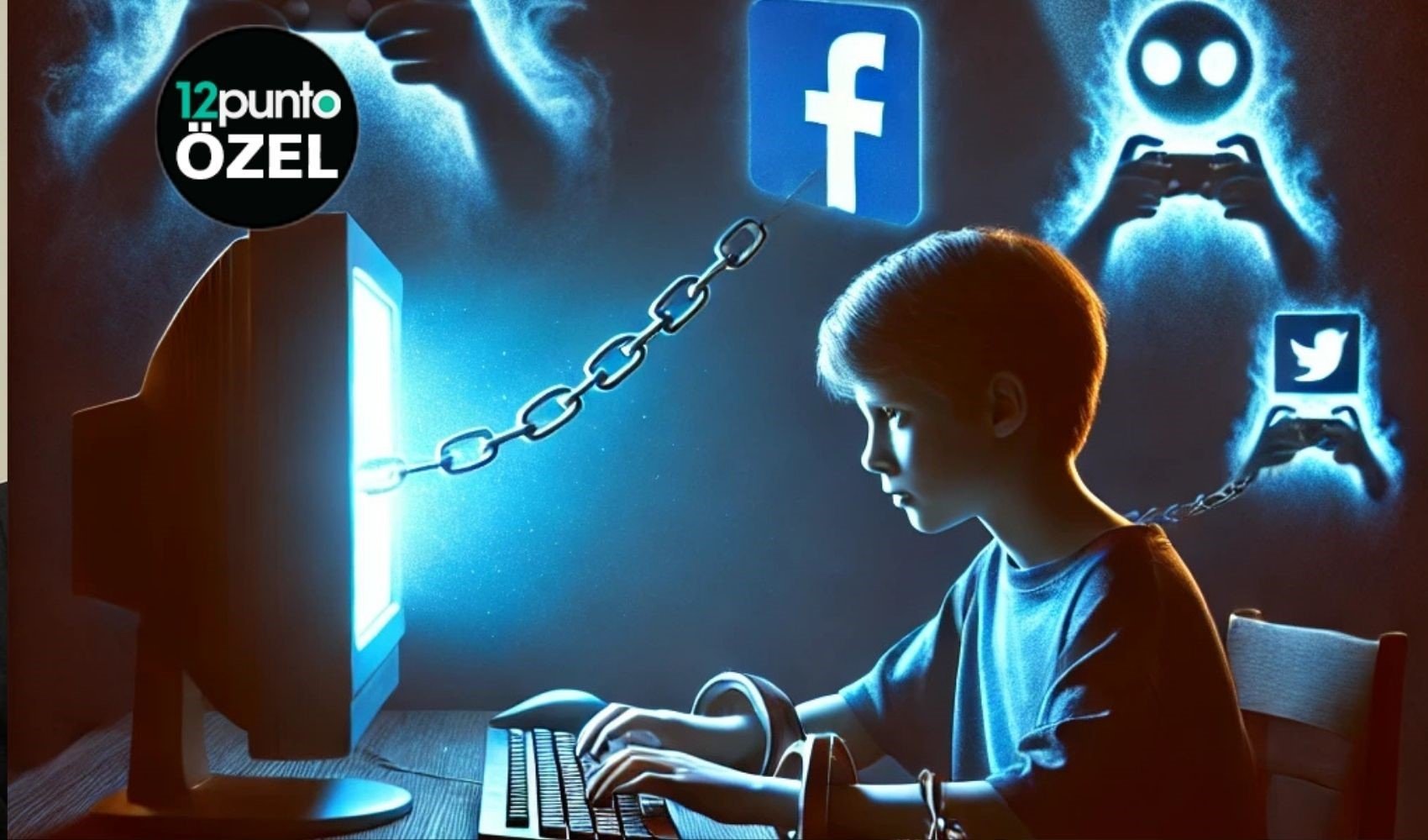
Parents are experiencing anxiety regarding their children's relationship with internet games... Are they spending too much time? Who are they talking to and meeting? What are the drawbacks of the relationship established with the virtual world?
In this context, 12punto columnist and political scientist Elfin Tataroğlu asked Psychiatrist Prof. Dr. Zeki Yüncü, who has been working for many years on all types of addiction in children and young people, especially drugs, alcohol, cigarettes, and the internet, about the things you are curious about this week.
Professor Zeki, first of all, thank you very much for sparing your valuable time. My first question is about internet addiction, which parents can no longer cope with... Does the internet, and especially online games, increase the tendency toward violence in young people?
The greatest principle of life is development. We have to adapt to the era and geography we live in. The period we are in is now the technology age. To what extent the term technology is correct to define this period is also debatable. This is a computer, even an artificial intelligence-supported technology era. It is a new era. All systems of the world are shaping themselves according to this new paradigm. There is also little possibility of going back from this innovation. Just when we had gotten used to the computer, now this has come upon us. A year or two ago, when I told my son, who was 12 at the time, "there were no mobile phones in our time," he looked at me blankly for a moment. I also looked blankly at his blank look. Our communication was momentarily broken. What I mean is that the internet and games supported by artificial intelligence are now part of our lives. However, all of these are not at the center of our lives.
When we first communicate with a person, we make some assessments about them. We evaluate their age, gender, sexual identity, education, and interests without realizing it, and we make an assessment about that person. We shape communication according to these preconceptions. All media and communication systems supported by artificial intelligence also communicate with us using the capabilities given to them by their software. They analyze our likes, our weak and strong points—in the trendy phrase, our algorithms—and bind us to themselves. Their only goal here is to keep us in their systems. The more we deal with it, the more it achieves its goal. In other words, we need to prick ourselves; the sole purpose of these game systems is for us to stay with it. We determine the content. This can be violence, sports, fine arts, gardening, or whatever you have in mind.
There is an old saying: I don't trust the environment, not you. It's a bit like that... The question that leads to a vicious circle is who determines the environment.

(Psychiatrist Prof. Dr. Zeki Yüncü)
Sometimes parents say, "My child was not prone to violence; it happened when they joined this friend group or closed themselves in their room and spent a lot of time with their computer..." Can a tendency toward violence develop later? Can underlying psychological illnesses be a trigger?
This is a very good question. When a family asks such a question, do you think they are looking for an answer? Or do they mean that others, not me, are responsible for my child's negative content choices? In other words, they attribute the source of violence in this non-violent world to everything outside of themselves. When we look at it from a psychoanalytic perspective—the place of which is indisputable philosophically—the structural theory shapes human personality on three foundations. It talks about the id, ego, and superego. Although many psychoanalytic schools after Freud and Freud himself have different interpretations, the structural theory maintains its validity. Because of our topic, I would like to dwell on the id. The id is the side of us that wants our most primitive needs to be satisfied immediately, right now. It adjusts itself only according to drives. Those drives need to be satisfied regardless of time and space. These drives are pleasure-giving actions such as sexuality, hunger, and thirst. These drives ensure survival and the continuation of the generation. In most research conducted today, the neurobiology of pleasure is also defined. In Freud's theory, he attributed a libidinal meaning to pleasure-giving activities. Since libido attracts the interest of most of us, the concept of destrudo, which Freud tried to define in the same theory, does not come to our minds. Or it remains in our unconscious without us making an effort for it not to come. Destrudo is the destructive side within a person, the death, annihilation, aggressive side. That is, it is the opposite of libido. What I mean is that we actually accept the productive side of pleasure, but we do not accept the aggressive side of pleasure. It is good that it happened this way! Throughout human evolution, people have tried to suppress this side! They have tried to curb this destructive side with different pursuits. It is obvious how successful they have been. Even though some societies glorify anger and aggression, this behavioral trait does not need to be cultivated by anyone. It is inside us like a volcano ready to erupt at any moment. I guess the question that needs to be asked is how we can put this genie back into the bottle.
How can we put it back? What are the ways to curb violence?
Generally, we don't like to say hopeless words in such interviews. We always want to keep the hopes of the reader or listener alive. We cannot succeed in curbing violence on our own. This must be a strategic goal. To achieve this, we need to ensure harmony. I would like to give an answer by slightly overstepping my boundaries. Please warn me if I go off-topic.
Polyphonic music in Turkey first started during the time of Mahmud II, before the proclamation of the Republic. With the palace orchestras established during this period, a contribution was also made to the Westernization movement. This was not an imitation or a Western admiration in the classical sense. It was an intellectual revolution. As most of us know, it was not successful. Polyphonic music mainly started during the Republican period. The first steps of many music institutions were taken after the proclamation of the Republic. Artists sent abroad to receive music education established music institutions upon their return and actively worked as instructors there, training artists and music teachers (Hatipoğlu, 2017). Polyphonic music in Turkey; the movement that came to the agenda with Mahmud II was placed on an institutional foundation thanks to the great genius Mustafa Kemal Atatürk. Polyphonic music has been a guide for the harmony of very different thoughts. The mixing of these sounds creates cacophony. Cacophony is defined as sound dissonance, everyone talking at once. It is a state where sounds, syllables, or words that come together create an unpleasant effect that is discordant to the ear.
So, in summary, I wanted to express this: an environment that is harmonious, consistent, peaceful, respectful of human and animal rights, attaches maximum importance to the safety of women and children, is respectful of nature, and where administrators make decisions with common sense must be established. It is difficult, but we have succeeded before. We will succeed again.
You are right, we can succeed again... Is addiction to internet games a kind of escape from the realities of life? What measures can families take in this regard?
Disconnecting from the realities of life is a natural act that we all resort to in our daily lives. Think of it this way: you are having a very busy day, there is a lot of news, you are trying to understand events, make connections, and establish cause-and-effect relationships. In the meantime, you received unpleasant information from a relative. You felt the need to get away from there for a moment and clear your head. You wanted to listen to a piece you like. This is a moment of disconnection. This situation is a moment of dissolution, defined as dissociation. It is the disconnection and lack of logical connection between thoughts, memories, surroundings, actions, and identity. Small escapes protect a person from larger disconnections. Vacations, concerts, small chats with friends, and games have great benefits at this point. As a matter of fact, computer games have benefits up to a point. However, sometimes things get out of hand. They get so out of hand that the line between the real world and these escape points disappears. That is when the dissolution begins. When we remember the information that the purpose of such game systems is to bind the person to themselves more, we face the problem of the disappearance of that boundary between the virtual world and the real world.
In the recent murders, we met a chat medium called Discord. Games, on the one hand, also open the door to different and dangerous friendships. Sometimes it is reflected in the press that young children have inappropriate correspondence with older people who hide their identities and hide these from their families... What do you suggest in this regard? What should families do if they sense such a relationship that children keep as a "secret" and do not talk about?
Technology usage has offered us a completely different dimension. We do not yet have a place for this dimension in our minds. We categorize this universe in our minds by calling it a virtual environment. We cannot enter the virtual environment as we wish, just by walking in. We can enter the virtual environment with applications that are structured according to our usage needs and are constantly renewed with the support of a giant software developer. There is an entrance door. We are accepted through that entrance door mainly with a username and password, and for now, to a lesser extent, with voice or face recognition systems. The applications entered have different functions. They have functions such as shopping, gambling, making friends, culture and arts, social media, and social networking. So, Discord is just one of these applications.
Discord is a free online platform that allows users who need to come together for various purposes to meet and communicate via voice, video, and text. The platform can be run either through a browser or by installing it as a program. Upon entering the Discord environment, one can be accepted into different rooms by obtaining links to various communities. These rooms can be art, sports, or science rooms, or they can be on different topics. In an internet search, it is understood that this site was founded in the USA in 2015 and reached many users in a very short time. Because the site had a huge popularity, I also became a member "with my own name" for a period. However, since I had no friends on the site, it took its place among the applications I did not use. As far as I can follow, this site is mainly used by people of youth age. It is known that every site has its own user profile and that this profile shows distribution according to different criteria. Although children and young people are on applications like Facebook and Instagram, they meet each other on applications like Discord, etc. I think of this a bit like a club membership. Like meeting points for people of similar age or views. For example, if you are a fan of Altay Sports Club, you meet your friends in the local branches of that club and chat.
Every local manager wants to gain new members to increase their operations, and no local manager wants to lose members. Therefore, they must ensure continuity by trying to select members and creating harmony among members, and of course, ensuring that they leave there safely until the next meeting after the session is closed. In other words, they must use an internal filter system and guidelines. These guidelines should also be open to inspection by the authorities in the service area. If there is no peace in the application, the number of participants will be limited. If the system is not open to inspection, it will lose members for different reasons. If the applications are subjected to heavy sanctions by the authority, it shifts to the area called the dark web and turns into a completely uncontrolled structure.
Of course, if it is determined as a result of inspections that it is inappropriate and poses a threat, these applications should be closed. However, paradoxically, closing is not a good solution. The essential thing is inspection. When Discord is closed, the way for alternative applications is opened. Unfortunately, we know that there are more risky and uninspected applications in use by everyone.
Despite everything, despite all internal and external inspections, malicious people pose a threat to people who do not yet have the competence to protect themselves. This makes us all anxious. Applications made with an easy way cause the area we can define as the "dark web" to expand. That is an uncontrollable and uninspectable environment. Families and individuals in solidarity should take children and people who do not have the competence to protect themselves under protection and support them with education. By education, I do not mean the didactic education we know, but rather good practice examples enriched with scenarios, and gaining experience in managing events before they become a threat.
Is the government carrying out sufficient work on all these addiction issues?
Unfortunately, our agenda is very busy, and when that happens, it is as if these types of issues remain in the background involuntarily. However, they become visible with the chaos experienced in the recent period. I assume that these issues are being discussed technically. However, there is a need for concrete examples reflected in practice.
News Source: 12punto