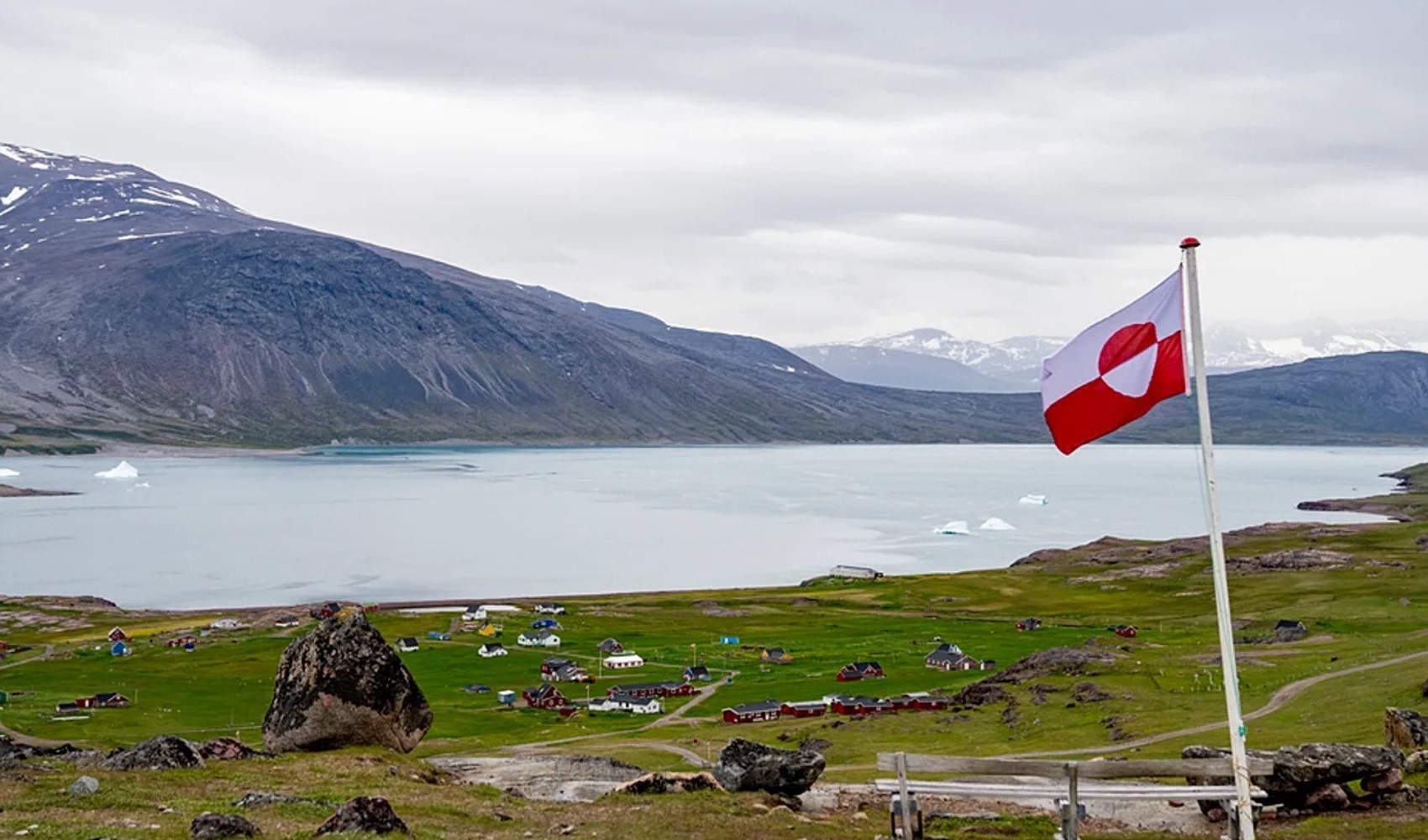
Greenland has an area of approximately 2 million 166 thousand km², which is two-thirds the size of India, yet it is home to only 56,000 people. It is larger than the sum of India's 10 largest states. It is the world's largest island. Greenland possesses 25 of the 34 critical minerals.
Although US President Donald Trump entered his second term with the "claim of ending wars," he has, on the contrary, revealed the full ambition of an imperialist state through his unconventional and aggressive political maneuvers. His military attack on Venezuela, the kidnapping of President Maduro, and his trial in America have shown that America has abandoned humanitarian values such as democracy, human rights, and peace, revealing its true face as a "rogue state." He continues his insatiable greed with threats to annex Greenland and, going even further, to make Canada the 51st state.
THE IMPORTANCE OF GREENLAND
1- Strategic location
With a rapid return to the Monroe Doctrine—dubbed the "Donroe"—the US views the consolidation of the US, Canada, and Greenland into a single entity under American control as a powerful strategic advantage against Russia.
The importance of the region goes far beyond resource exploitation and shipping routes; it is also a vital component of North American defense strategy. Given its proximity to Russia, the Arctic region constitutes a potential flashpoint in any future conflict between global powers. If hostilities break out, Canada and Greenland will serve as the first lines of defense against any military attack that might come from the north of Russia.
Indeed, the U.S. Northern Command (U.S. Northern Command) announced in a press release dated June 17, 2025, that "Greenland is now within the area of responsibility of the U.S. Northern Command. Greenland has long played an important role in the defense of North America. Reorganizing Greenland within the area of responsibility of the U.S. Northern Command strengthens our ability to protect the American homeland from today's dangers and emerging challenges. U.S. Northern Command is prepared to assume this enhanced relationship, and during the transition, it will work with U.S. European Command, Greenland, and the Kingdom of Denmark."[1] It has been announced that Greenland is now under the supervision of the American military.
Direct US control over Canada and Greenland provides a highly strategic advantage for defensive and offensive military operations against Russia. This is because these regions are positioned to allow for high-speed power projection deep into Russian territory due to their geographical proximity to Russia's critical military and economic centers.
To achieve this goal, the US has established a series of early warning and tracking radar networks in the northern hemisphere along the shortest routes that intercontinental ballistic missiles (ICBMs) launched from Russia westward or from Siberia and China eastward could take to reach the US, in order to monitor Russian and Chinese ICBMs that pose a threat to it.
The shortest suitable routes[3] that intercontinental ballistic missiles (ICBMs) launched from Russia's fixed missile bases at Vypolzovo and Tatischevo would follow toward Washington, Chicago, and Los Angeles are shown in Figure-3.
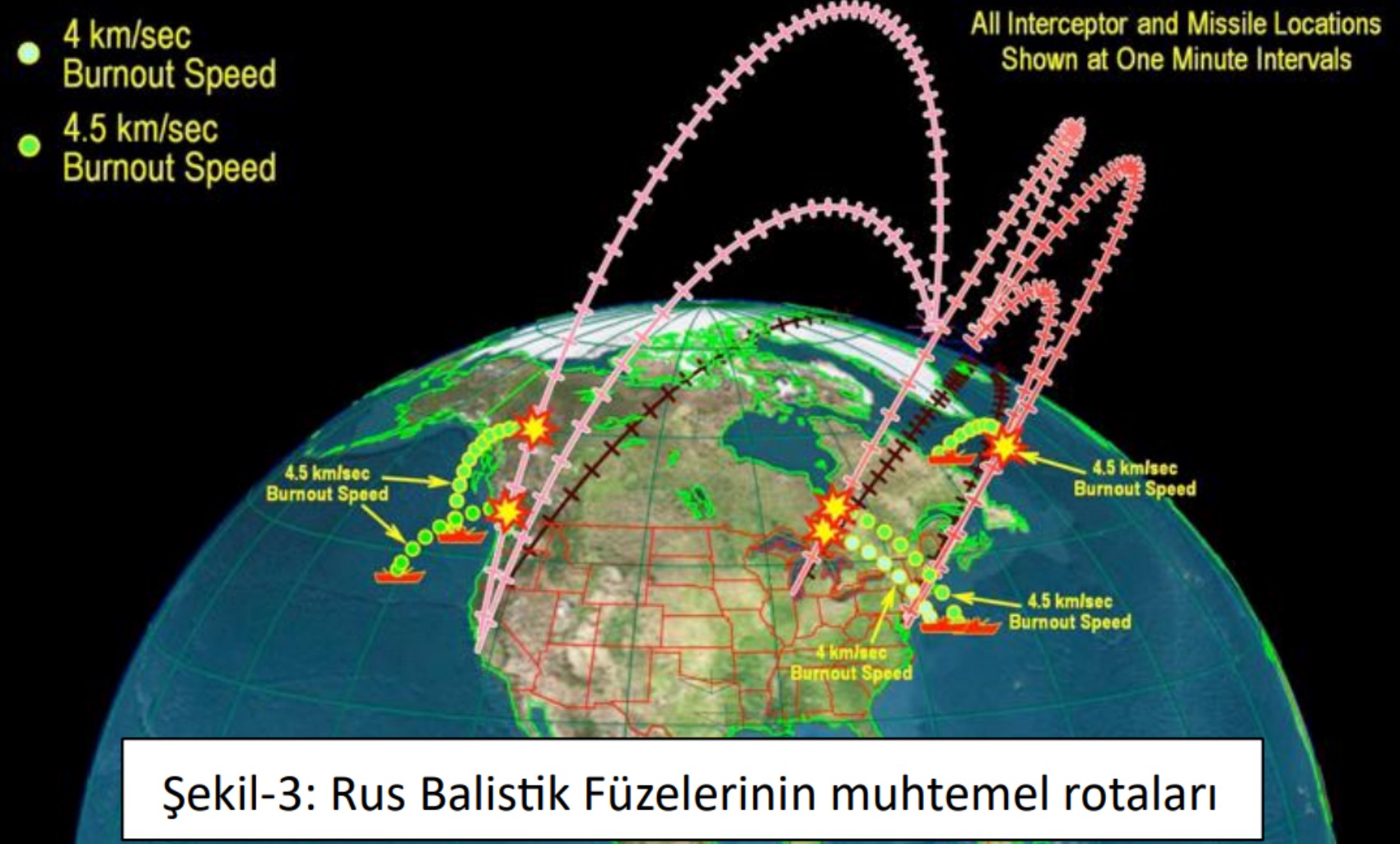
The shortest routes for intercontinental ballistic missiles launched toward America from land (ICBM) and sea (SLBM) pass over the North Pole. The identification and initial phase of these missiles' flight are carried out by the Globus-II radar in the town of Vardo, Norway. Data regarding missiles exiting the atmosphere is sent to the AN/FPS-120 model, dual-sided, solid-state, phased-array radar seen in Figure-4, which is part of the Ballistic Missile Early Warning System - Site I (BMEWS) located at the American (821st Air Base Group) base in Thule (now called Pituffik), Greenland, and the Fylingdales base in the UK. The data and information are transmitted to the Cheyenne Mountain Complex in Colorado Springs.
At Cheyenne Mountain, data from all sensors is integrated by the US Strategic Command's Missile Correlation Center and displayed at the Command Center of the North American Aerospace Defense Command (NORAD). NORAD evaluates the integrated sensor information and notifies national leadership in Ottawa and Washington whether North America is under ballistic missile attack. Additionally, NORAD provides an attack assessment, including potential impact points in North America.
Detachment 3 (Det 3) at Thule Air Base is the largest and northernmost unit of the eight worldwide satellite tracking stations in the Air Force Satellite Control Network (AFSCN). Detachment 3 is located approximately 5.6 kilometers southeast of Thule Air Base. The mission of Detachment 3 is to provide telemetry, tracking, and command operations for United States and allied government satellite programs.
The facility's very close proximity to the North Pole allows for communication with polar-orbiting satellites 10-14 times a day. It also provides ground relay services for more than 130 Department of Defense and allied satellites at altitudes ranging from 200 km to 40,000 km, and performs more than 22,000 satellite contacts per year, 24 hours a day, 7 days a week, 365 days a year, with a 99.8% success rate.[4]
As can be seen, Greenland is an extraordinarily strategic location for America and Canada. For this reason, the island chain in northern Canada and Greenland contains many suitable port facilities for US nuclear ballistic missile submarines that would provide strategic deterrence in a potential US-Russia conflict.
Furthermore, beyond its existing bases in Greenland, the US wants to install components of the "Golden Dome," a multi-layered missile defense system that would use a satellite constellation equipped with sensors and space-based interceptors.[5]
For this reason, America has announced its desire to make Canada the 51st state and to annex Greenland, aiming to secure itself from the north.
2- Arctic region natural resources
The Trump administration's threat to "seize Greenland" (in reality, to occupy Denmark, a NATO member country) has been a complete shock to Western political elites. However, the Trump administration's claim that Greenland and its waters are "gradually being brought under influence and seized by Russia and China" is not accepted anywhere.
The race to expand existing Exclusive Economic Zones (EEZs) through the Extended Continental Shelf (ECS) mechanism continues in the Arctic region. In EEZs, countries have the right to claim everything up to 370 km from their coasts. However, the ECS extends this to 650 km based on geological criteria; this process is officially overseen by the UN and provides rights to resources on the seabed. The ECS differs from the EEZ mainly because it covers the seabed and not resources in the water column (such as fish); that is, it is primarily designed for the extraction of resources on the seabed.
Although estimates vary significantly, everyone agrees that the Arctic is home to an unprecedented amount of resources (oil, natural gas, rare earth elements, etc.). Access to and control of these resources is only possible through EEZs and the ECS. For the Trump administration, this is only possible if the US annexes Greenland. Because, as seen in Figure-1, America only has a small share via Alaska.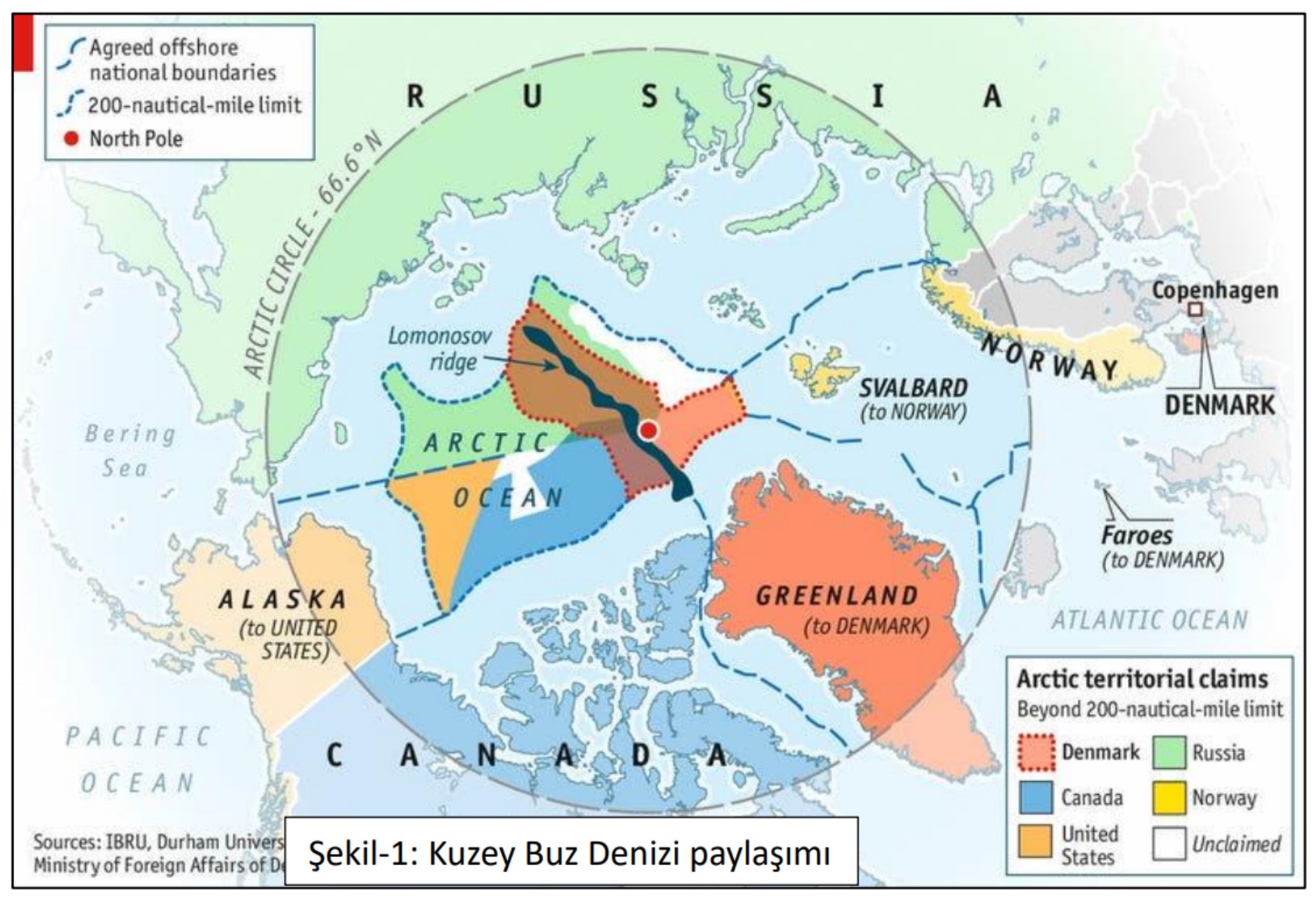
Today, China possesses 72 percent of the world's need for rare earth elements. This situation represents a major strategic "national security" danger for the US. It is estimated that the Arctic region contains approximately 13% of the world's undiscovered oil reserves and 30% of undiscovered natural gas reserves. While Canada's Arctic territories have massive crude oil and natural gas deposits, particularly in the Beaufort Sea and the Mackenzie Delta, it has been determined that Greenland's[6] offshore waters also contain 4.2 billion tons (31 billion barrels) of hydrocarbon reserves. Control over the oil and natural gas resources in this region would allow America to set energy prices, influence global supply chains, and even weaken economic rivals dependent on these resources.
Greenland has significant amounts of critical minerals
- Rare Earth Elements (REE): The deposits in Kvanefjeld, Kringlerne, and Motzfeldt are among the largest on a global scale. It is estimated to contain approximately 40 million tons of dysprosium+neodymium, an amount sufficient to meet more than 25% of the projected global demand for green technologies.
- Lithium: Found in Southern Greenland, it is vital for electric vehicle batteries.
- Uranium: Usually found together with REEs, its extraction has been banned due to environmental concerns.
- Other Metals: Gold, copper, nickel, and platinum group elements are found in smaller but valuable quantities.
Industrial Metals:
- Iron Ore: Large deposits in the Isua region.
- Zinc and Lead: The Citronen Fjord deposit is one of the world's largest undeveloped zinc reserves.
- Gold: Exploration projects in southern and western Greenland are promising.
"Direct access to elements such as dysprosium and terbium, which are required for electric vehicle motors and are vital for the defense industry and missile systems, could completely free the US from its dependence on Beijing. Therefore, Trump's 'national security' rhetoric is actually considered a diplomatic cover for the effort to secure the supply chain of these strategic minerals."
3- Arctic sea transport route
The Northern Sea Route is seen as an important alternative route for trade between Asia and Europe. This situation is increasing economic activity in the region and further intensifying the competition between major powers. This route provides significant economic savings, particularly for China, by shortening the Suez Canal maritime export route toward Europe by 8 thousand kilometers and the duration by two weeks. The new trade routes opened by icebreaker ships through the Arctic glaciers, which are thinning due to climate change, are routes outside the control of the American navy and have high geopolitical importance.
Retired Rear Admiral Cem Gürdeniz, in his commentary on the northern sea route, says, "This region is still outside the control of Anglo-Saxon naval powers. It continues to be one of the most serious problems of US geopolitics. It is trying to close this gap by making Sweden and Finland, which are adjacent to the region, NATO members. Shortly after Finland became a NATO member, it began to allow American bases under the name of NATO bases in a way that would bring the Arctic Ocean into its sphere of influence. I assess that high-firepower air and land elements will be deployed at these bases, and that very intensive weapons and ammunition stockpiling (Prepositioning) will be carried out in advance. In parallel with these developments, it can be expected that Russia will establish new bases on the Finnish border, deploy new bases with tactical and strategic missile batteries and air defense systems, and develop and increase the density of maritime traffic reaching Chinese ports on the Northern Sea Route in the Arctic Ocean."[9]
America has no active "polar icebreaker" other than the 9 icebreaker ships operated by the Coast Guard in the Great Lakes region. As a temporary remedy for this weakness of America, on July 10, 2025, the leaders of the US, Canada, and Finland signed a memorandum of understanding called "The Icebreaker Collaboration Effort (ICE Agreement)."[10]
Russia, on the other hand, has great power in the Arctic, where the US cannot show a presence. The world's first nuclear-powered icebreaker, Lenin, entered service on December 3, 1959. Since then, the USSR and Russia have maintained their leadership in the construction of ships of this class. Currently, Russia has a fleet of 41 icebreakers in total, 34 of which are diesel-electric and 7 of which are nuclear-powered. Thanks to this fleet, the amount of transit cargo on the Northern Sea Route, which is kept open for about eight months, was 36.254 million tons in 2023, and this amount will increase as the fleet's capabilities improve and this route is kept open for navigation throughout the year.
America's request to annex Greenland came after Trump's meeting with NATO Secretary General Mark Rutte, whom he met on the sidelines of the World Economic Forum Annual Meeting held in Davos, Switzerland, on Wednesday, January 21, 2026. Trump said, "We have a draft agreement. It's about security, big security, strong security, and other things." Avoiding giving further details, including whether the agreement includes any US ownership of Greenland's mining rights, Trump said the agreement would last "forever," and in his post on Truth Social, he stated that the discussions regarding the Golden Dome missile defense system concerning Greenland were part of the negotiations to be chaired by Vice President JD Vance, Secretary of State Marco Rubio, and special envoy Steve Witkoff.
According to these developments, Greenland will continue to exist as an autonomous region under Danish sovereignty, but in addition to the existing Thule base in Greenland, new Golden Dome missile defense bases will be established, and all base lands will be under US sovereignty forever.
This is the fundamental reason for Trump's desire to annex Greenland.
News Source: 12punto