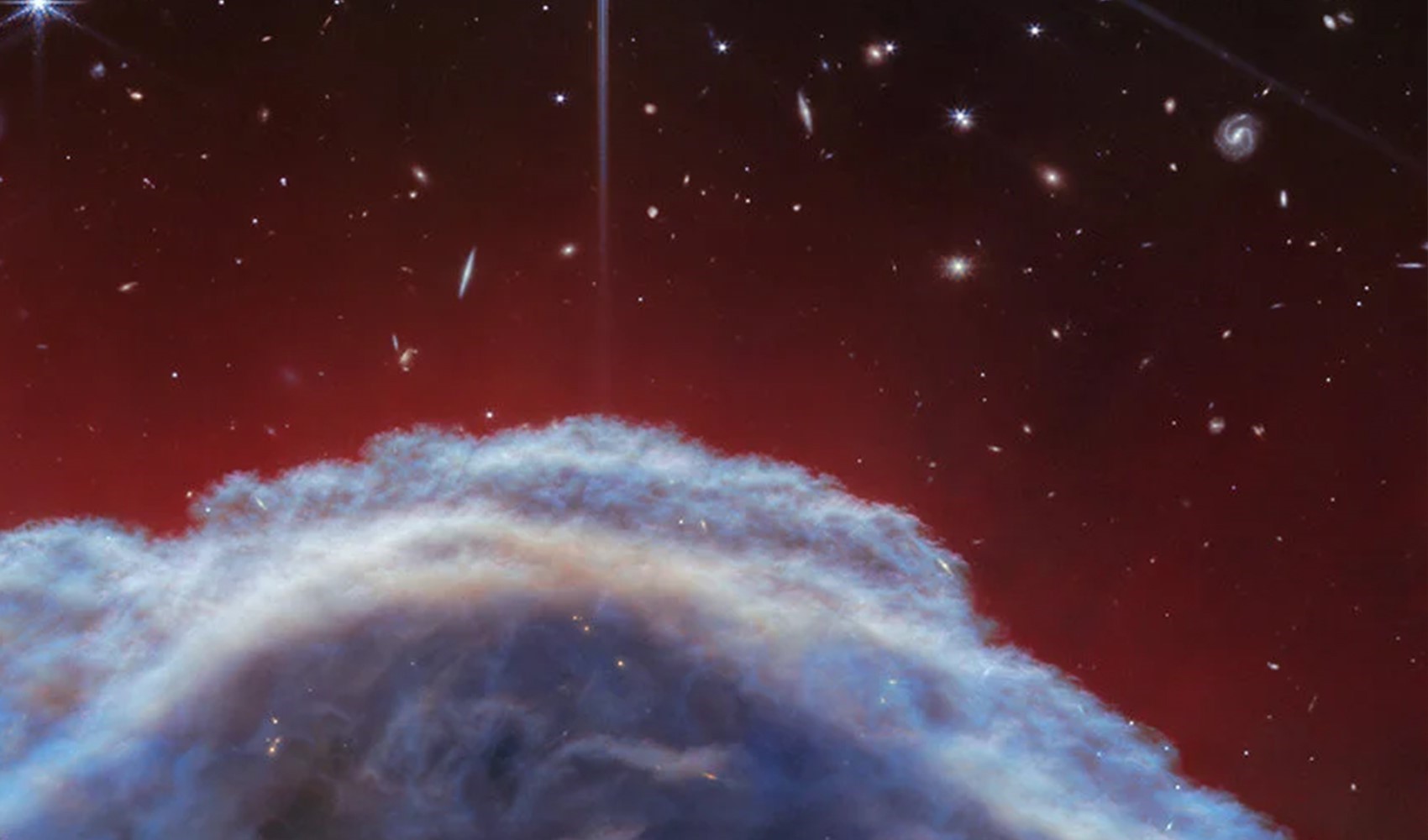
The U.S. National Aeronautics and Space Administration (NASA) James Webb Space Telescope (JWST) has taken the most detailed photographs to date of Barnard 33, located in the constellation Orion and also known as the Horsehead Nebula due to its striking appearance.
According to NASA, the Horsehead Nebula, which resembles a mare tossing its head, appears as turbulent waves of gas rising from the western side of Orion B, a molecular cloud conducive to star formation located 1,300 light-years from Earth in the constellation Orion.
The nebula, which glows as it is illuminated by a nearby hot star, consists of a dense column of cold gas and dust that has been revealed due to the erosion of lighter gas.
Astronomers estimate that this column will dissipate within 5 million years.
The JWST's Near-Infrared Camera (NIRCam) focused on the upper section of the nebula, which appears as a curved wall of thick, smoky gas and dust against which distant stars and galaxies are visible.
An international team of astronomers, examining the NIRCam images alongside those from the Mid-Infrared Instrument (MIRI), identified small-scale structures on the illuminated edge of the nebula.
As ultraviolet (UV) light evaporates the dust cloud, dust particles are dragged away from the cloud along with heated gas, creating structures that move in a similar fashion.
The Horsehead Nebula is known as a neutral, warm area of gas and dust called a "photodissociation region" (PDR), which is heated by ultraviolet light from young, massive stars and can be distinguished from the ionized gas surrounding those massive stars.
Studying the light from such regions allows scientists to examine the physical and chemical processes that drive star formation and the evolution of interstellar matter in the universe.
The research was published in the journal Astronomy & Astrophysics.

News Source: AA