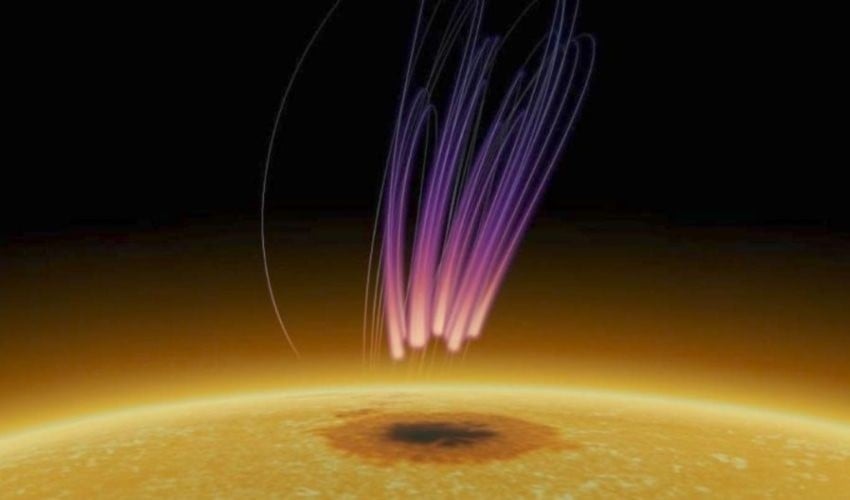
The striking phenomenon appeared 40 thousand kilometers above a sunspot. Sunspots are regions on the Sun where magnetic force is very intense and some heat is prevented from reaching the star's surface.
Astronomers observed the radio waves emerging above the sunspot in question for a week.
In the past, signals resembling auroras coming from distant stars had been detected. However, this is the first time such signals have been seen coming from the Sun.
UNDERSTANDING OF MAGNETIC PROCESSES IN STARS MAY CHANGE
As reported by Independent Türkçe, the findings obtained from the observations were published on November 13 in the peer-reviewed scientific journal Nature Astronomy.
Lead author Sijie Yu from the New Jersey Institute of Technology said, "This is quite different from the typical, transient radio bursts that last for minutes or hours":
We have made an exciting discovery that could change our understanding of the magnetic processes of stars.
This surprising phenomenon is believed to be the result of electrons released during solar flares accelerating along the sunspot's strong magnetic field lines.
The frequency of the emissions creating this phenomenon reaches up to 1 million kHz. The frequency of typical auroras on Earth, however, ranges between 100 and 500 kHz.
Yu stated, "The magnetic field of the sunspot is thousands of times stronger than that of Earth."
Co-author of the study Surajit Mondal also made the following remarks on the subject:
We are beginning to piece together the puzzle of how energetic particles and magnetic fields interact in a system with long-lived starspots.
News Source: 12punto