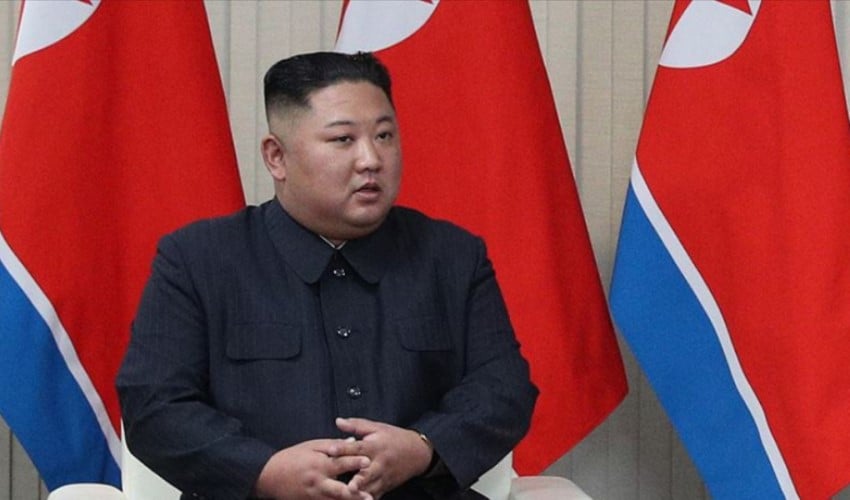
On January 5, North Korea fired hundreds of artillery shells into waters near South Korean border islands. Last week, it stated that it no longer views the South as a place inhabited by its "compatriots," but as a "hostile state" that it would subjugate through nuclear war. On Friday, it announced that it had tested an underwater nuclear drone designed to help repel US Navy fleets.
According to a report by Choe Sang-Hun in The New York Times, as the US and its allies are preoccupied with wars in Ukraine and the Middle East, these new threats have led foreign officials and analysts to wonder whether North Korean leader Kim Jong Un has moved beyond his usual posturing and is planning to use more military force.
A surprise attack on South Korea could be possible
For decades, North Korea has staged carefully measured and timed military provocations to maintain internal discipline, attract the attention of some of its neighbors and the US, or to do all of these at once.
However, for many who closely monitor North Korea, the latest signals from Kim carry a different meaning. While some interpret this as a hint that the North is frustrated in its search for diplomatic engagement with the West, a few are raising the possibility that the country may be planning a surprise attack on South Korea.
Kim Jong Un has made a decision for war
Two analysts experienced in North Korean affairs—former State Department official Robert Carlin and nuclear scientist Siegfried Hecker—sounded the alarm in an article they wrote last week for the US-based website 38 North, arguing that Kim is done with threats and writing, "Kim Jong Un has made a strategic decision to go to war."
The rules of the game may be changing
Analysts generally agree that North Korea has shifted its stance in recent years due to a combination of internal problems, such as its struggling economy and shortages of food and fuel, and frustrations in its foreign diplomacy, including Kim's failure to end international sanctions through direct diplomacy with former President Donald Trump. Most agree that the North's rapprochement with Russia, including the supply of artillery shells and missiles for use in Russia's war in Ukraine, will change the rules of the game in some way.
However, there are still serious disagreements about where Kim's new attitude will lead.
What is North Korea aiming for?
Many say that Kim's ultimate goal is not to fight a war with the US's treaty ally, South Korea, but to force Washington to accept his country as a nuclear power by initiating arms reduction talks.
If North Korea attacks, it would be suicide
Park Won-gon, a North Korea expert at Ewha Womans University in Seoul, said, "Unless the North Koreans decide to commit suicide, they will not start a war; they know very well that they cannot win a war," adding: "However, they would very much like their enemies to believe that they could win, because this could lead to engagement and potential concessions, such as the easing of sanctions."
Analysts in China, North Korea's most important ally, also have deep doubts that Kim will go to war unless the North is attacked. Professor Shi Yinhong of Renmin University in Beijing argued that the North's leadership is not irrational, that it ultimately acts for the purpose of self-preservation, and that starting a war would be contrary to that goal.
Other analysts noted that the North could demonstrate its military strength without having to trigger a lethal response, including through smaller conventional attacks and bolder weapons tests.
North Korea has many options other than war
Victor Cha, a Korea expert at the Washington-based Center for Strategic and International Studies, said, "There are many rungs on the ladder of escalation for North Korea short of all-out war," adding: "Kim is not that confident in his capabilities to deter a US response if he were to do something reckless."
If Kim wants to climb that ladder, recent history suggests now might be the time.
The timing is striking
North Korea enjoys unsettling its enemies during their most sensitive political moments, and both the US and South Korea are heading to the polls this year. The North launched a long-range rocket in late 2012, between the US and South Korean presidential elections. It conducted a nuclear test shortly before the South Korean leader took office in 2013. In 2016, it carried out another nuclear test two months before the US presidential election.
A plan to spread fear of nuclear war
Ko Jae-hong, an analyst at the Seoul-based Institute for National Security Strategy, said that North Korea might engage in provocations in the coming weeks to help liberals who support inter-Korean negotiations win the parliamentary elections to be held in South Korea in April. Ko stated that North Korea hopes to spread fear among South Korean voters that increasing pressure on the North, as the current administration of President Yoon Suk Yeol is trying to do, could lead to a "nuclear war" through these provocations.
North Korea tension will end with the US elections
Thomas Schäfer, a former German diplomat who served twice as ambassador to North Korea, stated that North Korea "will continue to escalate tensions until after the US elections." However, refuting the analyses of Carlin and Hecker, Schäfer said, "At the peak of the tension, North Korea will be willing to re-engage with a Republican administration in the hope of sanctions relief, some form of acceptance of their nuclear program, and—as a primary goal—the reduction or complete withdrawal of US troops from the Korean Peninsula."
Since coming to power in 2011, Kim has been determined to develop North Korea's nuclear capacity, using it both as a deterrent and as a bargaining tool to extract concessions from Washington, such as the lifting of UN sanctions, to facilitate economic growth.
The breaking point
He attempted this when he met with Trump in 2018 and tried again repeatedly the following year. However, Kim failed in these efforts and returned home empty-handed. He then vowed to find a "new path" for his country.
Since then, the North has rejected repeated calls for talks from Washington. Furthermore, by dismissing South Korea as a dialogue partner, he stated from 2022 onwards that he would use nuclear weapons against South Korea in a war, abandoning his long-standing position that the weapons would keep the Korean Peninsula peaceful as a deterrent. He has tested more diverse and harder-to-intercept vehicles to carry his nuclear warheads.
There are doubts that the North has yet built a reliable intercontinental ballistic missile capable of targeting the US. However, the North's two main enemies, South Korea and Japan, are much closer.
Dangerous rapprochement with Russia
On the diplomatic front, Kim has put significant effort into signaling that he no longer views the US as a critical negotiating partner, instead envisioning a "neo-Cold War" in which the US is globally retreating. Officials say Kim is aggressively developing military ties with Russia, and in return, he has likely secured promises of food aid and technological assistance for his weapons programs from Russia.
Despite adopting an increasingly aggressive military stance in recent years, China could potentially restrain any military adventurism by North Korea.
China and North Korea are bound by a treaty signed in 1961 that requires both countries to provide military assistance if the other is attacked. However, China currently has little reason to be drawn into a war in Korea.
A war in Korea would be a catastrophe for China
John Delury, a professor at Yonsei University in Seoul, stated, "A war on the Korean Peninsula would be a disaster for Beijing. The half-century of peace in East Asia, which has been a period of unprecedented growth for China, would come to an end."
News Source: 12punto