

The real test for the Left Party begins now: Will Elif Eralp bury her promises?
Very strange developments are taking place in Germany. In Sunday's elections, the conservative democratic CDU and the social democratic SPD, which jointly govern the state and city of Berlin, suffered heavy losses. The ballot box practically rubbed the political price of voter dissatisfaction in Germany in our faces. But it would be simplistic to read this election only as 'Berlin has turned to the left.' Because voters went both left and right. The only common point is that voters are moving away from the center.



IŞIN ERTÜRK
On one side, NATO, the war in Ukraine, defense spending, and armament. On the other, millions thinking about how to pay their rent, energy bills, and grocery shopping. The middle class is eroding a little more every day. The poor are becoming even poorer. At the ballot box, at least this time, peace did not win. As expected, the struggle for livelihood weighed more heavily.
The peace, anti-tension with Russia, and anti-armament line of Sahra Wagenknecht's left-leaning party, BSW, could not carry the voters in Berlin. In contrast, the housing shortage, the rent explosion, and municipal housing became the strongest issue in the Left Party's hands. The German alternative media clearly writes that peace policy has fallen behind in the voters' priority list in Berlin, and the housing issue determined the election. Although the conclusion that voters do not care about war policies cannot be drawn from a single election, it is clear that the pressure of daily life has moved ahead of the debate on war and armament.
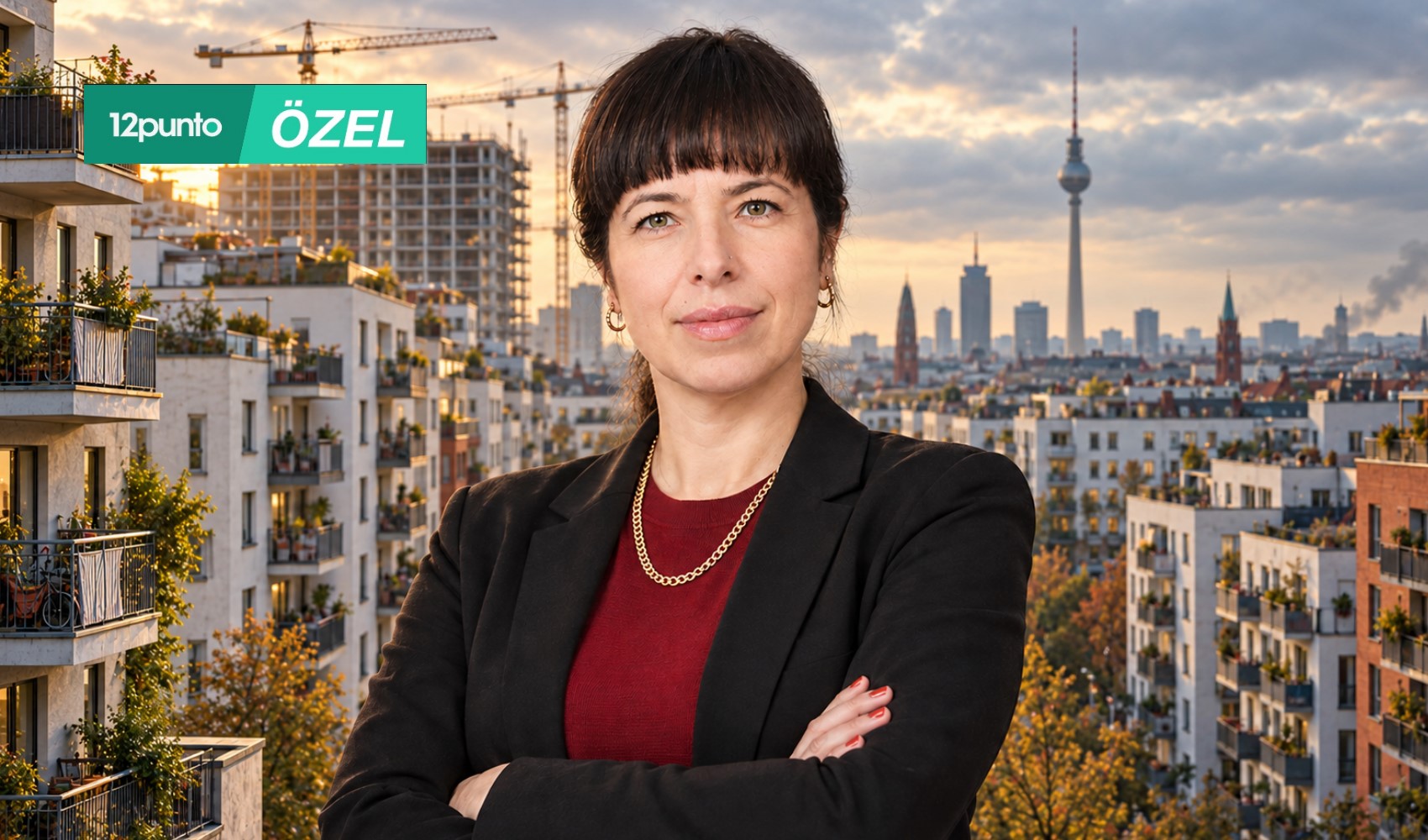
The name at the center of the night was Turkish-origin lawyer Elif Eralp. It is possible to say that a full “liberal left” German politician profile is being drawn for Eralp. She is a political figure who knows the subtleties of dancing at critical points, such as in the Israel-Palestine equation. But let's come to that later.
The Left Party achieved one of its strongest results in history in Berlin. If Eralp can form a coalition, it is possible for a female politician of the Left Party with Turkish roots to lead Berlin. However, the challenging test begins now. Because Eralp and her party did not just promise “change” to Berliners; they placed the expropriation of large private housing companies and large-scale municipal housing construction at the center of their campaign.
“THIS METHOD HAS ALWAYS WORKED SO FAR”
But are these promises that can really be implemented? For now, they look like demands that “win more votes,” which are expected to be pruned one by one when sitting at the coalition table. The warning today from German journalist and author Rainer Balcerowiak, one of the writers of Germany's leading critical news analysis portal “NachDenkSeiten,” is extremely important at this very point:
“The Left Party can be expected to act as ‘flexibly’ as ever in the face of the possibility of joining the government or even Elif Eralp becoming the Governing Mayor of Berlin. Not only the expropriation of large private housing companies but also other important promises of the election campaign could be buried quite quickly. The party base, which will later vote on the coalition agreement, can also be brought into line with the argument that ‘if these compromises are not made, something much worse will happen because the CDU will remain in power.’ This method has always worked so far.”
Therefore, it is time to ask perhaps the most critical question of the Berlin election: Will the housing policy that made the Left Party the winner in Berlin be defended with the same firmness when government negotiations begin?
ERALP’S “DANCE” HAD DRAWN ATTENTION BEFORE
We are not asking this question for the first time today regarding Elif Eralp. When the election results were announced, referring to the right-wing populist Alternative for Germany (AfD) party emerging as the first party in the Saxony-Anhalt elections, Elif Eralp described her election victory with the words, “I am an answer given to Saxony-Anhalt.”
As I reported in the article that appeared in 12punto about three weeks before the elections: “Even if Elif Eralp wins, she cannot stop the rise of the right-wing populist AfD in Germany. As for the Israel-Palestine issue, we can say for now that she dances well.”
As for the Israel issue, Eralp is indeed following a fine line. In March 2026, she openly opposed the “Zionism” decision of the Lower Saxony Left Party organization, saying that “Israel's right to exist cannot be a matter of negotiation.” She also emphasized that “the historical meaning that Zionism carries for many Jews cannot be ignored.” But it is not easy to say that she has retreated on the Palestinian issue.
Eralp stood behind the line advocating that both the concerns of the Palestinian community in Berlin and the fears of the Jewish community be taken into account at the Left Party congress in November 2025. At the same congress, the Gaza war was one of the most heated topics of discussion within the party. In December, she wanted a sister-city relationship to be established between Berlin and Ramallah, while also defending the continuation of the existing sister-city relationship with Tel Aviv. How about that?... A complete 'playing both sides' policy. In other words, she did not say “Either Tel Aviv or Ramallah.” She said “Tel Aviv and Ramallah.” Some might call this “trying to please everyone.” Eralp, however, sees this approach as “inclusive politics.” This politician, who works in the fields of combating antisemitism, racism, anti-Muslim sentiment, and discrimination, also opened the idea of making important Jewish and Muslim holidays official holidays in Berlin to discussion in May.
But how much resonance does this recipe find in today's hardened and polarized Germany?
We shall see.
There is one detail that should not be overlooked: Sahra Wagenknecht. The stars of Wagenknecht, one of Germany's strongest advocates of peace politics, and Eralp never aligned. Wagenknecht left the Left Party and founded the BSW, which bears her own name. Now the ballot box has produced an interesting result. Eralp's Left Party came in first in Berlin. Wagenknecht's BSW, on the other hand, fell below the 5 percent election threshold by a few thousand votes.
CDU’S FRUSTRATION: ONCE AN EAGLE, NOW...
Another heavy result of the election came for the Christian Democrats (CDU). The CDU was at the political center of Germany for 16 years with Helmut Kohl and another 16 years with Angela Merkel. It was one of the main actors in shaping not only Germany's but also the European Union's economy and politics. Now it is experiencing heavy losses in the capital, Berlin. In Mecklenburg-Vorpommern, the situation is even more dire. The CDU fell to 4.9 percent and remained outside the state parliament, failing to cross the 5 percent threshold. German journalist Balcerowiak evaluates the result as a “spectacular disaster” and conveys that the result could further fuel the Friedrich Merz debate within the federal CDU with these words:
“This extraordinary election disaster experienced by the CDU will not be without consequences within the federal party. It is expected that this heavy experience will strengthen the signs of disintegration within the CDU and seriously fuel the debate on the dismissal of Friedrich Merz.”
Of course, his party being wiped out of parliament in one state does not legally bring down Friedrich Merz. However, it does not make it easy for the CDU to continue as if nothing happened. Because the CDU, which once appeared to be the country's almost natural ruling party, being completely wiped out of a state parliament cannot be brushed off as an ordinary election defeat.
“HOUSING CRISIS” MATERIAL: THE POWER EQUATION WILL CHALLENGE THE LEFT PARTY
The winning topic of the election in Berlin was clearly housing. While the housing shortage and rent explosion are reaching existential dimensions for more and more people, the Left Party put forward the clearest demands on this issue. The expropriation of large private housing companies and a large-scale municipal housing program were at the forefront of the campaign. The Left Party received over 40 percent of the vote, especially in the 16-24 age group. Moreover, it benefited from the increased voter turnout and attracted far more voters who had not gone to the polls before compared to other parties.
Balcerowiak, who also writes for various publications including Neues Deutschland and Cicero, points out that this was previously an area where the AfD was particularly strong. After the election in Berlin, two main government options appear. “CDU-Greens-SPD” and “Left Party-Greens-SPD.” The Left Party, as the first party, can claim to form the government. But the CDU option is also in the hands of the Greens and the SPD. One of the biggest conflict topics will be the expropriation of large private housing companies.
In his article in NachDenkSeiten, Balcerowiak emphasizes that he expects a harsh veto from the SPD on this issue. He says that Berlin's Olympic bid and the strengthening of the police are also among the areas that could cause problems between the parties. He notes that it is also possible that the Greens and the SPD might see the weakened CDU as an easier partner after the first meetings with the Left Party. The German journalist also does not overlook that on election night, leading figures from both parties brought up the “antisemitism problem” within the Left Party as one of the obstacles in front of a possible red-green-red coalition.
It will also be necessary to look at how durable the coalition to be formed in Berlin will be. The problem may not come from the outside, but from within the coalition itself. Will the majority be able to survive critical votes? We will wait and see.
THE “BLUE WAVE” THE AfD EXPECTED DID NOT REACH BERLIN
The AfD, which also includes far-right and fascist groups, had entered Berlin with high expectations following its success in Saxony-Anhalt. Although it received high results in the regions where it is strong in the east of the city, it could not achieve the leap it expected across Berlin. In Balcerowiak's words: “The AfD was practically unable to walk from its power following its election victory in Saxony-Anhalt and was expecting a much better result in Berlin. It reached rates reminiscent of Saxony-Anhalt in its strongholds in the east of the city, but this was definitely not enough for a ‘blue wave’ that would cover all of Berlin.”
As Balcerowiak emphasizes, the fact that the “blue wave,” the party's color, did not arrive in Berlin does not mean that the AfD issue has disappeared. Let me repeat the sentence I wrote here three weeks ago: Even if Elif Eralp wins, she cannot stop the rise of the right-wing populist AfD in Germany alone. Because while voters in Berlin were moving to the left, the AfD became the first party in Mecklenburg-Vorpommern with 38.2 percent.
WHY DID THE PEACE DISCOURSE NOT WIN?
In the article, the BSW's result is shown as one of the topics that should be thought about the most in these elections. Balcerowiak, who reports that the party hoped to rise again in Berlin following its success in Saxony-Anhalt, states that it highlighted peace policy in an environment where tension with Russia is escalating, and that the protests organized against the closure of the Russian House in Berlin were also one of the visible parts of this line.
Balcerowiak's assessment is clear: “Peace policy, which found a certain response in Berlin in the European and Federal Parliament elections, fell significantly behind in the voters' priority list when it came to state elections in this city, whose infrastructure and social structure have been seriously worn down. Moreover, the fact that the BSW could not offer anything unique regarding Berlin's urban policies was added to this. In the end, it was not enough to cross the threshold.” Furthermore, Mecklenburg-Vorpommern is on the Baltic Sea coast. It is a state where the tension with Russia is felt much more closely. Despite this, Balcerowiak states that this topic found a very limited response among voters.
Actually, this is exactly the sensitive point: Do people not know the consequences of war? Of course they do. But for a voter thinking about how to make ends meet at the end of the month, tomorrow's major geopolitical danger and today's rent do not look the same weight. Even war and armament policies that directly concern the future of their children can remain in the shadow of daily livelihood struggles.
“WAR CREDIT” CRITICISM
In Mecklenburg-Vorpommern, the current SPD-Left Party coalition no longer has a majority. A three-party government with the participation of the Greens is possible. Balcerowiak makes one of the harshest assessments of his article right here: “No serious disagreement is expected between the three parties regarding the policy of becoming war-ready. The SPD and the Greens already belong to the war-mongering camp. The Left Party also passed the state's vote on war credits in the Bundesrat (Federal Council) without showing any serious objection. Therefore, there is not much reason to expect a major conflict that would shake the newly formed government on this issue.”
This sentence is important. Because while peace and armament were being discussed during the election campaign, it directly raises the question of how differently the governments to be formed after the election will actually behave on this issue.
MERZ INSISTS ON “REFORM” POLICY
The bill, which the federal government plans to put into effect on January 1, 2027, includes stopping the planned increase in housing assistance and halving the section called Heizkostenkomponente (heating cost support). The government defends this not as the liquidation of the social state, but as balancing the budget and securing the long-term financing of social systems. Meanwhile, Sidar Çarman, Director of the Stuttgart Branch of the United Services Union (ver.di), called for taking to the streets on September 26 at Stuttgart Schlossplatz with the slogan “#HARTVERDIENT – Sozialstaat schützen” (“Hard-earned – Let's protect the social state”) against the federal government's plans regarding social policy and working life. The topics of the discussion include longer and flexible working hours, fixed-term employment contracts, retirement, health, the care system, and Wohngeld (rent support).
In Germany, the question is becoming increasingly naked: Who will bear the cost of the social state?
After this background, let's continue with Balcerowiak's election assessment. The German journalist points to the speech Friedrich Merz made immediately after the first estimates as one of the striking moments of election night. The author describes Merz's image as “strangely detached from reality.” Despite the heavy losses his party suffered, Merz argued that the government's reform policy should be implemented more decisively. Balcerowiak interprets the situation as follows: “The Chancellor said that despite the heavy collapse his party suffered, the government's reform line should now be pursued even more decisively. He announced that this requires ‘backbone, determination, and patience,’ and that he would show these as the CDU Chairman and, above all, as the Federal Chancellor. What the two election defeats will mean for the BSW is not yet clear; the shock after the success in Saxony-Anhalt is deep, and the first reactions present a defiant but equally clumsy image.”
IS THE TIMER TICKING FOR MERZ AND THE GOVERNMENT TOO?
Although Sunday's election did not remove Friedrich Merz from office, nor did it topple the government, it opened the debate. The CDU suffering heavy losses in Berlin, remaining outside the parliament in Mecklenburg-Vorpommern, and the general melting of center parties could increase the pressure on Merz in the coming period. That is why the final sentence of German journalist and author Balcerowiak should be read carefully: “A lot will happen by then. And today, probably no one would want to bet that Friedrich Merz will still be chancellor then or that the federal government will continue to exist in its current form.”
What is certain is that the ballot box in Berlin and Mecklenburg-Vorpommern did not just produce numbers that would change governments; it once again made the erosion of center politics visible. It also placed a heavy responsibility on the Left Party in Berlin. Now, Elif Eralp faces the real test. Will she be able to stand tall when the government door opens regarding the promises made to the voters? Frankly, the impression that the demands that won the election, especially the expropriation of housing companies, will turn into “compromise” topics at the coalition table is overwhelming.
In short, voters in Berlin did not listen to politics that did not listen to the people. In other words, voters in Berlin did not bother to pay attention to politics that did not take the people into account.
Now it is time to see if those who say they hear the voters' voice are really listening.
That is what happened.
IŞIN ERTÜRK - STUTTGART
News Source: 12punto
Most Read

Transaction suspension decision from MASAK

'Direct dialogue between Erdoğan and Trump has created room for maneuver'

From 1453 to 2026: As the West's 500-year world system comes to an end

Number of MP transfers from the New Party to the CHP is rising
A call from Şamil Tayyar following the fund operation

New operation in fund investigation
Partners of famous Istanbul shopping mall detained
The real test for the Left Party begins now

Operation on law firms and companies in 4 provinces
'Her jeans were shredded, there was so much blood on the ground'