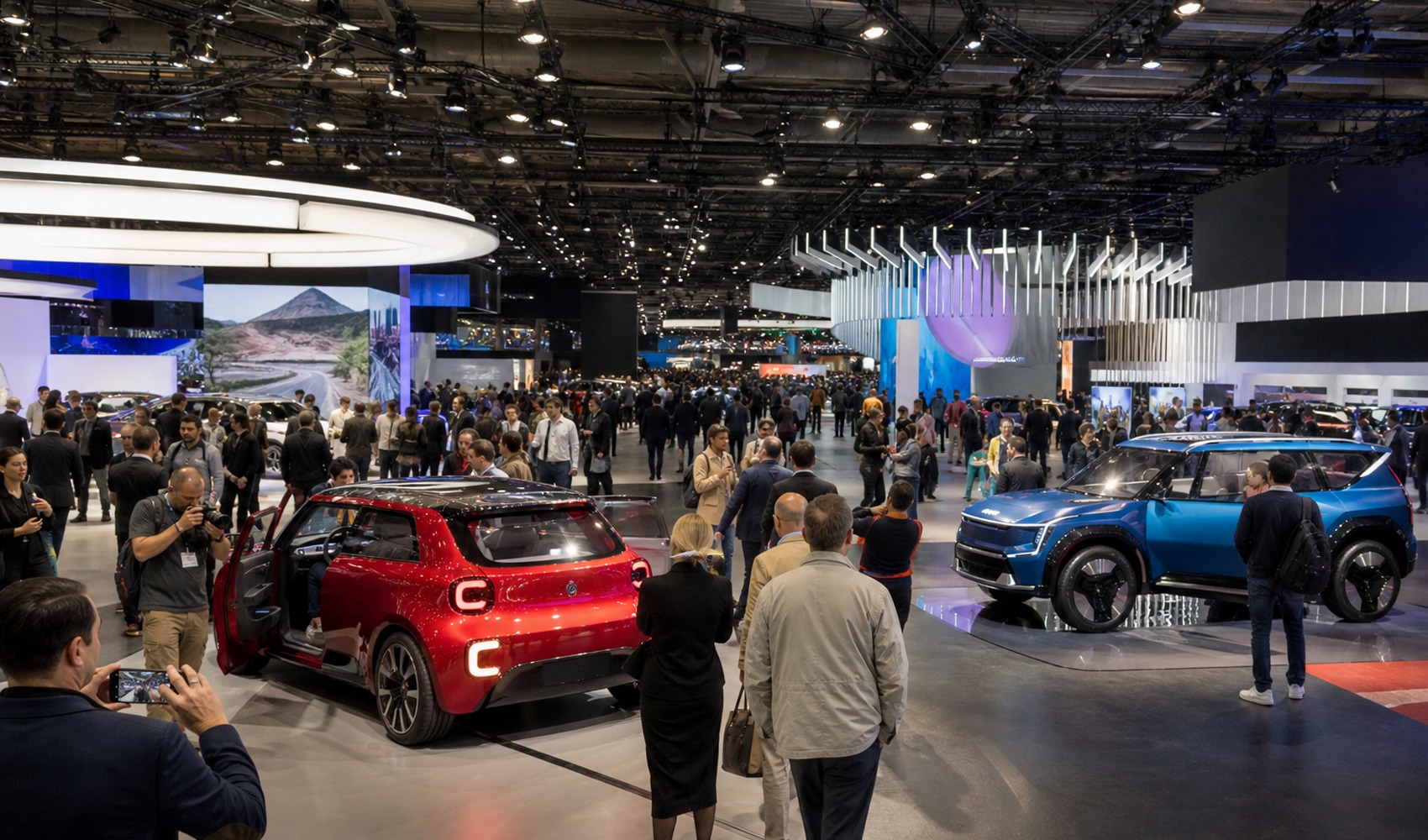
The 2026 Paris Motor Show has brought the automotive industry's electric transformation to the agenda, not only with new SUV models but also with reinterpretations of familiar names from the past. The event, which began on October 12 at Paris Expo Porte de Versailles, will welcome visitors until October 18.
One of the prominent themes at the fair was brands revisiting models that left a mark in the past to meet the needs of the electric age. The Citroën 2CV, Renault E-Space, and Peugeot RCZ Vision were among the notable examples of this trend. However, not all vehicles on display are at the same stage; while some were introduced as models preparing for sale, others are positioned as design and technology research projects.
CLASSIC NAMES ARE BEING CARRIED INTO THE ELECTRIC AGE
Citroën's most striking work in Paris was bringing the 2CV name back to the agenda with an electric concept. The 3.76-meter-long 2CV Concept carries traces of the original model's simple and lightweight character. According to the brand's statement, this study could form the basis for a car planned to join the product range by 2028. The target starting price for the model, which is envisioned to be produced in Europe, is approximately 15,000 euros; however, this amount is not a finalized sales price.
Volkswagen, on the other hand, is preparing for a new era in its electric SUV family with the ID. Tiguan. The model, which is planned to replace the ID.4 and ID.5 at the beginning of 2027, will be included in the product range alongside internal combustion and hybrid Tiguan options. The ID. Tiguan, which uses the MEB+ platform, features 58 and 77 kWh battery options, as well as rear-wheel drive and all-wheel drive alternatives. While power varies between 190 and 299 hp depending on the version, it is stated that the WLTP range could reach up to 600 kilometers.
On the compact electric car side, the Smart #2 and Audi A2 e-tron stood out. While the Smart #2 continues the two-seater city car approach with a fully electric model, it is being prepared for the European and Chinese markets. The Audi A2 e-tron was introduced with a WLTP range of up to 646 kilometers and bidirectional charging capability. The model is planned to hit European roads in December 2026.
TURKEY-PRODUCED BAYON AND AFFORDABLE MODELS
Hyundai's new Bayon was one of the prominent introductions of the fair for Turkey. The model, which is produced in Turkey for the European market, was displayed with a more angular body design and a renewed cabin. Depending on the equipment, dual 12.3-inch screens, a digital key, and wireless smartphone connectivity will be offered. For the hybrid engine option, 2027 is being pointed to.
The second-generation Spring and the new Striker drew attention at the Dacia stand. The new Spring, produced in Europe, is aimed to be positioned with a starting price of under 18,000 euros. The Striker in the C-segment was introduced as a crossover targeting both individual users and corporate fleets with hybrid and LPG engine options.
Renault reopened the debate on the interior space idea in family cars with the E-Space Concept. A single-volume body, a cabin that receives natural light, and a reconfigurable layout are at the center of the concept. The brand defines this car not as a direct successor to the current Espace, but as a study where new ideas are tested.
Peugeot presented two different electric concepts on the performance side. The E-T16 Concept references the rally heritage of the 205 T16 and was introduced with a power output of 816 hp. The RCZ Vision brought the coupe body type back to the agenda; 500 hp of power and a range of up to 600 kilometers were announced for the concept. Both studies are considered not as exact technical specifications of future mass-production models, but as examples showing the direction of design and technology.
The BYD Atto 8 also took its place in the fair's expanding electric SUV agenda. The seven-seater model uses a second-generation Blade battery with a capacity of 115 kWh. While a 653-kilometer WLTP range was announced for the rear-wheel-drive version, European sales are planned to begin in the first quarter of 2027. The nine-minute 10 to 97 percent charging time announced by BYD is conveyed as data regarding the brand's Flash Charging technology; this does not mean that this performance will be achieved at every charging point.
The picture in Paris shows that automotive manufacturers are not stuck with a single body type in the electric transformation. Different options, from small city cars to family vehicles, station wagons to sports coupe concepts, have taken the stage. How many of these studies will reach showrooms will become clear with the production and market decisions of the brands.
News Source: 12punto