


We are growing, but are we developing? Turkey's human capital reality



Turkey has been producing more, exporting more, and increasing its economic size in recent years. But can this growth create an equally educated, healthier, and more qualified society? This is the question that truly needs answering. Because the real measure of development is not just smoking factory chimneys, increasing production volumes, or breaking export records; it is the extent to which this economic success reflects on people's quality of life, education level, and welfare.
When evaluating the development level of a country or a city, GDP, industrial production, export figures, and investment amounts are often brought to the forefront. However, economic size and human development do not always progress in the same direction. Although Turkey is in the “Very High Human Development” category in the United Nations Development Programme's (UNDP) Human Development Index (HDI), regional and urban differences within the country show that growth is not reflected equally in social welfare.
The three-year average results of the 2021-2023 Human Capital Index, prepared based on TURKSTAT data, reveal a striking divergence between Turkey's economic production map and its human development map. Many cities that serve as the locomotives of industry and trade fail to show the same success in human capital performance. This picture clearly demonstrates that growth and development are not the same thing and that sustainable welfare is only possible with policies that put people at the center.
THE GREAT FALLACY OF GROWTH: GDP is Rising, Is Development Coming at the Same Speed?
Economic growth is one of the most frequently cited success indicators by economic administrations and politicians. The rise in national income, the increase in production capacity, and record-breaking export figures often create a perception that development is also taking place. However, one of the fundamental truths revealed by economic science is this: Not every growth is development.
The growth of an economy refers to an increase in the quantity of goods and services produced. Development, on the other hand, is concerned with how this economic capacity reflects on the quality of life of society. People living longer and healthier lives, receiving higher-quality education, having more equal access to opportunities, and receiving a greater share of prosperity are the true indicators of development. For this reason, growth figures alone are not enough to explain how much a country has developed. The Human Development Index (HDI) was created to emphasize that the ultimate criterion for evaluating a society's development should not be just economic growth, but people and their capabilities. The index places people at the center of development and evaluates the performance of countries in three fundamental dimensions: health, education, and standard of living.
The health dimension is based on the life expectancy of individuals from birth; the education dimension is based on the mean years of schooling and expected years of schooling; and the standard of living dimension is based on per capita income calculated by taking purchasing power into account. Thus, it is revealed not only how much a country produces, but also to what extent it can reflect the value it produces into the lives of its people.
Today, Turkey ranks among the world's largest economies in terms of economic size. However, it cannot show the same success in human development rankings that evaluate health, education, and quality of life together. The fact that a country among the world's top 20 economies ranks in the top 50 band in human development is an important sign that economic growth is not transforming into social welfare to the same extent.
Because true development is measured not by rising buildings, expanding roads, or increasing production figures, but by concrete improvements in people's lives. Economic growth alone is not enough when a structure cannot be established where children can receive a better education, young people can access qualified employment, and citizens can lead a healthy and safe life. In such a case, the country may be growing, but the society is not developing to the same extent.
For this reason, development policies should focus not only on capital accumulation but also on human capital accumulation. Countries that cannot invest in their people struggle to transform their economic size into lasting prosperity. The path to sustainable development lies not in viewing people as an element of production, but in evaluating them as both the subject and the purpose of development.
THE INVISIBLE BILL OF INDUSTRIALIZATION: What Does the Human Capital Report Card of Provinces Say?
One of the indicators that most clearly reveals the difference between economic growth and human development is the Human Capital Index. Based on the World Bank methodology, this index measures the level of productivity a child born today can reach in adulthood, considering the education and health conditions in the city where they live. In other words, the index reveals not only the current economic power of cities but also their future human resource capacity.
The index, which consists of three fundamental components—survival, health, and education—evaluates many variables together, from children's life chances to duration of education, and from academic achievement levels to adult health. The index value approaching 1 indicates that a child's probability of realizing their potential is increasing.
When the three-year average results of the 2021-2023 Human Capital Index, prepared based on TURKSTAT data, are examined, it is seen that Turkey is experiencing a significant geographical divergence not only economically but also in human terms. The country's development map largely reflects structural differences shaped along the east-west axis.
As seen in the table below, Çanakkale, Antalya, Eskişehir, Erzincan, and Rize, which are at the top of the index, stand out in indicators of education quality, living standards, social infrastructure, and human resources. In contrast, provinces such as Muş, Şanlıurfa, Ağrı, and Şırnak are at the bottom of the list due to inequalities of opportunity and inadequacies in education and health indicators. This picture shows that regional development differences continue not only in the economic dimension but also in the human capital dimension.
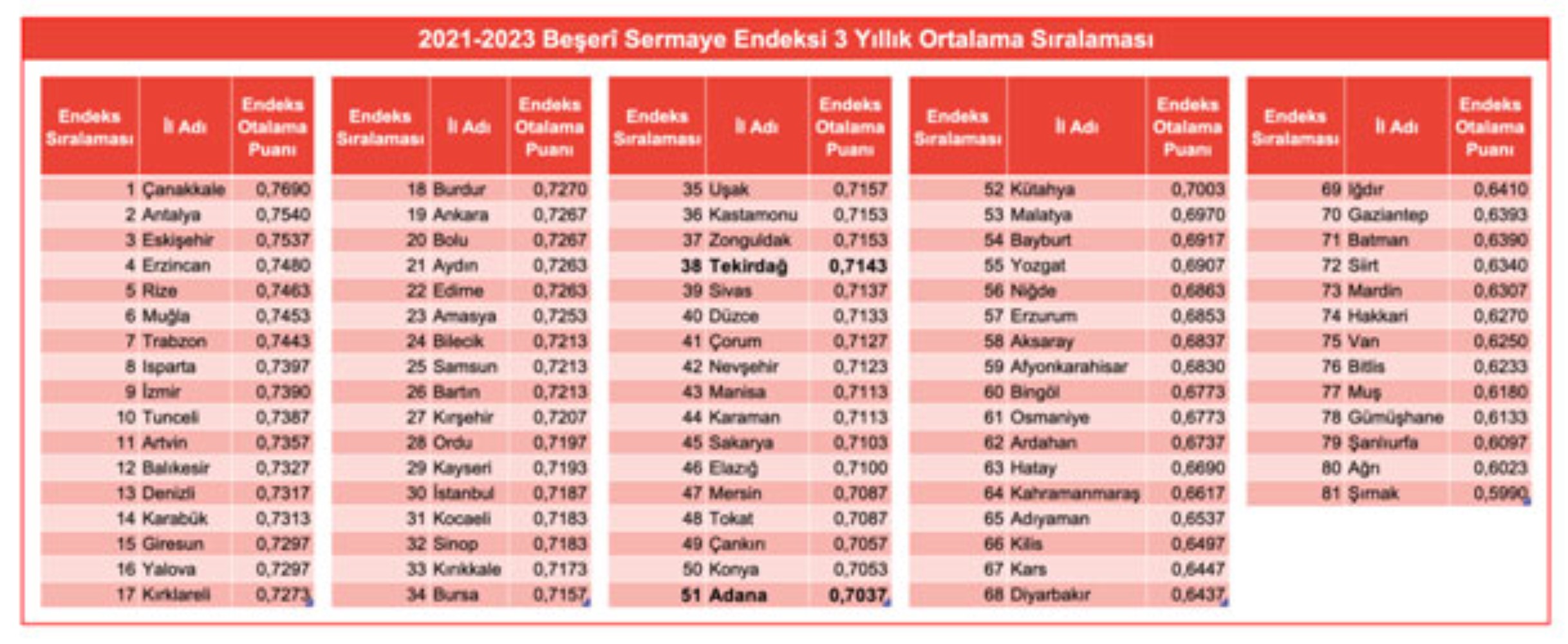
However, the most striking truth revealed by the data is the incompatibility between economic production power and the level of human development. Many industrial and trade centers, seen as the locomotives of the Turkish economy, fail to display the expected performance in human capital rankings. It is noteworthy that Istanbul, which produces approximately one-third of the country's economy, ranks 30th; Kocaeli, seen as the heart of industry, ranks 31st; and Bursa ranks 34th. Similarly, although Izmir, the economic center of the Aegean, is in the top 10, it would be expected to be in higher ranks when compared to its economic weight. A more striking example is Gaziantep. The city, which is shown as Turkey's export and production base, is located near the bottom of the human capital index.
This picture reminds us of an important truth: Industrialization and development are not the same thing. The proliferation of factories, the increase in production, or the rise in export figures do not automatically improve education quality, life satisfaction, and human capital. On the contrary, rapid industrialization processes can create new pressures in many areas, from educational infrastructure to urbanization, and from the environment to social services, if not supported by necessary social policies. Therefore, it is not possible to establish a direct and automatic relationship between a city's economic size and the quality of life of the people living in that city. The real success is the ability to transform economic production capacity into qualified human resources, a strong education system, and a high quality of life. This is exactly one of the fundamental issues Turkey is facing today.
THE DEVELOPMENT PARADOX FROM TEKİRDAĞ TO ADANA: Why Can't Economic Power Transform into Social Power?
To better understand the picture revealed by the Human Capital Index data, it is necessary to take a closer look at cities that stand out with their economic potential but cannot achieve the same success in human development indicators. Tekirdağ and Adana are among the most striking examples of this contradiction.
Although they are located in different geographies, both cities are production, employment, and logistics centers of their respective regions. These cities, which stand out with their industrial investments, trade volumes, and economic contributions, clearly show why the distance between economic size and human development should be questioned.
Tekirdağ, one of the most important industrial and logistics centers of the Marmara Region, has become one of Turkey's fastest-growing production bases in recent years. The expansion of organized industrial zones, increasing export capacity, and the advantages provided by its proximity to Istanbul have significantly increased the city's economic performance. Despite this, Tekirdağ's 38th place in the Human Capital Index shows that economic growth alone is not enough.
The rapid industrialization process experienced in the city has brought with it intense migration movements. The pressure of population growth on educational infrastructure, social services, cultural opportunities, and urban quality of life is becoming more visible every year. While production capacity increases, social and human investments that do not develop at the same speed make it difficult for economic success to transform into quality of life.
A similar situation applies to Adana, one of Turkey's most deep-rooted production centers. Despite its fertile agricultural lands, strong industrial history, strategic location, and metropolitan scale, it is noteworthy that Adana has regressed to 51st place in the Human Capital Index. This is not a picture that can be explained only by current economic indicators; it is also a result of structural problems spanning many years.
Factors such as the intense migration Adana receives, inequalities of opportunity in education, youth unemployment, and the inability to sufficiently utilize qualified human resources limit the transformation of the city's economic potential into human development. Despite its historical accumulation and production capacity, the city has not been able to reach the desired level in developing and retaining its human resources.
The examples of Tekirdağ and Adana show us an important truth: There is no spontaneously functioning relationship between economic growth and social development. Factories may multiply, production records may be broken, and exports may increase. However, if the quality of education is not rising, young people cannot access qualified employment, and the quality of life is not developing to the same extent, the resulting picture expresses quantitative growth rather than development. Real success is measured not only by how much cities produce, but by how much they can reflect the value they produce into their people. Because at the center of sustainable development are not industrial facilities, but the knowledge, skills, health, and quality of life of the people living in those cities.
TURKEY'S INVISIBLE CRISIS: Brain Waste, Idle Potential, and Unemployment with Diplomas
One of the most visible results of the disconnect between economic growth and human development is the emergence of an employment structure that cannot fully utilize the potential of the young population. Because the real power of development arises not only from goods produced in factories but from people's knowledge, skills, and talents. When this potential cannot be utilized, it results not only in an employment problem but also in a serious loss of human capital.
Turkey has experienced significant quantitative growth in access to higher education over the last twenty years. The number of universities has increased, participation rates in higher education have risen, and hundreds of thousands of young people have joined the labor market as diploma holders every year. However, it is not possible to see the same success in the field of qualified employment. The mismatch between the human resources produced by the education system and the qualifications needed by the economy is deepening.
Today, many young people struggle to find jobs in their own fields of expertise after completing their education with years of effort. While some are forced to work in jobs far below their education level, others remain unemployed for long periods, and others seek their future in other cities or other countries. Thus, social resources as well as individual dreams become idle. This situation is defined as "brain waste" in international literature. The inability of human power, for which a country spends significant resources to train, to use the knowledge and skills it possesses means a great loss both economically and socially. Because every unused talent, every unutilized skill, and every body of knowledge that cannot be transformed into production is a value lost from the development potential.
Another dimension of the problem is regional inequalities. In many provinces that lag behind in human capital indicators, young people turn to big cities due to the lack of qualified employment opportunities. This situation, on the one hand, increases population pressure in certain centers, and on the other hand, causes cities with development potential to lose their trained human resources. As a result, some cities are dragged into a structure that constantly receives migration, while others constantly provide trained people.
More importantly, not only individuals but also cities lose out in this process. Cities that cannot retain the young people who graduate from their universities also lose their capacity to produce knowledge, develop innovation, and create high added value over time. Thus, while economic growth remains largely limited to production based on low or medium technology, productivity growth and competitiveness cannot reach the desired level. Yet, in today's world, the wealth of countries is measured not by their natural resources, but by the quality of their human resources. The fundamental element that distinguishes high-income economies from others is not that they own more factories, but that they can transform knowledge into technology, technology into production, and production into high added value.
For this reason, investment in human capital is not just a social preference, but also an economic necessity. The link between the education system and the labor market must be strengthened, young people must be employed in areas suitable for their talents, and regional development policies must be redesigned to utilize qualified human resources locally. Otherwise, despite growing economic indicators, the country's most valuable resource, human potential, will not be sufficiently utilized; while diplomas increase, productivity, efficiency, and social welfare will not rise to the same extent. Real development, however, will only be possible to the extent that people can unlock their potential.
CONCLUSION: Is It Possible to Develop Without Investing in People?
When Turkey's economic growth story and human capital data are evaluated together, the picture that emerges is quite clear: Production growth, industrialization, and export success do not guarantee development on their own. As seen in a wide spectrum ranging from Istanbul to Kocaeli, from Bursa to Gaziantep, and from Tekirdağ to Adana, there is not always a strong parallelism between economic capacity and human development.
The fundamental issue we are facing today is to transform the value produced into human capital rather than producing more. Because the real determinant of sustainable development is not the number of factories, the size of exports, or the volume of national income; it is the ability to build a society consisting of educated, healthy, productive, and happy individuals.
The results of the Human Capital Index show that Turkey needs a new perspective in its development policies. Especially in cities where industrialization is intense, strengthening the educational infrastructure, developing vocational and technical education models suitable for the need for qualified labor, increasing university-industry collaborations, and ensuring that young people can access qualified employment in their own cities is no longer a preference, but a necessity.
In addition to this, social, cultural, and environmental investments that will increase the quality of life in rapidly growing cities must progress simultaneously with economic investments. Because the success of a city is measured not only by how much it produces, but by what kind of education it offers its children, what kind of future it promises its youth, and what kind of quality of life it provides its citizens.
In the coming period, the element that will determine Turkey's global competitiveness will not be cheap labor or low-cost production advantages, but human resources that can produce knowledge, develop technology, and create high added value. For this reason, human capital must be at the center of not only social policies but also economic growth and development strategies.
Real development lies not in the quantitative growth of numbers, but in the qualitative development of people. Every investment made in people, from education to health, from science to technology, from youth to women, shapes not only the welfare of today but also the Turkey of tomorrow. The strong countries of the future will not be those that build the tallest buildings, but those that train human resources that have adopted reason, science, and free thought as their guide, and that can question, produce, and develop innovation.
As the founder of our Republic, Gazi Mustafa Kemal Atatürk, stated, the greatest assurance of the Republic of Turkey is generations with free ideas, free conscience, and free wisdom. Turkey's bright future and sustainable development will be shaped by the investment it makes in its youth, the value it places on science, and the opportunities it offers its people. Because the true wealth of a country lies not in the natural resources, factories, or economic indicators it possesses, but in its people who produce knowledge, create value, and build the future. Nations that strengthen their human capital win not only today but also the future.
Would you like to get notifications about new developments and save news?
- NotificationsNew developments and breaking news
- SaveNews is stored in the app
Most Read
National Anthem surprise from Japanese Ambassador
Diesel protest in Italy brings roads to a standstill
Diyanet Foundation, which claimed 'we have no resources,' owns 73 percent of the fund!

Is it time for the Turkish Parliament to revoke its 31-year-old 'Casus Belli' decision?
Ezel Akay and his brother's test results came back positive
No to the 'opening' bar masked as change, yes to the Republic's bar
Why is Paris burning? The crisis of the welfare state and the revolt of social justice

'From a Journalist’s Pen: The Tüfekli File'

A new balance in the Eastern Mediterranean
Fenerbahçe's sponsor in crisis