


You cannot squeeze the worker and the pensioner by saying 'everywhere is full during the holiday'



Economic notes on Turkey for Şimşek and the Central Bank team 2
In yesterday's article, we explained how income distribution has deteriorated and inflation has surged due to pressures on the minimum wage, interest rates, and exchange rates. Today, we will try to show Mehmet Şimşek and the Central Bank management that the increase in demand causing inflation in Turkey does not stem from minimum wages and pensions, but from the demand of the 5-10 percent of the population that has increased its consumption limitlessly due to the deteriorating income distribution.
In the December 2023 issue of the journal İktisat ve Toplum (Economy and Society), Prof. Dr. Erinç Yeldan, Prof. Dr. Ahmet Haşim Köse, and Prof. Dr. Korkut Boratav published a joint article titled “The Deepening Structural Crisis in Turkey and the Dynamics of Profit-Push Inflation.” First of all, I suggest that Şimşek and the Central Bank management read this article thoroughly. The journal can be read online with a 25 lira credit card payment. Therefore, out of respect for copyright, I will provide a very brief summary of the article. Let's see what the AKP government has done to the workers whose throats it is trying to squeeze even tighter?
“Turkey witnessed two separate distribution shocks during the AKP era. The wage share in GDP declined by 3.8 points (29.3% › 25.5%) between 2002 and 2013. The second distribution shock occurred between 2015 and 2022. If we take the first quarter of 2016 as the starting point, the share of wages in total income was reduced from 32.1% to 24.2% in the last quarter of 2022.
Undoubtedly, the opposite of this collapse story is an “enthusiastic” increase in capital shares. In the same process, the share of the net operating surplus (non-wage income or total profit mass) cleared of taxes, which generally represents capital income, in the total economy rose from 56.6% to 66.5%. While the share of wages in national income eroded, wage employment increased by 3.2 million. This is an indicator that unit wages have declined even further.
An indicator of the absolute impoverishing effect of the erosion in wages was the 15% or 25% decline in real wages (according to the GDP deflator or CPI) per worker (on average) in 2022 compared to their 2016 levels. (MK Note: If we measure with ENAG inflation, the real erosion in wages is over 40 percent.)
We can observe the comparison of the value of unit labor power in Turkey with developed and developing countries through the “real effective exchange rate index based on unit labor costs” presented by the Central Bank. This value collapsed after 2016. The value of the index in question for the developed country group declined from 69.2 to 28.9; and for the developing country group, it declined from 114.2 to 50.2. In other words, the value of the country's labor force, measured in foreign currencies, has been reduced to a radical extent compared to both developed and developing country groups. (MK Note: The starting year of the index is 2003, with an index value of 100. At the end of 2022, the worker's purchasing power, which was 100 liras, falls to 41 liras in real terms.)”
In the following sections of the article, the three esteemed economists examine the structural causes of the high inflation experienced in Turkey and show that the inflation experienced in Turkey has no relation to wages, and that the process we are going through is a profit-push process that protects profits, similar to examples in global capitalism. The article cites studies conducted by IMF and EU Central Bank economists during and after the Covid period. These studies also show that the inflation dynamics increasing in the US and EU are profit-push, not wage-push.
LET'S LOOK AT DEMAND A LITTLE BIT
Government representatives say, “Let's cut the demand of the worker and the pensioner in the fight against inflation, let's squeeze the throat of the low-income earner even more”... Let's see, which group has how much demand? Which segment's demand needs to be cut to fight inflation? (The three graphs below are quoted from Menekşe Yılmaz on the X platform.)
As a result of the policies implemented especially since September 2021, income distribution has deteriorated significantly. 80 percent of the population remained below the poverty line. The first graph shows how much of the population remains below the poverty line according to 20 percent income brackets.
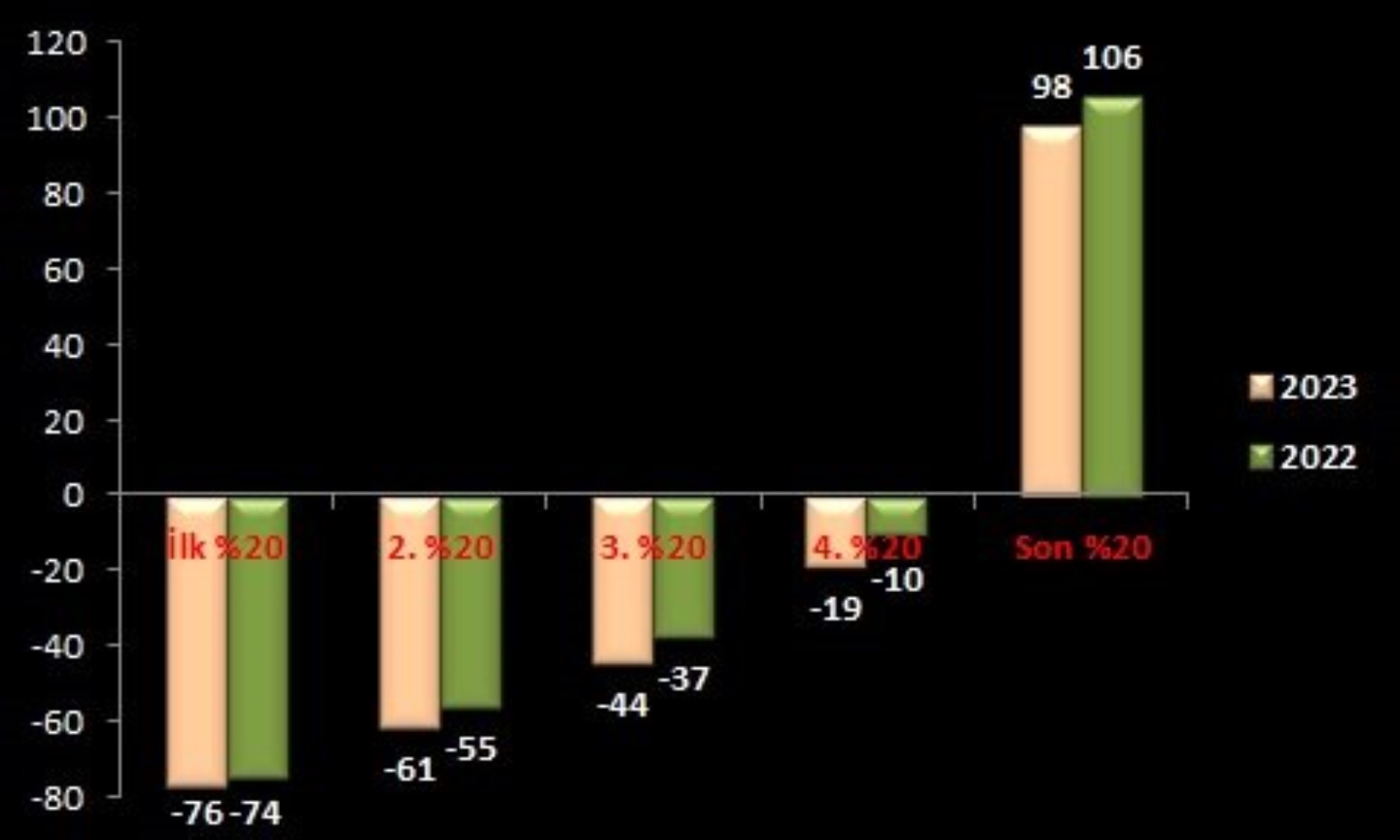
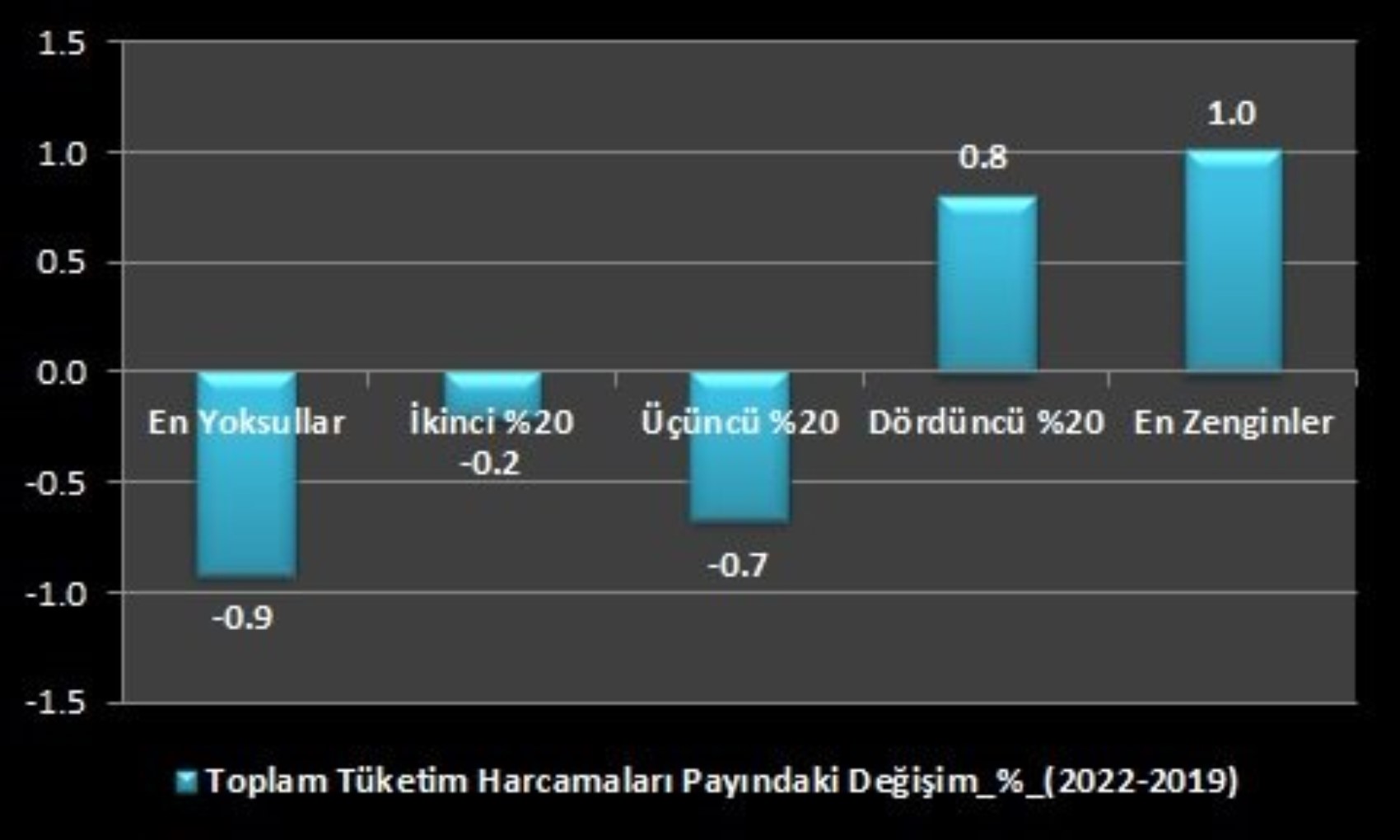
The second graph shows the amount of consumption expenditures made by the 20 percent groups of the population. While the richest 20 percent of the population spends 3 trillion 200 billion TL, the total consumption expenditure of the poorest 60 percent barely reaches the same level. A question might arise; even though the share of the poor or the bottom 40 percent in total expenditures is small, it might have increased significantly compared to the previous period. Therefore, inflation might have exploded. No, the third graph clearly reveals the picture. The share of the top two groups is increasing, while the share of the poorest 60 percent is decreasing.
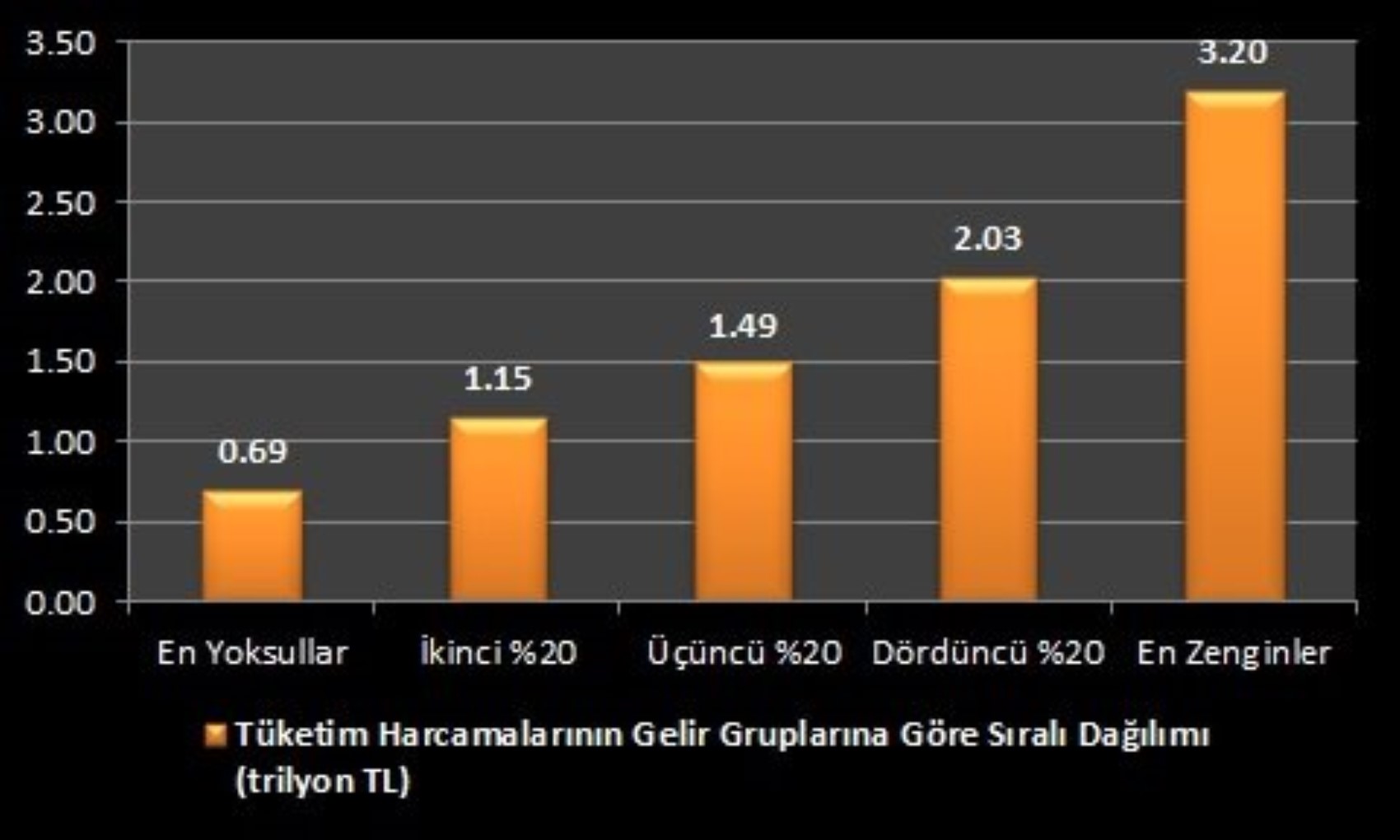
Let's ask Mehmet Şimşek, the Central Bank management, and financial economists who establish a relationship between minimum wage, pension, and demand increase and inflation. Is it the demand of the segment whose income has fallen in real terms and whose share in consumption has decreased that is increasing inflation?
One last objection might come. “Oh my dear, look, everywhere is full in Bodrum and Çeşme during the holiday. Shopping malls are packed.” Yes, they are full. We, the economists on our side, are already saying that you should take measures aimed at the segment that creates this demand in order to fight inflation.
The 20 percent of the population we are talking about is a total of 17 million people. The top income group receives 50 percent of the total income. Let's not even expand it to 17 million. The richest 5 percent of the population, 4 million 250 thousand people, receive 25 percent of the income.
The total number of certified beds in hotels in Turkey is 1 million 900 thousand, the number of vehicles sold is 1 million 300 thousand, and the number of houses sold is 1 million 300 thousand. The number of tourism-certified restaurants in Istanbul is 571, and the number of chairs in these restaurants is 155 thousand 312... The total number of shopping malls in Turkey is 446... Of course, these 4 million 250 thousand people who receive 25 percent of the income will fill the hotels, restaurants, shopping malls, and everywhere else, and buy 2 million 300 thousand automobiles and 1 million 200 thousand houses.
We have more to say on top of that. Turkey is a money laundering paradise. We are not on the Grey List for nothing. Together with the new Minister of Interior, we read news every day about drug barons and gangs operating internationally and locally all over the country. In addition to the richest segment of the population, there is also the consumption demand of unregistered, illegal black money earnings. Add the aid provided to refugees whose numbers exceed 10 million and the demand of this segment as well. 19 million tourists came to Turkey in 2023. If we consider that they are concentrated mainly in 4 months, it means an extra food demand of 4 million people per month.
Now, with all these data in front of us, what kind of relationship can we establish between the ballooning housing prices, automobile prices, skyrocketing sirloin prices, lamb chop prices in Turkey and the minimum wage and pension increases?
When our esteemed professor Prof. Dr. Bilsay Kuruç hears the expression “The cause of inflation is wage increases” from some official mouths and economists, he asks with all his courtesy in his column in Cumhuriyet on April 8, 2024:
“Economics does not tolerate jokes much. Let's say I ask a young colleague, 'Can we explain the large price increases in real estate such as land and housing with minimum wage increases? Can you do an econometric study?' It is not difficult to think that they would first look at me strangely, and then, without being impolite, say, 'Please, don't joke like that.'”
There are many economists within the Central Bank. Let me elaborate a little more on the suggestion of my esteemed professor Bilsay Kuruç.
“Could you please include in this econometric study the relationship between the increases in minimum wage and pensions and the increases in prices of automobiles, sausage, sirloin, lamb meat, lahmacun in tourist areas (450 TL), two sunny-side-up eggs in a pan (360 TL), yogurt, cheese, unadulterated olive oil, service fees of repairmen coming to the house, examination fees in private hospitals, soap and detergent prices, white goods and furniture prices, in addition to real estate such as land and housing?”
No, I'm not joking…
Would you like to get notifications about new developments and save news?
- NotificationsNew developments and breaking news
- SaveNews is stored in the app
Most Read

Video response to Kim Jong-un claims

Murat Ağırel’s police statement has been revealed

The Orionid meteor shower will be visible from Turkey!

Fatoş Seğmen reveals the cause of her daughter's death

Latest status in the race between AKP and YENİ Party revealed

Injury shock at Liverpool: He may miss the Fenerbahçe match

From brotherhood to a distant partnership...

Who authorized the concert held in a parking garage?

Acting mayor of Üsküdar has been determined

Good news from Izmir, may Istanbul be next