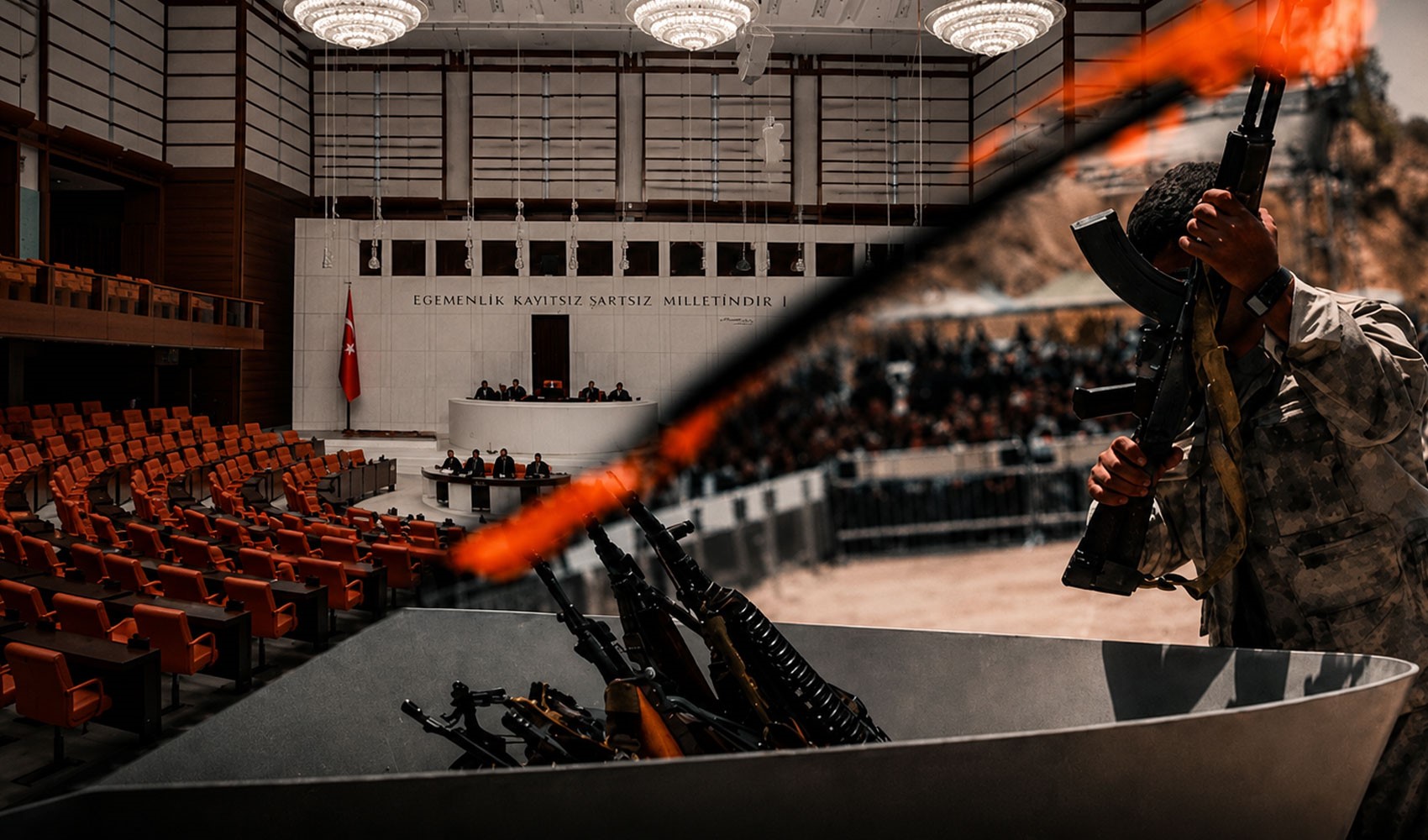
The 'Bill on Strengthening National Solidarity and Social Integration', which aims to establish the legal framework for a process toward a Turkey without terrorism and is referred to in the public as the 'framework law', has been accepted by the Grand National Assembly of Turkey (TBMM) General Assembly.
467 YES, 87 NO, 7 ABSTENTIONS
After all 12 articles of the proposal were accepted individually, the entire proposal was put to a vote in the General Assembly.
In the vote, 467 deputies voted “yes”, 87 deputies voted “no”, and 7 deputies “abstained”.
Thus, the 12-article framework law proposal was accepted by the TBMM General Assembly and became law.
FIRST STATEMENT FROM BAHÇELİ
MHP Chairman Devlet Bahçeli used the phrase 'may it be auspicious' in his statement after the vote.
PARTY LEADERS ALSO VOTED
AK Party Group Chairman Abdullah Güler, Deputy Chairman Efkan Ala, New Party Chairman Özgür Özel, MHP Chairman Devlet Bahçeli, DEM Party Co-Chairmen Tuncer Bakırhan and Tülay Hatimoğulları, İYİ Party Chairman Müsavat Dervişoğlu, New Welfare Party Chairman Fatih Erbakan, Felicity Party Chairman Mahmut Arıkan, DSP Chairman Önder Aksakal, HÜDA PAR Chairman Zekeriya Yapıcıoğlu, and TİP Chairman Erkan Baş also participated in the vote.
CONDITION OF PKK/KCK DISARMAMENT AND DISSOLUTION
The first article of the proposal defines the purpose and scope of the regulation. Accordingly, for the law to be implemented, it must be determined by security institutions that the PKK/KCK and its affiliated formations have ended their de facto existence and surrendered the weapons and ammunition under their control. A condition is set for this determination to be confirmed by the National Security Council (MGK) and for the decision to be published in the Official Gazette.
The regulation covers crimes such as establishing or managing the PKK/KCK, being a member of the organization or knowingly and willingly assisting it, engaging in organizational propaganda, crimes committed within the scope of the organization's activities, and the financing of terrorism committed in favor of the organization.
DEFINITIONS MADE FOR ORGANIZATION AND BOARD
The second article defines the basic concepts used in the law. Accordingly, “organization” refers to the PKK/KCK terrorist organization and all its affiliated formations; “Board” refers to the board to be established under the 7th article of the proposal.
INVESTIGATIONS AND PROSECUTIONS TO BE POSTPONED
The third article regulates the postponement of certain investigations and prosecutions within the scope of the law.
Accordingly, investigations and prosecutions regarding crimes requiring a prison sentence of 15 years or less will be postponed for 5 years, and investigations and prosecutions regarding crimes requiring more than 15 years of imprisonment, life imprisonment, or aggravated life imprisonment will be postponed for 10 years.
The crime of intentional killing committed within the framework of organizational activity and crimes committed before June 1, 2005, that require life imprisonment or aggravated life imprisonment are excluded from this regulation.
The statute of limitations for the case will not run during the postponement period. Files and evidence will be preserved, a liquidation decision will be made for items and assets subject to confiscation, and these will be recorded as revenue for the Treasury.
Objections can be made to the postponement decisions given by the public prosecutor to the criminal judgeship of peace within two weeks, and to the decision of the court to postpone the prosecution within two weeks.
Furthermore, initiating investigations after the fact for crimes that were committed before the MGK decision was published in the Official Gazette but fall within the scope of the law is subject to the Board's permission.
DETENTION AND JUDICIAL CONTROL DECISIONS TO BE RE-EVALUATED
The fourth article provides for the re-evaluation of detention and judicial control measures imposed due to crimes covered by the postponement.
The authorized judge or court, as well as the relevant criminal chamber of the regional court of justice or the Court of Cassation, may decide to lift these measures if the conditions are met.
In addition, a reversal decision will be issued for files under appellate or supreme court review. For these provisions to be applied, the MGK decision must be published in the Official Gazette and the relevant person must make the written application stipulated in the law.
POSTPONEMENT TO BE LIFTED IF A NEW TERROR CRIME IS COMMITTED
The fifth article regulates the recording of postponement decisions in a special system. These records can only be used if requested by a public prosecutor, judge, or court in connection with an investigation or prosecution.
If a new terror crime is committed during the postponement period, the postponement decision will be lifted and the investigation or prosecution will continue. In case of conviction, the execution of the sentence given will not be able to benefit from the postponement in Article 6 of the law.
If the postponement period is completed without a new terror crime being committed, a decision of non-prosecution or dismissal of the case will be made.
EXECUTION OF FINALIZED SENTENCES WILL ALSO BE POSTPONED
The sixth article provides for the postponement of the execution of sentences for those who have finalized prison sentences for certain crimes covered by the law.
Those convicted of intentional killing committed within the framework of organizational activity and those sentenced to life imprisonment or aggravated life imprisonment for crimes committed before June 1, 2005, are excluded from the scope.
Accordingly, the execution of sentences for those sentenced to a total of 15 years or less in prison can be postponed for 5 years, and the execution of sentences for those sentenced to more than 15 years in prison, life imprisonment, or aggravated life imprisonment can be postponed for 10 years by the decision of the execution judge.
The statute of limitations for the sentence will not run during the postponement period. The implementation of confiscation decisions will not be affected by the postponement.
If a new terror crime is committed during this period, the postponement will be lifted and the execution of the sentence will continue. If the period is completed without a new crime being committed, the sentence will be considered executed.
PROCESS TO BE MONITORED BY A BOARD CHAIRED BY THE VICE PRESIDENT
The seventh article establishes a Board chaired by the Vice President to monitor and evaluate the implementation of activities within the scope of the law.
The Board will include the Ministers of Justice, Foreign Affairs, Interior, and National Defense, as well as the Secretary General of the Presidency, the Head of the National Intelligence Organization, and the Secretary General of the National Security Council.
The Board may establish sub-commissions when necessary and may invite representatives of relevant institutions and organizations and persons it deems necessary to meetings. Assignments can also be made in sub-commissions to ensure the progress of the process within the organization.
Following the publication of the MGK decision in the Official Gazette, the complete liquidation of the organization and related observation reports will be evaluated periodically by the Board. If deemed necessary, requests can be made regarding judicial, administrative, and legal regulations.
The Board will also periodically evaluate postponement decisions. If deemed necessary, it may make requests to the relevant judicial authorities for the removal of rights deprivations arising from investigations, prosecutions, or conviction judgments with all their consequences.
For this request to be made regarding rights deprivations arising from conviction judgments, 2 years must pass from the date of the decision for 5-year postponement decisions, and 3 years for 10-year postponement decisions.
The Board will report its work to the TBMM regularly. Additionally, a Monitoring Commission will be established by the Speaker of the TBMM to monitor activities within the scope of the law. The Commission will be able to monitor activities and make recommendations.
SURRENDERED WEAPONS AND MATERIALS TO BE RECORDED
The eighth article regulates the recording of weapons, ammunition, vehicles, equipment, explosives, and all kinds of materials brought or declared by organization members within the scope of the law.
The procedures and principles for these transactions will be determined by the Ministry of Interior and the Ministry of National Defense after obtaining the opinions of security institutions.
6-MONTH PERIOD FOR APPLICATION
The ninth article determines the application period for those who wish to benefit from the provisions of the law.
Accordingly, individuals may apply in writing to the Chief Public Prosecutor's Offices in their location or to institutions assigned by the Board within 6 months after the publication of the MGK decision in the Official Gazette.
LEGAL PROTECTION FOR THOSE PERFORMING DUTIES
The tenth article mandates that duties assigned within the scope of the law be fulfilled promptly by the relevant public institutions and organizations.
Furthermore, it is regulated that individuals who perform duties within the scope of the law's purposes and activities will not face legal, administrative, or criminal liability due to these duties.
LAW TO ENTER INTO FORCE ON THE DATE OF PUBLICATION
The 11th article of the proposal contains the enforcement regulation. Accordingly, the law will enter into force on the date of its publication.
In the 12th and final article, it is stipulated that the provisions of the law will be executed by the President.
News Source: 12punto