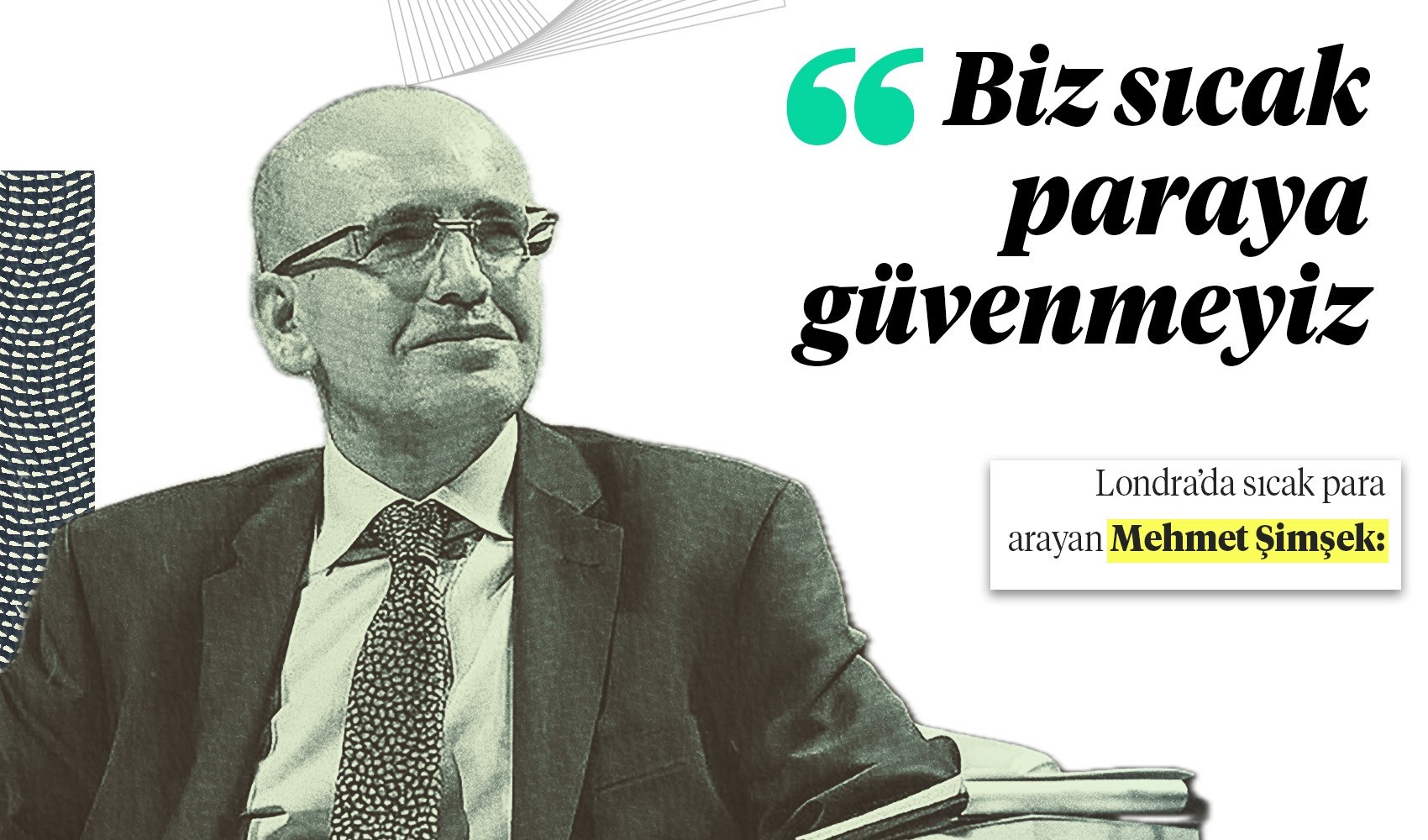
Treasury and Finance Minister Mehmet Şimşek stated that their program does not rely on carry trade. Addressing criticisms regarding the AKP government's recent economic policies, Şimşek said, "They are creating a new narrative these days, I don't know if it's to criticize the program a bit. They keep saying 'carry trade'. Our program does not rely on 'carry trade'. We never rely on hot money" he said.
In recent months, Şimşek met in London with managers of international asset management companies, investment funds, multinational banks, and infrastructure funds with a total asset size exceeding 75 trillion dollars.
Minister Şimşek, in his presentation at the opening of the 23rd Ordinary General Assembly of the Participation Banks Association of Türkiye (TKBB), stated that participation finance has significant advantages and that they want this sector to strengthen very rapidly, adding that they will do whatever is necessary for the sector to grow even further.
Stating that although Türkiye is not yet where it desires to be in terms of participation finance development, it has made significant progress over the last 10 years, Şimşek continued his remarks as follows:
In other words, while we were 23rd among 82 countries in 2012, we are now 13th among 136 countries as of the end of last year. In fact, if we address certain regulatory shortcomings, I believe we will enter the top 10 next year. Therefore, we are not yet where we aspire to be, but there is good progress. Of course, a great deal of responsibility falls on the sector here. Work on the Participation Finance Framework Law is ongoing. It has naturally been opened to the views of the entire sector. Those views will be compiled. I do not know if it will be ready for this legislative session within that framework, but I believe it will be brought to the agenda of our Parliament starting in October.
"OUR PRIORITY IS TO ENSURE PRICE STABILITY"
Minister Şimşek spoke about the macroeconomic stability and reform program being implemented.
Touching upon the priorities of the implemented program, Şimşek stated, "Very clearly, our biggest priority is to ensure price stability. In fact, for this sector and for capital markets to develop, we absolutely must restore price stability. That is to say, we must achieve low single-digit inflation."
Minister Şimşek stated that fiscal discipline for sustainable high growth, a sustainable current account deficit, and structural transformations are among the program's priorities.
'We are about to enter the disinflation period from the transition period'
Treasury and Finance Minister Şimşek addressed the reasons why price stability is at the top of their priorities and made the following statements:
Price stability is a prerequisite not only for macro-financial stability and predictability but also for channeling resources into efficient areas, into productive areas for our country. If we had not intervened last year, our citizens might have imported 40 billion dollars worth of gold. Yes, I am truly not exaggerating. But if gold is in the system, it is useful; if not, it truly appears as an idle resource. We are, of course, respectful of our citizens' choices, but what I am trying to explain is this: if our citizens are protecting themselves with such products or feel safer in other countries' currencies, it means there is a problem. Yes, there is a problem. What is it? High inflation. That is why price stability is very important.
Şimşek also emphasized that price stability is their greatest priority for the efficient allocation of resources, access to long-term financing, sustainable high growth, and a fairer income distribution.
Minister Şimşek underscored that inflation will fall, stating, "We are now about to enter the disinflation period from the transition period. We believe that inflation will fall to the 30s by the end of this year, below 15 next year, and then below 10 percent thereafter. We are taking the necessary measures for this."
Emphasizing that the implemented program is working, Şimşek stated that inflation expectations in the market are also improving and that inflation will decline permanently.
'We are reviewing tax exemptions and exceptions'
Treasury and Finance Minister Şimşek noted that additional measures have been and continue to be taken to restore fiscal discipline, and made the following assessments:
We have shared the public savings and budget expenditure discipline package with the public. The review of tax exemptions and exceptions is nearly complete. We hope to share it with the public within the next week or two. Tax justice and efficiency may also be a part of that package. These are continuous efforts. In other words, we do not have an approach where we say, 'we took a step, stopped here, and our job is done.' However, we will not announce a package or an action plan to combat the informal economy. We will fight it in the field in practice. The Treasury and Finance Ministry teams will be constantly in the field. There is no such thing as 'this sector or that sector.' Everyone should pay their taxes properly. Large entities will be subject to audits, but small businesses that abuse VAT will, of course, also be audited. Therefore, everyone will fulfill their responsibilities as required by law.
Minister Şimşek noted that it is clear how the program they are implementing is working, and said, "Our goal is policies that are rule-based and in line with international norms. We have given this message transparently and clearly since the first day. And then there are structural reforms. Why? Because Turkey needs structural transformation. These two together bring Turkey's story together. This story will find a response."
Reporting an increase in investor confidence, Şimşek said, "The latest figures might be released today. But I am generally able to follow them daily. As of yesterday, there has been a resource inflow of nearly 53-54 billion dollars into our Central Bank from both domestic and foreign sources over the last month and a half."
"WE DO NOT RELY ON HOT MONEY"
Minister Mehmet Şimşek stated that the economy is rebalancing, domestic demand is proceeding at a reasonable level, and that they have entered a period where net exports are no longer dragging down growth as they once did, but are even contributing positively. He made the following remarks:
The first quarter was such a quarter. It likely accelerated in the second quarter. We have discussed the improvement in the current account; there is a dramatic improvement. The latest figure is from March, but our forecast for May is significantly below 30 billion dollars. Again, there is a serious divergence in portfolio movements. Look especially at the post-election period. While money is flowing out of emerging countries, there is a very significant inflow of resources into Turkey. Furthermore, the external debt rollover ratios of our banks and real sector have improved significantly. Therefore, they are now creating a new narrative these days, I don't know if it's to criticize the program to some extent. They call it 'carry trade'. Our program does not rely on 'carry trade'. We never rely on hot money. Hot money is a part of the system, but the money brought in by the real sector is not hot money.
Noting that banks have found nearly 4.5-5 billion dollars in 'subordinated external funding' in the last 4-5 months, Şimşek provided the following information:
This is not hot money; we call it subordinated capital. Yes, it is long-term, and this is very important. So, if you look at it within this framework, yes, there is a portfolio inflow in this program. Of course, there will be. Meanwhile, our two-year and five-year interest rates have fallen. You might be surprised, but when the Central Bank tightened monetary policy, the Treasury's interest rates fell. Therefore, of course, portfolio investments will also come. As the maturity of portfolio investments extends, the risk also decreases. But it is very clear that our access to global resources is important for Turkey, supports growth, and a significant portion of it is qualified, permanent financing. The point is that the resources we obtain from multilateral international banks are generally much cheaper and have much longer maturities compared to global markets. Resources are coming into stocks and Turkish bonds. Resources are flowing into Turkey's structural priorities.
"WE HAVE NO EXCHANGE RATE TARGET"
Pointing out that Turkey's potential is great, Treasury and Finance Minister Şimşek concluded his remarks as follows:
We believe in this, and you (the TKBB delegation) should support this potential. Why? Because the existence of potential alone is not enough. However, Turkey holds an advantageous position. We will achieve this. In other words, the framework of our program is not essentially based on temporary capital flows. Capital flows are a choice. Of course, we are open to any kind of capital flow that supports the Turkish economy. We have no exchange rate target, nor do we provide any guarantees to anyone on any matter. We are implementing this program solely for the welfare of our nation, and with God's permission, we will succeed.
WHAT IS CARRY TRADE?
Carry trade is the profit obtained by borrowing in a currency with a low interest rate and investing that money in a currency that yields a high interest rate. To engage in carry trade, you must first invest in dollars and then convert it into the currency of the country you choose. Afterward, you wait for your investment to grow by putting the money into high-interest treasury bonds of the country you wish to invest in.
News Source: 12punto