

Turkey's January grain and pulse exports reached 930 million dollars
In January, Turkey generated 929 million 526 thousand dollars in export revenue from grains, pulses, and oilseeds, with sunflower oil standing out as the sector's top product in foreign markets.



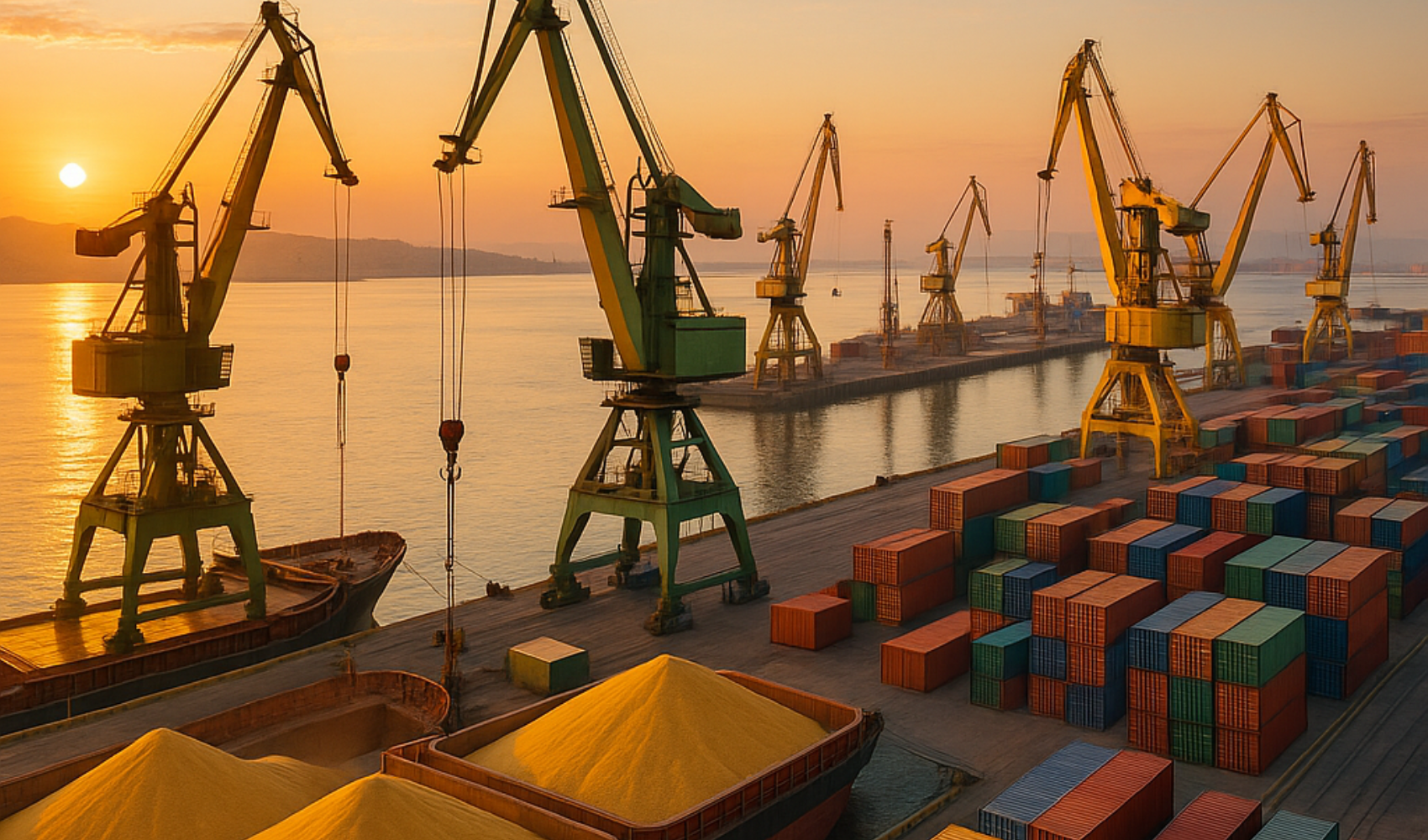
In the first month of the year, Turkey achieved a significant success in foreign trade by exporting a total of 867 thousand 182 tons of grains, pulses, oilseeds, and their derivatives to 190 countries and free zones. The sector generated a total revenue of approximately 930 million dollars.
During this period, the highest export value was recorded in sunflower oil at 88 million 250 thousand dollars. Chocolate and cocoa-based products ranked second with 86 million 187 thousand dollars, followed by sweet biscuits and wafers at 76 million 135 thousand dollars.
Following these developments, the sector's strategic roadmap for the upcoming period and geopolitical developments regarding global competition are also drawing attention.
RUSSIA AND INDIA'S GLOBAL FOOD STRATEGIES
Ahmet Tiryakioğlu, Chairman of the Cereals, Pulses, Oilseeds and Products Sector Board, emphasized that Russia aims to move beyond its identity as a raw material exporter in agriculture.
According to Tiryakioğlu's assessment, Russia is pursuing "a new strategy that aims to have a say in the higher links of the global food chain." He believes that the establishment of wheat flour, sunflower oil, and various food processing facilities by Russian companies abroad with state support is an indicator of this strategy.
The Chairman stated, "The underlying reasons behind Russia's desire to become a player that produces value-added products directly for third countries are the decline in agricultural profitability due to suppressed prices despite constantly expanding planting areas, and farmers moving away from grain cultivation toward oilseed production. With its strong industrial infrastructure, Turkey has been a country that transforms imported inputs such as wheat, crude sunflower oil, and corn into value-added products and offers them to international markets within the scope of the Inward Processing Regime (IPR). In this relationship, which provides a significant competitive advantage to the Turkish food industry, we may enter a second phase after Russia directs its own companies to milling and processing investments abroad."
On the other hand, Tiryakioğlu evaluated the consequences of the Free Trade Agreement between the European Union (EU) and India on global trade, while Russia increases its influence in major markets such as China and India. He shared his view, "Since Turkey's food exports to the EU are limited by quotas, this agreement will not have a significant impact on our grain exports to the EU. The exclusion of rice, for which India is the global export leader, as a sensitive agricultural item prevents this product from entering the EU market without limits and customs duties. Therefore, a 'flood of rice' from India to the EU is not expected for now."
Finally, the Chairman pointed out that India becoming a large-scale and competitive supplier in the field of food production could increase competition in major markets, especially in the Middle East, Africa, and Asia. Tiryakioğlu said, "New collaborations we will establish with India, where our annual grain sector exports average 45 million dollars, could create significant opportunities that mean win-win for both countries."
News Source: 12punto
Most Read

Galatasaray announces injury updates for Osimhen, Lemina, and Singo

Attention online sellers: Tax monitoring expanded

VAR for the Fenerbahçe-Beşiktaş derby has been announced!

Bridges and highways are being privatized: 15 July and FSM are also on the list

Peugeot September 2026 price list is out

New details emerge in 'panel' operation targeting lawyers
Gökçek era detail in ABB investigation

Özlem Şanver: 'He said he would change, I believed him; should I be beaten just because I didn't leave?'

First statement from Osimhen after injury in Başakşehir match

The Süper Lig's new team becomes the transfer champion