PART ONE
INTRODUCTION
Our country is located on fault lines whose exact number is not yet clear and which we are constantly encountering new ones. Due to its location between two moving main landmasses and the fact that it is surrounded by seas on three sides, it is in a position prone to natural disasters, including the risk of flooding.
We have a homeland like paradise, but every beauty has a disadvantage. To fully enjoy the beauty of our homeland, it is necessary to be aware of these risks and take precautions. I wish these risks did not exist, but it is not possible to ignore the realities of life.
To this end, Law No. 6306 on the Transformation of Areas Under Disaster Risk, which was published in the Official Gazette dated 31.05.2012 and numbered 28309, has entered into force. The purpose of the law is defined as: “to determine the procedures and principles regarding improvement, liquidation, and renewal in order to establish healthy and safe living environments in accordance with science and art norms and standards in areas under disaster risk and on plots and lands where risky structures outside these areas are located.”
Major disasters that have occurred have increased the scope and importance of the law. It is the common consensus of scientists that precautions must be taken to eliminate other potential negative outcomes. Indeed, countries that have made living with high technology a habit, such as Japan, where disasters are part of the natural flow of life, have long since overcome this problem.
With the Law No. 7471 on the Amendment of the Law on the Transformation of Areas Under Disaster Risk and Certain Laws and the Decree Law No. 375, which was published in the Official Gazette dated November 9, 2023, and numbered 32364, Law No. 6306 has been almost completely overhauled and renewed.
The newly introduced provisions have greatly expanded the scope, causing hesitation in society regarding the fact that the concept of property rights is being damaged and the concept of property is becoming risky.
IS IT NECESSARY TO WAIT FOR A DISASTER?
A disaster is an extraordinary situation that leads to great destruction. After it happens, healing the wounds is sometimes impossible, and irreversible results emerge. Therefore, essentially, necessary precautions should be taken before a disaster occurs. The legal regulations I mentioned above are mostly provisions to be applied after a disaster occurs, and in order to eliminate the damages of this great destruction, it may lead to practices that could cause many losses of rights, by being called the lesser of two evils.
So, what can be done before reaching these stages?
I think there is no one among us who does not know the story of the three little pigs. The little pigs who built houses out of straw, grass, and concrete. It is a story about how the one with the most durable building manages to survive and even save their loved ones.
Especially in city centers where there are old settlements, the number of old buildings is quite high. Although they were built according to old regulations and procedures, the corrosion experienced over time will have reduced the durability of the buildings; this is a rule of nature. Therefore, what is important is to be ready for potential risks by transforming old buildings.
Taking into account the infrastructure of the cities and by making the necessary improvements, some measures must be taken to renew existing structures. This is a method that cannot be implemented without State support.
In places where old buildings are located in cities, it is mandatory to provide a floor increase sufficient to cover a large part of the construction cost. Otherwise, in an environment where the economy is experiencing such high inflation, it does not seem possible for people to demolish their buildings and renew them with their own means.
Floor increases should be provided to reduce costs, and all old buildings should be renewed. It is known that what will be done after the risk occurs and lives are lost will not bring many things back.
Moreover, if this solution is provided, the individuals' own will will also play a role, and there will be no situation such as being caught unprepared. To prevent abuse, the decision quorums can still be a simple majority, but at least individuals will be able to have new and disaster-resistant buildings in their own settlements without being crushed under the burden of construction costs or facing a very small cost. This is very valuable. Continuing their lives in the living spaces they are accustomed to is not actually a luxury, but their right.
Neither being caught unprepared nor losing everything one has, and even one's life, can be compensated in any way.
Therefore, the real solution is to enable people to continue their right to life through necessary infrastructure and zoning works before the risk occurs.
Otherwise, their right to life will be taken away right before our eyes.
WHAT ARE THE BASIC CHANGES IN LAW NO. 6306?
We mentioned the purpose of the law above. It will not be easy to implement before a disaster occurs. Because it significantly damages property rights, people's living habits, and social situations. In the implementation of Law No. 6306, limitations are placed on individuals' property rights and limited real rights; in shared ownership, exclusion from the partnership and condominium ownership can be terminated. Interventions can be carried out on individuals' assets against their will.
While essential decisions that should be taken unanimously in normal legal regulations were regulated as being taken with a two-thirds majority in Law No. 6306, it has been tied to the decision of a simple majority with the new amendment. These issues will be explained in future articles.
The Presidency of Urban Transformation can determine risky buildings ex officio. If it finds them risky and the owners do not evacuate, it can ensure the evacuation of the immovable property through law enforcement officers. These are regulations that will completely eliminate property rights and possession. Based on the concept of protecting the superior interest of the public, individual property rights are almost completely eliminated by this law.
Owners will be able to object to the Presidency/Administration's risky structure determination decision to a seven-person committee consisting of three people to be determined by the Presidency and four people to be determined by universities. These objections can be made within fifteen days. The committee will examine and decide on the objection. In other words, the fate of a building and those living there will be entrusted to the decision of this committee.
Notifications to be made to the owners have also taken on a different nature. For example, procedures such as hanging a notice on the building, notification via e-Devlet, or announcing it at the headman's office (muhtarlık) and considering the notification as having been made on the last day of the 15-day announcement period have been introduced.
Thus, the disposal powers of people regarding what they have perhaps obtained with difficulty throughout a lifetime, and perhaps their only assets, are largely restricted.
If these practices are carried out for the high interest of the public, there is not much left to say. However, the risk of abuse of such great powers is quite high. Therefore, a very good inspection mechanism must also be in place. It is necessary to prevent grievances in the determination of risky areas.
In the following parts of my articles, I will write step by step about what the practices that may be encountered will be like.
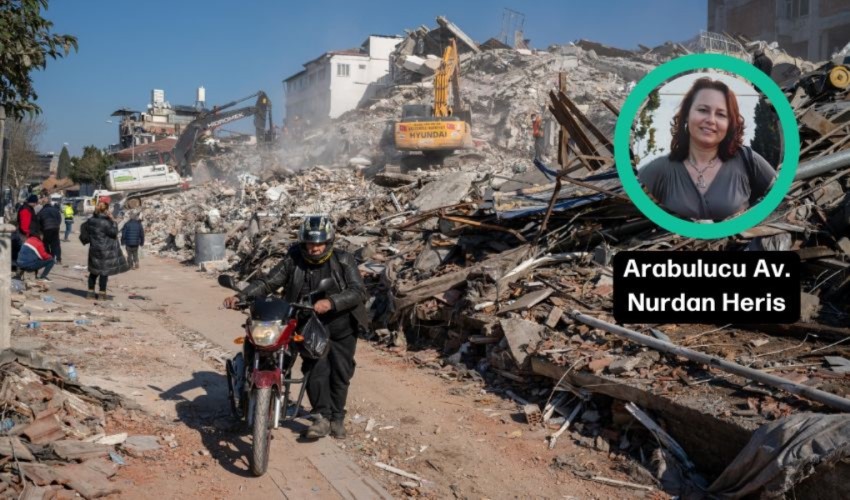
Mediator Lawyer NURDAN HERIS
News Source: 12punto