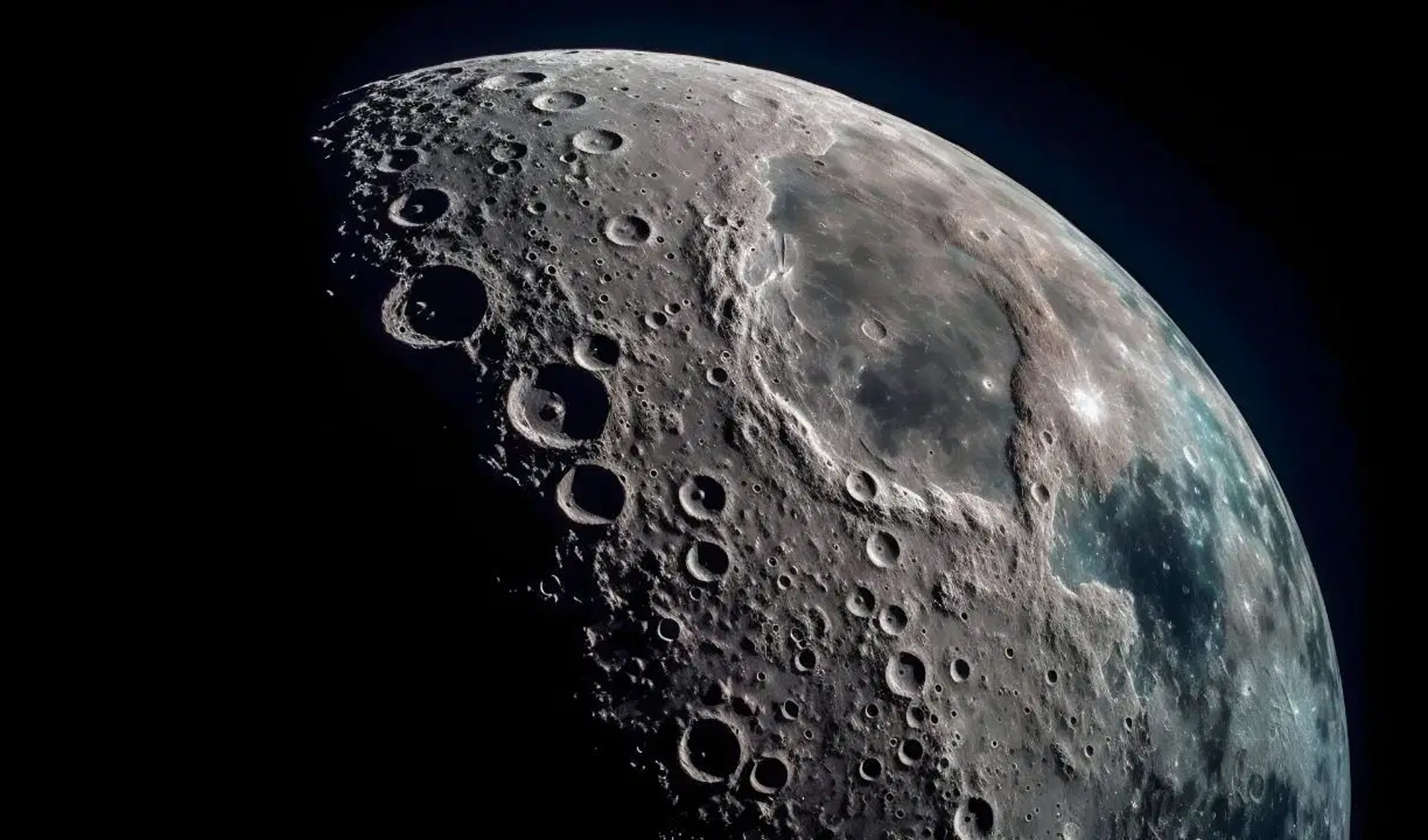
The most widely accepted giant impact scenario regarding the origin of the Moon has taken on a new dimension with recent computer simulations. According to a study by researchers at the Southwest Research Institute (SwRI) and the University of Arizona, the Moon may have emerged in a much shorter time than previously thought following the collision between a Mars-sized proto-planet named Theia and the young Earth approximately 4.5 billion years ago.
The research, published in The Astrophysical Journal Letters, proposes an alternative result to the traditional model, which suggests that the Moon formed gradually over a long period by coalescing from a debris disk after the impact. The simulations showed that under certain conditions, the Moon could have taken shape largely as a single piece in just about 5 hours.
Rock strength taken into account
The point where this study differs from previous models is that it takes into account the structural strength of the rock material in the colliding celestial bodies and its temperature-dependent behavior. In earlier simulations, it was assumed that the rocks completely melted or vaporized due to the intensity of the collision; therefore, it was accepted that Earth and Theia behaved largely like fluids.
In the new modeling, the temperature and geological strength of the material were treated as one of the key factors determining the outcome of the collision. The researchers found that in scenarios where Earth and Theia were cooler, a solid, Moon-like structure could form hours after the collision. In warmer scenarios, it is seen as more likely that the materials would form a debris disk around Earth and coalesce over time.
The findings indicate that there may be a strong relationship between the Moon's initial form of formation and the physical conditions at the time the giant impact occurred. However, the research does not fully answer some long-debated questions, such as the high similarity in the chemical compositions of Earth and the Moon.
According to the scientists, the new geophysical approach used could open an important window not only for understanding how the Moon was born, but also for understanding the conditions that determined planet formation in the early Solar System.
News Source: 12punto