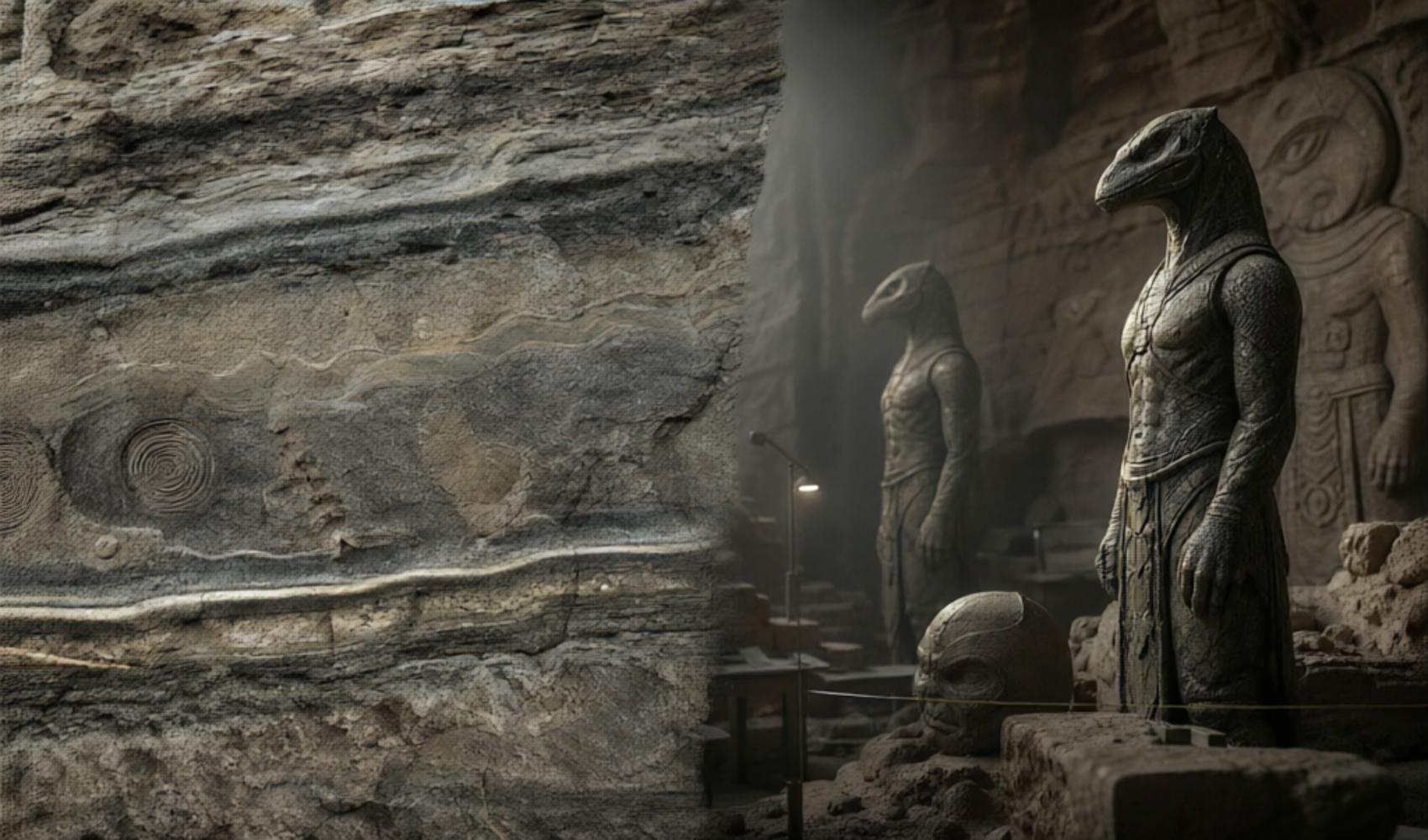
Could a technologically advanced civilization have emerged and vanished on Earth millions of years before humans? The “Silurian Hypothesis,” brought to the agenda by astrophysicist Adam Frank and NASA scientist Gavin Schmidt, does not aim to provide a definitive answer to this question, but rather discusses how such a possibility could be scientifically tested.
The idea behind Frank and Schmidt’s work took shape during a conversation in 2017. The discussion, which began with Frank’s question, “Do aliens also experience climate change?”, evolved in a different direction when Schmidt asked whether, if an advanced civilization had existed on Earth before humans, it would be detectable today. The two scientists later turned this thought experiment into a paper published in 2018.
The name of the hypothesis is inspired by an advanced reptilian race from the “Doctor Who” series. However, the study focuses not on proving a claim derived from popular culture, but on understanding whether technological activities in the distant past would leave traces, through the lenses of geology, climate science, and the fossil record.
WHAT CAN THE GEOLOGICAL RECORD TELL US?
The fundamental question the researchers address is this: If a civilization in the past had used large amounts of energy, altered the planet’s chemistry, and then disappeared, what would remain millions of years later? Finding direct physical remains such as buildings, roads, or cities is extremely difficult on this scale. Tectonic movements, erosion, and volcanic processes destroy most surface structures over time.
The fossil record has a similar limitation. Only a very small fraction of the creatures that have lived on Earth become fossilized; even fewer of these are found by scientists. For this reason, it is theoretically considered possible that the direct biological traces of a short-lived, hypothetical civilization could be overlooked.
For this reason, Frank and Schmidt focus more on chemical traces. Elements such as large-scale carbon emissions, heavy metals, plastics, agricultural chemicals, and non-biodegradable substances are considered capable of leaving marks that could persist in sedimentary layers for a long time. The researchers note that human civilization could also be identified by such a “technofossil” footprint millions of years from now.
One of the examples highlighted in the study is the Paleocene-Eocene Thermal Maximum. It is known that during this period, which occurred approximately 55 million years ago, global temperatures rose by about 8 degrees, large amounts of carbon were released into the atmosphere, and ecosystems were under severe stress. The cause of this event has not been definitively explained; massive volcanic activity or sudden methane release are among the possible explanations.
However, Frank and Schmidt do not claim to personally believe in this hypothesis. The approach of the two scientists is not to say, “This happened,” but rather to discuss the question, “If it had happened, how would we know?” within scientific boundaries.
Jan Zalasiewicz, a geologist and paleontologist at the University of Leicester, also evaluates the idea as a thought-provoking experiment. According to Zalasiewicz, while it is difficult to completely rule out the existence of intelligent but non-technological creatures in the past, a civilization that built cities, processed metal, produced plastic, and left behind large amounts of waste would be expected to leave distinct traces in the geological record.
News Source: 12punto