


Turkey's human capital report card: The gap between provinces is deepening, the distance from Europe is widening



Turkey’s human capital snapshot for the 2021-2023 period serves as a significant warning regarding the country's future development capacity. The "Human Capital Index at the Provincial Level" report published by TurkStat reveals the potential of Turkey's human resources on a city-by-city basis using an index calculated through survival, health, and education components. The findings show that the decline in education is pulling down the national average, regional differences are deepening, and the gap compared to the European Union average is widening. While provinces affected by the earthquake experienced significant drops in index values, provinces such as Çanakkale, Antalya, and Erzincan stood out positively, leading in human capital growth. The situation in Bursa and Adana, however, is thought-provoking. This picture reveals that Turkey must reconsider its development model from a human-centric perspective and reduce regional inequalities by prioritizing investments in education and health.
HOW IS THE HUMAN CAPITAL INDEX CALCULATED?
The report by the Turkish Statistical Institute (TurkStat) published on September 19, 2025, paints a picture of Turkey's economic and social future that is both promising and thought-provoking. Based on the World Bank methodology, the Human Capital Index (HCI) measures the level of productivity a child born today is expected to reach by the age of 18, depending on the health and education conditions in the city where they live.
The index consists of three main components—survival, health, and education—and is calculated using five different variables. The education component is based on expected years of schooling and student achievement test results; the health component is based on adult survival rates and child stunting indicators. The survival component expresses the probability of a child surviving until school age.
The index, obtained by multiplying these three components, takes a value between 0 and 1. A value approaching 1 indicates that the probability of the child reaching their full potential and becoming a productive individual in the future is at the highest level.
TurkStat's study does not merely provide a technical economic indicator; by making social and regional differences between cities visible, it serves as a critical warning regarding Turkey's development capacity and level of equal opportunity. Beyond reflecting the current state of education and health infrastructure, the report serves as a strong roadmap for future growth and prosperity.
TURKEY'S GENERAL TREND: A Slight Decline
As seen in the table below, Turkey's human capital index was 0.693 in 2021, rising to 0.696 in 2022 with a 0.5% increase. However, it reversed its recovery trend in 2023, falling to 0.690 with a 0.9% decline. The most important reason for this seemingly small decline was the weakening of the education component, which is the most decisive element of the index.
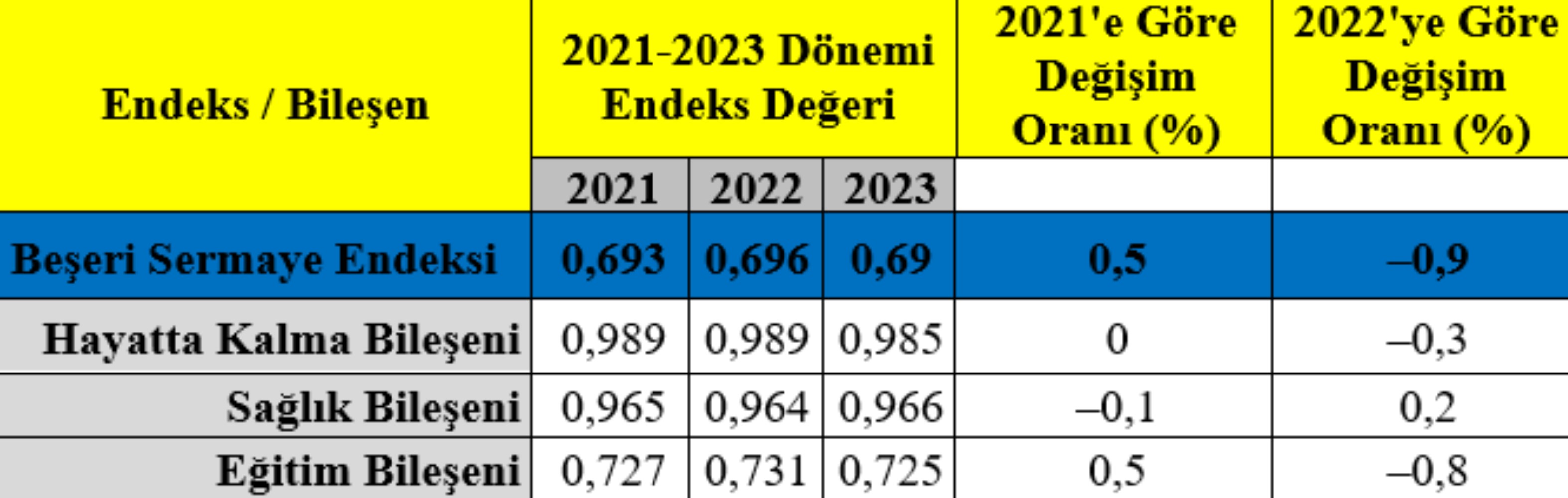
Looking at the table, the survival component fell to 0.985 with a 0.3% decrease. This decline is associated with increases in infant and child mortality rates, difficulties in accessing maternal-infant health services, and regional inequalities. Experts emphasize the need to strengthen health services in rural areas and expand maternal-child health programs.
A positive development was recorded in the health component. The health index, which rose to 0.966 in 2023 with a 0.2% increase, recovered thanks to progress in vaccination, the expansion of preventive health services, and infrastructure investments. To sustain this trend, it is recommended to strengthen primary health care services and chronic disease management programs.
The truly concerning picture is in education. The education component fell sharply by 0.8% to 0.725. Post-pandemic learning losses, rising school dropout rates, the high number of students per teacher, and regional quality differences are the main reasons for this decline. It is possible to reverse this picture with remedial education programs, training to improve teacher quality, the expansion of preschool education, and vocational-technical education investments.
In conclusion, the fracture in Turkey's human capital index serves as a critical warning that directly affects the country's future productivity. Despite partial progress in the field of health, it seems difficult for the general index to rise unless the weakness in education is addressed.
COMPARISON WITH EUROPE: The Gap is Widening
While the 2020 human capital index average for the 27 members of the European Union (EU) was 0.730, Turkey ranked 22nd in 2021 with a value of 0.693, falling behind this average. Finland tops the list with 0.796 points, followed closely by Sweden (0.795) and Ireland (0.793). At the bottom of the list are Romania (0.584), Bulgaria (0.614), and Slovakia (0.665). In this picture, Turkey is positioned below the EU average but slightly above the lowest-performing countries.
Behind this gap lie structural problems such as quality differences in education, regional inequalities in access to health services, injustice in income distribution, and the rural-urban infrastructure divide. In particular, the decline in quality in education and the inability of the young population to fully utilize its potential limit Turkey's future labor productivity.
According to experts, to close this gap, Turkey needs to transition to a system compatible with EU education standards, restructure vocational training according to European norms, strengthen regional health infrastructure, and benefit more effectively from EU social funds. Taking these steps will both increase the quality of the workforce and enhance Turkey's global competitiveness in the long term.
THE GAP BETWEEN PROVINCES: Çanakkale at the Top, Şırnak at the Bottom
The most striking finding of the TurkStat report was the large gap between cities. According to 2023 data, Çanakkale ranked at the top with an index value of 0.781, followed by Antalya (0.761), Erzincan (0.756), Eskişehir (0.755), and Rize (0.749). These cities are cited as examples in raising the qualified workforce of the future with their strong performance in education and health.
Turkey's major metropolises fell behind expectations. Ankara ranked 15th (0.735), Istanbul 35th (0.711), Bursa 42nd (0.697), İzmir 43rd (0.693), and Adana 57th (0.668). This picture reveals that cities that stand out in terms of population and economic size have not been able to achieve the same success in human capital production.
On the dark side of the coin, Şırnak is at the bottom with an index value of 0.599. It is followed by Ağrı (0.615), Şanlıurfa (0.618), Gümüşhane (0.620), and Muş (0.622).
This situation reveals the inequalities in the eastern and southeastern regions of the country and the risk that children in these regions will not be able to fully utilize their potential. The main reasons for the differences between provinces stem from geographical and economic disparities. The difference in development levels between the Marmara and Aegean regions and Eastern and Southeastern Anatolia is the most prominent example of this. Education infrastructure also plays an important role in inequality; the number of universities and schools, teacher quality, and access to educational materials show serious differences between provinces. In terms of health services, the number of hospitals, the population per doctor, and access to specialized services deepen the differences between provinces. In addition, socio-economic factors such as unemployment rates, income levels, and access to social assistance are also factors that increase inequality.
To reduce these inequalities, increasing the effectiveness of regional development agencies, directing teachers and health personnel to disadvantaged regions with incentives, planning infrastructure investments with the principle of regional justice, and delivering social transfers more effectively to target groups are among the critical measures.
The top five provinces where the human capital index increased the most between 2021 and 2023, as seen in the table below, were Çanakkale with 0.026 points, Uşak with 0.022 points, and Siirt, Antalya, and Erzincan, which had the same increase of 0.017 points, respectively.
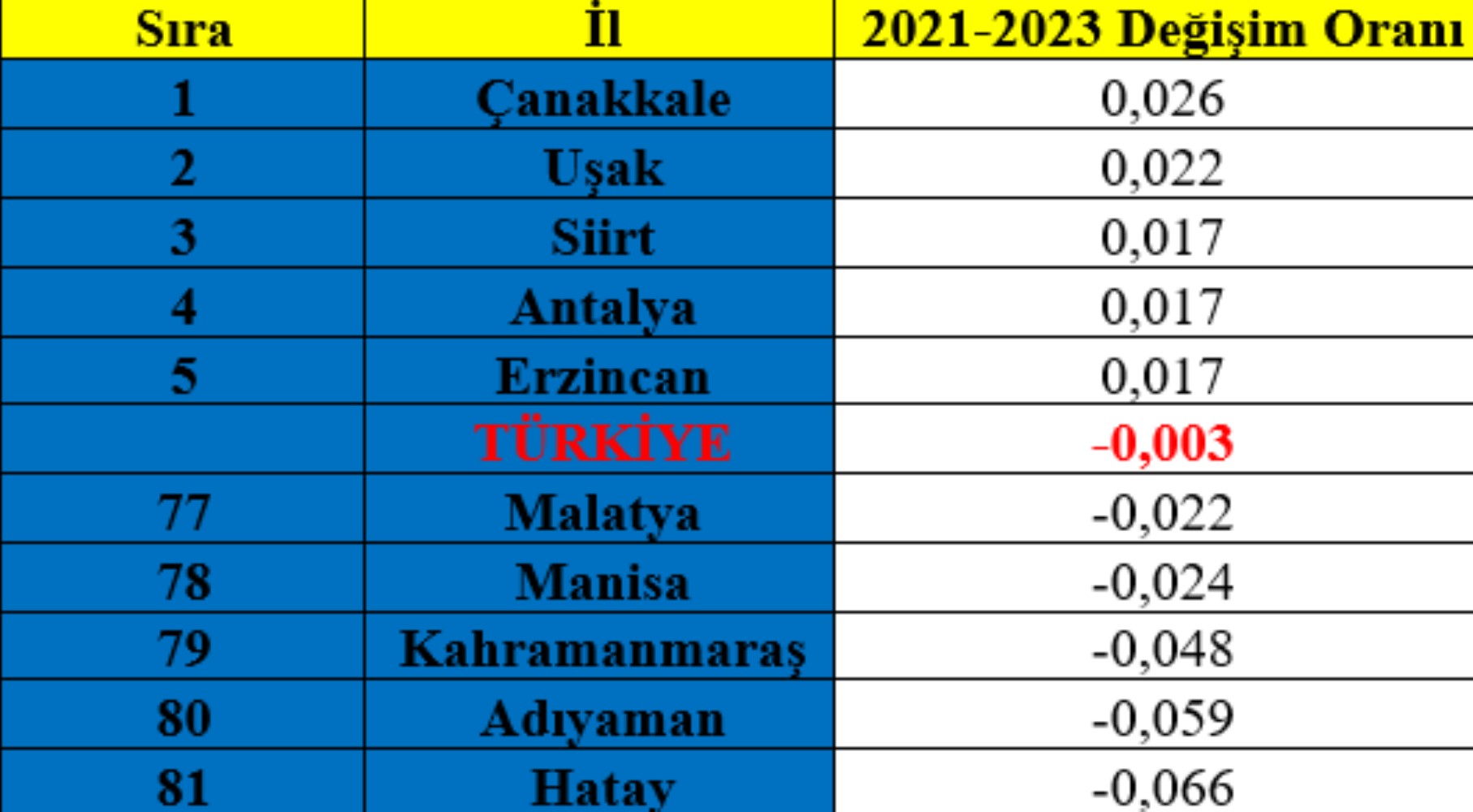
The most poignant data in the report were hidden in the provinces that experienced the largest decline in the human capital index during the same period. Hatay with a decrease of 0.066 points, Adıyaman with a decrease of 0.059 points, Kahramanmaraş with a decrease of 0.048 points, Manisa with a decrease of 0.024 points, and Malatya with a decrease of 0.022 points were the provinces that experienced the greatest decline in index values. The fact that four of the provinces in this ranking were the ones most affected by the February 6 earthquakes shows that the disaster deeply shook not only buildings but also human capital, the most valuable resource of society. The closure of schools, the collapse of health infrastructure, and mass migration seriously threaten the futures of children and young people in these provinces.
While successful provinces stand out with local governments that prioritize education and health investments, active civil society participation, and strong university-industry cooperation; declining provinces are struggling with economic stagnation, migration pressure, and the devastating effects of disasters. Experts recommend accelerating post-disaster recovery programs, updating regional development plans, and strengthening inter-provincial cooperation mechanisms to reduce these differences.
THE REPORT CARD OF METROPOLITAN CITIES: The Examples of Bursa and Adana
Bursa: Restructuring Education and Industrial Power
Bursa, one of Turkey's most important production centers, has a potential above the national average with its industrial capacity, university infrastructure, and employment potential. However, the national decline in education in recent years is also negatively affecting Bursa. The decline in quality in education makes it difficult to renew the qualified workforce, putting industrial and digital transformation processes at risk.
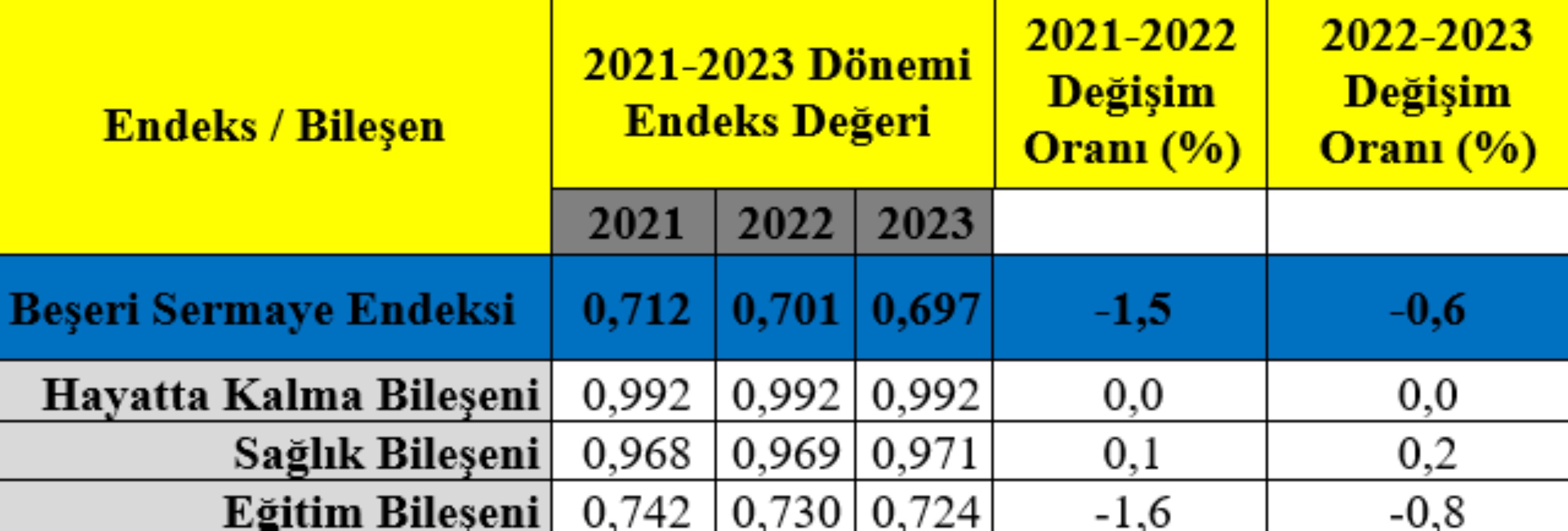
The table below shows how Bursa's human capital index and its components have changed in recent years: While Bursa's human capital index was 0.712 in 2021, ranking 36th, it fell by 1.5% in 2022 to 0.701, ranking 46th. With a 0.6% decline in 2023, the index fell to 0.697, and Bursa ranked 42nd this time. The most critical factor in this decline was the education component; it fell from 0.742 to 0.724 within three years, making the problems in the quality of education in the city visible. Intense migration, education infrastructure that cannot adapt to the increasing population, insufficient training opportunities for young workers in Organized Industrial Zones (OIZs), and environmental problems (traffic, air pollution) are among the main reasons for this decline.
Among Bursa's strengths, university-industry collaborations stand out. Collaborations between Uludağ, Bursa Technical, and Mudanya Universities and industrial organizations provide the city with significant potential. However, the decline in education threatens this potential. For Bursa to make its industrial infrastructure sustainable, it needs to strengthen its integration with education.
To achieve development in areas such as digitalization, green transformation, and automation, it is essential to train a qualified workforce rapidly. At this point, updating vocational training programs, expanding certificate and applied training, and training human resources according to the needs of local industry are of great importance. Flexible working models, remote working opportunities, and the expansion of care support to increase female employment can also strengthen Bursa's labor capacity.
Bursa's future depends on how quickly and effectively it can achieve the integration of education and industry. Restructuring vocational training centers in cooperation with industry and launching skill-building programs focused on digital and green transformation will protect and increase the city's production power in the long term. Investments that will stop the decline in education and make the workforce qualified will enable Bursa to use its potential more effectively and make it sustainable for it to remain one of the locomotive cities of the national economy.
Adana: Transforming Agriculture and Food Potential into Human Capital
Adana, one of Turkey's most fertile agricultural basins, is a strategic development center thanks to its strong agricultural production, developed food industry clusters, the Eastern Mediterranean Container Port planned in Ceyhan, and investments such as the SASA Yumurtalık Special Industrial Zone. However, the human capital index data for the 2021–2023 period shows that this economic potential is not fully reflected in human resources.
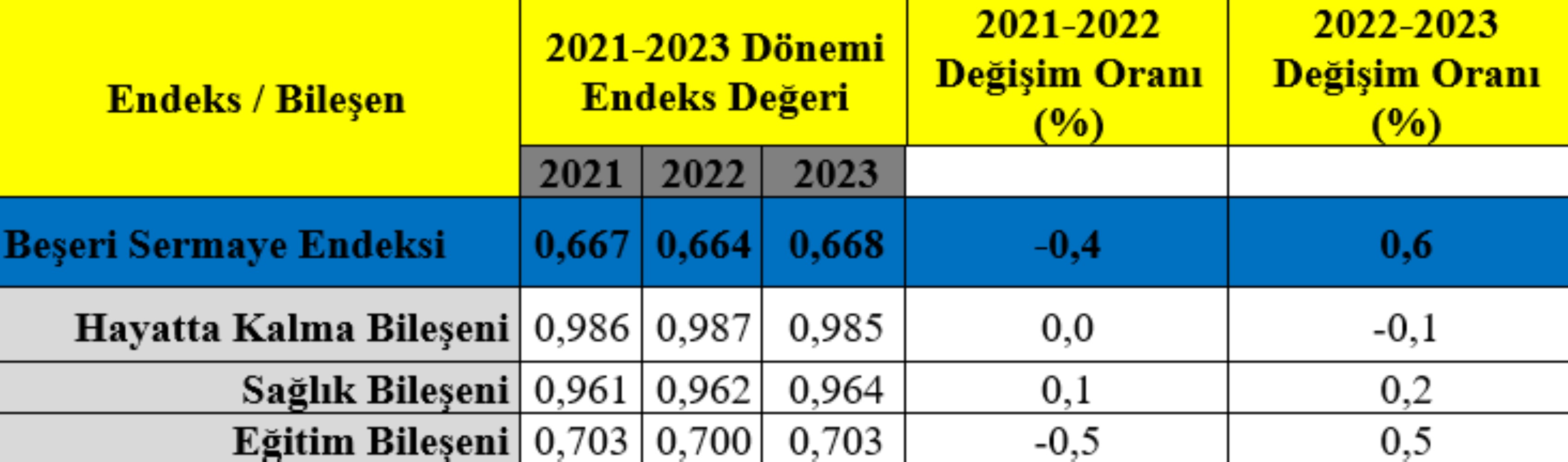
When the human capital index and component data are examined in the table below; while Adana was at 0.667 in 2021, ranking 64th, it fell to 0.664 in 2022 with a 0.4% decline. In 2023, it rose to 0.668 with a limited recovery of 0.6%, ranking 57th. Despite this partial improvement, ongoing structural problems in education and health components limit the city's human capital potential. In particular, the migration of the young population to metropolitan cities creates a risk of human capital loss for Adana in the long term. The orientation of qualified young people to other cities for work and education opportunities threatens the sustainability of the workforce needed by the agriculture and industry sectors.
At the root of this stagnation lie unstable employment due to seasonal labor, high absenteeism rates in education, the health effects of climatic conditions on children and the elderly, and high youth unemployment rates. All these factors negatively affect the quality and sustainability of human capital.
However, Adana has significant opportunities. Establishing training centers in the fields of agricultural technologies and the food industry, ensuring continuity in education with summer schools, expanding local health screening programs, and increasing youth-sports facilities can create a positive impact on both the city's education and health indicators.
For a solution, the priority should be to implement vocational training programs that connect young people to the region by establishing agriculture and industry-focused competence centers. Applied training in areas such as food technologies, cold chain management, and digitalization in agriculture can increase the employment capacity of the young population. Bridges between industry and education should be strengthened, internship and certificate programs should be expanded in vocational high schools, and the direct participation of young people in production processes should be encouraged.
In addition, strengthening health infrastructure and developing health support programs integrated with early childhood education are of critical importance for long-term human capital growth. For this transformation to be sustainable, co-financing models should be established between local governments, universities, and organized industrial zones, and regular resources should be transferred to projects that will strengthen human capital.
Ultimately, Adana has the capacity to turn its natural resources and young population potential into a development advantage with investments focused on continuity in education, accessibility in health, and local employment. When this transformation takes place, Adana will stand out not only as an agricultural production center but also as a city that produces qualified human resources.
CONCLUSION: Human-Centric Transformation and Building the Future
Turkey's 2021–2023 human capital table clearly shows that the decline in education reduces productivity, deepens the differences between provinces, and widens the gap with the EU. The permanent losses in the earthquake region threaten not only today but also the future. The solution is clear: reforms that will rapidly increase quality and access in education, strong primary health care services, targeted incentives for disadvantaged regions, and competence-focused employment models through industry-university-local government cooperation.
The human capital index published by TurkStat is a strong warning that Turkey needs to review its development model. Instead of measuring sustainable development only by GDP growth, priority should be given to policies that create a healthy, educated, and productive population that puts people at the center. Because a country's true wealth is measured by the knowledge, skills, and health of its citizens.
This transformation is possible with short and long-term plans to be developed jointly by the public, local governments, and the private sector. Equitable, inclusive, and quality policies in education and health should be implemented; public expenditures should be restructured to prioritize these areas. Beyond statistics, human capital is the foundation of our production power, prosperity, and competitiveness.
In Bursa, policies that deepen industry-university integration, support female employment with competence ecosystems compatible with digital and green transformation should be implemented. In Adana, agriculture-food-focused centers, cold chain, and digitalization training should be used to establish employment bridges that will keep young people in the region. Each province should announce its 3–5 year targeted plans according to its strengths and weaknesses; progress should be monitored with concrete indicators such as schooling rate, learning outcomes, teacher-student ratio, health coverage, and youth NEET rate. Education of girls, accessible services for disabled individuals, integration programs in provinces receiving migration, and safe transportation-housing solutions should be an integral part of the strategy.
The coming years are a turning point for Turkey. Bold, measurable, and inclusive steps to be taken today will strengthen our human capital, allowing us to close the gap and turn sustainable development into a permanent success. Otherwise, today's gap will turn into an irreparable disadvantage tomorrow.
Today's investments will shape the Turkey of tomorrow. Every investment made in people is the strongest step taken toward the future; as human capital strengthens, Turkey also strengthens.
Would you like to get notifications about new developments and save news?
- NotificationsNew developments and breaking news
- SaveNews is stored in the app
Most Read
National Anthem surprise from Japanese Ambassador
Diesel protest in Italy brings roads to a standstill
Kılıçdaroğlu sends formal notice to YENİ Party

Diyanet Foundation, which claimed 'we have no resources,' owns 73 percent of the fund!

Is it time for the Turkish Parliament to revoke its 31-year-old 'Casus Belli' decision?

No to the 'opening' bar masked as change, yes to the Republic's bar
Ezel Akay and his brother's test results came back positive
Why is Paris burning? The crisis of the welfare state and the revolt of social justice

'From a Journalist’s Pen: The Tüfekli File'

The politics of particles and the financing puzzle: 'Calamitous questions'