



We present to your attention the third part of our four-article series, in which we discuss Homer's Odyssey, which has recently come to the fore again, with our short narratives and interpretations. You can access the previous articles via the links “https://12punto.com.tr/yazarlar/sefa-taskin/odysseusun-yolculugu-1-151301”
https://12punto.com.tr/yazarlar/sefa-taskin/odysseusun-yolculugu-2eve-giden-yol-insandan-geciyordu-152047”
addresses.
______________________________________________
The adventure of the clever Odysseus, one of the heroes of the Trojan War told by Homer of İzmir, who ensured that the brilliant Anatolian city of Troy fell into the hands of the Achaeans/Hellenes through trickery, was continuing.
On the way home, on the turbulent sea.
Either the wrath of the sea god Poseidon or his own mistakes had made this journey, in which the gods of that time were also involved, difficult.
Where were they, the smoke rising from the chimneys of their homes on the island of Ithaca!
After the terrible attack they encountered in the land of the giant, man-eating Laestrygonians, only one of Odysseus's twelve ships remained.
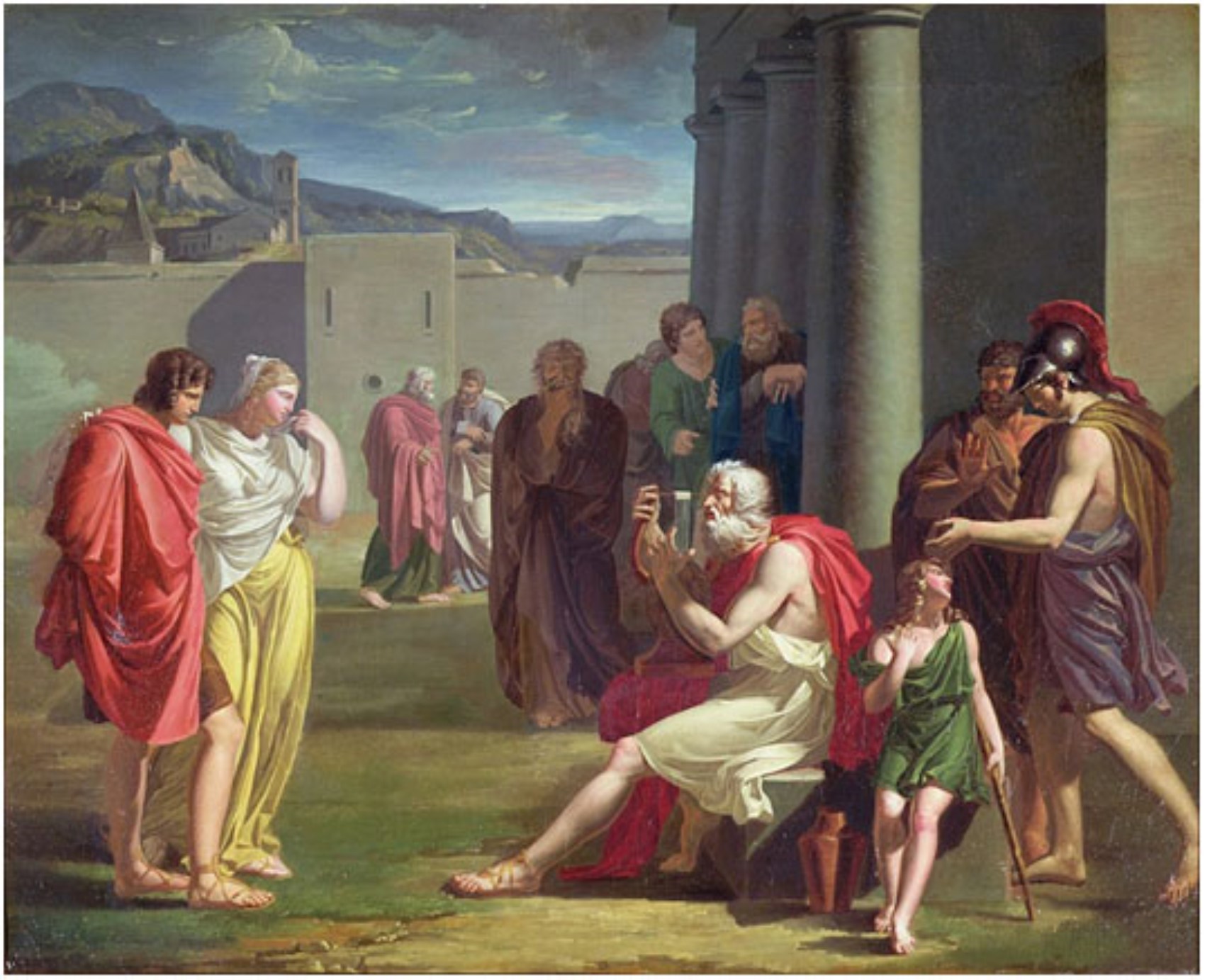
(Félix Boisselier (1776-1811): Homer reciting his poems with his lyre.)
***
Odysseus crossed the waves and reached the island of Aiaia with this single ship along with his surviving men.
Circe lived here.
Circe, the daughter of the Sun God Helios, was a goddess with extraordinary powers in magic and medicinal herbs.
When he saw a house with smoke rising from its chimney on the island, Odysseus sent his men to explore. He stayed on the shore.
Circe welcomed the travelers who arrived at the house. She invited them inside.
In accordance with the tradition of hospitality, she provided food and offered wine.
The drink she gave was magical. And with her wand, she turned her guests into pigs.
Their heads, voices, bristles, and bodies had become those of pigs.
But one very important thing had not changed:
Their minds were still human.
Odysseus's assistant, Eurylochus, who went to Circe's house with the sailors, did not enter, and when he saw his companions turned into pigs, he was frightened.
He fled and told Odysseus the situation.
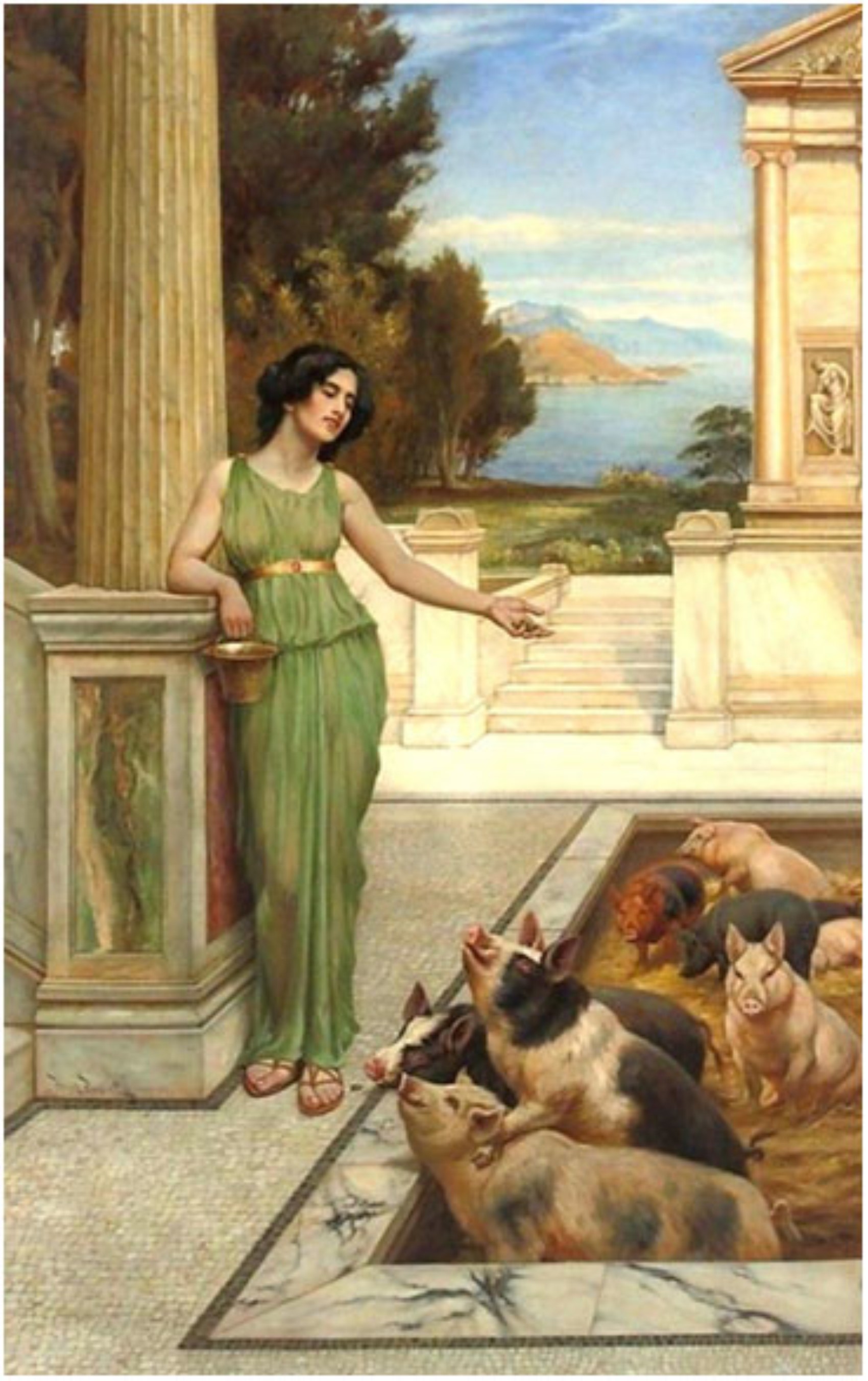
(John William Waterhouse, Circe and the pigs. 1891)
***
Odysseus walked toward Circe's house to save his friends.
On the way, Hermes, the messenger of the gods, appeared before him.
He gave him the moly plant to protect him from the magic.
He drank the potion Circe gave him, but her magic did not affect him.
Odysseus drew his sword and marched on Circe.
In the end, sensing that there was a mysterious situation at hand, Circe turned his men back into human form.
Odysseus and his friends stayed on Circe's island for a year.
It was no longer tyranny that kept Odysseus and his men on the island.
Comfort, abundance, and pleasure had been enough to keep a person from their path.
The sorceress Circe took good care of them, placing plenty of food and drink before them.
So why was Circe acting this way?
Why was she turning the men who came to her island into animals?
Why did she later change her attitude, show them hospitality for months, and even live with Odysseus for days, having children with him?
Homer does not state the reason for these in his epic.
It could be thought that Circe had seen evil from strangers who came before, or that she turned men into pigs to punish and humiliate them.
Her change in behavior is perhaps because she sensed that the will and determination Odysseus showed in protecting his companions were divine.
After all, she too was a woman with extraordinary powers.
Homer shows her to us first as a sorceress and a threat, then as a hostess and a guide.
In the Odyssey, everyone who appears before a person does not remain the person they first appeared to be.
They change, they can change!
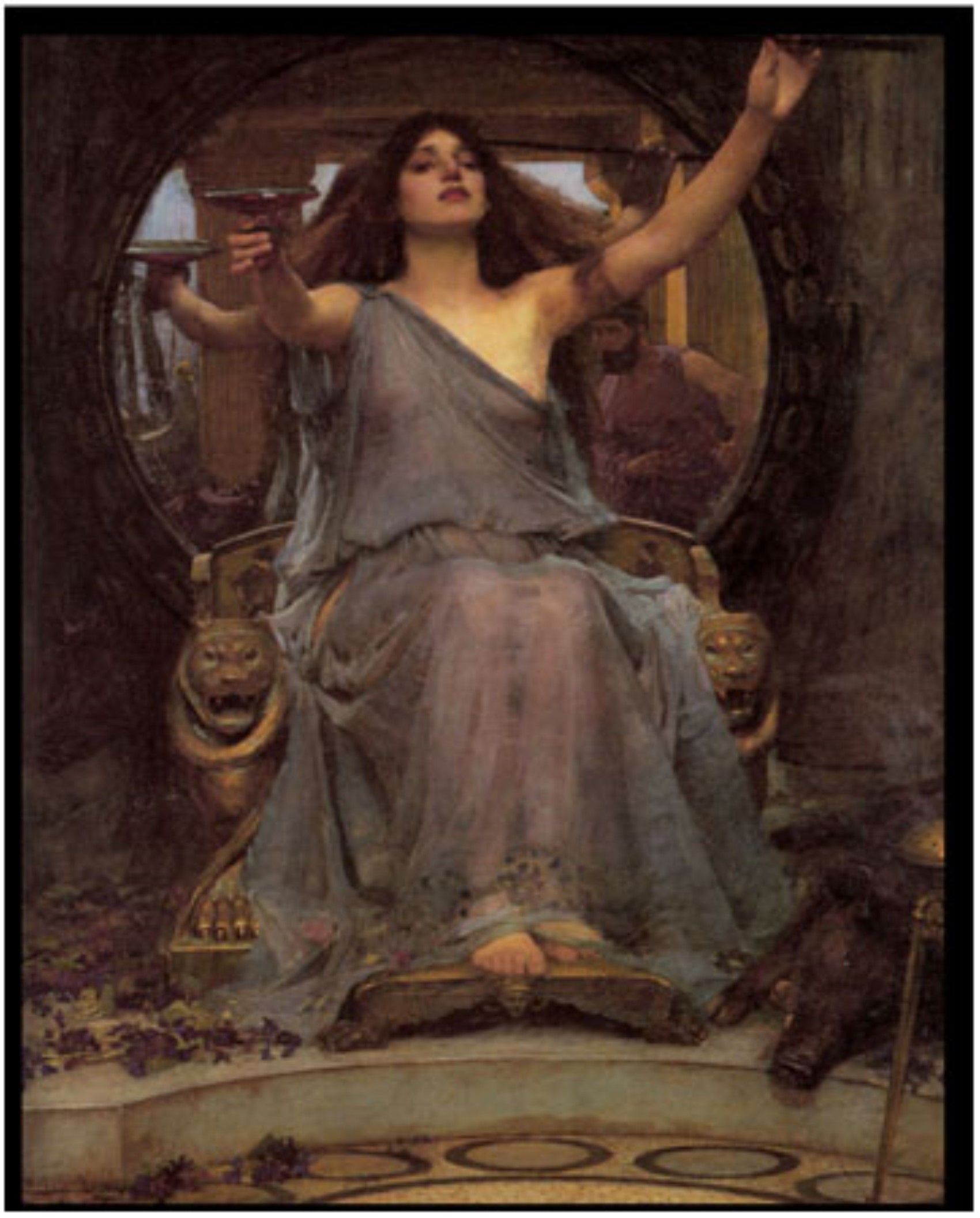
(John William Waterhouse, Circe offering a cup to Odysseus. 1891.)
***
The most striking image of the Circe adventure is undoubtedly the transformation of humans into pigs.
But Homer gives a very interesting detail.
Their bodies had become pigs. But their minds had remained human.
The body turns into an animal, but the human's consciousness remains inside.
Here, the following question can be asked:
What makes a human human?
Their appearance? Their body? Or their mind, memory, and knowing who they are?
Even three thousand years later, the same question stands before us:
Is it the body that makes a human human, or is it the consciousness of who they are?
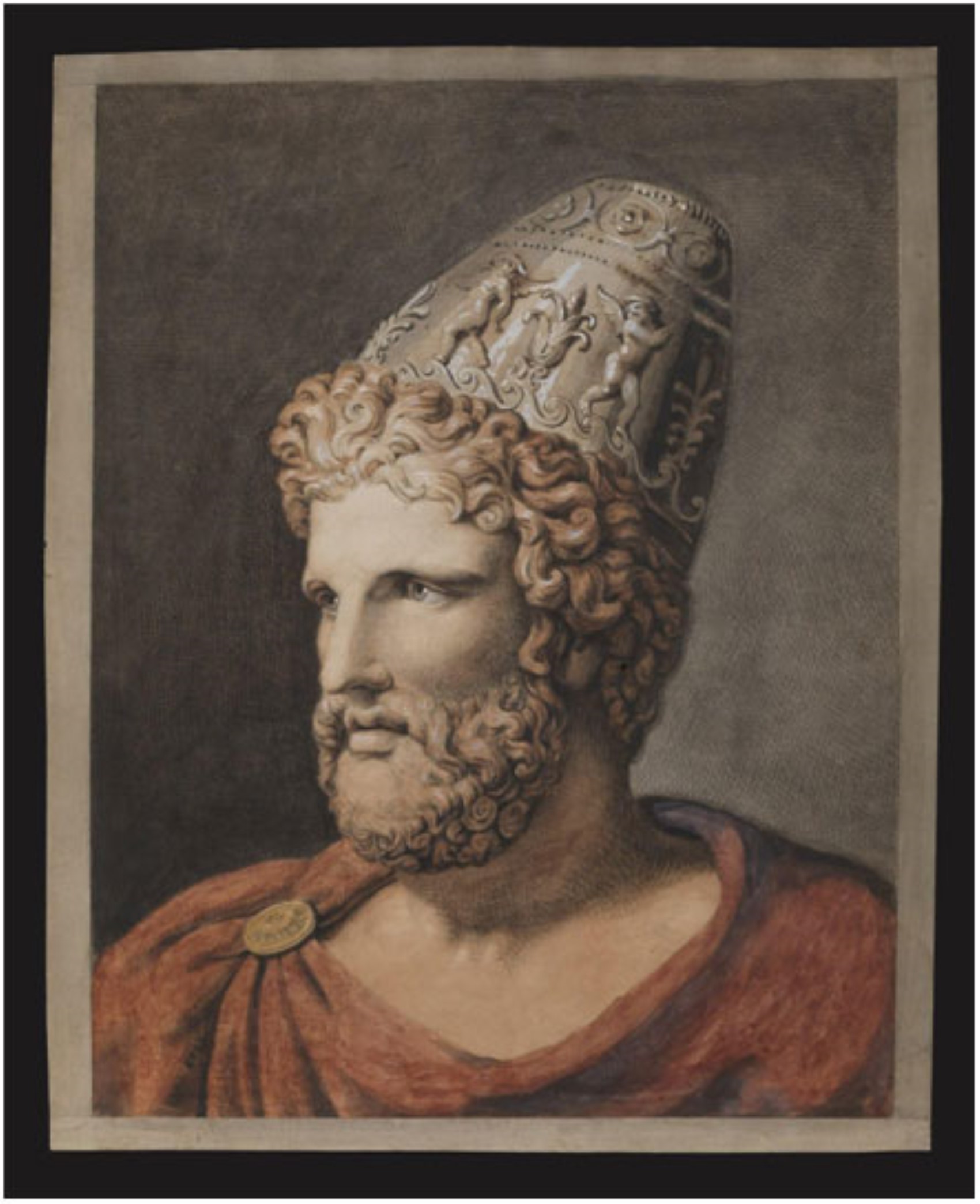
(Portrait of Odysseus. Johann Heinrich Wilhelm Tischbein. Galleria d’arte Paolo Antonacci. Rome)
***
In the Circe adventure, Homer reminds us again of the theme of hospitality.
Circe invites strangers to her table with a smiling face, but she adds magic to her food.
Here, the image of hospitality covers a trap.
This means that sometimes, to understand danger, one must look not at how one is welcomed, but at what lies behind that warm welcome.
Danger does not always have a terrifying face.
As his friends entered Circe's house, Eurylochus's suspicion and refusal to join them points to the importance of being cautious.
Sometimes, not going where everyone else is going is not cowardice.
After running to Odysseus and telling him what happened, his fear and refusal to go with him to the sorceress's house to save his companions who had turned into pigs is another human condition.
The person who sees the danger first is not always the bravest person.
But the person who appears the bravest is not always the one who sees the danger first.
Human communities sometimes need both:
The one who advances and the one who says “stop.”
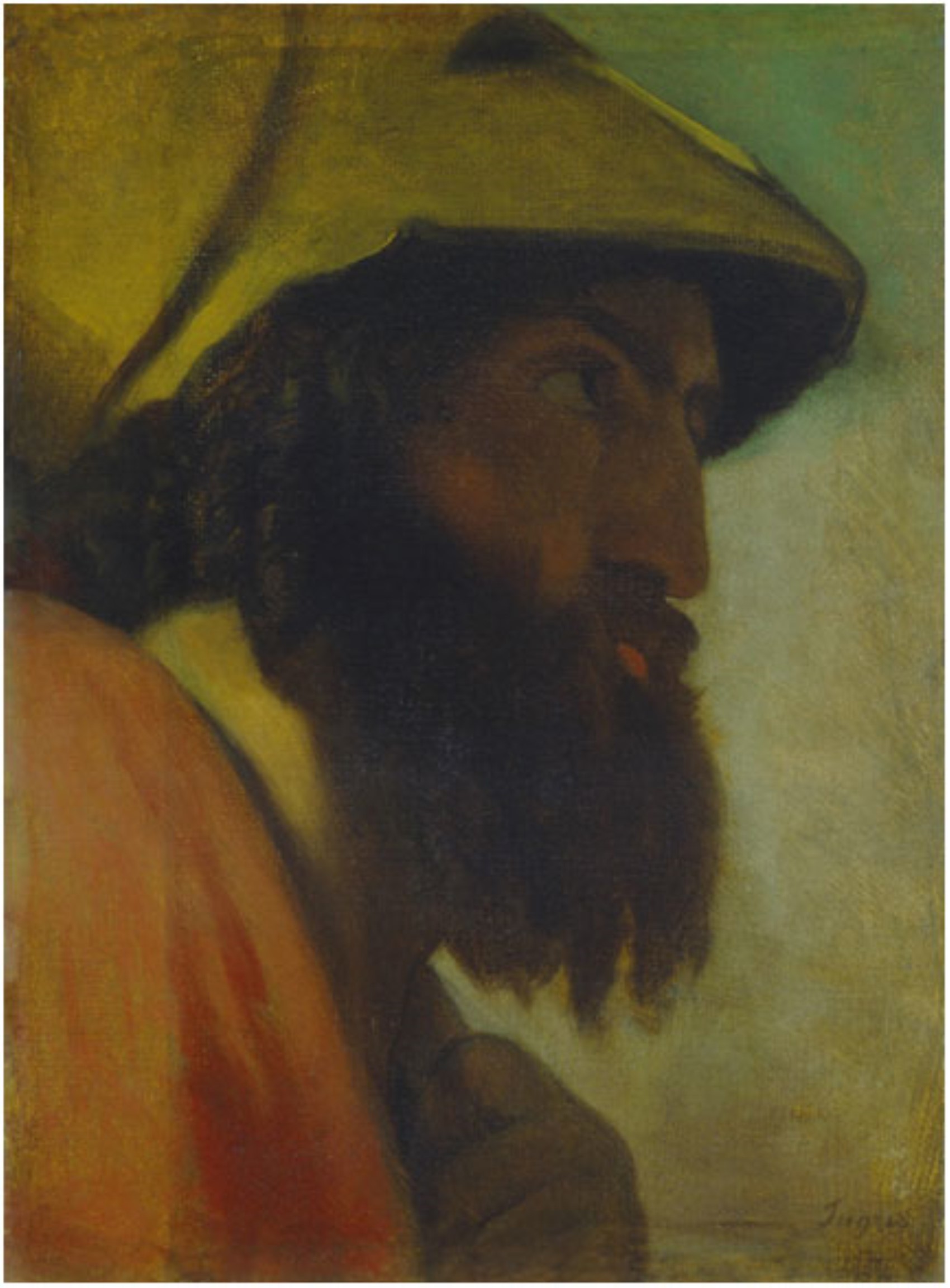
(Jean-Auguste-Dominique Ingres, Ulysses (Odysseus), 1827)
***
The fact that Odysseus, who always uses his mind to solve problems, receives help from the divine power Hermes against the mighty sorceress Circe adds another truth to Odysseus's journey:
A person cannot achieve everything alone.
Sometimes even the smartest person needs help.
What matters is not receiving help, but having the mind to use it when it comes.
Finally, the days of the weary warriors of Troy on Circe's island were over.
One day, his men reminded Odysseus why they were still there.
They needed to return to Ithaca, to their homes. That was their goal.
Circe did not oppose their departure.
But first, there was a terrible place Odysseus had to go.
The Land of the Dead.
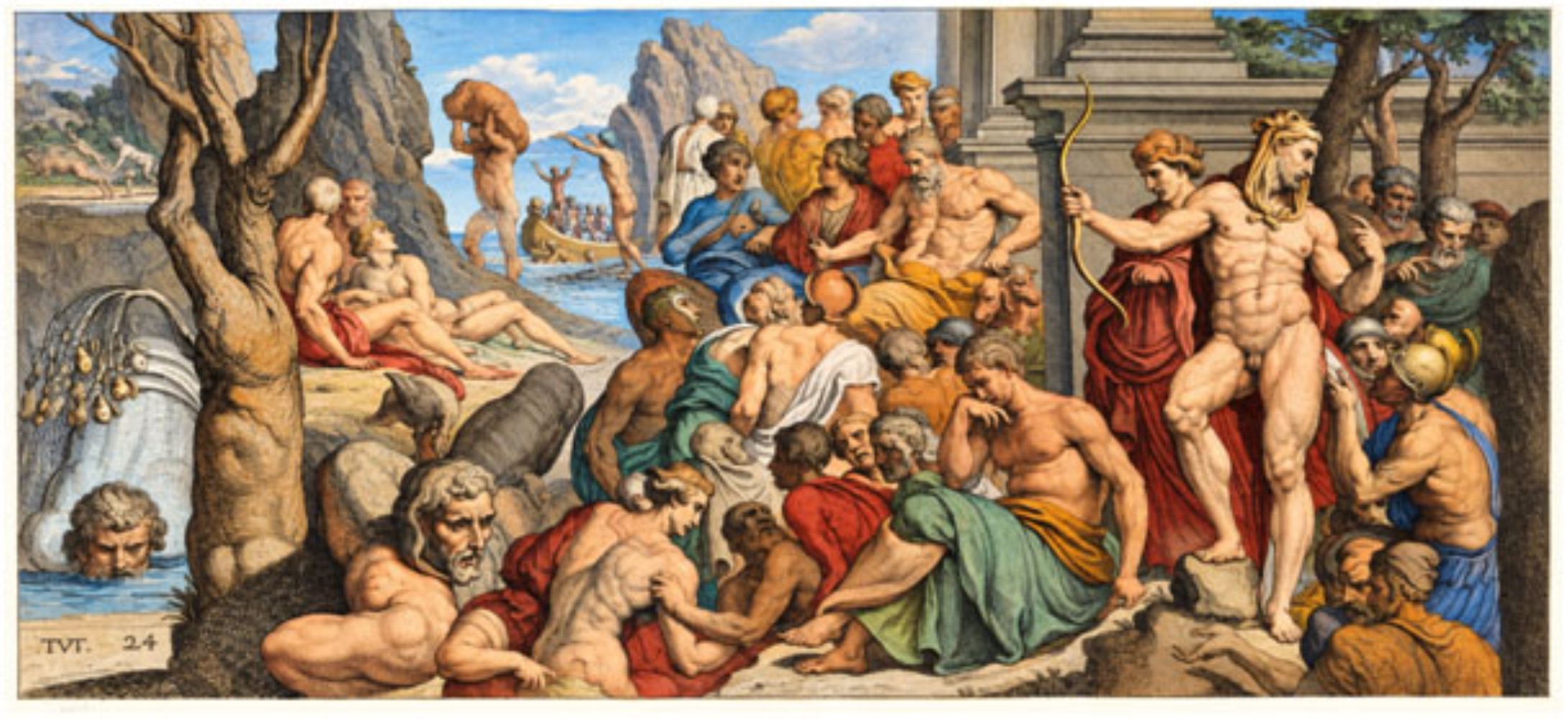
(AI-colored version of the 1632–33 engraving “Odysseus in the Underworld” by Theodoor van Thulden, based on a composition by Francesco Primaticcio)
***
According to Circe, before Odysseus returned to Ithaca, he had to visit the Land of the Dead.
The ruler of the Land of the Dead was Hades; the brother of the chief god Zeus and the god of the seas, Poseidon.
Hades was not the god of death, but the god of the world of the dead. Homer referred to this realm directly as the “land of Hades.”
In the Land of the Dead, which Homer describes as a cold and gloomy place on the distant borders of the world, Odysseus would speak with the spirit of the blind seer Teiresias and learn the dangers awaiting him on the way back.
Teiresias was one of the most famous seers of that time.
He was dead, but he had not lost his power to see the future.
Odysseus and his men set out.
When they arrived at the entrance to the Land of the Dead, Odysseus dug a pit in the ground as Circe had taught him.
He poured honey and milk into the pit, followed by wine and water. He sprinkled barley flour over it.
Then he slaughtered the sacrifices and let their blood flow into the pit.
This was the procedure.
The spirits of the dead began to gather around the blood.
Odysseus finally spoke with the spirit of Teiresias.
Teiresias told him about the dangers he would encounter on the way back.
He said they should absolutely not touch the sacred cattle of the Sun God Helios located on the island of Thrinakia, which they would encounter.
If they touched them, they would experience a great catastrophe.
But what Teiresias said did not end there.
After Odysseus returned to Ithaca and settled accounts with the suitors, he would take his ship's oar on his shoulder and set out again.
He would walk to a place where people lived who did not know the sea at all, did not add salt to their food, and did not know what an oar was.
One day, someone he encountered would mistake the oar on his shoulder for a winnowing fan.
That is where Odysseus would plant his oar in the ground and offer a sacrifice to Poseidon.
Then he would return home.
Teiresias said that his death would also come far from the sea, in a peaceful old age.
That is how Poseidon would forgive him!
But Homer would not tell of this happening.
Or could it even happen?
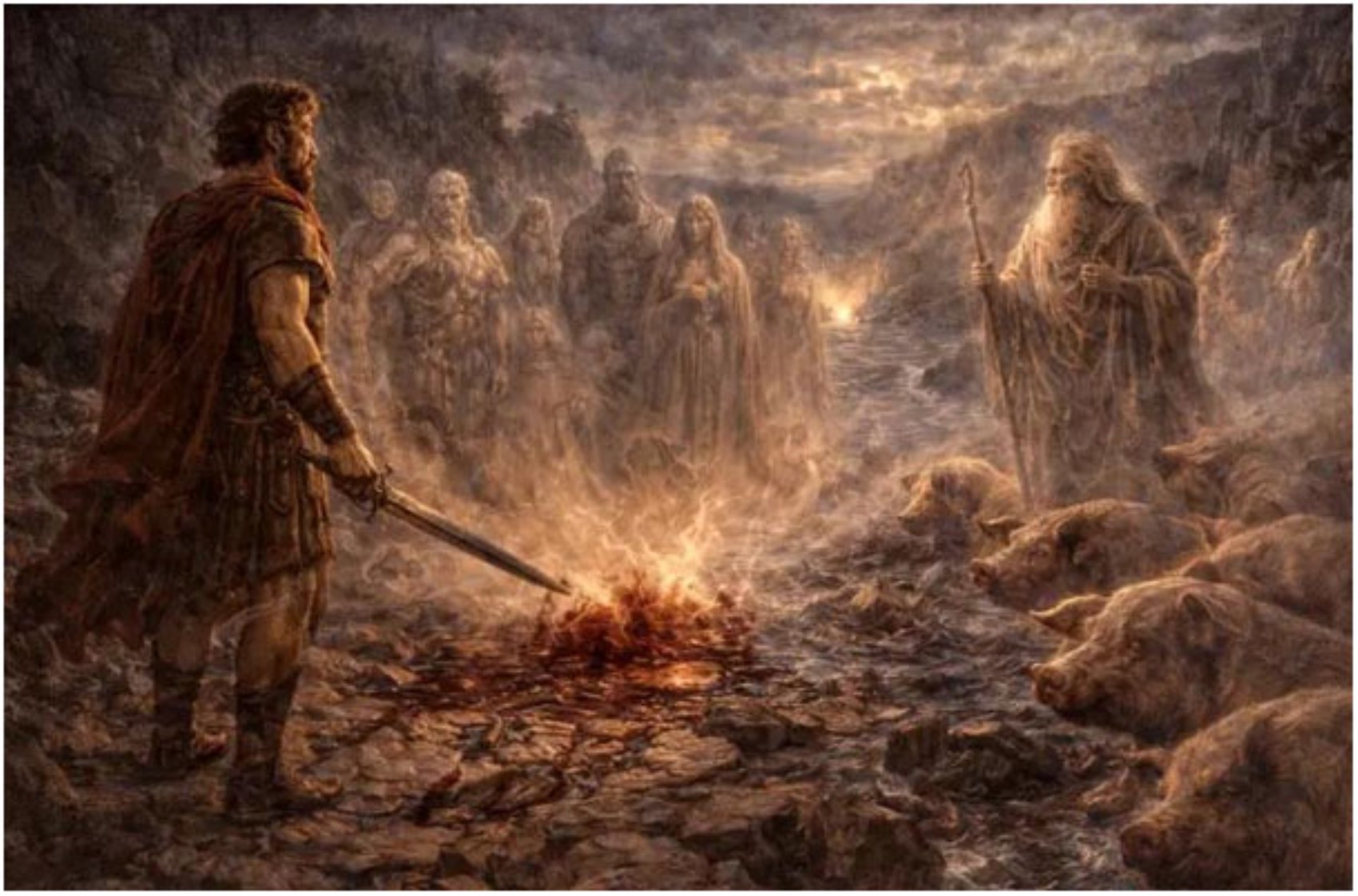
(Odysseus speaking with Teiresias in the Land of the Dead. Image. AI)
***
In the Land of the Dead, Odysseus also encountered the dead he knew from the Trojan War.
He spoke with King Agamemnon and the Trojan hero Achilles.
For Achilles, who was a great warrior while alive, fame and greatness no longer had much meaning.
He said he would “rather be a laborer for a poor man among the living than rule in the Land of the Dead.”
This saying, conveyed by Homer, would be used for centuries in different languages to describe a dramatic phenomenon with a similar meaning.
Odysseus now knew what awaited him on the way back.
He left the Land of the Dead and returned to Circe's island with his men.
Circe warned them one last time.
Ahead of them were the beautiful-voiced Sirens who bind people to themselves, the six-headed monster Scylla, and the destructive whirlpool Charybdis.
And further on, the island of Thrinakia, where Helios's sacred cattle grazed, was waiting for them.
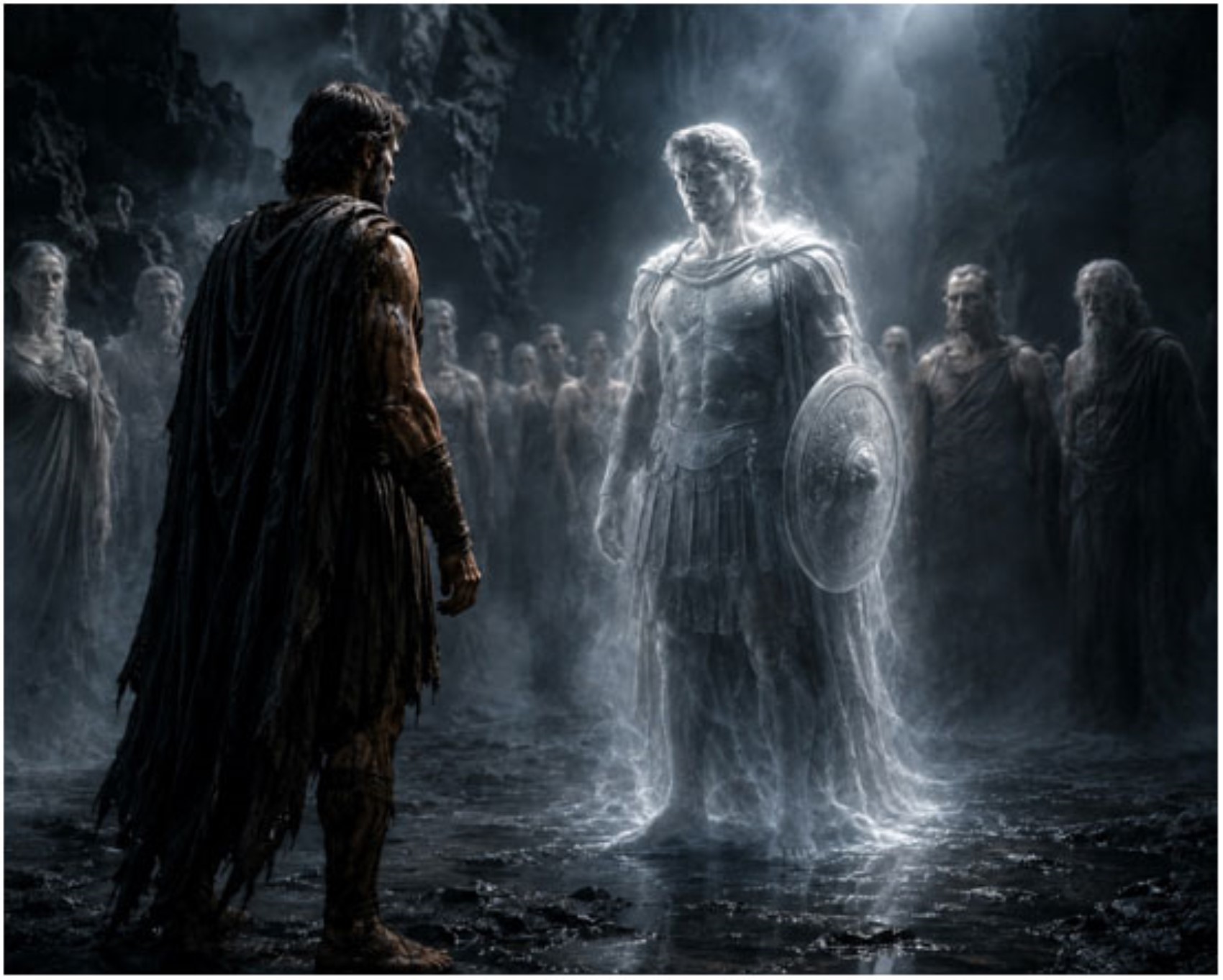
(Odysseus encounters Achilles in the Land of the Dead. Image. AI)
***
Odysseus, who left the Land of the Dead, returned to Circe's island again.
Because there, he had made a promise to the spirit of his dead friend Elpenor.
Elpenor had died by falling from the roof of Circe's house on the morning they were to set out for the Land of the Dead; his friends had left the island without realizing he was dead.
Odysseus kept his promise.
When they arrived at Circe's island, his companions burned the body of their comrade Elpenor and buried his ashes. His spirit found peace.
In those ages, leaving a dead person's body in the open without burying or burning it was one of the greatest disrespects that could be shown to the dead.
They also planted his oar on the grave of the unfortunate Elpenor.
Then Circe told them one by one about the dangers awaiting them.
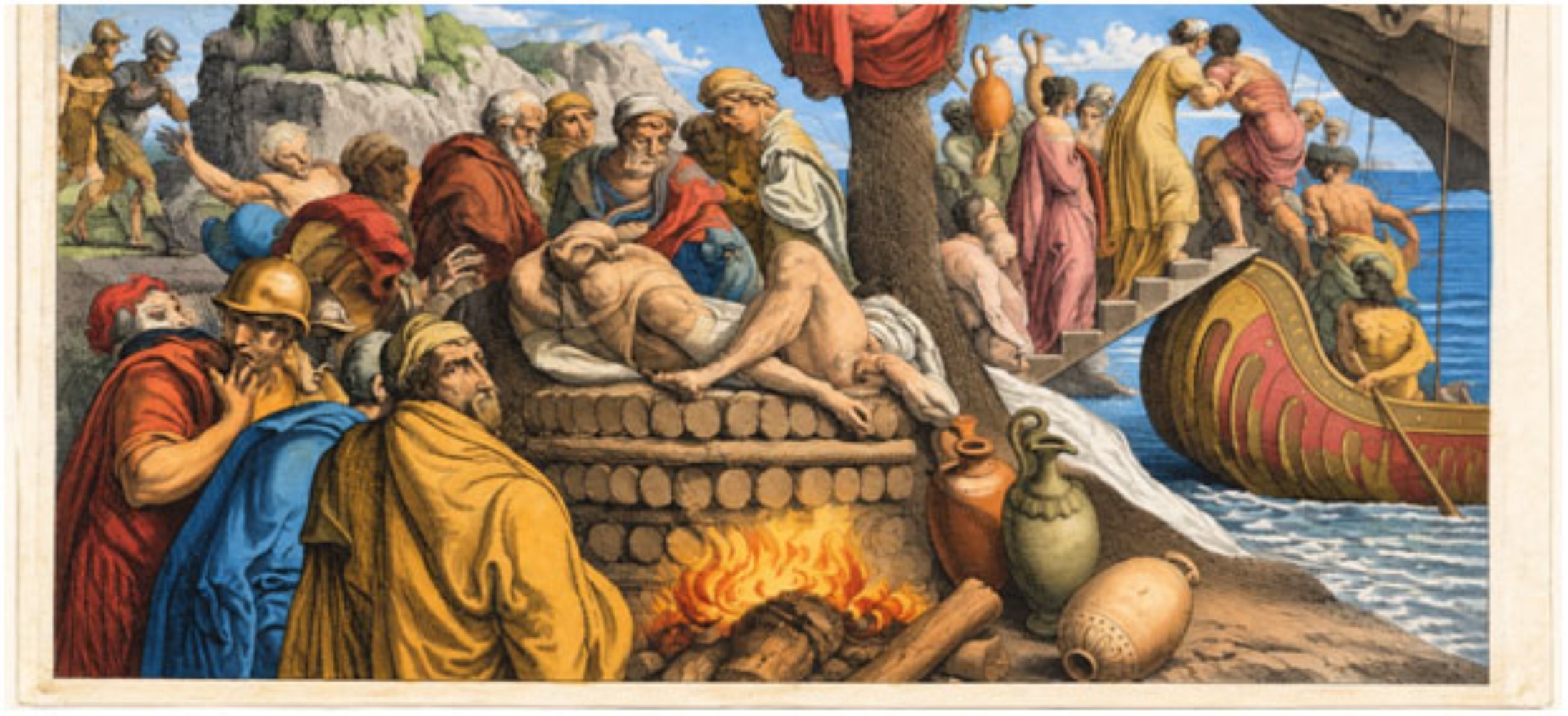
(AI-colored version of the 1632–33 engraving “The cremation of Elpenor's funeral” by Theodoor van Thulden, based on a composition by Francesco Primaticcio)
***
The first were the Sirens.
Homer does not describe their appearance.
In later Ancient Greek art, Sirens were mostly depicted as creatures with women's heads, bird bodies, and wings.
The appearance of a beautiful woman or mermaid that comes to mind today is an image created by much later periods.
Their real weapon was not their beauty...
It was their voices.
Hearing their voices was fatal.
The ships were passing in front of the shore where the Sirens were.
Odysseus was curious.
To see the unknown...
To hear...
He wanted to learn.
The curiosity that caused him to enter the cave of the one-eyed Polyphemus was still inside him.
He also wanted to listen to the Sirens.
If so, Circe had told him what to do.
His men would plug their ears with beeswax, and he would have himself tied tightly to the ship's mast.
Thus, he would hear the voice of the Sirens but would not be able to follow them.
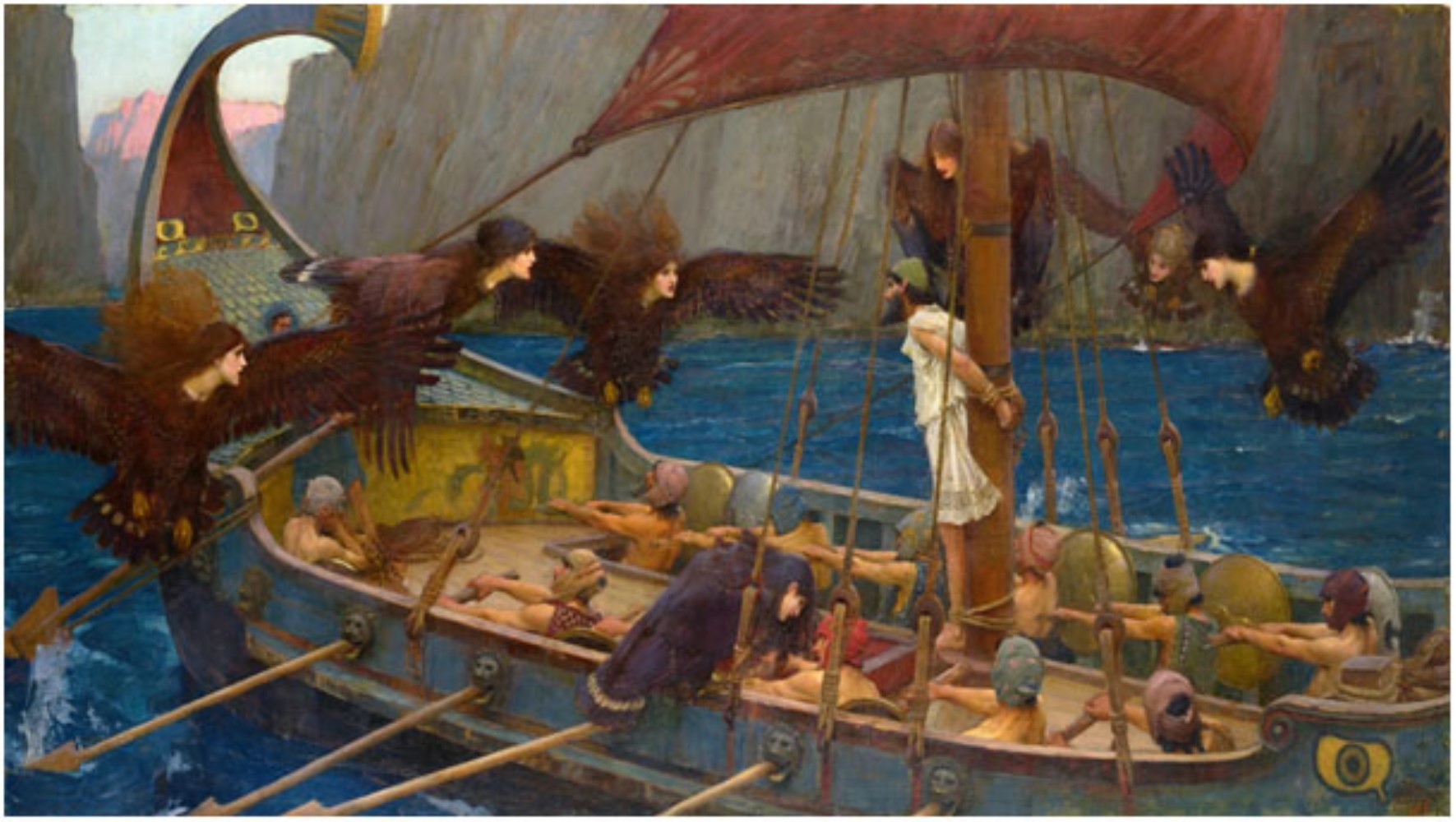
(John William Waterhouse (1849–1917). Odysseus and the Sirens. (1891). National Gallery of Victoria (NGV), Melbourne, Australia)
***
The Sirens were not promising Odysseus love or immortality.
They were promising knowledge.
They were saying that they knew what happened in Troy, that they were aware of everything happening on earth.
“Come, Odysseus, stop and listen to us,” they called out, inviting him to the meadow on the shore where they were.
They were appealing to one of Odysseus's weakest points:
His curiosity.
But there was now a difference between the Odysseus in the cave of the one-eyed giant Polyphemus and the Odysseus here.
He had learned to control his curiosity without giving it up.
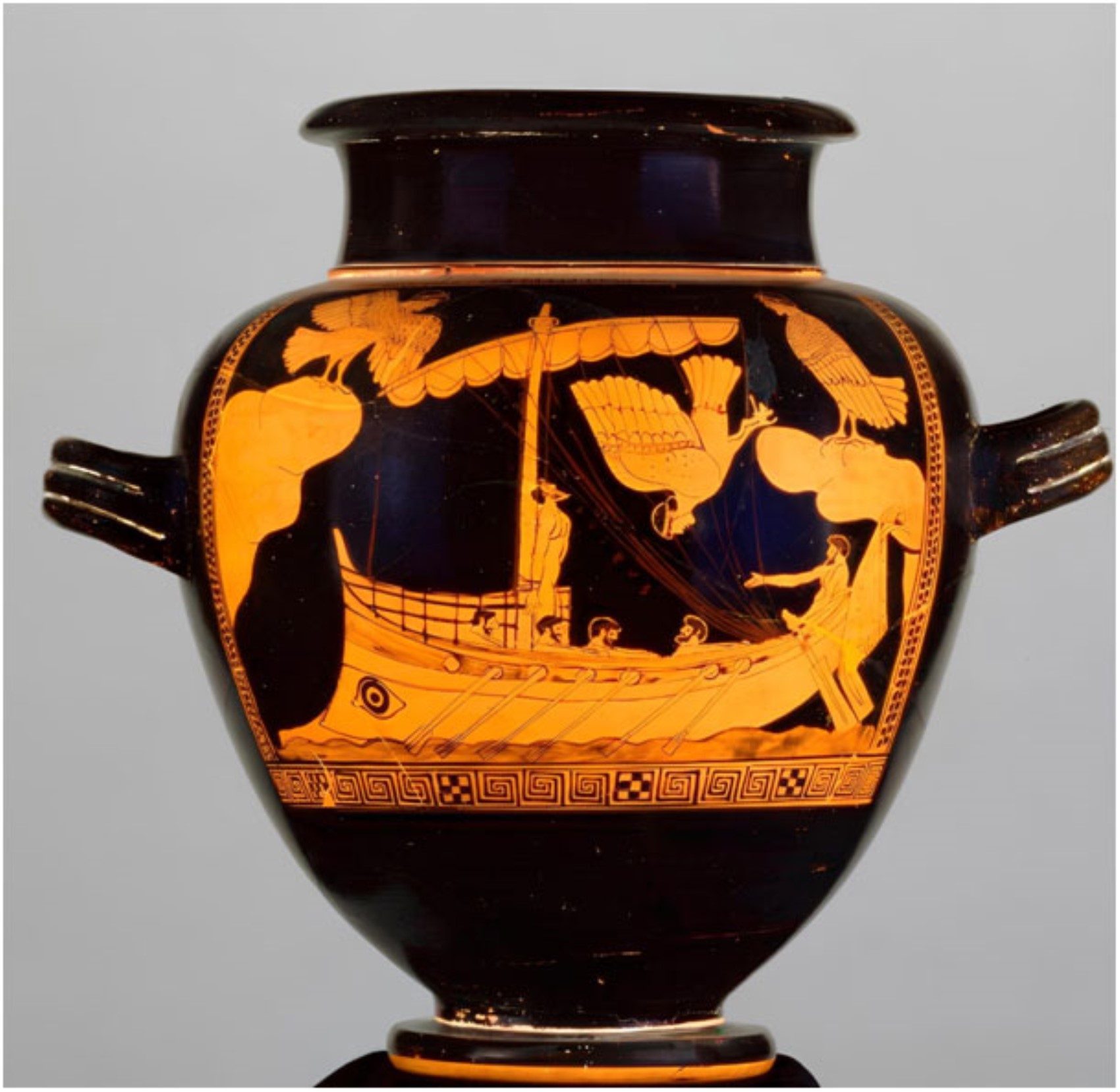
(An Attic red-figure vessel attributed to the Siren Painter, dated approximately 480–470 BC. Vulci-Italy)
***
When they approached the shore where the Sirens were, after having himself tied to the ship's mast, he ordered his men:
No matter how much I beg...
Do not untie me.
Then the sailors covered their ears with beeswax.
When the voice of the Sirens came, Odysseus truly wanted to be untied from his ropes.
He begged.
He ordered.
His men saw his struggle but did not untie him.
They tightened the ropes even more.
Odysseus had done something different here.
He had not fled from the Sirens...
He had not silenced them...
He had listened.
But before hearing their voices, he had calculated that his will might change when he heard that voice.
Those voices...
In a sense, he had bound his future will with his present mind.
Perhaps this is one of the ways a person protects themselves:
As much as knowing how strong one is...
Knowing where one might remain weak.
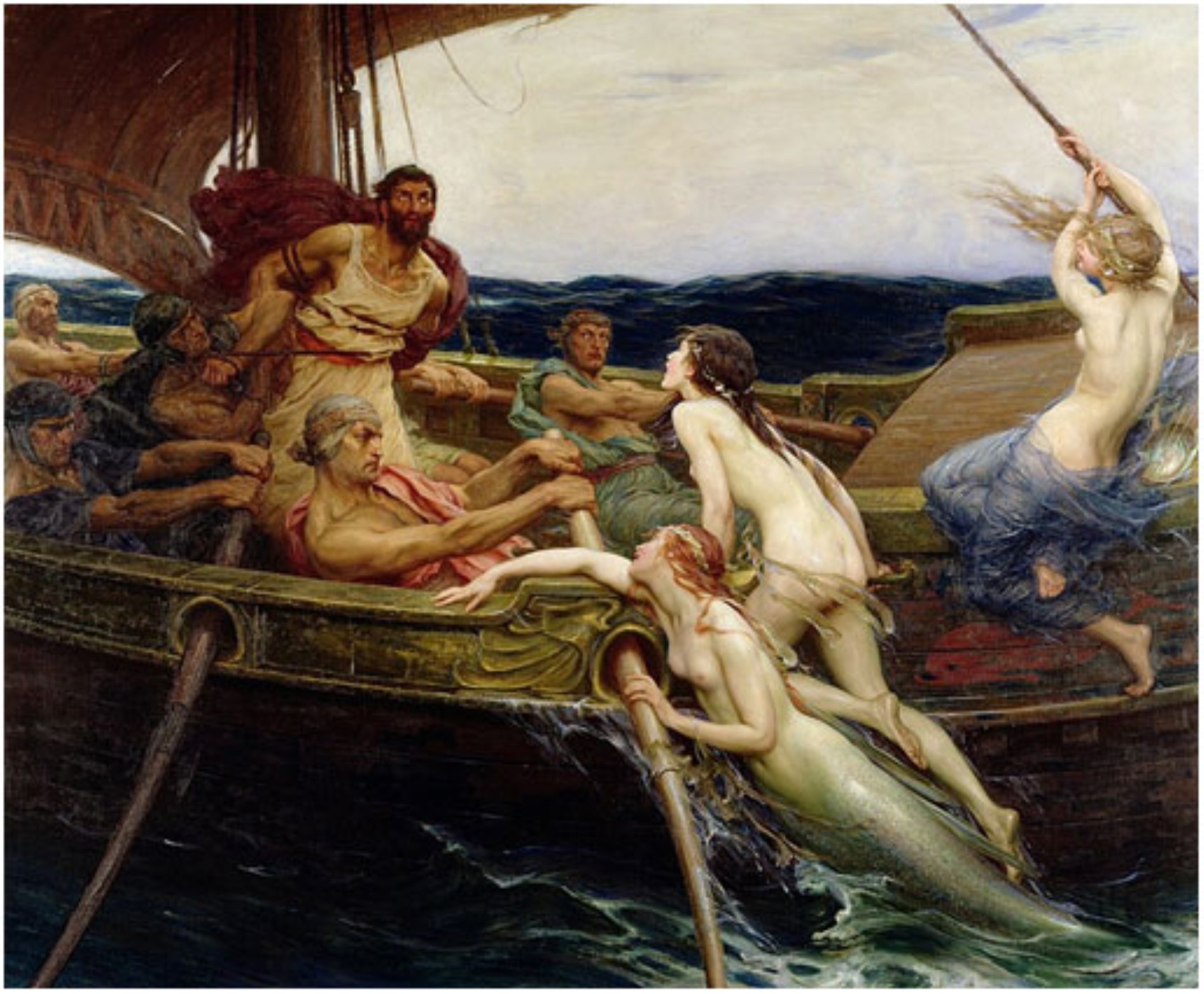
(Herbert James Draper (1863-1920). Odysseus and the Sirens (1909). Ferens Art Gallery, Kingston upon Hull)
***
The oars dragged the ship, the Sirens were left behind.
As Circe had warned, there were now two dangers ahead of them:
Scylla and Charybdis.
On one side, the six-headed Scylla...
It was a terrible sea monster living among narrow cliffs.
It had six heads at the ends of six long necks.
As ships passed by, it would grab and eat a sailor with each head.
On the other side, Charybdis...
It was a terrible whirlpool that sucked the waters of the sea in with great force and then spewed them out again. It did this three times a day.
They had to pass between them.
While trying to move away from one, it was inevitable to approach the other.
Circe's advice was frightening:
If you approach Charybdis, you will fall into the whirlpool, everyone could die.
The terrible water cycle can pull the ship in and swallow you all.
Pass by Scylla.
The monster might grab six of your men, you might only lose them.
Odysseus did not have a good option before him.
He could only choose the less bad one.
He avoided the whirlpool and entered the strait.
The six-headed monster Scylla took six of his men.
Odysseus could not save them.
Sometimes there is no choice between right and wrong before a person.
They are forced to choose between bad and worse.
Perhaps these are the heaviest decisions in the lives of leaders, commanders, and people: Sophie's Choice...
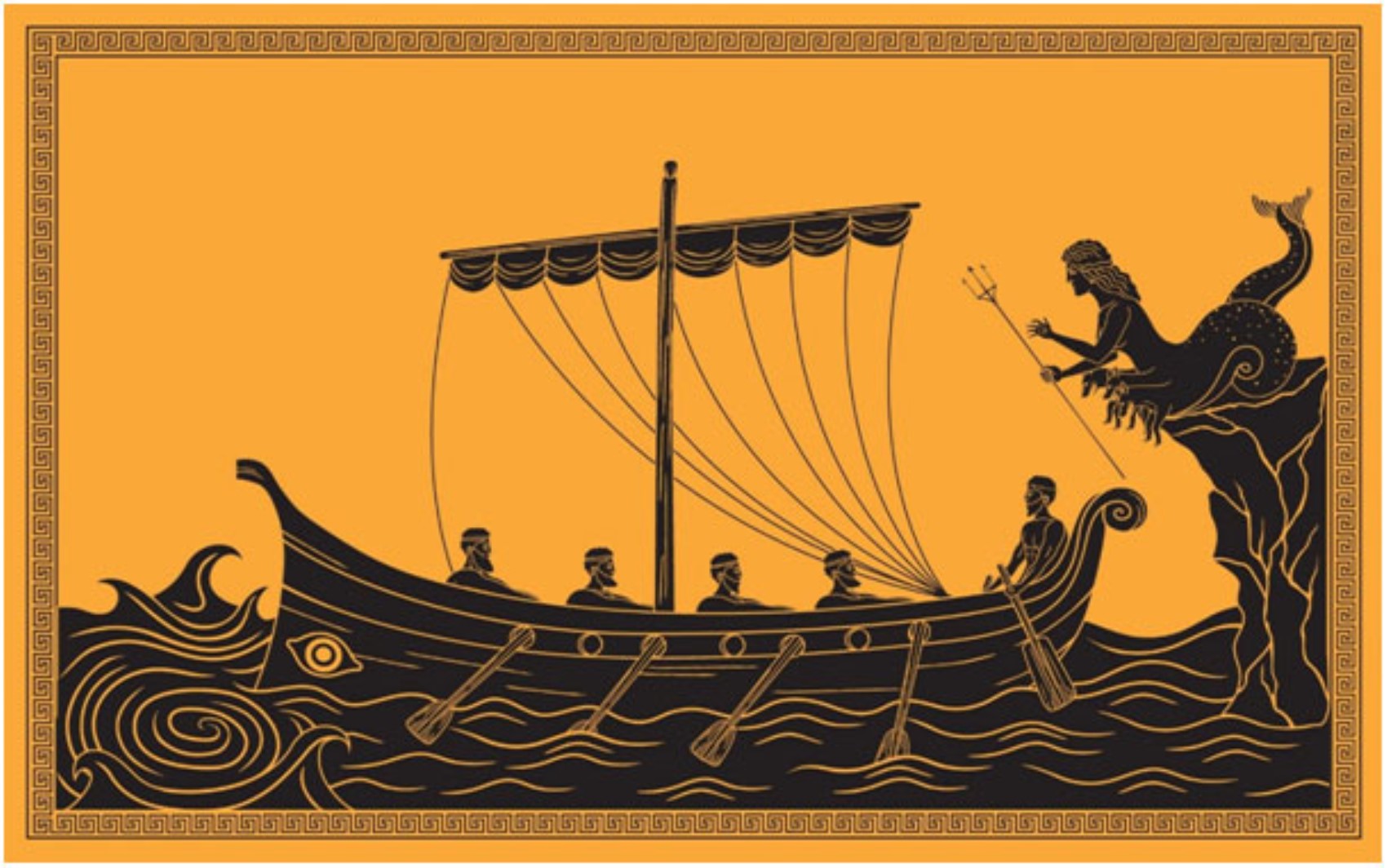
(An image on a vessel representing Scylla, Charybdis, and Odysseus's ship, designed by an independent digital graphic designer using the username or nickname "darko" on stock image platforms such as Adobe Stock, Getty Images, or Shutterstock, imitating the ancient Greek Athenian Red-Figure ceramic style in a digital environment)
***
Then they came to the island of Thrinakia, where the Sun God Helios's cattle were.
Thrinakia was an island that looked like paradise when viewed from afar.
In the Land of the Dead, Teiresias had warned them.
Circe had repeated the same warning.
No matter what, they were not to touch Helios's cattle, which were wandering and feeding freely on the island.
They knew the price of this would be heavy.
Odysseus and his men promised to obey this prohibition.
But the winds did not blow for days.
The travelers' food ran out.
Hunger began.
On one side hunger, on the other the cattle of the fertile island...
When Odysseus went away one day, Eurylochus, one of his leading men who sometimes acted as his assistant, persuaded the others.
They slaughtered the cattle.
They ate.
Helios, the divine sun that gives life to nature with its rays and sees everything, was enraged.
He asked the chief god Zeus to punish those who killed his cattle.
To escape their sins, the sailors caught a favorable wind, left the island, and set sail again.
However, Zeus had listened to Helios.
Punishment rained down from the sky.
Zeus's lightning bolts shattered the ships.
Everyone except Odysseus died.
Why had it happened like this?
It is not easy to reach a definitive conclusion here.
The men had not kept their word.
Keeping one's word is one of the unwritten universal rules of humanity.
But they were hungry.
Before them, on one side was the god's prohibition...
On the other side was hunger.
Still, one truth did not change:
It is easy to keep a promise when conditions are good.
The real test begins when the price of keeping that promise becomes heavy.
Odysseus was now alone.
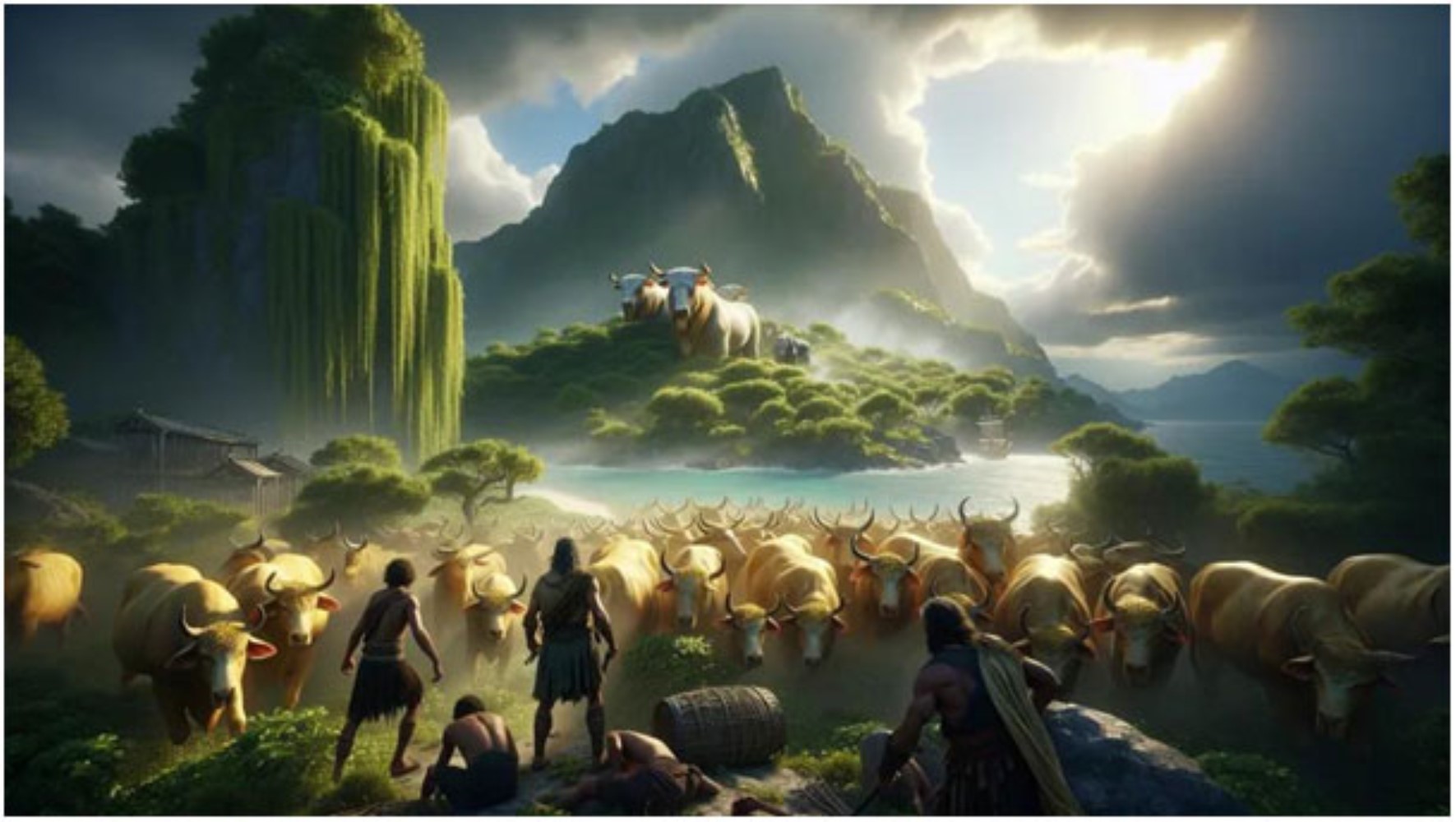
(Image depicting Helios's cattle. Image. AI)
***
Clinging to pieces of wood, the shipwrecked Odysseus drifted at sea.
He remained at sea for nine days.
On the tenth day, he reached the island of Ogygia, where Calypso lived.
Calypso was an immortal nymph, a nature spirit.
He stayed there for seven years.
Calypso's island was beautiful.
Water springs... Trees... Flowers... Birds... Vines...
Almost a paradise.
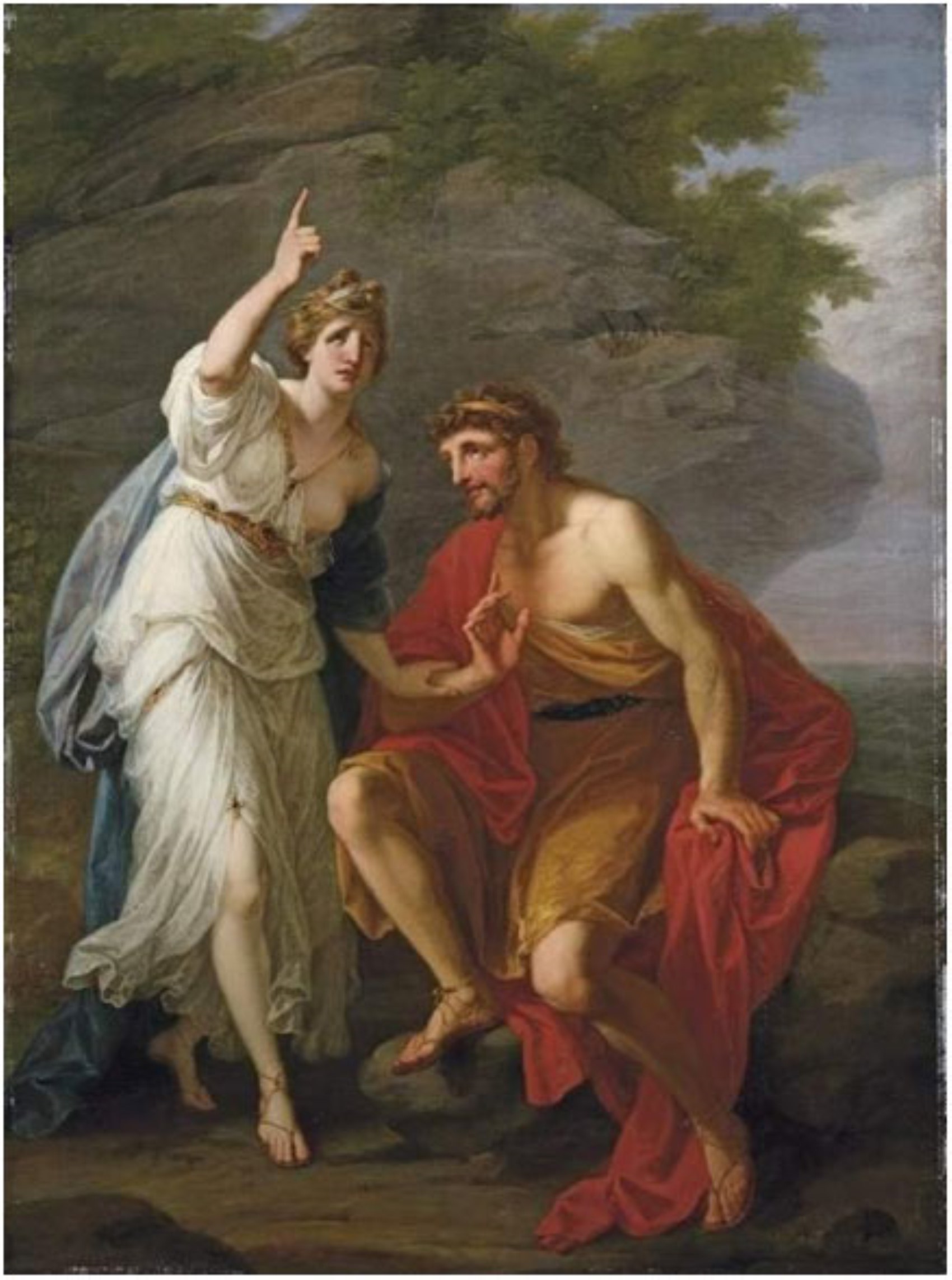
(Angelica Kauffman (1741–1807). Calypso Witnessing Heaven and Earth to Her Sincere Love for Odysseus. 1770. The Cobbe Collection. Highlands Park Museum. Surrey)
But the place a person wants to live is not always the most beautiful place in the world.
Sometimes it is only:
Their home.
Calypso, who had kept him living in abundance and comfort for years, offered Odysseus something extraordinary.
If he stayed with her, he would be immortal.
He would not age.
He would not die.
In return, he would give up only one thing:
Ithaca.
Odysseus did not accept.
Because in Ithaca, there was his wife Penelope.
His son Telemachus...
His father Laertes...
His dog Argos...
His home...
His land...
His past...
Everything that made him Odysseus...
His identity!
Calypso could give him immortality.
But she could not give him the life he lived as Odysseus.
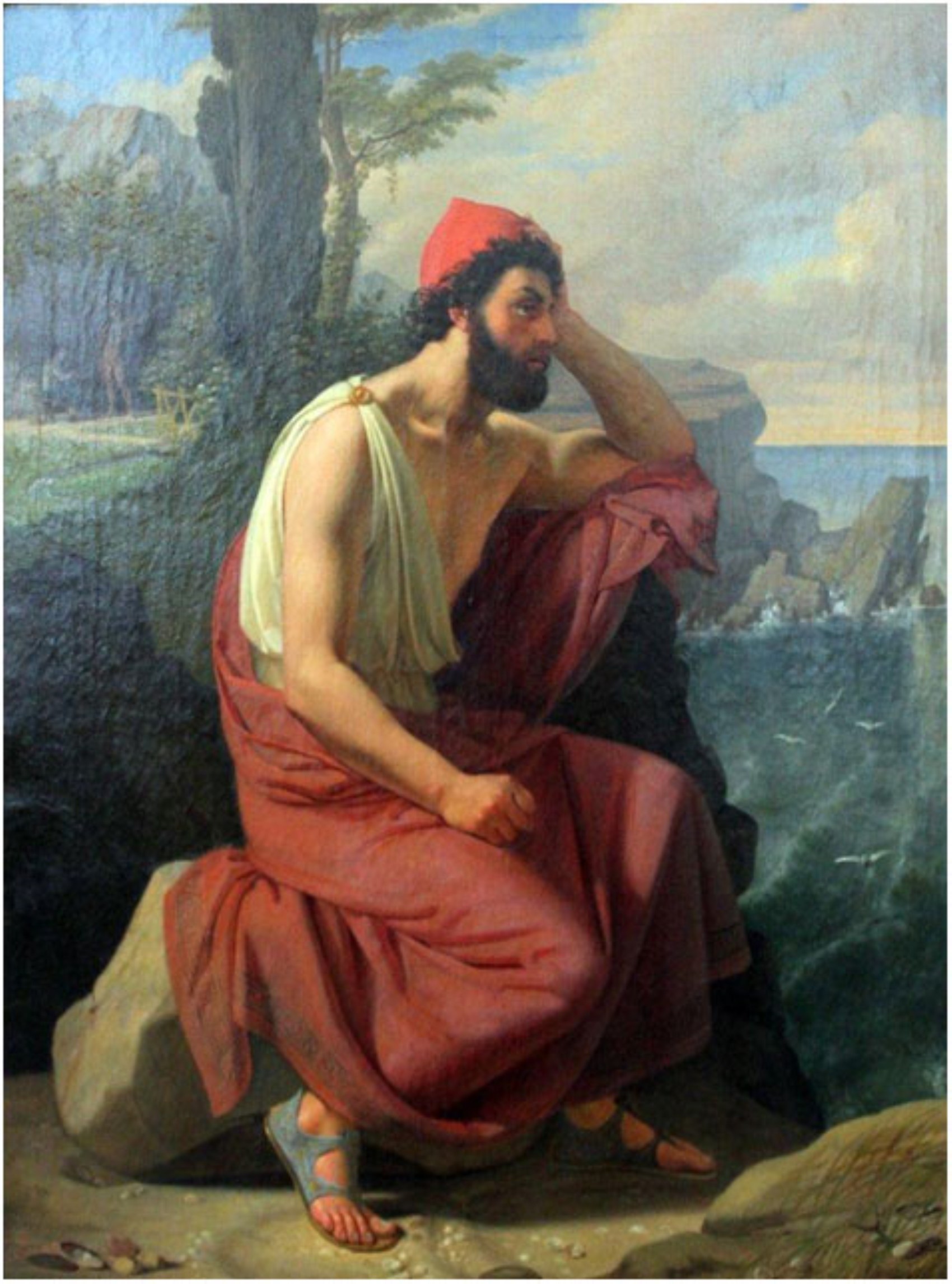
(Ditlev Blunck. Odysseus, on Calypso's island… 1830)
***
While the angry Poseidon was away, the gods finally commanded Calypso to release Odysseus.
Calypso obeyed the gods.
Even though she wanted Odysseus to stay with her so much, she did not cause trouble; she couldn't anyway, she could not oppose the gods.
The strange Odysseus made a raft.
He set out to sea.
Poseidon, unaware of the decision made by the other gods, saw Odysseus at sea.
His anger had not yet subsided.
He stirred up the sea.
He caused a great storm.
The waves rose!
The raft was shattered.
Odysseus struggled with the sea for two nights and two days to stay alive.
While the sea god Poseidon was trying to bury him in the waters, another sea goddess, Ino-Leucothea, took pity on Odysseus and rushed to his aid.
His guardian goddess Athena, on the other hand, stopped the other winds and ensured that only the north wind, Boreas, blew, helping the waves to calm down and Odysseus to reach the shore.
Apparently, in Homer's world, even the gods did not always share the same will.
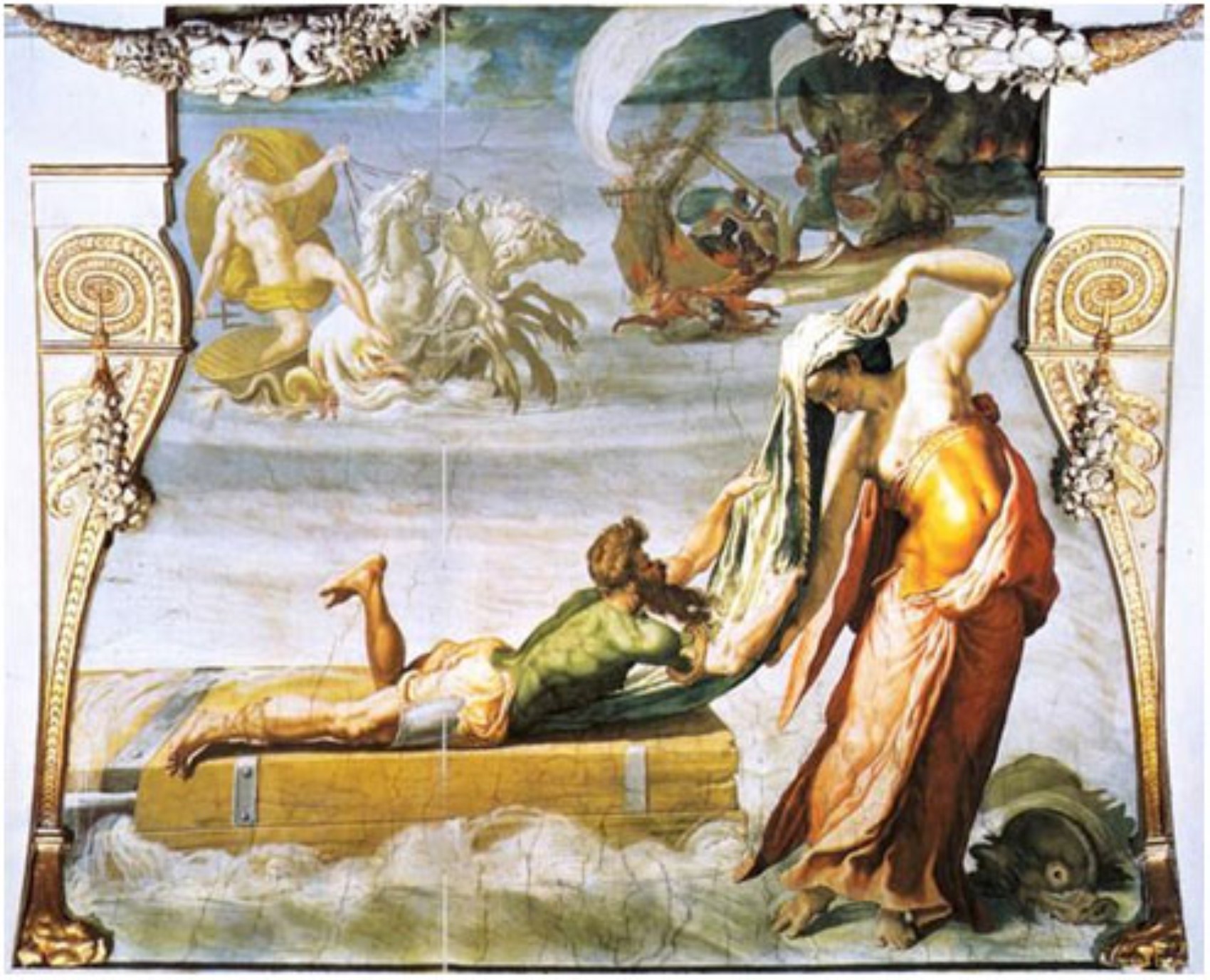
(Italian Pellegrino Tibaldi (1527–1596). Odysseus and Ino Leucothea. 1550–1551. Stanza di Ulisse (Odysseus Room) on the ceiling of Palazzo Poggi. Bologna-Italy)
***
Finally, the waves threw him onto the shores of the land of the Phaeacians.
On the shore, he took refuge under two olive trees, one grafted and the other wild, with their branches intertwined.
It was as if he were between two worlds: one represented wild nature, the other life established by human hands.
That night, Odysseus also covered himself with dry leaves on the threshold where he would pass from wild nature back to civilization and slept.
The next day, he woke up to the voices of Nausicaa, the daughter of the island's king, and the young girls with her.
Nausicaa helped him.
She gave him clothes.
Then she showed him the way to her father King Alcinous's palace.
Odysseus arrived at the palace after a while.
Here he encountered something he had not seen for a long time:
Hospitality.
Warm humanity!
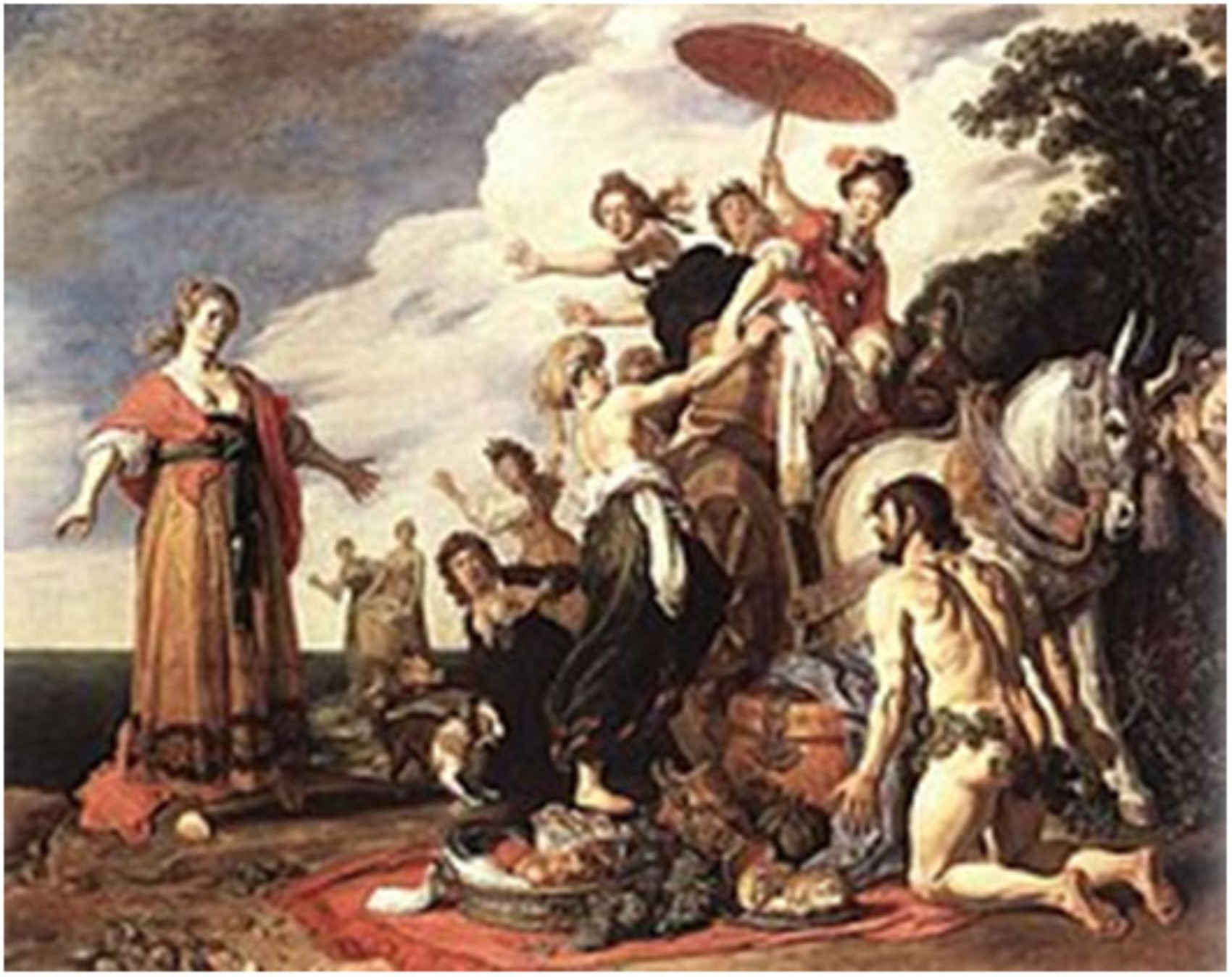
(Peter Paul Rubens. Odysseus and Nausicaa. 1619, Munich, Germany)
***
When the Phaeacians learned who he was and what he had been through, they decided to take him to Ithaca.
Odysseus slept on the ship.
The Phaeacian sailors rowed throughout the night.
In the morning, they arrived at the coast of Ithaca.
They left the sleeping Odysseus on the shore.
They placed his gifts beside him.
And they left.
The man who left Ithaca twenty years ago...
He was finally back on his own land.
Homer says, “there is nothing sweeter for a person than their homeland and family”, “(os udèn glikion ês patrídos udè tok?on”!
However, when Odysseus woke up, he couldn't even understand where he was at first.
He was on the seashore.
He looked around but could not recognize his country.
His guardian goddess Athena appeared before him.
And she turned him into an old beggar.
Because returning home was not enough.
Now he had to win back his home.
(We will continue next week)
Sefa Taşkın
20.09.2026
Dikili/İzmir
Most Read

Altunç Kumova’s prosecutor testimony revealed

Debt dispute turns into armed brawl in Şanlıurfa

AKP increased its votes, the decline in the New Party drew attention
Kadir İnanır's inheritance revealed

Are you aware of the danger in the economy?

Surprise invitation from Aziz Yıldırım to Ali Koç

Towards a new era in the world

The Journey of Odysseus-3. The sea where man is tested

3.4 magnitude earthquake in Sivrice

Iran: Our conditions for ending the war have been conveyed to mediators