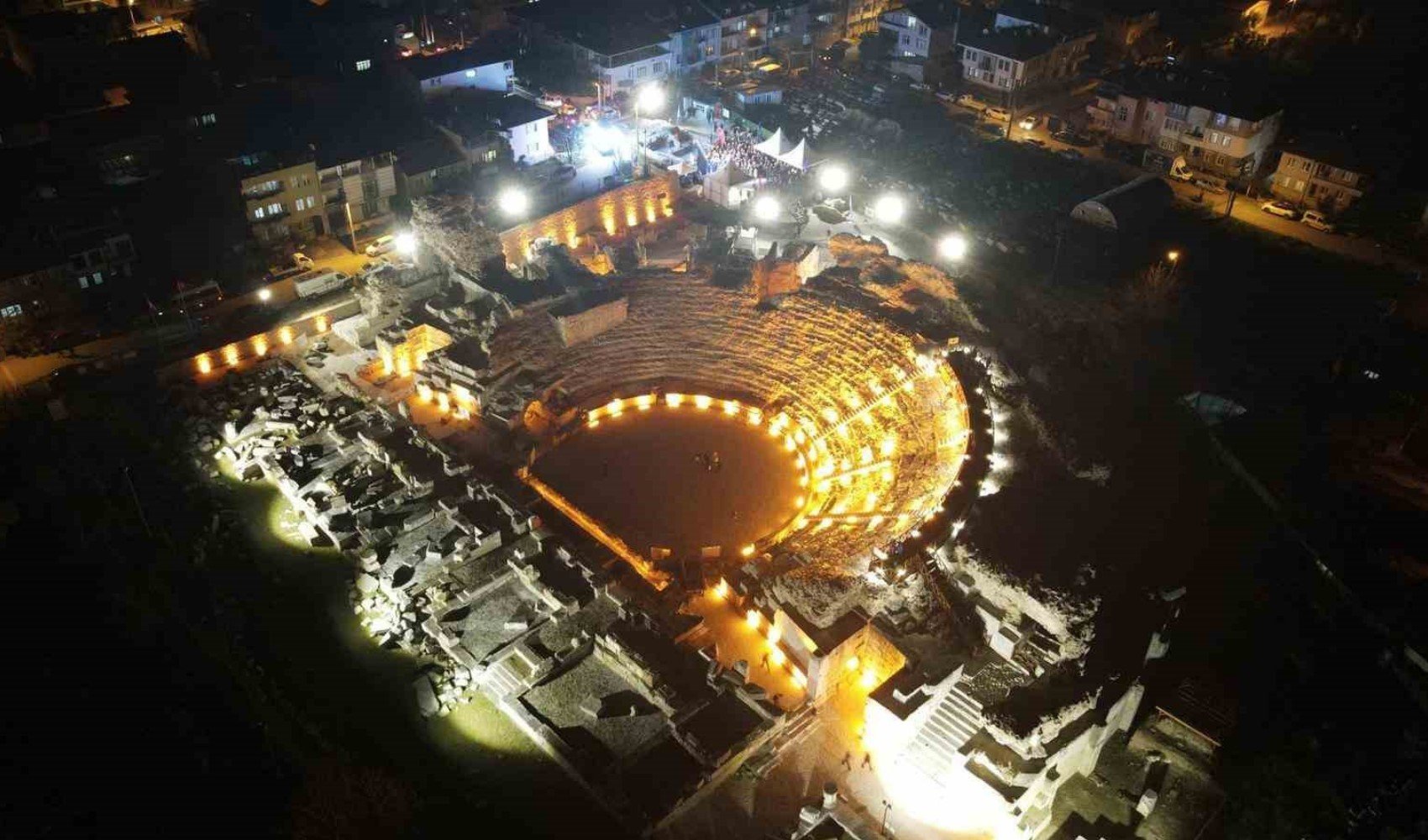
Iznik, a district of Bursa founded in 316 BC by Antigonus Monophthalmus, one of the commanders of Alexander the Great of Macedon, still bears clear traces of the Bithynian, Roman, Byzantine, Seljuk, and Ottoman civilizations in every corner, with history literally bursting forth.
The Iznik Theater, where excavation work has been ongoing since 2015 under the sponsorship of the Bursa Metropolitan Municipality, stands as one of the most magnificent surviving Roman-era structures in Anatolia.
USED AS A RELIGIOUS SITE
The theater, which is the only example of its kind in Turkey in terms of architecture because it was built on flat ground and elevated with vaults, was commissioned in the 2nd century AD by Roman Emperor Trajan for the historian and writer Pliny, who was the Governor of Bithynia. The theater, which once hosted gladiator fights, was later used as a religious site following the ban on theater after the rise of Christianity.
The theater, which was damaged and repaired during the major earthquakes of 358, 362, and 368, was eventually sacrificed for the defense of Iznik, with stones removed from the theater used to reinforce the city walls. Excavations at the Roman Theater, which first began in 1980 with the permission of the Ministry of Culture and Tourism, have been carried out since 2015 by a team led by the Department of Archaeology at Dokuz Eylul University, following the intervention of the Bursa Metropolitan Municipality.
STRENGTHENED AFTER ATTACKS
Meanwhile, the Iznik City Walls, which began construction in the 4th century BC during the Bithynian period and, according to information provided by the ancient writer Strabo, were 2.5 kilometers long, were strengthened and extended following the attacks by the Goths, a barbarian tribe living in Northern Europe, in 258 AD, reaching their current state with 4 main gates, 12 secondary gates, and a length of 4,970 meters.
The historic walls, which have managed to survive to the present day despite sieges and major earthquakes throughout history, along with the Istanbul Gate and Yenisehir Gate, were restored by the Bursa Metropolitan Municipality under the direction of the Iznik Museum and with the permission of the Ministry of Culture and Tourism.
The Roman Theater, built in the 2nd century AD—where archaeological excavations have revealed traces of life dating back to the 6th century BC—along with the historic city walls' Istanbul and Yenisehir Gates, which date back 2,300 years, have been reopened to visitors following the completion of restoration work carried out by the Bursa Metropolitan Municipality.
News Source: İHA