The National Intelligence Organization (MIT) has made a 1933 archival document public in the “Special Collection” section of its official website. The document, which bears the note “To be opened personally,” is notable for demonstrating the practices used for examining and deciphering secret correspondence of that era.
The document, dated August 27, 1933, contains information regarding the work of the D (Technical Support) Branch of the National Security Service (MAH) on opening envelopes and revealing secret writing. A piece of correspondence sent to the İstanbul B Directorate was cited as an example in the document.
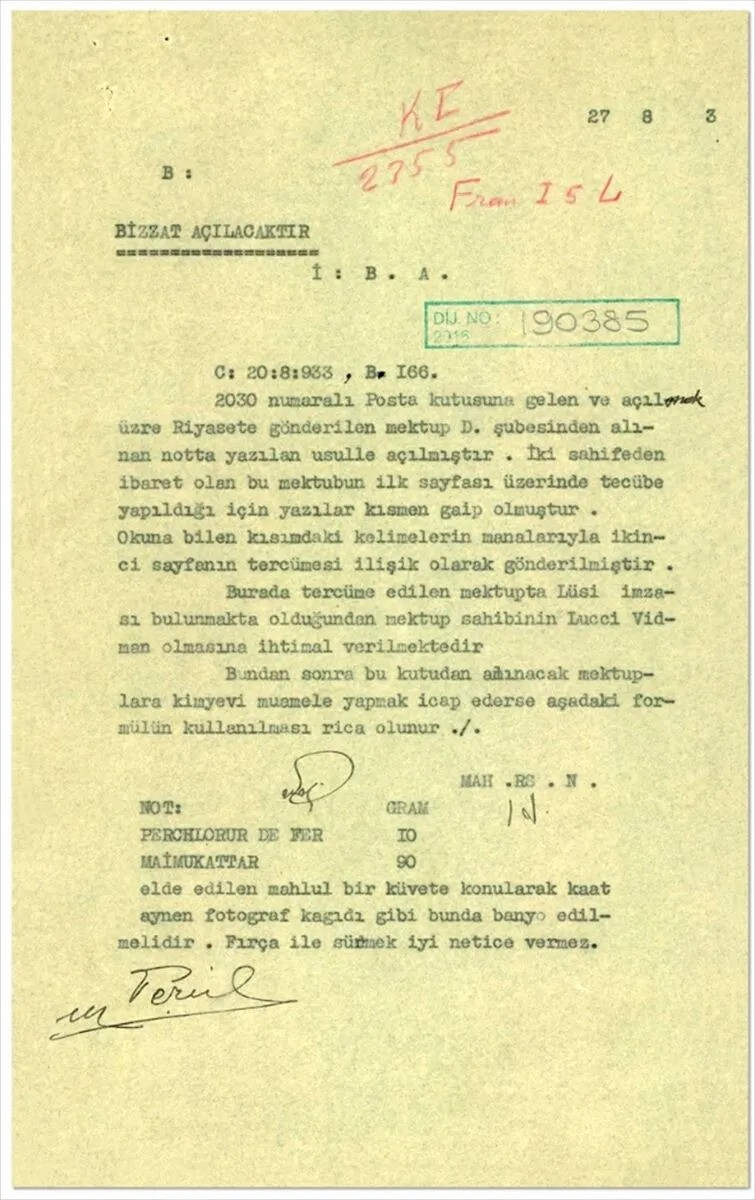
According to the shared document, a letter that arrived at post office box number 2030 and was sent to the presidency for examination was opened using the method specified in a note from the D Branch. It was noted that some of the text was lost due to a trial run on the first page, and that the translation of the second page was sent after the legible parts were interpreted.
CHEMICAL METHOD IN THE DOCUMENT
The document also includes an assessment that the owner of the letter, which was signed “Lüsi,” might be “Lucci Vidman.” A detailed note was provided regarding the chemical method that could be used to open similar letters.
In the notes section, a mixture consisting of 10 grams of ferric chloride and 90 grams of distilled water was described for revealing secret writing. It was stated that the paper should be soaked in this liquid like photographic paper, and that applying it with a brush would not yield good results.
MIT’s archival release has taken its place among new documents that make the technical details of early Turkish intelligence history visible.
News Source: 12punto