– We know you are working on a book about Eurocentrism and "Turkophobia" (fear of Turks). In your opinion, what kind of relationship exists between Turkey and the Eurocentric perspective? How do you see the landscape—"within its historicity and today"—in terms of the rulers, the ruled, and our left in general?
ÖZCAN BUZE - The relationship between Eurocentrism and Turkophobia is not two separate phenomena; one is the constitutive mechanism of the other. Europe defined itself not with positive content, but by stating "what it is not": "Civilization is that which is not despotic, that which is rational, that which is not Eastern, progress is that which is not Ottoman." The historical roots of this distortion go back to the Crusades. Because the Crusaders first encountered Turks on the way to Jerusalem. Then, they became even more frightened as the Ottoman Empire advanced into the heart of Europe.
The evolution of Turkophobia into Eurocentrism occurred in the late 18th century, with the beginning of colonialism in the 18th century, and it fully matured in the 19th century.
Meanwhile, even in the writings of Marx and Engels, there are traces of this prejudice. But the true legacy of classical Marxism is the method of linking ideology to material foundations and class interests, not the ideology itself. Therefore, it has been possible to erase these traces, and Marxism has become globalized instead of remaining European.
"PROGRESS" AND EUROCENTRISM
To continue: Eurocentrism presents the path Europe has taken as unique, categorically different from the rest of the world, and the sole medium of progress. Its logic works as follows: "We developed because we were different from everyone else; we transitioned to capitalism. We followed a dynamic historical line; they remained static. If they want to develop, they will either imitate us or accept our hegemony." To substantiate this claim, Europe declared that it had entered a different and more productive path than the rest of the world since antiquity. According to this, the cradle of Europe was Ancient Greece, which it claimed was different and more creative than everyone else. Europe's feudalism was also very unique and dynamic. It had leaped into capitalism through a decentralized, fragmented feudalism. It claimed that the East—such as the Ottoman Empire, China, and India—had established "despotic," centralized, and unchanging structures. The most striking example of this is Karl Wittfogel's "Oriental Despotism" thesis. I say striking because Wittfogel reproduced this old prejudice in the 20th century by dressing it in Marxist garb.
The one who definitively untied this knot was Samir Amin's—which we could translate into Turkish as "tax-based" or "tributary"— "tributaire", "tributary" social-economic formation formula. According to this formula, regardless of the institutional differences on the surface, there is a common mechanism that was valid everywhere in the world before capitalism: the appropriation of surplus product through extra-economic coercion. In this respect, there is no qualitative difference between East and West, North and South. European feudalism, the Ottoman timar system, and the feudal system in China based on landowners and bureaucrat intellectuals are all different institutional variants of the same tributary formation. With this formulation, the Eurocentric stain in Marxism was also cleaned. This was made possible by Marxism's method of linking ideology to material relations and class interests. Thus, the implicit Eurocentrism of the simplified "five-stage scheme" (primitive community, slavery, feudalism, capitalism, socialism), which presents the European experience as a universal necessity, gave way to a truly universal category: a single tributary formation operating everywhere in the world under different institutional guises.
The historical record shows the exact opposite of the "despotic East" thesis: centralized structures like China and the Ottoman Empire were extremely developed in certain periods. In fact, as in Song Dynasty China, they had reached the threshold of capitalism with their own dynamics. The problem was the interests of these central powers in maintaining the status quo: as the law of uneven development shows, strong and successful formations standing at the center of the system become afflicted with the institutional inertia produced by their own success and resist change; because the existing order serves their interests. They insist on preserving it. In contrast, poor and weak countries on the periphery of the system—especially England—were able to take the path of making a breakthrough because they had no status quo to lose. But this was not a conscious, planned development. It was a path that necessity pushed and shoved them into.
EFFORTS AT "CULTURAL GENEALOGY"
Later, especially with colonialism, Europe was not satisfied with this economic-structural claim to prove its uniqueness; it also concocted a cultural-genealogical basis for it. With the transition to capitalism, in order to prove that its own path was the sole and universal medium of progress, it invented a completely fictional "Greco-Roman" heritage. This heritage systematically erased the true Afro-Asiatic, Egyptian, and Mesopotamian roots of Greek civilization. Especially after the Second World War, a second layer was added to this fictional genealogy: the "Judeo-Christian" line. Europe based its own historical uniqueness on the artificial combination of these two elements: the pagan Greco-Roman heritage and the Judeo-Christian religious heritage. Yet these two elements were historically in tension with each other, and the term "Judeo-Christian" was almost never used in political discourse before 1945. This formula served the ideological need of the Cold War perfectly, as a religion-based front against the materialism of the Soviet Union, and as a boundary line that excluded Islam (i.e., the abstract "Turk," the historical other) from this front. At the same time, it erased the fact that medieval Islamic civilization not only preserved but also developed the Greek philosophical-scientific heritage with a single expression.
For the rulers, this relationship worked ambivalently. From the dissolution of the Ottoman Empire to the Republic, and from there to the present, the ruling class in Turkey has largely internalized this Eurocentric framework; because this was the way to legitimize its own class position. Here, Gramsci's concept of "transformismo," or "transformism," is explanatory: the ruling class constantly adapts to metropolitan norms to maintain its own power, judging its own society in the mirror of those norms. Samir Amin's "extraversion" concept describes the same mechanism at the economic level: production is outward-oriented, demand comes from outside, and the logic of internal development is suspended.
For the left, the situation points to a more complex and serious theoretical problem. A large part of the Turkish left, despite its own anti-imperialist vein, unquestioningly adopted the categories of Eurocentric historiography—especially for a time the "Asiatic mode of production" and its derivative, the "oriental despotism" thesis. This was a theoretical error: Marx's writings on this subject (the 1853 India articles, the scattered notes in the Grundrisse) never turned into a systematic theory; Wittfogel's systematization of these in his 1957 book "Oriental Despotism" was an operation that directly served the ideological needs of the Cold War.
The landscape today is this: Turkophobia is not just a prejudice coming from the outside, but an epistemological framework reproduced on the inside—both on the right and the left. The task of the Left is not just to expose this as a moral prejudice, but to fundamentally resolve the false "despotic and static East – democratic and dynamic West" opposition beneath it at both the economic and cultural levels; just as Samir Amin's tributary-tax-based formation theory did...
– Can't the Eurocentric perspective also be considered imported into the system with the Turkish enlightenment, especially with the republic founded in 1923? After all, a goal such as "reaching the level of contemporary civilizations" had been declared. Can this goal be accepted as a Eurocentric trap? Or was it not? We cannot say that this goal of reaching [that level] is without drawbacks, but do you think that what it gained was more? Why?
ÖZCAN BUZE - This goal, when viewed from a classical Marxist framework, should be read in two directions. This duality itself is a case study showing how Eurocentrism works. What is this so-called "contemporary civilization"? Is it an abstract human progress, or is it concretely the European capitalist system itself? As we showed a moment ago, the claim of the "uniqueness" of this system is also a historical myth, as the tributary formation theory shows. The goal of "reaching" this system required importing its categories—nation-state, bourgeois parliamentary form, etc.—without questioning them.
ISLAMISM'S "REVERSE EUROCENTRISM"
However, classical Marxism does not deny historical gains in the name of an abstract "authenticity." Marx himself, while exposing the exploitative nature of capitalism in the Communist Manifesto, unconditionally acknowledges its capacity to develop productive forces. He describes it as a force that shatters feudal stagnation and melts "all fixed, frozen relations." Social and economic backwardness had to be overcome. If this is what "above the level of contemporary civilization" means, there is nothing to criticize in it. With the Republic, women's right to vote, the secular legal system, mass education, etc., are real historical advances, and rejecting them as "Western, therefore fake" is itself a kind of reverse Eurocentrism; that is, it is a mirror of the orientalist logic that traps the East in an unchanging essence, just like today's Islamist discourse voluntarily entering the same prison by saying "modernity does not belong to us."
The problem is not in the goal itself, but in where the means to reach that goal are derived from. The mistake is the imitation of the Western model. The decisive distinction here is Samir Amin's concept of "deconnexion," "delinking," that is, "breaking away" from the capitalist imperialist system: independent development means making external relations subject to the logic of internal development, that is, not importing the West's norms, but building a modernization project based on the internal dynamics of one's own social formation. The tragedy of the Republic of Turkey is revealed exactly here: the gain is real, but expressing this in a language that constantly measures itself in the mirror of Europe has paralyzed its own independent theoretical production capacity from the beginning. While the Republic was establishing a nation-state within the borders drawn by Lausanne, it could have adopted a modernization route independent of the Western template.
– Is the USA a European derivative? Is it possible to speak of an "US-centric" perspective in Turkey? Why didn't such a political orientation catch on much in Turkey and in the eyes of society (the rulers were already active in this direction)? For example, people haven't yet thought of taking to the streets with American flags to protest the government. Why?
ÖZCAN BUZE - There is no such concept as "US-centrism." Even if there is, I haven't heard of it. I assume that by your question, you mean those whose qibla is Washington.
The USA's origin was initially European, and it thought this way when defining itself. However, if subsequent developments are taken as a basis, it is not a "European derivative" in the classical sense. It is a structurally different form of hegemony. Our relationship with the USA can be grasped within the framework of Lenin's theory of imperialism. Because we established a relationship with the USA mainly after it reached that imperialist stage.
Eurocentrism carries a claim in terms of culture and civilization. The global hegemony of the USA is based directly on military-economic power with the logic of finance capital, monopoly capital export, and the division of the world into spheres of influence, as described by Lenin. Europe is also like that in its imperialist stage, but the USA does not present itself as a "cradle of civilization." It presents itself as the "leader of the free world." This difference is important: while Eurocentrism produces an inferiority complex, a fear of being uncivilized, and an anxiety about "not being able to reach the level of contemporary civilizations," Americanism produces more of a direct relationship of domination (military bases, loan conditions, IMF prescriptions, arms dependency). This makes direct domination easier to see and expose than mythological legitimacy.
An Americanist political orientation in Turkey became overly influential in state echelons after the Second World War, but especially after the 1952 NATO membership. But the reason it didn't catch on at the social level is exactly this: the USA's presence in Turkey is always remembered with concrete, visible interventions: the 1964 Johnson letter (which clearly showed that Turkey was not a "sovereign" NATO partner, but a state effectively under protection), the 1971 and 1980 coups, the indirect and direct roles in the Cyprus intervention, and the tension continuing over the YPG relationship in the recent period... At this point, Gramsci's concept of hegemony is decisive. Hegemony is the capacity to produce consent without using force; Eurocentrism achieved this with a two-hundred-year-old cultural-academic apparatus (Helenomania, curricula, museums, the invention of Greco-Roman and Judeo-Christian genealogy), while the USA appeared on the scene in Turkey as a direct geopolitical tool (NATO, coup support, IMF impositions) without establishing this cultural apparatus.
It is easy to consent to an abstract myth; it is difficult to build ideological loyalty to a power that causes direct pain. Because force itself bears the traces not of consent-based hegemony, but of naked domination, and these traces remain in the people's memory as concrete dates, concrete names (Johnson, Kissinger, IMF).
SEPTEMBER 12, TURKISH-ISLAMIC SYNTHESIS AND THE AKP
– Let's look at today: We can take the founding fathers of the AKP from quite far back, even from before 1923, from the very beginning. However, the most ruthless of those fathers were the September 12 generals. We can say that these were also the legitimate fathers of the AKP. How do you interpret the relationship of these (the September 12 coup plotters and the AKP officials) with Eurocentrism?
ÖZCAN BUZE - The link between the September 12 junta and the AKP is not just personnel and cadre continuity, but also ideological continuity. This continuity is a striking example of how Eurocentrism can be instrumentalized by different political projects. One of the most important actions of September 12 was to make the Turkish-Islamic synthesis the state ideology; this was a formula that seemed to be against Eurocentrism on the surface but was actually its derivative. Because "Islam" here was not an authentic source of liberation as it was in Latin America, but a tool used to suppress revolutionary left potential and at the same time position Turkey as a "religious but pro-Western" buffer state in the Cold War's "atheist communism against Christian West" front.
The "civil society" discourse built in the post-junta period was also entirely an imported Eurocentric product. Here, Gramsci's analysis of "Jacobinism" was used in reverse: for Gramsci, Jacobin energy was a quality that the working class should adopt and transcend. There was a capacity to mobilize the masses for a revolutionary project. The civil society discourse in Turkey, on the contrary, stigmatized and liquidated organized political will with negative emphasis as "Jacobinism," "authoritarianism," and "statism." It replaced revolutionary organization with NGO-ization, the goal of state power with policy influence, and class struggle with "democratization" discourse. The AKP was built on this ground: first, it gained legitimacy with the language of "democratization," "EU membership," "civil society," "liquidation of military tutelage," that is, with Eurocentrism's own discourse, the Copenhagen criteria, etc. Then, once it consolidated, it put this language aside and switched to the "domestic and national" discourse.
But this transition was not a break from Eurocentrism itself. The decisive theoretical point here is this: accepting the "East-West," "civilization-barbarism" duality drawn by Europe and building an identity politics within that duality is not transcending that duality; on the contrary, it is producing a local version of Huntington's "clash of civilizations" thesis translated into the language of victimization. The common point of the September 12 coup plotters and the AKP is that both of them, instead of a truly class-based alternative, use the civilizational duality produced by Eurocentrism to consolidate their own power. One by "Westernizing and making Islam the safety valve of this Westernization," the other by "despite the West but within the civilizational boundaries drawn by the West, only by changing which side of that boundary it stands on..."
– This "Turkophobia" is a title that Turkish fascists and Islamists love very much. Because it is so, this "perspective" has become food for times and tendencies when Turkish history was almost ignored in the name of leftism. How do you historicize Europe's or the West's "fear of Turks"? And—more importantly—why does the Islamist government need such a "Turkophobia vitamin" now? What kind of attitude can the Left take against this vitamin?
ÖZCAN BUZE - Historically, Turkophobia was a category produced by Europe to legitimize its own imperialist expansion—it was constantly reproduced from the Crusades to Helenomania, from there to the Cold War's "Greco-Roman and Judeo-Christian" formula and Huntington's "clash of civilizations" thesis. Once "the other" was accepted with Turkophobia, this was expanded to Islamophobia, then to the Middle East, Africa, Asia, and everywhere that is not Western. Because the model had been established, all that remained was to operate it.
TURKOPHOBIA: A HISTORICAL CONSTRUCTION
This historical construction itself is real and needs to be exposed, but its reality should be evaluated independently of how it is used today.
The reason the Islamist government needs the victimization of Turkophobia and Islamophobia today is to serve a classic ideological function. To legitimize its own authoritarian consolidation, there is a need for an "external enemy" narrative. The discourse that "the West has always looked down on us, excluded us, and looked at us with a Crusader mentality" perfectly meets this need. The mechanism operating here is a version of what we call the "right-wing's Gramsci." Turkophobia is truly real; it is the constitutive element of Eurocentrism. This correct historical-structural diagnosis is taken, stripped of its class content, and turned into a victim-nation narrative. Just like the reverse Gramscians stripping the concept of hegemony of its class content and making it a tool for a plutocratic project... Class contradictions (capital-labor, capitalist exploitation, the tremendous inequality produced by the AKP period's own construction-rent capital, the destruction of inflation on the working classes) are made invisible; instead, a false front is opened between "us" (the nation, the ummah) and "them" (the West, the Crusader mentality, the interest lobby), and this false front replaces the real class front.
The Left should take the following theoretical attitude against this vitamin: to accept the historical-structural reality of Turkophobia and that it is the constitutive mechanism of Eurocentrism and the product of an academic-political genealogy lasting from Wittfogel's "Oriental Despotism" thesis to Huntington; but to definitively separate this from a victim narrative stripped of class analysis and the phenomenon of imperialism... The criterion for this separation is clear: if the critique of Turkophobia exposes the ideological obstacles in front of the class struggle, it is a socialist analysis; if it leads to the conclusion that "Turks, Muslims are victims, therefore every action of the government—every law in favor of capital, every worker layoff, every trustee appointment—is justified and legitimate," this is an ideological tool that appears anti-imperialist but functions in the exact opposite way.
– On this issue of Turkishness, how can a firebreak be drawn between fascist ideology and socialist liberationists? What are your first impressions and findings?
ÖZCAN BUZE - The dividing line is methodologically precise: the fascist-Islamist critique of Turkophobia presents Turkishness or Islam as an essential identity, an unchanging "national spirit" or "ummah consciousness." It defends the "authenticity" of this essence against Europe's pressure. This is the reverse image produced by racism or religious reactionism: it structurally reproduces the "us-them" logic of Eurocentrism exactly, reversing it in terms of content in its own favor. Just as Helenomania essentializes the Greek, this discourse also essentializes the Turk or the Muslim. Here, essentialism ("essentialism"), whichever side it is on, is epistemologically the same error; both turn historical-social construction (like the invention of Greco-Roman, Judeo-Christian) into a fixed essence.
Socialist and liberationist critique of Turkophobia, on the other hand, does not defend any essential identity. This is the basic principle of class analysis: social being determines consciousness; not national-religious identity. (This is not to deny their role in the formation of identity, but to emphasize that what is decisive is social being.) It examines Turkishness, Muslimness, Greekness, and Christianity in the same way, with the historical materialist method; the goal is not to glorify an identity, but to expose how a historical-class mechanism, Eurocentrism, is produced and whose class interest it serves. Dimitri Kitsikis's "Intermediate Region" ("Intermediate Region") thesis is a methodological example at this point: showing that the Rum-Greek and Turkish peoples have a common historical-social formation, the Ottoman tributary social structure, and that the Phanariot Greeks shared a common administrative life for centuries is not a nationalist "brotherhood" discourse. It is a materialist analysis that exposes how NATO and imperialist interests artificially produced this hostility with concrete, documented tools such as the September 6-7 provocation and the deliberate rendering of Cyprus dysfunctional with the 1960 constitution.
OPPRESSED NATION AND NATIONALISM-RELIGIOSITY
The practical test is this: does this critique lead to the defense of a nationalist-religious essence, or to an analysis of production relations, class interests, and imperialism? Lenin's writings on the national question are important here. The right of the oppressed nation to self-determination is supported, but this support never means the adoption of nationalism itself as an ideology. Lenin makes a political distinction between the nationalism of the oppressor nation and the nationalism of the oppressed nation, but he does not see either as the ultimate ideology of the proletariat. He relates this problem to the struggle against imperialism. Socialist analysis aims to transcend reactionary nationalism while exposing national oppression; fascist-Islamist discourse, on the other hand, reduces national oppression to the defense of an essence and deepens it as a new exclusion, a new "us-them" front.
– How do you think the socialist stage of the Enlightenment can be experienced in the Turkish geography? Do you have any predictions? Or perhaps to put it more clearly: how should a socialist government to be established in Turkey in the near future establish a relationship with Europe and Eurocentrism?
ÖZCAN BUZE - The "socialist stage of the Enlightenment" in Turkey means the dialectical overcoming of the unfinished bourgeois enlightenment project of the 1923 Republic; that is, overcoming the Eurocentric modernization scheme (capitalist development equals progress) with Samir Amin's concept of "breaking away from the system" and building an independent liberation project based on its own historical-social formation... This is the political result of the law of uneven development. A social structure coming from behind does not have to mechanically repeat the development stages of advanced capitalist countries. It can move towards a directly socialist liberation project based on its own historical-social specificity and by completing the tasks left unfinished.
The relationship of a future socialist Turkey with Europe should be built on the following principles:
Acting with a consciousness that has theoretically resolved the historical myths of Eurocentrism—Helenomania, clash of civilizations, Turkophobia, and the invention of Greco-Roman and Judeo-Christian genealogy—and has gained epistemic immunity against them, as Samir Amin said; getting rid of the anxiety of "being worthy of Europe" entirely.
Secondly, building this not as an inward-looking or Islamist-nationalist anti-Europeanism, but with the principle of internationalism. Solidarity with the peoples of the world, and meanwhile with the peoples of Europe and the working class.
Thirdly, as the Atatürk-Venizelos example shows—which was deliberately buried by NATO's behind-the-front operations—knowing that regional hostilities are not natural but produced, and exiting the "managed hostility" framework to establish independent regional alliances (in the Mediterranean basin, the Balkans, the Caucasus).
In short: neither a development goal that aspires to Europe, nor a nationalist inward-lookingness that is resentful of Europe... Instead, an internationalist socialist project that has resolved the historical-material construction of Eurocentrism with the Marxist method and stands on its own feet. This is neither "becoming like the West" nor "turning to the East"; it is an independent path that starts from Turkey's own historical-social specificity, moving from the universal logic of the anti-imperialist line and class struggle.
WHO IS ÖZCAN BUZE?
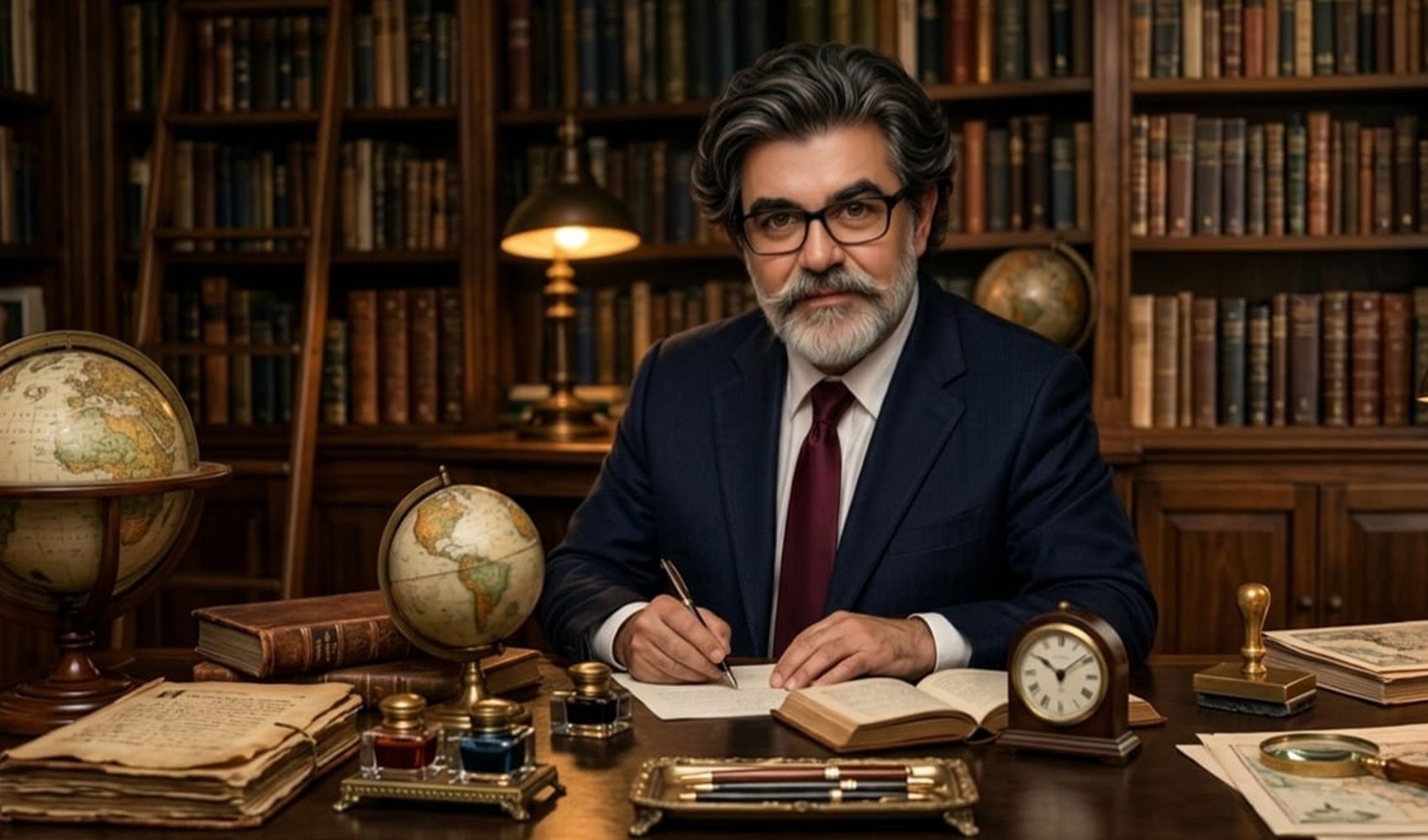
He completed his higher education, which he started at Istanbul University Faculty of Letters, Department of Western Languages and Literatures, at the University of Oslo, Faculty of History and Philosophy. He worked in publishing houses, newspapers, and magazines. His articles were published in some newspapers in Scandinavian countries. He worked on radio in China and Norway. He did documentary film voice-overs. He wrote commentaries on world events in Turkey and Scandinavian countries. His articles were published in "Teori" and "Bilim ve Ütopya" magazines; he served on the editorial boards of these magazines. For a period, he undertook the editor-in-chief of "Bilim ve Ütopya" magazine. He prepared and presented discussion programs for television and radio. He prepared and presented Papirüs, a book promotion and criticism program broadcast on a television channel. His book translations were published in China and Turkey. He continues to translate from English and Scandinavian languages.
QUESTIONS: OSMAN ÇUTSAY
News Source: 12punto