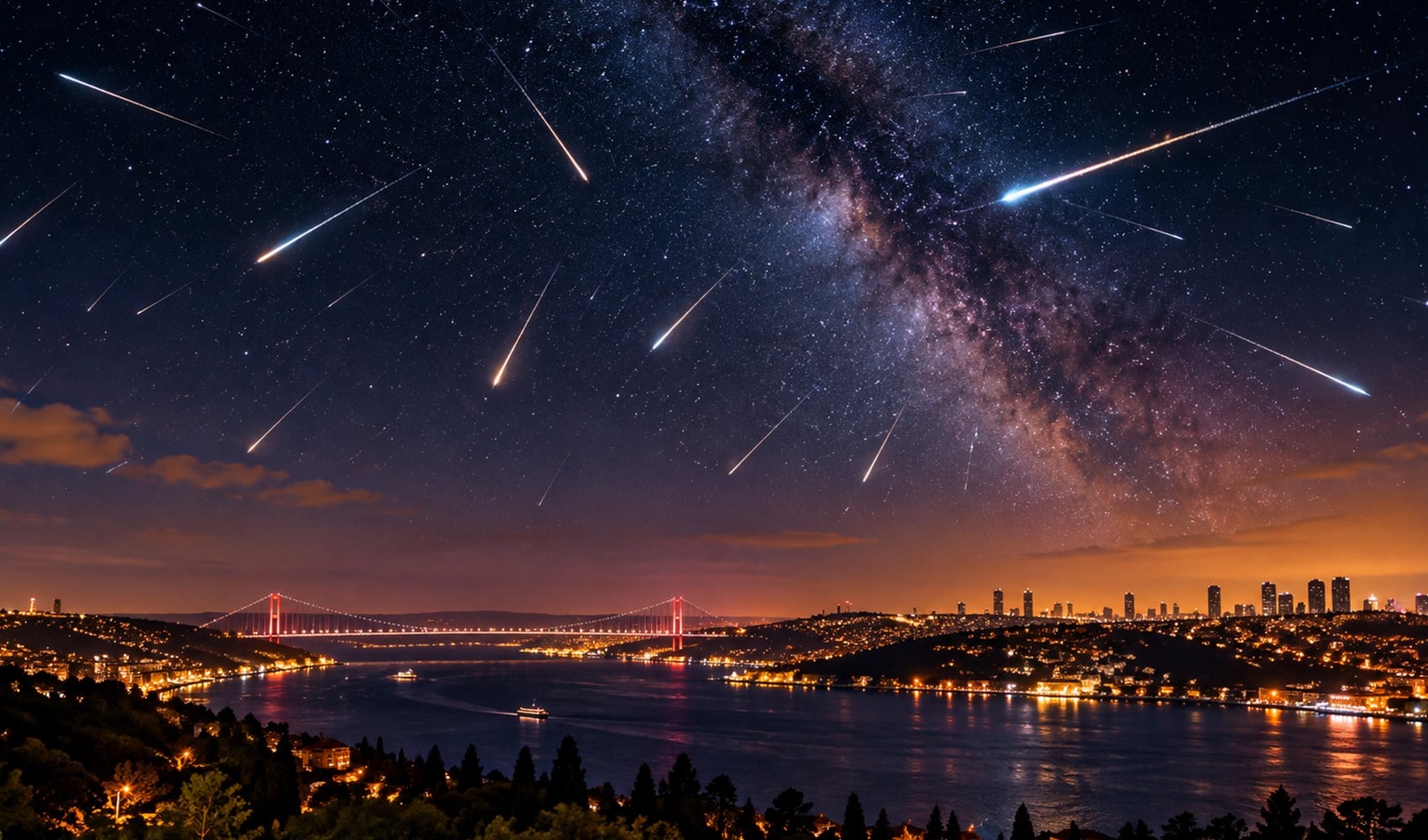
The Orionid meteor shower, one of the prominent celestial events of October, will reach its peak on the night between October 21 and 22. The meteor shower, caused by particles left in the orbit of Halley's Comet entering Earth's atmosphere, will be observable from all across Turkey.
According to NASA data, the Orionids remain active between October 2 and November 7. This year, the most favorable observation window is expected to be the night of October 21-22. Under favorable weather and dark sky conditions, approximately 10 to 20 meteors can be seen per hour.
The Orionids are named as such because they appear to originate from the direction of the Orion constellation in the sky. Although the radiant point is located near the bright star Betelgeuse in Orion, one does not need to look only at this region to see the meteors; bright trails can appear in different parts of the sky.
BEST TIMES FOR OBSERVATION
The main factor that could make observation difficult this year will be moonlight. On October 22, the Moon is expected to be in a waxing gibbous phase, with approximately 86.5 percent of the lunar disk appearing illuminated in Istanbul. Bright moonlight can make it difficult to spot particularly faint meteors.
NASA recommends the pre-dawn hours after the Moon sets for watching meteor showers. In Istanbul, the Moon is expected to set at approximately 03:01 on the morning of October 22, and astronomical twilight is estimated to begin around 05:51. Therefore, the 03:00-05:30 time frame stands out as a more favorable window for Istanbul and its surroundings.
WILL THE ORIONID METEOR SHOWER BE VISIBLE FROM TURKEY?
While the Moon is expected to set at approximately 02:46 in Ankara, it is assessed that the hours from 03:00 until dawn will be more suitable for observation across most of Turkey. The number of meteors visible may decrease significantly in city centers due to light pollution.
ORIONIDS MOVE AT A SPEED OF 66 KILOMETERS PER SECOND
The Orionids are considered among the fastest meteors of the year. The particles left by Halley enter Earth's atmosphere at a speed of approximately 66 kilometers per second; for this reason, some meteors can leave bright trails that may last for several seconds in the sky.
No telescope or binoculars are needed to watch the meteor shower. Experts recommend choosing an area away from city lights with a wide view of the sky and waiting 20-30 minutes without looking at bright screens to allow eyes to adjust to the darkness.
WHEN WILL HALLEY'S COMET BE SEEN?
1P/Halley, the source of the Orionids, was last observed from Earth in 1986. The comet's next close approach is expected to occur in 2061. The debris from Halley creates the Orionids in October and the Eta Aquariid meteor shower in May.
News Source: 12punto