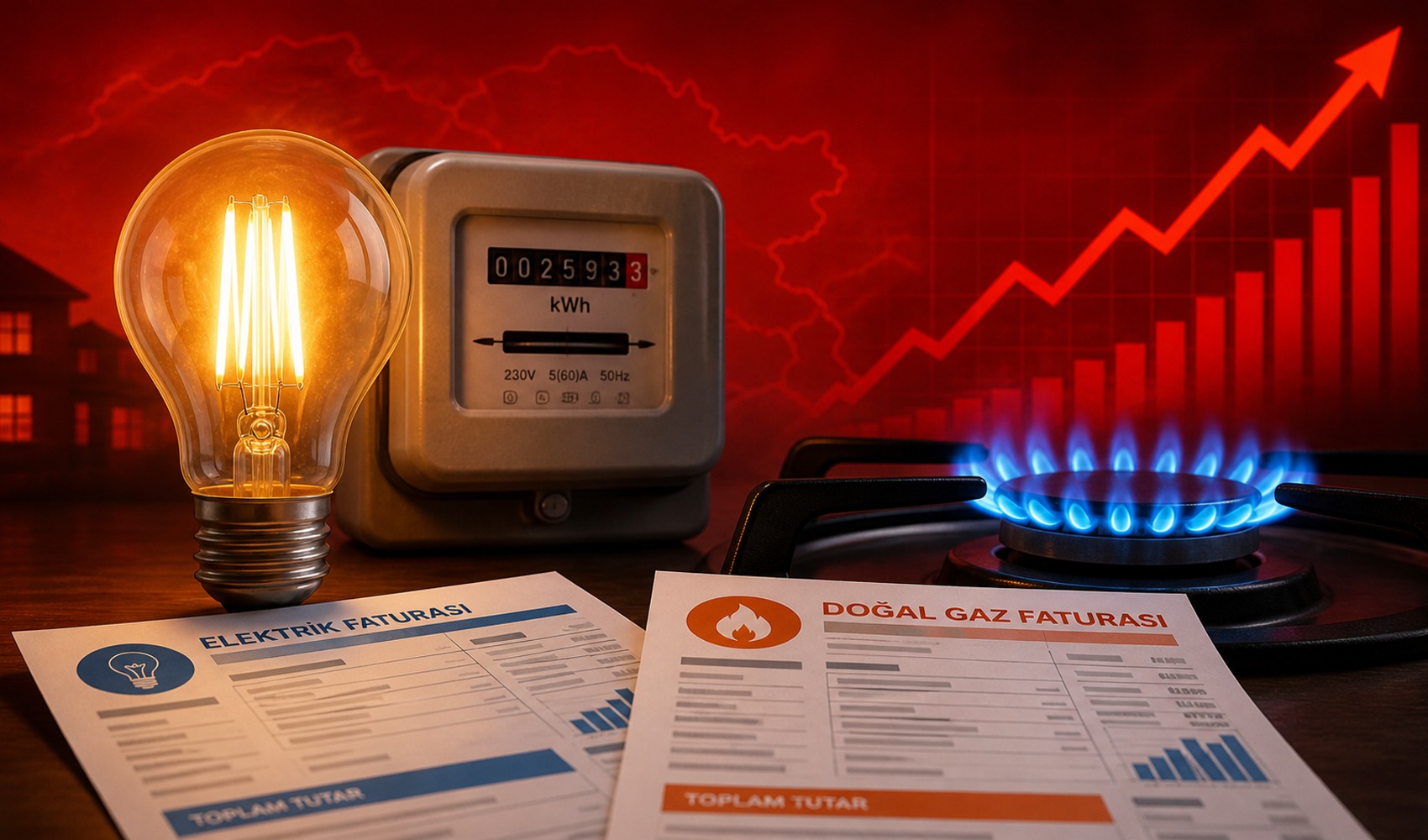
Economist Mahfi Eğilmez evaluated the impact of regulations changing the scope of state subsidies for electricity and natural gas on household bills. According to Eğilmez, even if there is no direct hike in energy prices, narrowing the scope of subsidies could increase the amount paid, especially by high-consumption subscribers.
In an article titled "A New Era in Energy Bills" published on his blog, Kendime Yazılar, Eğilmez emphasized that before the winter months, consumers should pay attention not only to energy unit prices but also to which subscribers are covered by state subsidies.
The point to note here is the difference between a direct increase in energy prices and a reduction in state subsidies. In the former, the price applied to energy is raised, while in the latter, the price paid by the consumer increases due to the narrowing of the subsidy scope.
ELECTRICITY LIMIT DROPS TO 3 THOUSAND KILOWATT-HOURS
According to Eğilmez, the annual last-resort consumption limit applied to residential electricity subscribers has been lowered again. The limit, previously set at 5 thousand kilowatt-hours for 2025 and 4 thousand for 2026, will be applied as 3 thousand kilowatt-hours starting January 1, 2027, following the EMRA decision dated October 30, 2026.
This limit corresponds to an average monthly consumption of approximately 250 kilowatt-hours. The regulation is expected to affect approximately 6.5 million residential subscribers. Eğilmez noted that this group accounts for 14.7 percent of total subscribers.
Subscribers who exceed the annual consumption limit will not be switched to the new tariff immediately. For subscribers without a bilateral supply agreement, the last-resort supply tariff determined for high-consumption consumers will be applied starting from the first day of the third month following the month in which the limit was exceeded.
As an example, Eğilmez stated that a subscriber who exceeds the 3 thousand kilowatt-hour limit in October 2026 could be subject to the new tariff starting January 1, 2027, while one who exceeds it in December could be subject to it starting March 1, 2027. Therefore, the regulation is considered not as a general electricity price hike, but as a narrowing of the subscriber group covered by subsidies.
NATURAL GAS TIERS VARY BY PROVINCE
In natural gas, there is a tiered pricing application that came into effect on April 4, 2026. While residential subscribers are divided into two groups based on consumption volume, state subsidies continue in the first tier; in the second tier, high-consumption subscribers face a different tariff.
The limits determined by BOTAŞ vary by province and month. According to information shared by Eğilmez, the consumption limits for November are 136.01 cubic meters in Istanbul, 283.78 cubic meters in Ankara, and 67.97 cubic meters in Izmir. In December, the limit rises to 259.35 cubic meters for Istanbul and 420 cubic meters for Ankara.
Eğilmez stated that this differentiation stems from the fact that climate conditions and heating needs in Turkey vary by region. However, he warned that if the limit determined for the relevant month is exceeded, a significant difference could occur in the bill.
Drawing attention to the burden of subsidies on public finance, Eğilmez noted that international energy prices, exchange rates, and energy imports can increase the cost of subsidies. However, he emphasized that consumption volume does not always accurately reflect the income level of households.
A large family living in a large house, a low-income household living in a poorly insulated residence, or a citizen living in a cold region may also fall outside the scope of subsidies due to high consumption.
According to Eğilmez, although energy conservation is necessary from an economic perspective, social impacts can be overlooked when subsidy policies are based solely on consumption volume. Therefore, the payment capacity of households and the energy efficiency of the residences they live in should also be taken into account.
News Source: 12punto