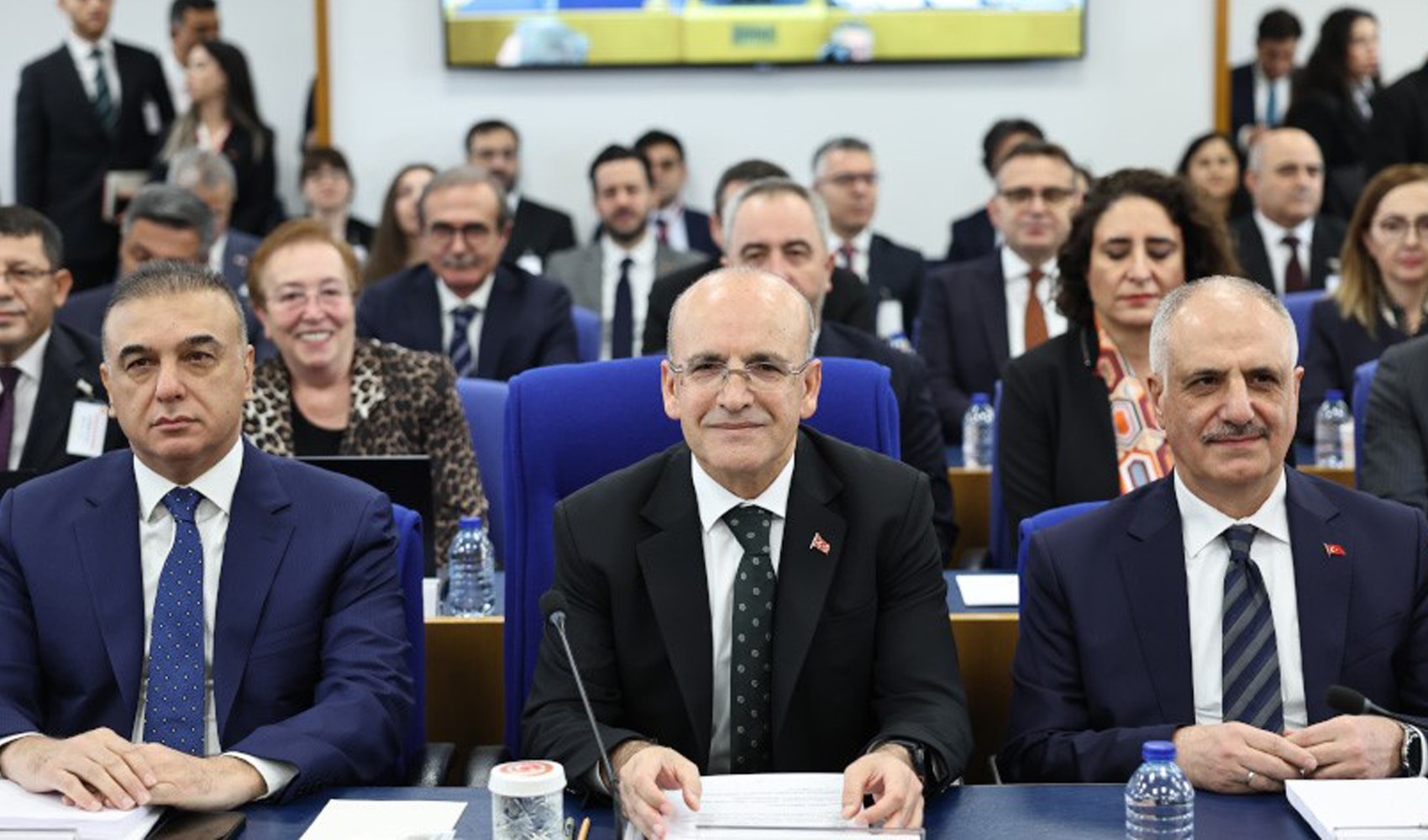
The Turkish Grand National Assembly (TBMM) Planning and Budget Committee, chaired by AKP Samsun Deputy Mehmet Muş, met to discuss the 2025 budget of the Ministry of Treasury and Finance, as well as the Court of Accounts reports and budgets of the Revenue Administration, Privatization Administration, Capital Markets Board, Banking Regulation and Supervision Agency, and the Public Procurement Authority. Treasury and Finance Minister Mehmet Şimşek responded to questions from deputies within the framework of the budget discussions.
Minister Şimşek stated that one of the most discussed topics was income distribution and inflation forecasts. Noting that significant steps have been taken over the last 22 years to reduce poverty and improve income distribution, Şimşek expressed that thanks to the policies implemented, there had been significant improvements in income distribution indicators until recently. Şimşek stated, "For example, while the ratio of the share of disposable income received by the top 10 percent income group to the share of the bottom 10 percent income group was 17.7 percent, it fell to 13.8 in 2023. There has been some deterioration recently due to inflation. This will continue to be reflected in the figures in the coming period."
Stating that high inflation distorts income distribution, reduces purchasing power, and decreases the inclusiveness of growth, Şimşek noted that their most important goal while designing the program is price stability.
"OUR GOAL IS TO REDUCE INFLATION TO SINGLE DIGITS"
Explaining that it takes time to shape the necessary policy framework for inflation to fall and to reconstruct monetary policy, Şimşek said, "At the point we have reached today, conditions are now conducive to permanent disinflation. We planned this process in three stages. The first year was the transition period to disinflation, that is, the policy construction process. We are currently in a disinflation period. The recent period, especially 2026 and beyond, will be a period of stability. In other words, it will be the period when it evolves towards single digits and inflation is permanently brought under control. Our goal is to reduce inflation to single digits. To reduce it to permanently low single digits. Because this is the definition of price stability."
"WE TRUST AND BELIEVE IN OUR COMPETENT INSTITUTIONS REGARDING INFLATION FORECASTS"
Stating that there are changes in their own forecasts just as there are in international organizations, Şimşek said, "Our Central Bank says inflation will be this with a 70 percent probability. There is a probability situation there. Because you have to make a number of assumptions regarding the global and domestic conjuncture, and these assumptions can change over time. Conditions can change. International organizations, for example, the IMF, make major changes to their forecasts at least twice a year, and they also make changes in the interim period, meaning they change their forecasts four times a year. Our relevant institutions also meticulously follow all developments regarding the internal and external conjuncture and meet regularly to evaluate them. As a minister, I do not have the opportunity to make forecasts. In the latest Medium-Term Program (OVP), our Central Bank stated its year-end inflation forecast. The Strategy and Budget Presidency stated another forecast. We took the average of our institutions' forecasts. Therefore, we trust and believe in our competent institutions on this matter."
Speaking about the transfer of the Currency Protected Deposit (KKM) scheme to the Central Bank of the Republic of Turkey (TCMB), Şimşek stated that KKM is a subject related to the Central Bank's monetary policy, exchange rate policy, and reserve management, and expressed that it would be more appropriate for the procedures and principles regarding the implementation to be determined and managed by the TCMB.
"IF YOU SPEND A RESOURCE EQUAL TO 6 PERCENT OF NATIONAL INCOME ON A DISASTER, THE ROOM THERE IS LIMITED"
Responding to questions directed at him regarding public expenditures, Şimşek said, "In truth, it is not the case that we have any savings to make regarding earthquake expenditures. It is being spent entirely as much as can be spent. Probably, about 70 billion dollars of resources will have been spent on the earthquake in the last two years based on the average dollar exchange rate. Even in a country with no problems at all, if you spend a resource equal to 6 percent of the national income on a disaster, the room there is limited. Therefore, our budget flexibility is not very high. It is useful for you to know these. 41.6 percent of our budget expenditures go to personnel and premium transfers related to the social security of this personnel. We will reduce the budget deficit in 2025, and thanks to this, we will definitely support the Central Bank's disinflation process much more strongly."
"THERE IS TREMENDOUS EXPENDITURE DISCIPLINE AND SAVINGS IN THE PUBLIC SECTOR"
Explaining that they have achieved a significant level of expenditure discipline regarding savings measures in the public sector, Şimşek said, "If we look at how much we have saved from a macro perspective, let's take a 10-year period. Non-interest expenditures, excluding the earthquake, because you cannot foresee the earthquake either. Interest is also known under market conditions. The upward deviation in non-interest expenditures between the budget approved by our parliament and the realized budget over 10 years was an annual average of 9.1 percent. We have reduced this deviation to 0.8 percent in 2024. If there were no philosophy of savings, could the deviation have been reduced from 9.1 percent to 0.8 percent? If the deviation had continued in the context of the last 10 years' average, it would have corresponded to 814 billion liras. Therefore, there is a tremendous expenditure discipline and savings."
"WE ARE PROVIDING TOGG AS AN OFFICIAL VEHICLE IN THE PUBLIC SECTOR"
Speaking about the number of vehicles in the public sector, Şimşek said that the number of vehicles in the public sector has increased by a net of 3,848 units this year compared to 2023. Şimşek said, "90 percent of these increasing vehicles are vehicles acquired for security, health, and disaster management. 2,910 units, that is 76 percent, are vehicles donated by the General Directorate of Security's Turkish Police Organization Strengthening Foundation. In other words, we did not pay any money from the budget. Now, if you are saying that our Ministry of Interior and our General Directorate of Security should not renew their vehicles and should not buy vehicles, the discretion is yours. 252 of them are ambulances of the Ministry of Health. Do you not want this for emergency response services? 151 units are vehicles purchased for public order again for the Gendarmerie General Command and the Coast Guard Command. 168 units belong to the Disaster and Emergency Management Presidency. In terms of official vehicles, we approve all renewal requests with the decision to liquidate the existing ones. In terms of official vehicles, we are providing TOGG."
"THERE IS NO RETIREMENT IN THE 40S OR 50S IN DEVELOPING COUNTRIES IN THE OECD"
Stating that they asked the Social Security Institution (SGK) about the cost of the Retirement Age Regulation (EYT) and that the figures were calculated by the SGK, Şimşek said, "The technical teams of the Treasury and Finance Ministry take this amount and add the financing cost to this amount. Because this is not something that was foreseen. Therefore, our Minister of Labor and Social Security says '592.6 billion liras for 2024'. But this does not include the financing cost. We, as the Treasury, calculate and add the financing cost to this, and we reach 752 billion liras from there. The important thing here is this, friends. Is it a practice that disrupts the actuarial balance? Yes. There are 38 countries in the OECD right now. Among them are underdeveloped and developing countries. Among them are developing countries. And show me one of these countries where there is almost no country left where people retire in their 30s, 40s, or even 50s. Many countries have gone above 65."
"I WISH OUR MINIMUM WAGE WERE MUCH, MUCH HIGHER THAN THIS"
Expressing that many assessments have been made regarding the minimum wage, Şimşek said, "We determine the minimum wage with a commission. It would not be appropriate for me to make an assessment at this stage. I have said this before. I wish we could produce high value-added products, have very high productivity, have a very high technological dimension, and that our minimum wage were much, much higher than this. We have already allocated the biggest heading in our structural reform agenda to R&D, technological transformation, green transformation, and digital transformation to reach that point."
"WE HAVE NOT ALLOWED OUR EMPLOYEES TO BE CRUSHED BY INFLATION IN ANY WAY, AND WE WILL NOT"
Stating that the real increase in the lowest civil servant salary has risen from 238 dollars to 1,139 dollars in dollar terms over the last 22 years, Şimşek said, "The real increase in the lowest pension is 543 percent and the dollar-based increase is 812 percent, that is, from 40 dollars to 363 dollars. The real increase in the minimum wage is 212 percent. The dollar-based increase is 343 percent. It has risen from 112 dollars to 494 dollars as of today. In summary, we have not allowed our employees to be crushed by inflation in any way, and we will not."
Underlining that 853 billion liras of tax expenditures stem from the exemption of the minimum wage from tax, Şimşek said that investment incentives amount to 536 billion liras.
Stating that they have reduced the lowest bracket of the income tax tariff from 22 percent to 15 percent in the last 22 years, Şimşek reminded that they have increased the top bracket from 35 percent to 40 percent.
Stating that the share of direct taxes in total taxes was 53.1 percent in 2002, Şimşek said that today the rate has risen to 56.1 percent.
Underlining that no minister or administration has the authority to waive tax debts in Turkish tax law, Şimşek said that the authority to waive taxes belongs only to the Parliament.
"I HAVE NO AUTHORITY TO WAIVE THE TAXES OF INDIVIDUALS OR COMPANIES IN ANY WAY"
Responding to criticisms that tax debts are being waived, Şimşek said, "In Turkish tax law, no minister or administration has the authority to waive tax debts. The minister does not have the authority to waive taxes. The authority to waive taxes belongs only and only to the Supreme Parliament. I have no authority to waive the taxes of individuals or companies in any way. It is a good thing I don't. If the issue you are mentioning is a number of corrections within the scope of reports evaluated as incorrect within the scope of the settlement institution, that was introduced in 1963. After I became minister, contrary to this law that has been in effect since 1963, we introduced a law saying, 'From now on, no reduction can be made in the principal amount in settlements.' Therefore, I have never waived a tax debt. Because I would never take on such a responsibility in any way."
Stating that there were criticisms regarding Ziraat Bank, Şimşek said, "I immediately told my friends, 'Call the general manager, if there is anything he wants to say, convey it quickly.' Now they say the signs of all the bank's branches never change. Only the signs are changed during the renovations needed in the earthquake zone. Those that need renovation and are in the earthquake zone. 'They say the Demirören group is paying its installments and has no overdue debt.' I am telling you what the general manager told me. As all banks do, Ziraat Bank has also been meeting regularly at the end of the year for the last 13 years to consult and discuss the targets for the next year in this context."
Stating that the relevant ministers will address the issue for Type-1 diabetes patients, Şimşek said that they will try to solve this problem as soon as possible within the framework of available resources.
Stating that the assessments that direct electronic seizure is applied to those who pay and those who do not pay their tax debts are not in question, Şimşek stated that e-seizure is never applied directly without notifying the relevant person.
News Source: İHA