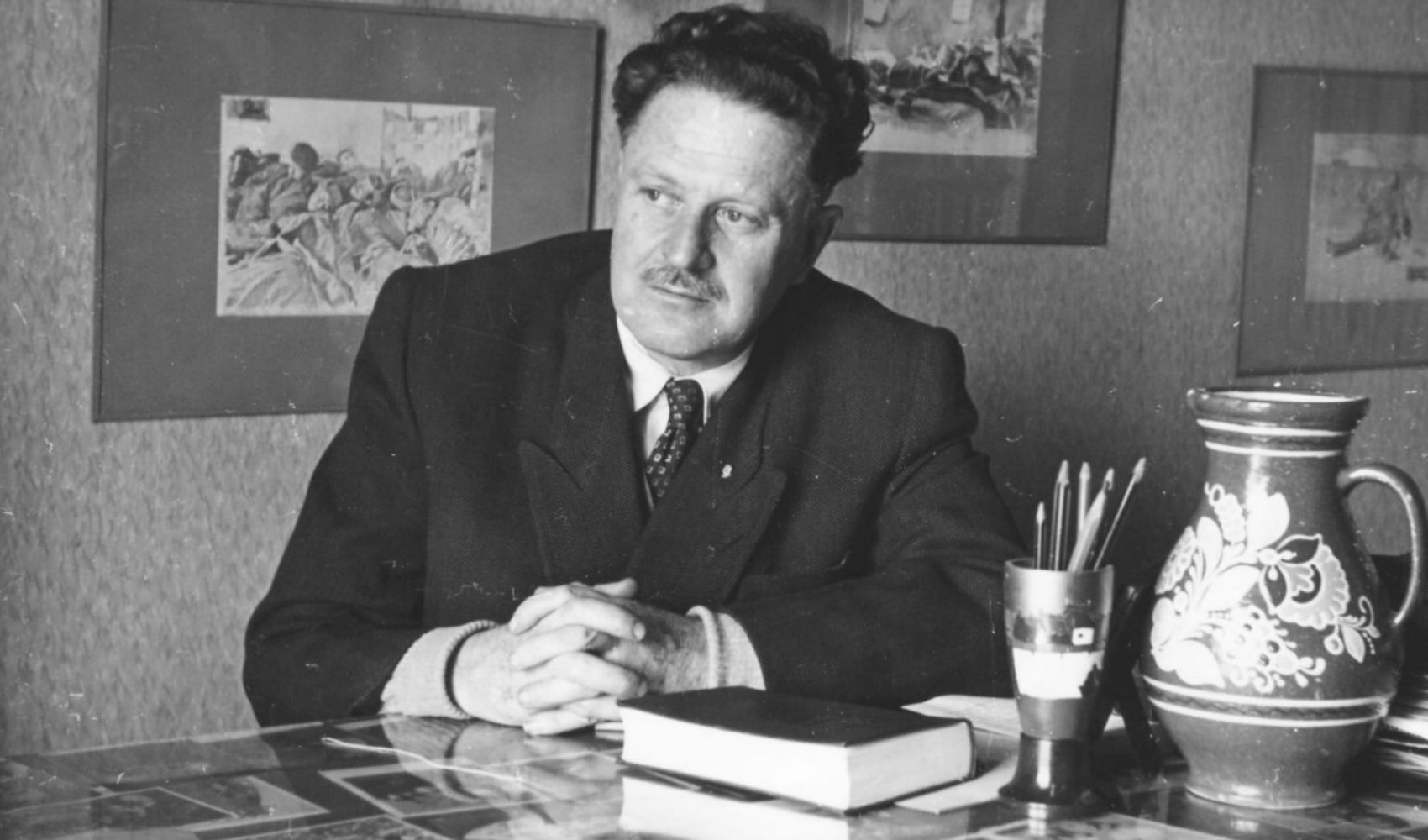
Born in Thessaloniki on January 14, 1902, according to some sources, as the son of painter Ayşe Celile Hanım and Hikmet Bey, the poet—whose birth name was Mehmet Nazım—attended primary school at Göztepe Taş Mektep before enrolling in the preparatory class of the Mekteb-i Sultani.
Due to his family's financial difficulties, Ran was withdrawn from school a year later and enrolled in the Nişantaşı Sultanisi.
Nazım Hikmet wrote his first poem, "Feryad-ı Vatan" (Cry of the Homeland), on July 3, 1913. With the support of Minister of the Navy Cemal Pasha, who was impressed by his poem "Bir Bahriyelinin Ağzından" (From the Mouth of a Sailor) written for sailors, he entered the Heybeliada Naval School in 1917 and graduated in 1919.
HE LEFT THE NAVY IN 1921
Appointed as a trainee deck officer on the Hamidiye cruiser, the master poet was discharged from military service by a medical board decision in 1921 due to an illness he contracted in 1920.
During this period, he continued his interest in literature, showing the poems he wrote to Yahya Kemal, whom he greatly admired, and listening to his critiques.
The unforgettable poet won first prize in a poetry competition organized by the Alemdar newspaper in 1920.
In his early period, the master writer, whose name was associated with "syllabic" poets, wrote enthusiastic resistance poems reflecting his love for the homeland during the days when Istanbul was under occupation.
In 1921, to join the National Struggle, Nazım Hikmet secretly boarded the Yeni Dünya steamer departing from Sirkeci with Faruk Nafiz, Yusuf Ziya, and Vala Nurettin and crossed to İnebolu. After teaching in Bolu for a while, the poet went to Moscow via Batumi and studied at the Communist University of the Toilers of the East (KUTV).
Influenced by the form of a Russian poem he heard in Batumi but did not understand the words of, the poet began to take an interest in free verse.
Nazım Hikmet, who experimented with free verse in his poem "Açların Gözbebekleri" (Pupils of the Hungry) written during his journey to Moscow, had some of his poems published in the magazines "Yeni Hayat" and "Aydınlık" in 1923.
HE SIGNED THE FIRST EXAMPLES OF TURKISH POETRY IN FREE VERSE
Returning to Turkey from Moscow in 1924, Nazım Hikmet went back to Moscow when a 15-year prison sentence was requested due to his poems and articles published in Aydınlık magazine.
Ran's first poetry book, "Güneşi İçenlerin Türküsü" (The Song of Those Who Drink the Sun), met with readers in Baku in 1927.
The poet, who was caught while entering Turkey in July 1928 to benefit from the amnesty issued on the occasion of the fifth anniversary of the Republic, remained in custody for a while.
Nazım Hikmet Ran published his poems in the "Resimli Ay" magazine, where he joined the editorial staff, while also making harsh criticisms against the established values of literature. Defining himself as a "socialist poet," Nazım Hikmet took the side of the social-realist approach in the debate on the purpose of art, stating, "Art is not for art's sake."
'835 LINES' BROUGHT A NEW BREATH TO LITERATURE
The master poet, whose poem "835 Satır" (835 Lines), published in Istanbul in 1929, created a wide echo in literary circles, developed a poetic language that was a mixture of classical and experimental.
Nazım Hikmet, who was acquitted in many lawsuits filed regarding his poems, was arrested in 1933 for the crime of establishing a secret organization and sent to Bursa Prison, and in 1938 he was arrested for inciting the army and navy to rebellion. Poet Ran was sentenced to 28 years and 4 months in prison.
In 1939, Nazım Hikmet began writing his work titled "Memleketimden İnsan Manzaraları" (Human Landscapes from My Country), which consists of 17 thousand lines.
The poet, who was released in 1950 by benefiting from the General Amnesty Law, was awarded the "International Peace Prize" by the World Peace Council, along with Picasso, Paul Robeson, Wanda Jakubowska, and Pablo Neruda.
When the master poet learned that he would be drafted into military service after his release, he went to the Soviet Union under Stalin's rule, fearing he would be killed.
Nazım Hikmet Ran was stripped of his Turkish citizenship by the Council of Ministers on July 25, 1951. In the same year, the poet's son, Mehmet, was born.
Due to his participation in international peace congresses and his struggle in this direction, the poet's works were translated into many languages, and he gained great fame worldwide. Traveling to many countries, attending conferences, and reading his poems, Nazım Hikmet passed away in Moscow on June 3, 1963, due to heart failure.
MOST OF HIS WORKS WERE PUBLISHED AFTER HIS DEATH
The year 2002 was declared the "Year of Nazım" by UNESCO on the occasion of the 100th anniversary of Nazım Hikmet Ran's birth.
The poet, who was laid to rest in the Novodevichy Cemetery, was readmitted to Turkish citizenship by the Council of Ministers' decision dated January 5, 2009.
While works such as "Dağların Havası" (The Air of the Mountains - in Ottoman Turkish), "Güneşi İçenlerin Türküsü", "835 Satır", "Sesini Kaybeden Şehir" (The City That Lost Its Voice), "Benerci Kendini Niçin Öldürdü?", and "Taranta Babu'ya Mektuplar" (Letters to Taranta Babu) were published during his lifetime, many others including "Kurtuluş Savaşı Destanı" (Epic of the War of Independence), "Rubailer" (Rubaiyat), "Memleketimden İnsan Manzaraları", "Cezaevinden Memet Fuat'a Mektuplar" (Letters from Prison to Memet Fuat), "Kemal Tahir'e Mapushaneden Mektuplar" (Letters from Prison to Kemal Tahir), "Kuvayi Milliye", "Sevdalı Bulut" (The Amorous Cloud), "Nazım ile Piraye", "Hikayeler" (Stories), "Piraye'ye Mektuplar" (Letters to Piraye), and "Henüz Vakit Varken Gülüm" (While There Is Still Time, My Rose) were published after his death.
The poet, whose works have been translated into more than 50 languages, shared some of his poems with readers under the pseudonyms İbrahim Sabri and Mazhar Lütfi, as well as anonymously while in prison, and in 1949, he published his book titled "La Fontaine'den Masallar" (Fables from La Fontaine) under the name Ahmet Oğuz Saruhan.
Ran, who worked as a columnist and editor-in-chief for the newspapers Akşam, Son Posta, and Tan under the pseudonym "Orhan Selim," also has a book titled "İt Ürür Kervan Yürür" (The Dog Barks, the Caravan Moves On), also signed by Selim.
The 22 theatrical works written by Nazım Hikmet, including "Kafatası" (The Skull), "Bir Ölü Evi" (A House of the Dead), "Unutulan Adam" (The Forgotten Man), and "Ferhat ile Şirin", were staged in Turkey as well as in Russia, Germany, Hungary, Poland, and Czechoslovakia.
News Source: 12punto