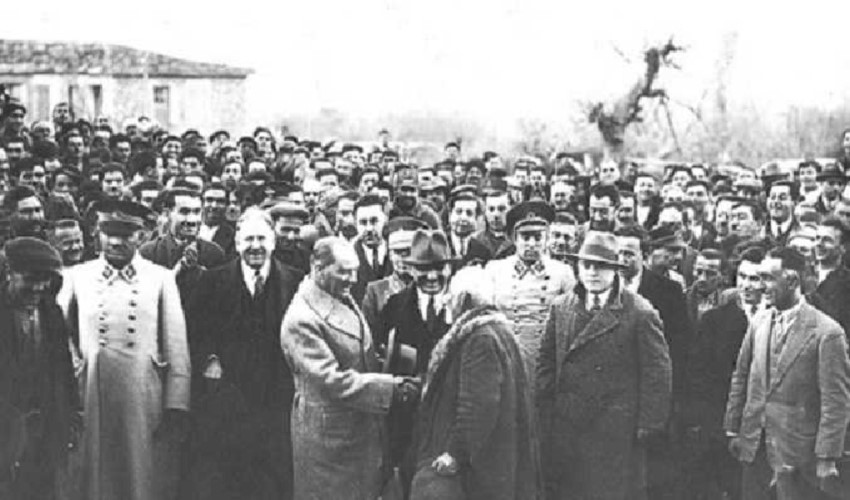
Atatürk, who was always by his nation's side, would listen to the complaints brought to him and try to resolve them immediately. One such incident occurred in February 1933. Upon learning that teachers in Kırşehir had not received their salaries for several months, Atatürk set out from Ankara toward Kırşehir in the middle of the night, in the midst of a snowstorm. Adnan Yılmaz wrote about Atatürk's journey to Kırşehir. Yılmaz's article is as follows:
In the hours past midnight on February 1, 1933, a phone call wakes Kılıç Ali; “The Pasha is very angry, prepare the vehicle immediately! We are leaving on a trip at once. He ordered you to come to the mansion immediately.”
Kılıç Ali jumps out of bed. There is extraordinary activity at the Çankaya Mansion… They set out to go from Ankara to Kırşehir in snowy, wintry conditions. It is a stormy day when the “relentless fifty” days of midwinter are at their peak. In some places, you cannot see a hand in front of your face. The blizzard is severe. The vehicles frequently get stuck in the snow…
They would later learn that the Pasha had read a complaint letter that arrived at Çankaya the previous night from teachers in Kırşehir stating that 'they had not received their salaries for several months.' The Pasha was angered, asking “why are the teachers' salaries not being paid?” When Atatürk asked the Minister “what is the situation?” he was met with the excuse: “The weather is wintry, perhaps that is why the mail could not get through.” “I see... So we are under siege now, are we? In that case, we will get up now, go, both clear the road and listen to the troubles of the teachers in Kırşehir up close,” he said, and they set off for Kırşehir late at night…
…But the departure is sudden, and he only said to his friends who were going with him, “Children, take items for a day or two. Let’s go for a ride.”
Regarding his travel companions, it was not even clear “where they were going.”
Atatürk set off for Kırşehir by car via Bala-Kaman, taking Kılıç Ali, Prof. Afet İnan, Falih Rıfkı Atay, Ruşen Eşref Ünaydın, and some commanders and friends with him.
The season is winter. The weather is terribly rainy, foggy, and cold. Moreover, it is midnight… At one point, they lose their way and take shelter in a village coffeehouse. They have the iron stove lit, and after warming up, they continue on their way.
Falih Rıfkı Atay, who was at Atatürk’s table that evening and was among those on this sudden midnight departure, notes the following in his memoirs in summary:
“In those days, we could barely travel even to the vicinity of Ankara. In the countryside, a road consisted of a stony path that a peasant cart would reluctantly take to avoid getting stuck in the mud. The era of the oxcart. You know, the Governor of Sivas would build a macadam road and immediately ban two-wheeled carts, and the peasants would beg, 'Please, Mr. Governor, do not ban our oxcarts, we will not use your road.' Or in one of the southern provinces, a governor had opened a road between the station and the town. When ministers or deputies came from Ankara, he would untie the ribbon, and when they left, he would tie it back up so it wouldn't be used and ruined. That is the time we are in… We might have reached Bala. But further? One of the ministers said: ‘You cannot go!’ 'How? Could he not go? Suddenly his weariness vanished. So he could not go. So he was tied hand and foot within the white prison of Ankara… 'You are a minister. You cannot leave here anyway. We will go,' he said.
“We came from home with a bag each. He gifted a coat from his wardrobe to those among his friends whose clothing he did not find very sturdy. We set out. Ruşen Eşref and I were in one car. When we reached Bala, it was past midnight. The aide-de-camp went to wake the gendarmerie commander. The poor man looked out the window half-naked. When told, 'Atatürk has come, why don't you go out and prepare a place,' he laughed. What business does Atatürk have in Bala on this snowy winter night? At most, these are a few travelers. They must have found such an excuse to get him dressed, out on the street, and to find a place. He pulls down his window and curtain and goes back to sleep. They had a hard time convincing the commander.”
“The minister was right. We could not go further from here. We had to turn back. By morning, we would have reached Ankara and our homes. The aide-de-camp came: ‘We are continuing on the road,’ he said. ‘Where are we going?’ 'You will follow Atatürk!'”
“We headed in the direction of Kırşehir. The broken macadam road went somehow for a while. We survived the night. Atatürk would stop his car from time to time to see if the caravan was complete. He was in high spirits and possessed a youthfulness that never wore out. At one point, the road stopped. It was flat snow, but it had a thaw that made one suspect it was a quagmire. Since Atatürk’s car was heavy, we had to try with our light car. We went a little further and got stuck good and proper.”
“Atatürk made a turn toward the side ridge with his car and crossed to the other side of the quagmire without waking the mud of the raw earth. The other cars followed him. Ruşen Eşref, I, and our driver remained where we were stuck. Far away, in front of a dark shape that looked like a village, we could see that a spare car had been left for us. There was no choice but to walk there. We walked for quite a while in the mud, sometimes sinking up to our ankles, until we reached the pickup truck where a few guard soldiers were. I sat next to the driver. Ruşen Eşref sat cross-legged inside the car. The bottom was full of items:
– What is under this cover? he asked.
The soldiers:
– Hand grenades, sir, they said.
Truth be told, we were in a very fearful state of security.
We were quite late. Evening and immediately after, night fell. The weather turned into a blizzard. The driver:
– I cannot see in front of me, he was saying.
Ruşen looking at the tire tracks from the left, and I from the right, we said to the driver;
– Please, a little toward me…
We were moving very slowly by guesswork. Since the precipitation was increasing, the tracks were disappearing. Constantly wiping the windows, at night, we were trying not to roll into a ditch. This was torture. I don't know how many hours it lasted. Every now and then:
– You cannot go!
We would remember the words and remember our minister friend with good wishes! At one point, I even thought about staying in the first house we encountered. But we would have left Atatürk worried. We had to endure our ordeal, whether we liked it or not.
Finally, the pale lights of Kırşehir appeared in the fog and mist. Atatürk had stayed at the governor's house, and his heavy car had gotten stuck in the mud right at the threshold of the mansion. This was also a strange thing.
In the light of the smoky lamp, we found Atatürk laughing and talking:
– I was worried about you. We sent word here and there. We didn't get an answer. We are hungry… Come on, straight to the table… he said.
He, in particular, was cheerful. Everyone was asking the person next to them:
– What will we do tomorrow?
We were supposed to cross Çiçekdağı and find the train prepared at the first railway station. But I wonder what the road was like?
– It was even worse… they were saying.
We went to bed early. They took us to a large house. A few of us friends huddled on the bed-covered platforms of a room that suddenly heated up like a bath with an iron stove, and then suddenly cooled down like a roof.
The next morning, Atatürk took the organization of the caravan upon himself. There was too much snow. The road was not visible. Therefore, a light Ford would go first, and behind it would be a truck loaded with gendarmes. The duty of the Ford car was to open a path for us. If it occasionally went off the road and was buried in the snow, it would be put back on the road with the help of the gendarmes.
Only the chimney tops of the villagers were visible above the snow. The governor, who saw us off quite a distance from the city, got out of his car at one point and saluted Atatürk. We left, leaving behind a pitch-black top hat with a pitch-black ceremonial suit on the snow-white, endless snow.
I don't know how we managed to cross Çiçekdağı. A thick pile of snow, a precipice as far as the eye could see on our right side, it was night… Many times we lost the dream of “arriving.” Death was an inch away from us. We were climbing straight up. Is this fate, or what is it, it was to surrender to it. This was a state of resignation.
We were being dragged, caught in the inseparable, unbreakable attraction of a will. He was stronger than fate. Atatürk was going to go. He had to go.
Then we descended with the same difficulty, with the same danger… And on the plain, we fell into a slippery, muddy ground that turned the steering wheels into loose reins. Throwing ourselves to the right or left with great speed, we were trying to escape from a claw, as it were.
Finally, the train appeared with all its windows lit.” (Falih Rıfkı Atay, Mustafa Kemal’in Mütareke Defteri, Pozitif Yayınları, November 2008. ISBN: 978-975-6461. Pages: 47-52)
EXCERPTS FROM THIS VISIT IN THE 'MEMOIRS' OF A LIVING WITNESS OF THE PERIOD…
Cevat Hakkı Tarım, a writer of Kırşehir history and one of the intellectuals of Kırşehir of the period, who would later also serve as Mayor, describes the hours he experienced regarding this visit, along with the observations that did not escape his eyes and with those beautiful expressions of his.
He conveys it as I have given it in the form of some excerpts, summarizing and selecting paragraph by paragraph:
“A mail carrier coming from the opposite direction stopped in front of me. As if feeling he was going to say something secret, he brought his mouth close to my ear, and slowly said: ‘Gazi is coming,’ and then started to continue on his way, limping. At that moment, because the famous carriage of Mr. Müfit Kurutluoğlu, who was coming from behind, stopped in front of me, I immediately opened its door and jumped inside. My first words were: ‘Gazi is coming. That mailman who passed by said so. I wonder what the reason for this trip is in this snow and blizzard?’ Kurutluoğlu, who was a deputy for Kırşehir in the First Grand National Assembly, laughed and gave this answer: ‘I know the Master. He should not decide on something, otherwise he makes the impossible possible..’
“News enthusiasts had filled our room. The proposal of our friend Arif Sıtkı Gönendik, one of the middle school teachers, ‘We should also form a delegation and rush to welcome him. It would be very good if we also took a few female friends among us,’ must have pleased the Honorable President as well, as he went to his house across from the printing house to bring his daughter. Arif also sent word to his wife, the teacher Nesibe, and I, too, was both happy and thoughtful when Mr. Müfit Kurutluoğlu, whose carriage I requested to bring ours, said, ‘Cevat, tell the coachman to bring your sister-in-law with you.’”
“Although Müfit Hoca allowed his wife, we could not convince him to join us. Hoca, who took part among the opposition factions in the Assembly, had been left off the list in the second election, and his name had been involved in some gossip. Those who wore out his doorstep when he was a deputy were now hesitant to even greet him. When our late deputy and his friends, whom they loved very much, saw each other as a family, and even gave his name, came to Kırşehir, they were running away from them. What strange manifestations this politics has…”
“The automobiles coming from the opposite direction stopped in front of the people. A commotion and a storm of applause broke out. The President of the Republic, who shook the hands of the government officials and representatives of the societies in the front row, also visited the hospital and the patients, and as they were getting into their cars, when he saw our group, which had taken a position in a place that would catch the eye and included women, we started to move toward him and he toward us.”
“I am introducing his friends one by one. When they came in front of my sister-in-law, when I said ‘The wife of the former Kırşehir deputy Müfit Bey,’ his eyes sparkled and he extended his hand, and with a warm voice said, ‘How are you, madam? I hope Müfit Bey is also well? You have gone to trouble, thank you very much.’”
“The evening Atatürk came to Kırşehir, he told the Governor at the table, referring to Müfit Hoca, that he could not happen upon Müfit Efendi, and the Governor, to manage the situation, said, “I know he went to one of the nearby districts to follow up on a case; if they were here, they would have taken their place at your table, my Pasha.” Sensing the meaning in such an answer from the Governor, Atatürk said, ‘If Hoca were not here, his wife could not have come to the welcome without his permission. I know Hoca’s convictions. There may be political differences between us. I came to his homeland as a guest. It was necessary for them to come, respecting our old friendship. By sending his wife, Hoca has revived a beautiful tradition of the Turks; give him my regards.’”
“The next morning, all the people and officials had gathered in front of the door of the Governor’s Mansion to see Atatürk off. After Atatürk, who came out a little later, said goodbye to the people, when he did not see some of his friends, he turned to the Governor and made such a witticism: ‘I will move alone, do not bother, it is understood that the friends are still asleep. I will wait for them ahead. Please tell them to follow me like a Pasha’s debris.’
News Source: 12punto