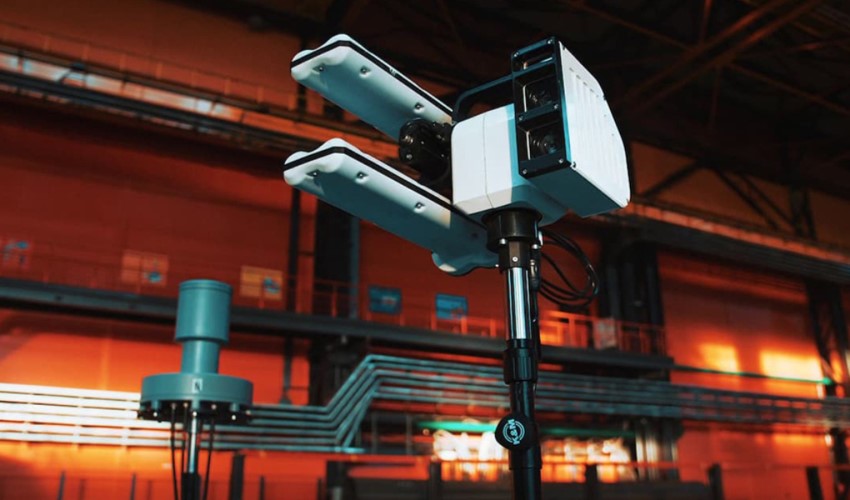
Kaspersky's updated Antidrone solution offers smarter detection, scaling, and customization.
According to the company's statement, the global civilian drone market is expected to nearly double by 2027 compared to 2023, reaching $21.62 billion. Consequently, there is an increasing need to protect commercial facilities, critical infrastructure, and public events from unauthorized video recording and even industrial espionage.
Customers are turning to antidrone solutions to protect themselves against increasingly sophisticated civilian drones. Kaspersky states that it has enhanced its Antidrone solution with the latest technology, including artificial intelligence algorithms and neural networks, to meet this growing demand.
The new Kaspersky Antidrone interface uses intelligent algorithms to display on the map only what the system "approves" designed to display events it considers relevant. This approach aims to have the system perform certain analytical tasks to reduce the operator's workload.
Kaspersky Antidrone's algorithms compare information from various devices, such as radars, directional radio frequency controllers, radio frequency detectors, and optical and thermal imaging cameras. An event detected by at least two types of technology "verified" is considered as.
The scalability of Kaspersky Antidrone has been significantly increased in the updated system. Thanks to advanced integration capabilities, the solution can serve as an entire regional ecosystem. Antidrone can now be integrated with third-party solutions via API, allowing the entire system to be managed from a single console while expanding geographical coverage.
According to the solution's internal test results, the interface now runs 12 times faster thanks to the new graphics engine. Kaspersky Antidrone has undergone a significant redesign with its own improved map and a new framework, resulting in higher operating speeds. All graphic elements can be easily viewed in real-time, and users can now easily switch between video analysis and map modes to examine all details more closely.
The Kaspersky Antidrone archive stores information about all events, including false positives. Reports are generated automatically and only for events selected by the user. The reports highlight key features such as the takeoff point, the pilot's location, flight start and end times, and the first and last frames detected in the video. In the new version, the archive is presented in a more detailed and easier-to-understand format.
In a statement, Alexander Gorbunov, International Business Development Manager at Kaspersky Antidrone, said, "When people talk about antidrone solutions, they immediately think of hardware. However, as the threat landscape evolves and hardware devices alone cannot provide comprehensive security, software is becoming increasingly important." Stating that they are focused on developing and improving the entire solution package they offer in this field, he added, "In the new version, we have optimized many vital functions in the software and solved the issue of false positives. We have simplified interface navigation and eliminated information overload. Improving our integration capabilities has reduced the developer resources needed to deploy our solution in the field."
News Source: AA