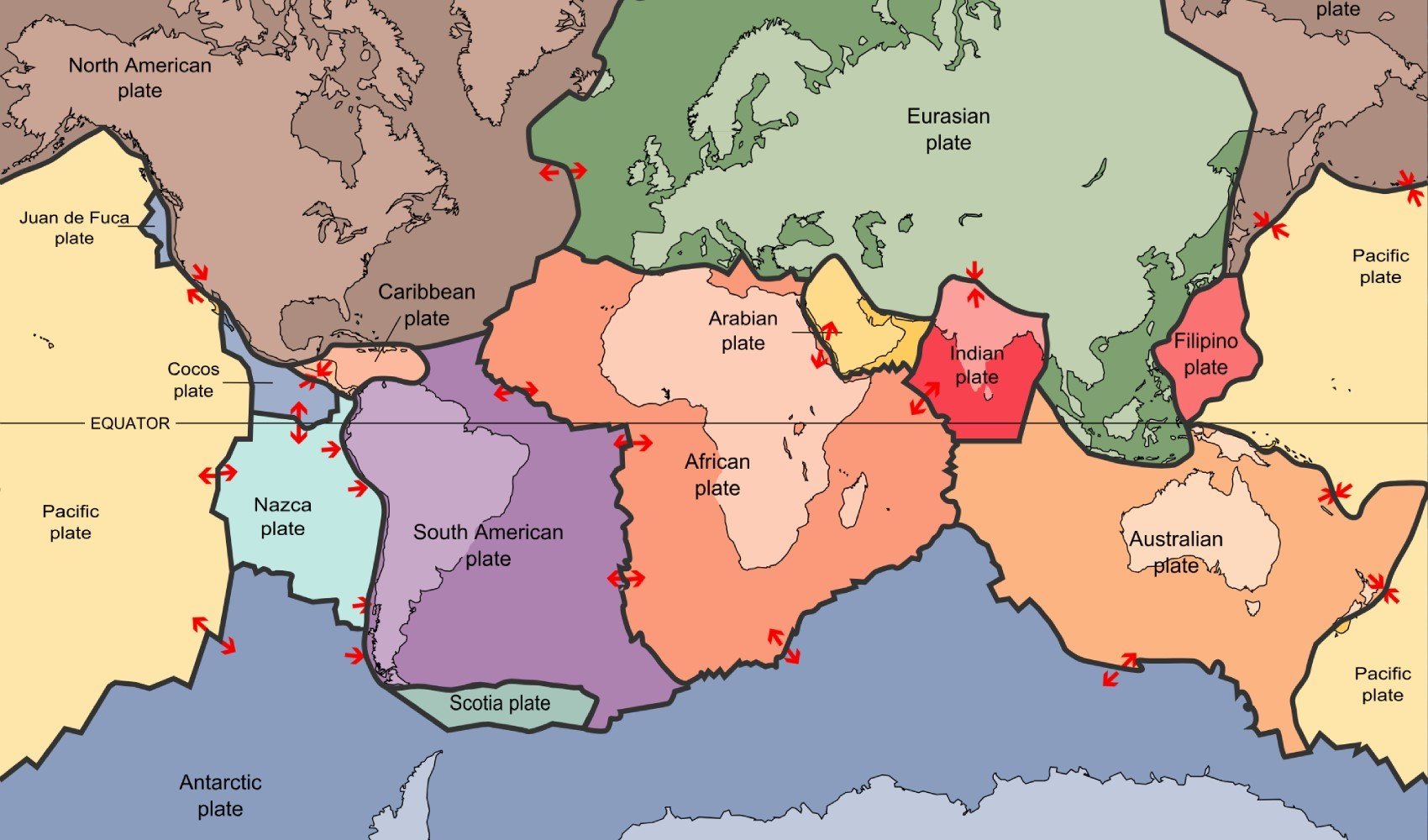
Scientists have published a study suggesting that the tectonic plate beneath India could be splitting in two.
India is the seventh-largest country in the world, covering an area of approximately 3.287 million km². This area follows countries such as Australia, Brazil, and the USA.
If India were to be divided vertically in two, two countries each the size of Mongolia would emerge. However, scientists believe that India is sliding horizontally.
This theory was first presented at the American Geophysical Union conference held in December 2023. The study, titled 'Tearing and Peeling of Indian Lithospheric Mantles in Southeast Tibet', examines the formation of the Himalayas.
The Himalayas are a mountain range spanning five countries: India, Pakistan, Nepal, China, and Bhutan. According to the Geological Society, the Himalayan mountain range and the Tibetan plateau were formed as a result of the collision between the Indian Plate and the Eurasian Plate, which began 50 million years ago and continues today.
THE INDIAN TECTONIC PLATE IS SPLITTING IN TWO
Researchers examined the plates beneath the Himalayas. The study began by investigating helium levels found in sources in Tibet and presented a new theory about the plates beneath the mountain range.
The study found that helium levels in southern Tibet were higher than in northern Tibet, which indicates that the Indian tectonic plate is splitting in two beneath the Tibetan plateau.
The study used '3D S-wave receiver functions' to analyze the Indian Plate. This technique uses information from teleseismic earthquakes to image the Earth's structure and internal boundaries.
In the study published in the ESS Open Archive, it was stated, "Our 3D S-wave receiver functions reveal a new way of orogen-parallel tearing or warping of the Indian Plate."
RESULTS
The study focused on the Indian and Eurasian tectonic plates. One of the images shows the upper and lower layers of the Indian Plate separating.
This suggests that the Indian Plate is entering a lower layer beneath a 'mantle wedge' or is in a subduction process. The study stated, "Our SRFs objectively map the Indian and Tibetan lithosphere-asthenosphere boundaries in a significant region of southeastern Tibet."
In conclusion, this means the Indian Plate is peeling in two.
News Source: 12punto