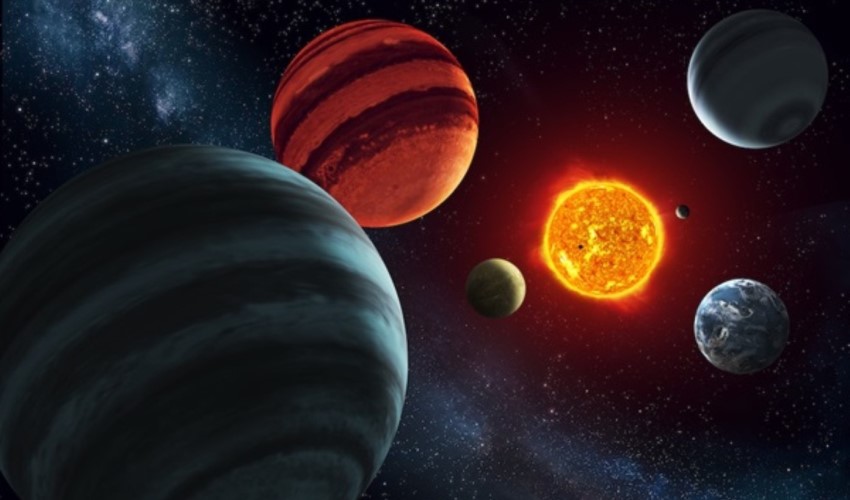
NASA’s Transiting Exoplanet Survey Satellite (TESS) and the European Space Agency’s CHEOPS Telescope were used for the discovery of the solar system.
Located in the Milky Way Galaxy, which also contains Earth, this solar system is 100 light-years away from our planet.
THEY MOVE IN SYNCHRONIZATION
The innermost planet completes three orbits for every two orbits of its nearest neighbor.
Since this situation is the same for the second and third closest planets, as well as the third and fourth closest planets, all the planets move in their orbits in a synchronized motion.
“NOT AT A HABITABLE DISTANCE”
Researchers estimate that there is no life in the system, as none of the planets are at a habitable distance from the system's sun.
Researchers, who believe that the sun named HD 110067 at the center of the system may have other planets, stated that the full orbits of the planets discovered so far around the sun vary between 9 and 54 days.
Researchers estimate that all systems, including Earth's solar system, were formed in this synchronized state and that the movements of the planets changed later as a result of external factors such as meteorites, noting that 1 in every 100 systems maintains this synchronized movement.
Enric Palle, one of the authors of the study, stated that about 50 solar systems moving in synchronization have been discovered, but none of them have as many planets as HD 110067.
The results of the discovery and the details of the research were published in the journal Nature.
News Source: AA