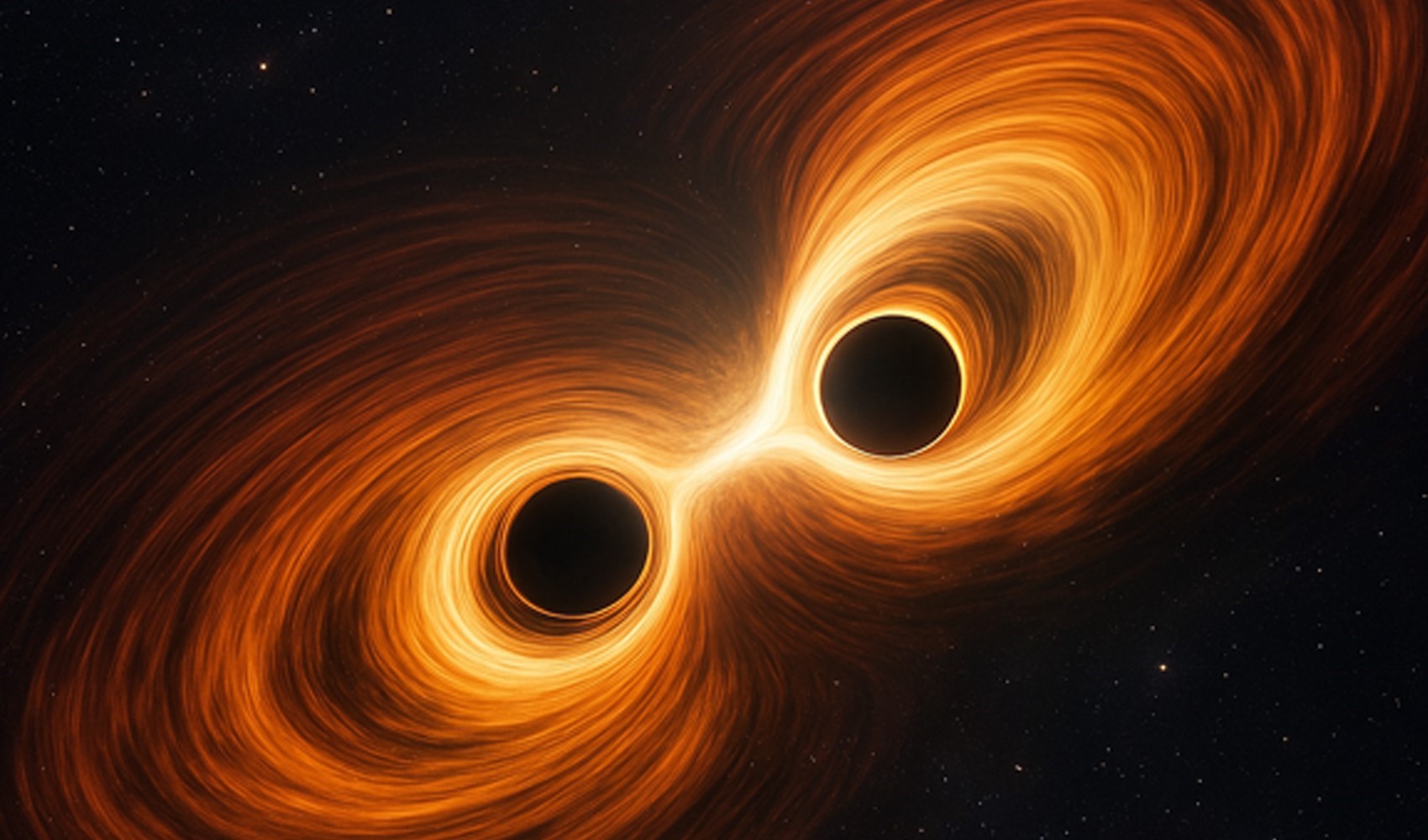
Black holes, among the most mysterious and formidable entities in space, have sparked excitement in the scientific community with a new merger event. The new black hole formed by the collision of two giant black holes is 225 times the mass of the Sun. This merger has been recorded as the largest black hole pair ever observed via gravitational waves.
This extraordinary event was detected by the LIGO Hanford and LIGO Livingston observatories through a signal designated as GW231123. However, the fact that the signal lasted only 0.1 seconds made it difficult for scientists to analyze the data.
Professor Mark Hannam from Cardiff University stated that it is impossible to explain black holes of this size using standard stellar evolution models, noting, "This is a serious challenge to our understanding of black hole formation." Hannam suggested that such massive black holes could be formed by the merger of smaller black holes.
Black holes are known as celestial bodies with gravity so intense that not even light can escape. The black holes in this merger are notable not only for their mass but also for spinning at speeds 400 thousand times faster than the Earth's rotation. Dr. Charlie Hoy from the University of Portsmouth stated that this rapid rotation made interpreting the signal difficult and that they were approaching the rotation limit permitted by Einstein's theory of general relativity.
To date, approximately 300 black hole mergers have been observed via gravitational waves, but this event has surpassed all previous records in terms of mass. The previous largest merger was 140 times the mass of the Sun. However, much larger black holes are also being detected with instruments such as the James Webb Space Telescope. For instance, a black hole with a mass 400 million times that of the Sun was observed last year.
This significant discovery will be presented to the scientific community at the 24th International Conference on General Relativity and Gravitation to be held in Glasgow. Theories regarding the evolution and nature of black holes are being re-evaluated with such discoveries.
News Source: 12punto