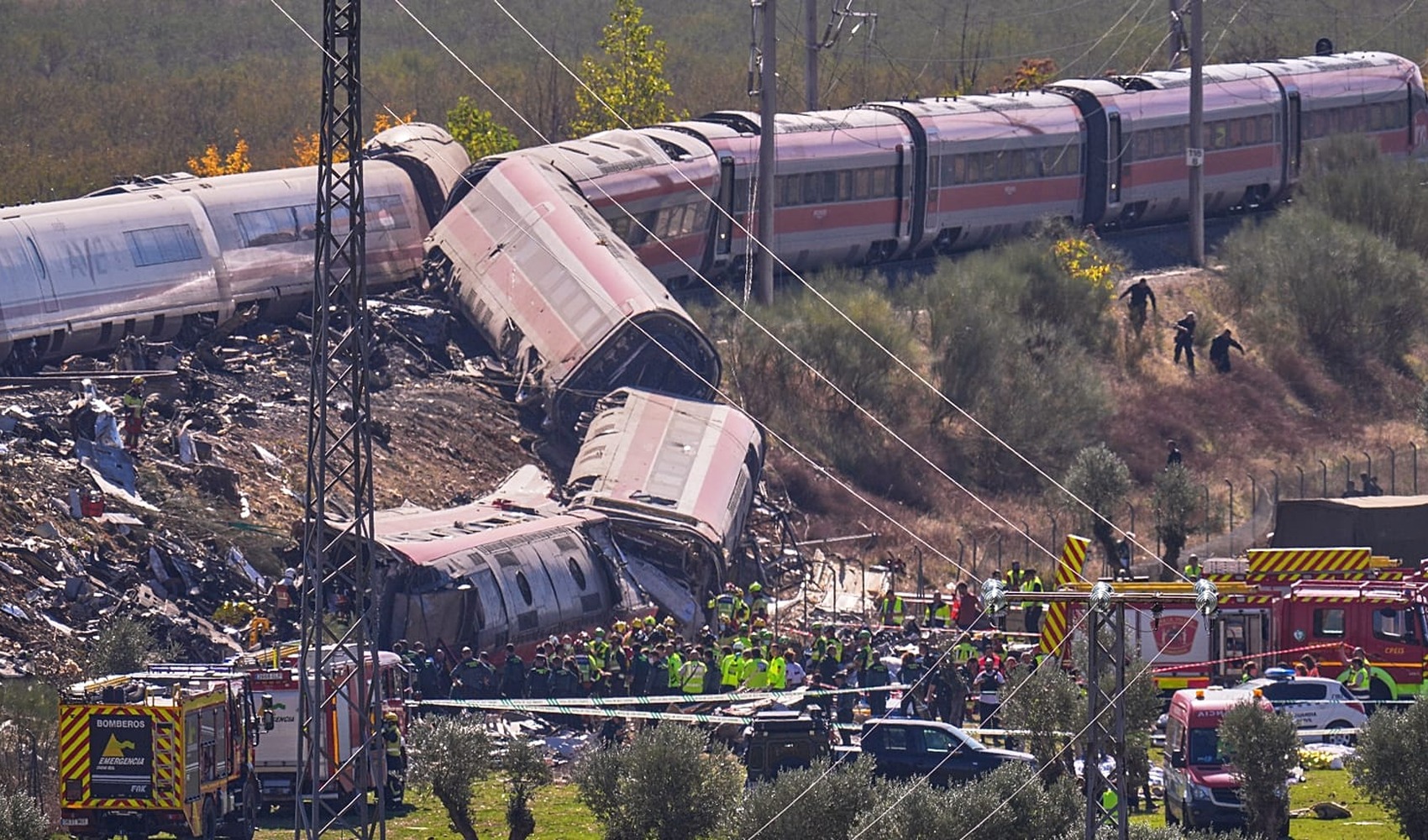
In the high-speed train accident that occurred near Urda in Spain's Toledo province, initial findings have placed the decisions made in the short time interval before the collision at the center of the investigation. At least 69 people lost their lives and more than 100 were injured after a Renfe AVE train on the Madrid-Sevilla line rear-ended an Iryo train that was stopped on the same track.
The accident occurred on Wednesday morning, October 28, at 08:53 at the 118th kilometer of the line. Investigations are focusing on the movement authorization given to the AVE train following malfunctions that began in the signaling and communication systems approximately 17 minutes earlier. Authorities emphasize that the exact cause of the accident has not yet been determined and that judicial and technical investigations are ongoing.
AUTHORIZATION GIVEN AFTER SIGNAL FAILURE
It is stated that the first malfunction was recorded around 08:30. A computer-related issue disabled the LZB safety system on a section of the Madrid-Sevilla high-speed rail line approximately 63 kilometers long. Due to the disruption in this system, which helps maintain a safe distance between trains, some trains were forced to stop or adjust their speed.
During this time, the Iryo 6076, carrying 147 passengers including a baby, and the Renfe AVE 2080, carrying 397 passengers, were among the affected trains. One of the critical points of the investigation is why alternative procedures that should be applied when the main signaling is not working failed to prevent the two trains from being in the same line section.
According to the Ministry of Transport's study on the sequence of events and communication records reflected in the press, Adif's control center in Madrid Atocha gave the AVE driver permission to continue on their route under the block system at 08:36. It is stated that this permission included "normal travel" conditions, whereas in the "visual driving" procedure, the speed should have been limited to 40 kilometers per hour.
Spanish Minister of Transport Óscar Puente described the control center's decision as "inexplicable" and said that the train should not have been allowed to proceed under these conditions. However, who bears the ultimate responsibility is not clear until the investigation is completed.
CRITICAL TIMELINE
- - 08:30: The LZB safety system was disabled due to a computer failure; some trains on the line stopped or reduced their speed.
- - 08:36: The Adif control center in Atocha gave the AVE 2080 permission to move.
- - 08:41: The driver of the Iryo train reported that they were still stopped near Urda due to a communication problem; they were also given permission to proceed.
- - 08:48: The Iryo driver reported that they could not reactivate the LZB system and that the train was still stopped.
- - 08:53: The AVE train rear-ended the stopped Iryo train after traveling approximately 25 kilometers.
The fundamental question raised by the records is why the AVE train was not instructed to slow down or stop after information reached the control center that the Iryo train was still stopped. Driver interviews, traffic records, and the trains' black box data will be decisive in answering this question.
The Court of First Instance and Instruction No. 2 in Orgaz, Toledo, is conducting the judicial investigation under a confidentiality order. The court has restricted access to the two-kilometer high-speed line section in the accident area, prohibited the unauthorized removal of wreckage, and ordered the preservation of the trains' black boxes. The independent technical investigation aims to determine the causes of the accident and prepare recommendations regarding railway safety.
News Source: 12punto